Good Vibrations: My Stuff & Stories May 20

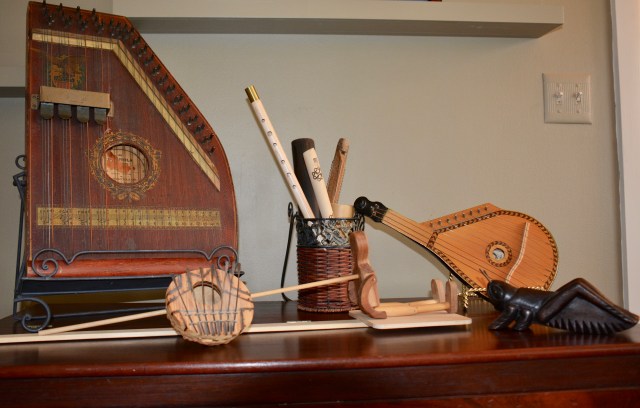
fullsizeoutput_1fb4They all vibrate—either by strumming, or plucking, or striking, or tapping, or rubbing, or blowing into them. And those vibrations make music. There are so many ways to create music and so many ingenious musical instruments in the world. This is just a sample of my humble yet global, intercultural collection of instruments.

I think this compulsion first hit in 1962 at the Seattle World’s Fair. I purchased a wooden flute (the one leaning to the right) at the Yugoslavian exhibit. Or was it Czechoslovakian? Ever since, I haven’t been able to stop myself from gathering musical instruments like a hen gathering chicks. In addition to the music makers around my house, I keep a drawer full of tambourines, drums, and various jingling, ringling instruments at my church. Episcopalians, among several Protestant denominations, may be known as the “frozen chosen,” but we can cut loose on a good ol’ spiritual or Gospel song when abetted by appropriate percussion.

Knowing my weakness, friends and family have added to my collection, especially those who are world travelers. Among many gifts, I received a nose flute from Africa, a Melodica from Germany, and a “piping chanter kit” from Scotland. The kit, complete with instruction tape and booklet, is a way to play the bagpipes without the bag. I have yet to master it, bag or no bag.

The photograph includes an antique (on the left) that I believe is a precursor to the more modern autoharp, the instrument Mother Maybelle Carter made famous—not to mention Brian Bowes in the Pacific Northwest. I haven’t figured out how to make the antique playable, but I have three modern, working autoharps to make up for it.

One of my favorites (and my great-grandson’s favorite) is the wooden fellow sitting so stiffly on his paddle. But when you stand him up and get his paddle bouncing, he can tap dance like nobody’s business. The cricket to his right sounds, yup, just like a cricket when you stroke his belly with a stick.

Over the years, I’ve had a succession of pianos and organs, too. Limited now by space, I have just a keyboard. It’s a good one, and I enjoy it, but it’s dependent on electricity. At least I know if the power ever goes out, I’ll still be able to make music.

(To celebrate my 75th birthday this month, I’m posting daily stories about the stuff I’ve acquired over a lifetime and can’t let go of. I invite you to consider the stories attached to the stuff you treasure—maybe even share them.)
JEA Mug: My Stuff & Stories May 19

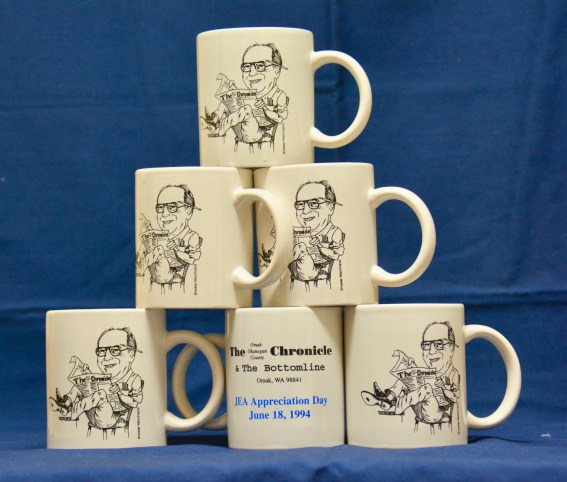
fullsizeoutput_1fb3Smoker Marchand, who created the caricature of my late husband, is renowned for his magnificent, life-size metal sculptures portraying native life. They’re all over the place, from Sasquatch leaping across the highway near Desautel Pass to women digging roots not far from Grand Coulee Dam. I’m in awe of Smoker’s artistic skill and humbled that he took the time to sketch this amusing likeness. But that’s not the only reason I cherish my remaining six mugs from the many dozen that were created twenty-five years ago.

The occasion was JEA (as John E. Andrist was fondly known) Appreciation Day. It was an official welcome home for John after he’d survived a brain stem stroke, endured months in Seattle rehab facilities, and returned to Omak with an uncertain future, totally paralyzed and unable to speak. Too often we wait until people are gone to say thank you and honor them. Our community was not going to let that happen. They pulled out all the stops with a parade (led by an Omak city councilwoman riding a horse as Lady Godiva), a program in the high school gym with music and speeches, and these commemorative mugs.

Dave Harper, our business neighbor and friend, came up with the mug idea and induced Smoker to draw John’s likeness. Smoker captured John more quintessentially than any photographer could. The smile’s the best part, the receding hairline, his pride and content as he surveys the newspaper fresh off the press.

The thing that’s always amused me about the caricature is the Adlai-Stevenson-type hole in the bottom of John’s shoe. John didn’t like to spend much money on clothing, except when it came to shoes. He wanted his feet to be comfortable. It seemed only Nordstrom’s very best, most expensive shoes of finest leather could meet his needs. At the end of the day, he religiously inserted cedar shoe trees into each treasured shoe. He polished his shoes with more precision and care than I use to apply lipstick.

Still, the hole is appropriate. It suggests the wearer of the shoe is too busy with the big picture to sweat the small stuff. That would be John.

(To celebrate my 75th birthday this month, I’m posting daily stories about the stuff I’ve acquired over a lifetime and can’t let go of. I invite you to consider the stories attached to the stuff you treasure—maybe even share them.)

fullsizeoutput_1fb2
Smoker Marchand’s dueling horses at the Omak Stampede Historical Museum

Letting Go: My Stuff & Stories May 18

fullsizeoutput_1fb0Time out. Yesterday, within the span of eight hours, two of my friends became widows. I’ve been posting daily stories about stuff I’m hanging onto. Yet sometimes the universe—God, if you will—insists that we let go. It feels appropriate to spend this day pondering that.
Neither man’s death was a surprise. For years, both had journeyed the grueling road of occasional hope and frequent despair that accompanies cancer treatment. For both, when all possibilities of cure had been eliminated, death came mercifully soon. Both leave a legacy of service in our community with a resulting vacuum that is felt deeply.

David Lindeblad was a professor, beloved by students and colleagues, a supporter of the arts, a fierce advocate of community solidarity, generous with time, talent, and treasure. His patient determination bespoke of the skilled fly fisher that he was.

Richard Ries came to Okanogan County in 1981 to run the IT department at the county courthouse. His work as a public servant was augmented, perhaps even outstripped, by his years of volunteer labor on behalf of the arts and the county historical society.

David’s wife Betty and Richard’s wife Marilyn are powerful forces in their own right. They were champions in helping their husbands navigate and endure the medical maze. They will not be alone as they grieve. This community has a way of showing up when needed. People call and ask, “How can we help?” Sometimes there are small ways to help, but there’s no way to help with the letting go part, no way to fill the hole in the heart. We have to let go of the ones we love, but we never let go of the love itself.

Barn Jacket: My Stuff & Stories May 17

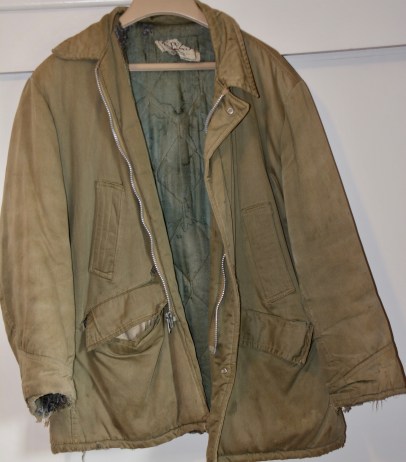
fullsizeoutput_1fadI wrote about my late husband’s barn jacket a number of years ago when I was adjusting to widowhood. I explained how I tried to sell the jacket for fifty cents in a yard sale and, when there were no buyers, how I paid to have it dry-cleaned, thinking it would come out looking less disgusting. It didn’t.
When I moved from the house John and I’d shared to one two-thirds smaller, when I theoretically gave away two-thirds of my stuff, somehow the barn jacket once again survived the purge. John called it his barn jacket because at one time in his life he had horses—a lot of them—and wore this jacket to muck out the barn. By the time we married he’d given up horses, but we had dogs. John wore the barn jacket when cleaning the dog kennel.

And that’s the thing. In our marriage we pretty much didn’t follow traditional gender assignments when it came to household chores. He did most of the cooking, I did most of the laundry, and we hired someone else to clean the house. He took it upon himself, however, to shovel the dog poop. It was a lot. We always had at least two dogs—at one point three. He never complained, never suggested I join the fun. I never fully appreciated it until he couldn’t do it anymore. The task fell to me, and what a revelation that was!

Now when I shovel dog poop in winter or run the snow blower, I don the barn jacket, more for inner strength than for warmth. The fabric may be seriously frayed, but this jacket has within it a mysterious moral fiber.

(To celebrate my 75th birthday this month, I’m posting daily stories about the stuff I’ve acquired over a lifetime and can’t let go of. I invite you to consider the stories that make you treasure your own stuff—maybe even share them.)

Tea Cart: My Stuff & Stories May 16

fullsizeoutput_1fa7
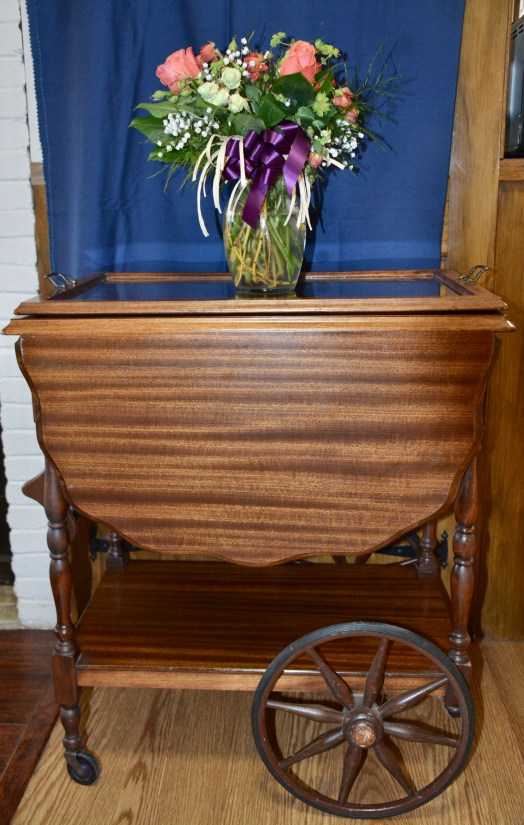
No more tea sets in my home, but the cart continues to serve, holding a birthday bouquet from my sister

This antique tea cart puts me solidly in the LOL category. I don’t mean Laugh Out Loud or Lots Of Love, but Little Old Lady. It’s the kind of thing you find in Little Old Ladies’ homes. Jan, the friend who gave me the tea cart, is approaching the age of ninety. She has expanded on the LOL acronym by adopting a kind of alter ego she has named Lollie. Lollie has invaded Jan’s body, and they’re not on particularly good terms. Jan wants to go to an event, but Lollie insists on staying home. Jan wants to get a list of things done in a day, but Lollie lingers in an easy chair, imprisoned by aches and pains.

I don’t use the “old” of LOL in a pejorative sense. Jan refers to this time of life as s-aging. Wikipedia tells me that the term “ageism” was coined in 1969 by Robert Neil Butler to describe discrimination against older people. But, wrote historian Georges Minois, our ambiguity about old age has “been with us since the stage of primitive society.” Old age, he continued, has been seen as “both the source of wisdom and of infirmity, experience and decrepitude, of prestige and suffering.” Thus we hide our ambivalence with euphemisms such as “elderly” and “senior citizen.” Never “old.”

Jan gave me her deceased mother’s tea cart decades ago when she moved to England. It was a common enough furnishing for that generation of women who had a specific approach to gracious hospitality and entertaining. That’s why I suspect you’d be hard pressed to find a tea cart in the home of anyone under sixty.

Forty years ago, our weekly newspaper still had what we called “country correspondents,” women who reported the social events in their rural neighborhoods. John and I happened to own numerous, dainty tea cups, inherited from both sides of our families, so we hosted the correspondents for tea at our home, spotlighting the cart. That kind of journalism has disappeared, and I’ve sold and/or given away all my tea sets. Still, I enjoy the cart. I roll it around when I’m dusting under and behind it. It squeaks and groans as it moves. Apparently it has its own Lollie.

(To celebrate my 75th birthday this month, I’m posting daily stories about the stuff I’ve acquired over a lifetime and can’t let go of. I invite you to consider the stories that make you treasure your own stuff—maybe even share them.)

Conception Deception-My Stuff & Stories May 15

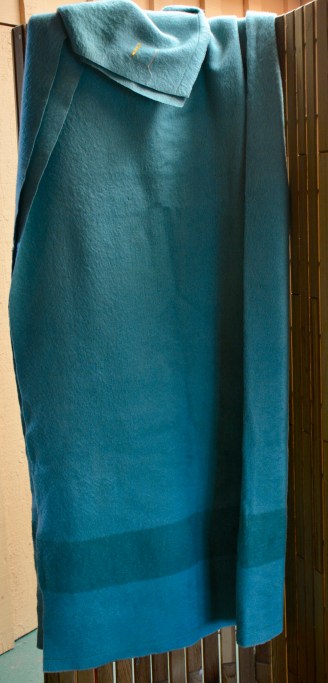
fullsizeoutput_1fa4It’s one hundred percent wool, a Hudson’s Bay blanket that at one time had the distinctive store label and binding in satin. More than eighty years old, it’s the kind of thing most people would repurpose as the dog’s bed. For me it is sacred. I was sure I was conceived under this blanket.

I suspect most people don’t give a lot of thought to their conception; it may be uncomfortable to think about our parents, um, doing it. While on staff at Holden Village, the church retreat center, I asked a young man where he was from.

“Cannon Falls, Minnesota,” he replied.

“Oh,” I blurted. “I was conceived there.” He was visibly nonplussed.

I remember this blanket being on my parents’ bed when I was a small child. I inherited it when they discovered the joy of a dual control electric blanket. Then, sorting through old family photos, the significance of the blanket finally dawned on me. It was prominent among a photo of my parents’ wedding gifts. Having read both parents’ journals from that time, I know how madly in love they were as newlyweds. Sleeping under that blanket held an aura of romance for me, warming not only my body but my heart.

While I was arranging the blanket for this photo, I finally did the math.  I realized I was conceived in August. Cannon Falls is in southern Minnesota, where August is hot and humid, and the air does not cool much at night. Seventy-five years ago, no one had air conditioning. That blanket was nowhere in the vicinity when I was conceived. In fact, it’s unlikely anyone was conceived under it. My sister probably got her start in early September and my brother in July. My parents were clearly warm weather lovers.

So now what? It’s just another old woolen blanket. Give up and use it for dog bedding? No way. My heart is telling me that sometimes the mythology around an object can hold a deeper truth than the facts.

(To celebrate my 75th birthday this month, I’m posting daily stories about the stuff I’ve acquired over a lifetime and can’t let go of. I invite you to consider the stories that make you treasure your own stuff–maybe even share them.)

Back to Bach: My Stuff & Stories May 14

fullsizeoutput_1f91
My altar to Bach includes recordings, books, and a bust.

“How did you know?” I asked the choir at Sand Point Methodist Church in Seattle when they presented me with a bust of Johann Sebastian Bach as a going-away gift. They laughed. They’d been hearing me play Bach at every opportunity throughout my tenure as organist for their church. It was a wonderful pipe organ, the best I’d ever played. Yet I was giving up my career as a professional (aka paid) church musician for a less esoteric (and better paying) career in journalism.

I no longer have the “chops” to play Bach as I did in my college years. Nor do I have words to explain why the music of Bach sears my heart, comforts my soul, defies my musical abilities, and excites my brain. Calvin R. Staper, a music professor, claims in the preface to his book on Bach’s music: “In the history of western music, J.S. Bach is unsurpassed in mastery of technique and profundity of thought.” Unsurpassed.

Though my CD collection is far from extensive—given the massive amount of Bach’s music that has been recorded—I do more listening than playing these days. The bust itself is not great art, possibly not even a credible likeness. Yet it represents a time, a place, an experience in my life—a reminder that I’ve been given many wonderful opportunities, and for that I’m grateful.

One of those opportunities came earlier this month when I played with the pit band for the Okanogan Valley Orchestra and Chorus annual stage musical. The camaraderie among the musicians in the pit was joyous; the boundless energy of conductor Matt Brown inspiring. But after months of rehearsals and hours of individual daily practice, I’m left with nagging “earworms,” snatches of melodies from the show playing in endless loops inside my head.

I’m trying Bach as a cure. Just now, I’m listening to the opening notes of the Andante in his First Violin Concerto. In a moment the deep, hypnotizing rhythm in the orchestra will underscore a soaring melody of intense longing and ardor, and I will have to stop writing. Bach cures earworms but also, as usual, leaves me wordless.

(To celebrate my 75th birthday this month, I’m posting daily stories about the stuff I’ve acquired over a lifetime and can’t let go of. I invite you to consider and possibly share the stories that make you treasure your own stuff.)

Island Life: My Stuff & Stories May 13

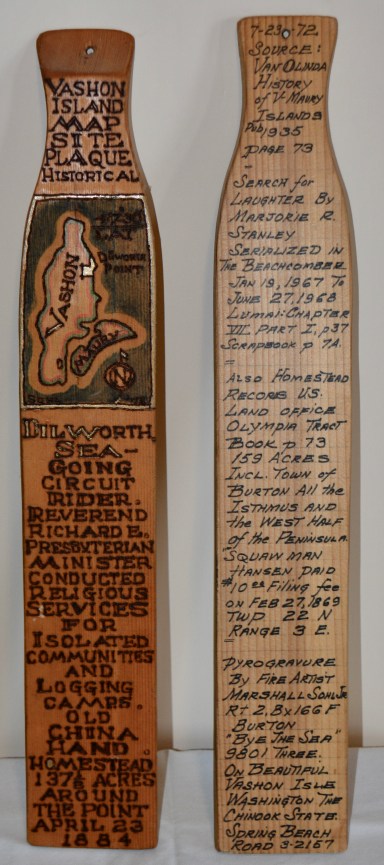
fullsizeoutput_1f88 These odd-looking paddles are among the very few artifacts I’ve kept from the ten years I lived on Vashon Island in Puget Sound. It was a formative decade, starting at age 25. I ended a marriage by mutual agreement, discovered my vocation at last, made lifelong friendships, played in a funky bluegrass band, and learned to sail. I should say, I learned to crew on sailboats. The few times people sailed with me at the rudder, they tended to decline a repeat voyage.
In the 1970s, island life was relatively inexpensive. Rents were cheap, and I eventually bought a small house with a million dollar view for ten thousand dollars.  The island setting with affordable cost of living attracted a thriving population of artists, philosophers, and hippies. For example: Marshall Sohl Jr., creator of the paddles, which he preferred to call “historical pyrogravures.” Marshall referred to himself as a “fire artist,” specializing in historical anecdotes. Kind of like wood-burned tweets.

This pyrogravure tells us that Dilworth Point, where I lived for a while, was named for a “sea-going circuit rider, Reverend Richard E., Presbyterian minister [who] conducted religious services for isolated communities and logging camps.” Not great art nor in-depth history, but the pyrogravures hang on my bedroom wall because they take me back to a time and place that are no more. Sure, Vashon Island is still there, not as affordable, and most of my friends have moved on. As Thomas Wolfe proclaimed, “you can’t go home again.”

As an Associated Press editor, I’d relished the daily commute via Washington State ferry from my island home to my Seattle office. I passed up several promotions because it meant I’d have to move from the island. Finally I got an offer I couldn’t refuse. My husband-to-be promised me I’d learn to love the Okanogan just as much as any island. Now, instead of living on a salt water sea, I live along a fresh water river. Instead of daily tides, I watch the river ebb and flow on an annual basis. John was right.

(To celebrate my 75th birthday this month, I’m posting daily stories about the stuff I’ve acquired over a lifetime and can’t let go of. I invite you to consider and possibly share the stories that make you treasure your own stuff.)

A Real Mother’s Day: My Stuff & Stories May 12

fullsizeoutput_1f81
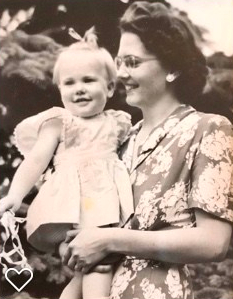
This photo of my mother and me is in a “memory book” she gave me for my 52nd birthday. She died May 25, 2009, at age 92.

Early in the morning of Friday, May 12, 1944, Elsie Louise Koch Fagerlin realized she was going into labor. Even though she and her family had moved to a new town just ten days earlier, she had everything well organized. Her mother was on hand to care for the two older children, Carol, about to turn seven, and Mark, who’d just turned five. Elsie, an attractive twenty-eight-year-old, figured she had time to paint her toe nails before leaving for the hospital, just twenty-five miles away. So she did.

She didn’t take into account that her beloved husband Carl had a knack for getting lost nor that this particular baby was in a big hurry to join the family. As Carl attempted to steer while simultaneously checking on his wife, she’d insist, “Never mind me. Just drive!” When they finally arrived at Swedish Hospital in downtown Minneapolis, Carl rushed to sign in his wife while nurses rushed Elsie directly to the delivery room.

It wasn’t long before she was holding me for the first time and later remembered being thankful “that you made it here so quickly.”

Maybe I was trying to catch up with my name, which they’d decided upon five years earlier. Pregnant with Mark, my mother was certain she was going to have twins. She herself had a twin brother and, she explained, “I was so big!” They decided that the twin names would be Mark Louis and Mary Louise. Cute. I’m sure my brother is as relieved as I that we had a convenient five-year gap between us.

Every once in a while my birthday falls on Mother’s Day, as it has this year. Some time ago I realized that we have things backwards when we celebrate birthdays. Our birthdays should be the real mothers’ days, when we recognize that the biggest birthday gift we’ll ever get is the life they gave us.

(To celebrate my 75th birthday this month, I’m posting daily stories about the stuff I’ve acquired over a lifetime and can’t let go of. I invite you to consider and possibly share the stories that make you treasure your own stuff.)

Up, Dry, and a Little Dirty: My Stuff and Stories May 11

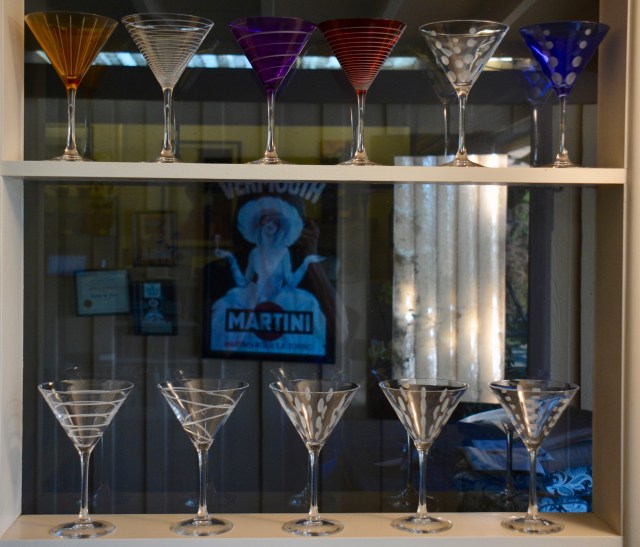
fullsizeoutput_1f79My friends and family consider me the Martini Doyenne of Omak, WA. I don’t think there’s much competition for the title.
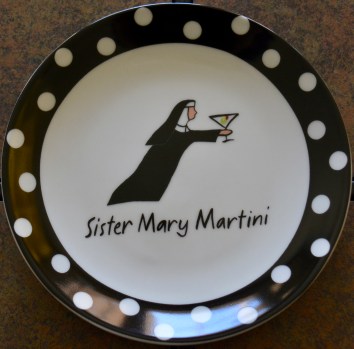
Truth is, I suspect their claim that I’m an expert martini maker is an easy way to come up with gifts for a woman who’s probably hard to buy for. (It’s clear by now that I already have a lot of stuff.) The martini glasses in the photo are a small representation of the martini accoutrements that have been given me over the years, much of it irreverently humorous: shakers, jiggers, glasses, towels, napkins, recipe books, olive picks, plates, placemats, note cards, and that poster in the background, which came from my mother.

There’s nothing magic or mysterious about my martini recipe. I like ’em up, dry, and just a little dirty. For non-martini speakers, that means cold but no ice to dilute the drink, very little sweetener, and a hint of olive juice. The big issue, among martini connoisseurs, is whether to shake or stir. Stirrers claim that shaking bruises the juniper, an essential ingredient of gin. I’m ecumenical. If I’m making just one or two servings, I shake. It chills the drink more thoroughly. If I’m making a pitcher for a crowd, I stir.

I begin by pouring just a dab of dry white wine over ice. I don’t use the standard vermouth, because it’s too sweet. Next comes the gin. I prefer Amsterdam. It’s not expensive and it has a nice citrusy edge. If someone brings me the pricier Beefeater or Bombay, who am I to complain? I occasionally make vodka martinis for a friend who can’t stand gin. The friendship is more precious than my taste for gin, and that’s saying something.

fullsizeoutput_1f7dI top the mixture off with a sprinkle of olive juice (that’s the dirty part), stir or shake, and pour into the glass over an olive or two. The olives need to be big and bold, like Tassos Double Stuffed Garlic & Jalapeno.

I bet you think I’m going to have a martini on my birthday. Wrong. For seventy-five, it’s champagne all the way.

(To celebrate my 75th birthday this month, I’m posting daily stories about the stuff I’ve acquired over a lifetime and can’t let go of. I invite you to consider and possibly share the stories that make you treasure your own stuff.)