
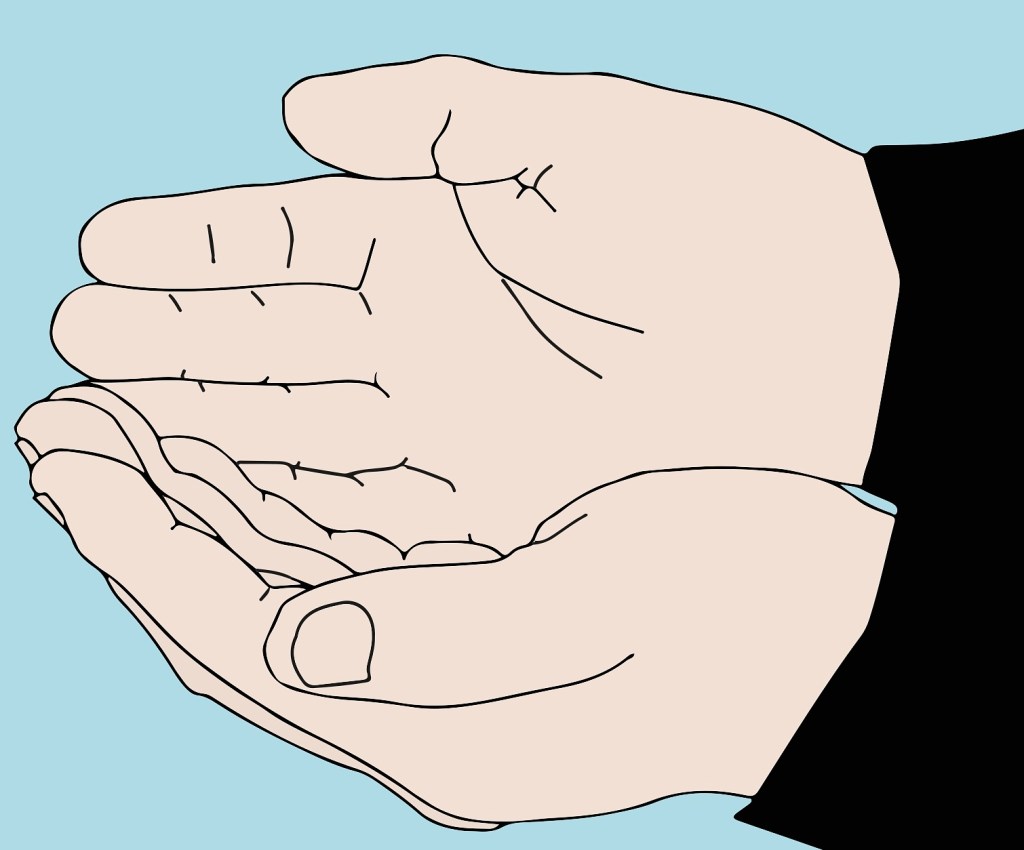
I learned the hard way never to give cash to a “panhandler.” Then I learned that hard-fast rules like that are made to be broken.
A man we’ll call Jerry was a regular guest at a homeless shelter where I volunteered. The shelter, staffed entirely by volunteers, operated only in winter, when nights in the Okanogan Valley are bitterly cold. The shelter required “guests” to pass a high bar: they had to be “clean and sober” for the previous twenty-four hours.
Jerry was a regular guest, earnest and helpful, ready to carry a hot casserole from my car into the shelter kitchen. He’d chat about the job he was about to get, or the apartment he was considering …
One day after the shelter had closed for summer, I ran into Jerry while walking my dogs through the park. He asked if I could give him some money. I told him, truthfully, that I never carried money when walking the dogs, only my phone. He shrugged, okay.
All the way home I thought about him, how “clean and sober” he’d been all winter. I grabbed my purse and drove back to the park, handed Jerry a twenty saying that I “knew” him and was confident he’d spend the money wisely. The next day, again walking the dogs, I spotted Jerry. He was out-of-his-mind high.
“You idiot,” I said. Not to him. To myself. I should never have given him cash. I could have bought a gift certificate at Arby’s or something like that. More important, with the shelter closed, Jerry had lost a vital base of support. Better than cash, I could have simply sat and talked with him a while. Months later I learned that Jerry had died on the street.
Now I live in Seattle, where a disastrously high number of people live on the streets. Nonetheless, I’m rarely panhandled. When I am, I offer a believable lie that I never carry cash. I excuse the lie by donating to various nonprofits that minister to homeless people.
A while ago, I was waiting at a bus stop when a woman rolled up with a luggage carrier neatly piled with an assortment of cloth and canvas bags. Short and a little stout, she smiled at me brightly, and I smiled back. Out of the corner of my eye, I examined what were probably all her life’s belongings. The bags were arranged so she could remove the top one, creating a temporary bench to sit upon.
After a minute or so, she turned to me and asked in heavily accented English, “Could you loan me five dollars so I can buy bread?” I gave my standard lie — no cash. She nodded and turned away. Again, I watched while avoiding eye contact. At first, her face was stoic, but in silence, her expression changed. Her eyes scrunched to avoid tears, and her mouth was tight. What was I seeing? Defeat? The last thread of determination? I was convinced she was neither a drinker nor a user, but probably at a loss, without hope.
My bus rolled up. She continued to sit.
“I have change!” I declared, as if I’d just remembered. My small change purse was stuffed with quarters, but it was hard to dig out more than two or three at a time. I kept digging for quarters while she shyly held out her hand. My bus was preparing to leave.
“Sorry it’s not more,” I said in a rush. It may have been close to five dollars. She murmured her thanks as I boarded the bus. I never saw her again. I’ve been asked for cash a few times since. Remembering Jerry, I still raise my hands in a gesture that says sorry, no.
I have no grand solution to the complex problem of homelessness. I continue to donate to programs that make a difference, one person at a time. I volunteer at the St. James Cathedral Kitchen. And I follow my rules — except when my heart takes me in a different direction.








You must be logged in to post a comment.