
We stood in the cathedral courtyard, some hundred or more of us holding small lighted candles that flickered in the November night. The bell above rang a solemn funeral toll. One by one the names were read of 410 homeless people who have died in Seattle over the past year.
“Clifford … David … William … Roberto … Fernando … Brian … Melissa … Matthew … Nabil … Shawna … Sukhwinder … Isaias … Edward … Hyshyn … Sirisopha …”
We were observing the annual “Mass in Remembrance of the Deceased Homeless of Seattle,” offered by St. James Cathedral. Inside the cathedral, we had sung, prayed, heard scripture and sermon, communed, and prayed some more. Finally the mournful tones of a bagpipe led us outside. We processed along the street and into the courtyard, where a sculpture of Madonna, cuddling the Child, presides.
“Santos … Noel … Sonny … Timothy … Thomas … Sean … Liem … Hector … Tracy … Jesse … Pedro … Mark … Arnold … Gustavo … Michelle … Nathan … Carlos … Sharleen …”
The rumble of planes overhead made us strain a bit to hear the names. Only a few hours earlier, I’d been aboard one of those planes, flying across the state after a brief visit to Spokane. Officials in Washington’s second largest city report a decline in homelessness, but that is of little comfort to the two thousand-or-so folks sleeping on or under cardboard while I nestled in my hotel bed.
“Martin … Isaac … Kathy … Gary … Tina … Logan … Martha … Phetsamone … Nimo …”
It’d been a gloriously clear day to fly. The fertile fields of eastern Washington spread quilt-like below. The Columbia River and its tributaries embroidered meandering designs in brilliant blue threads.
“Wayne … Brad … Adam … Earl … Kim … Paul … Randy … Esteban … Steven … Matthew … Alexia … Cassandra … Ross … Henry … Leslie … Christopher … Katherine … Ernest …”
The Columbia River defines the southern border of Okanogan County, where I lived for forty-five years before returning to Seattle last year. I recalled the homeless individuals I’d met while volunteering at a shelter in Okanogan. Each was unique, their stories fascinating, more often than not carrying a common thread: the struggle to stay “clean and sober.” Homeless people died on the streets and under the bridges in the Okanogan Valley, too. There was no mass to honor their lives, but we spoke their names regretfully, in sorrow. What more could we’ve done?
“Vuong … Violet … Collin … Teo … James … Gary … Charles … Kebereseb … Mohammed … William … Patrick … Maria … Justin … Cheryl … Jennifer … Jameelah … Larry …”
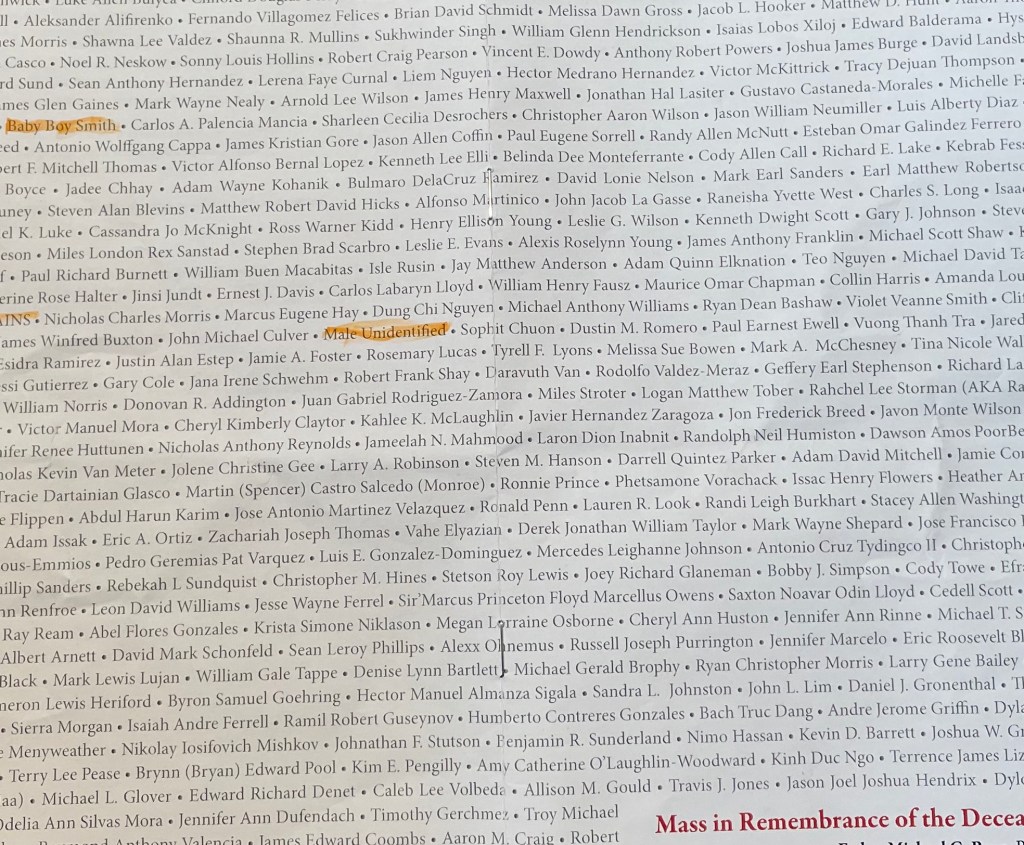
The wail of a passing ambulance sounded as a counterpoint to the tolling bell. The reading of names had become a chant, a rhythm that matched my breathing. A dozen names, a dozen breaths, each minute. I list only first names here but full names were intoned, including middle names, if known. A few of the names stopped my breath.
“Baby Boy Smith … Baby Boy Green … Unidentified Remains … Male Unidentified …”
I focussed on the Madonna sculpture, pondering the miracle of birth that she represents. At birth, all of us were “created equal.” That’s what our nation’s founders proclaimed. With hands over heart, we pledge that we are a nation with “liberty and justice for all.” Both statements are more aspirational than reality. The signs of inequality, beginning from birth, are all around us, when we care to look.
“Ivan … Anthony … Jason … Travis … Jennifer … Terry … Cynthia … Sean … Sompheth … Doreen … Krista … Eric … Faisal … Randolph … Sandra …”
Our candles burned to nubbins, then sputtered out. Still the names continued. I recalled the verse from John’s Gospel: “The light shines in the darkness, and the darkness cannot overcome it.”
“Olivia … Michael … Charles … Shannon.” At last we’d heard all 408 names and two Unknowns. The bell stopped tolling; the bagpipe played “Taps.” A reception followed, but I couldn’t do that. I walked home in silence, oblivious to the noise of city traffic. As a student, I strived to be on the honor roll, the dean’s list. My name likely won’t appear on this list of homelessness. I’m grateful, humbled. For this list, the roll has been “called up yonder.” These too are names, people, lives to be honored.

 Every New Season
You must be logged in to post a comment.