Last-Minute Shopping? Think Extravagance

A well-worn five dollar bill tucked inside a Christmas card is the most extravagant gift I expect to receive this year. It was given to me during my Friday night piano gig at St. James Cathedral Kitchen.

Five nights a week Kitchen volunteers serve a free, hot meal to whomever shows up — usually around two hundred folks or more. By appearances, I’m guessing the patrons include plenty of homeless folks, some elderly residents of subsidized apartments in the neighborhood, maybe a few university students, occasional families with youngsters. And dogs. Dogs on leash are admitted.

I’m one of the pianists who add background ambience, making the church social room feel less institutional with a layer of music under the chatter and clatter of dishes. The piano is one of the most out-of-condition I’ve ever contended with. There’s no bench, but an office chair on wheels. That does not work for me. I haul a couple of cushions on the four-block trek from my apartment to the cathedral. I set them on a folding chair so I can approach the keyboard from a perch that won’t roll away. The keys almost always sound when activated. Who could ask for anything more? 

It is the highlight of my week. I occasionally substitute for pianists on other nights, but Friday is mine.

Friday happens to be the night when Sue and Susan meet up for their weekly dinner together. I do not know their last names, stories or ages (I’m guessing in their sixties, maybe crowding seventy). Nothing about their appearance suggests monetary wealth. I know Sue rides the bus from her home in the south end of Seattle. And I know that they will always, always exclaim after I finish how wonderful my playing was (whether it was or not). 

Last Friday Sue placed an envelope on the piano as I played. When music and dinner were done, I began to open the envelope, anticipating a Christmas card. 

“Careful,” Sue cautioned. Tucked inside the card was the five-dollar bill. 

“I can’t …” I began. 

“Stop!” Sue interrupted. “It’s a gift! You can’t refuse a gift. I wouldn’t give it if I couldn’t afford it.” 

I’ve occasionally supplemented my income with piano and organ gigs. But no payment could top the handwritten message in the card: “To our piano player who myself and Susan love to hear your beautiful music while we have our dinner. You make us feel so comfortable and Happy. From your friends, Sue and Susan”

We talked a little longer. Sue is celebrating that her son just got out of jail, where he spent seven months. It was his girlfriend who got him in trouble, says Sue.

“I told him! No more girlfriend!”

After they left, I handed the five dollars to Mick, who runs the Kitchen, and told him the story. “This was from OUR folks?” he asked, mildly disbelieving. Then he smiled.

Whenever I’m given a gift of cash, I like to tell the giver how I used the money. I’ll enjoy telling Sue — and she’ll enjoy hearing — that I spent her gift on a new book of music that I’ve been wanting. Music that she and others will soon be hearing.

Wait a minute, you may be saying. You gave the money to the Kitchen. Yeah, well, money is an illusion. Gifts from the heart are the real thing. There’s no limit to how much love they can buy.

Chicken or Egg: Where Are You Comin’ From?

If you’ve ever puzzled over the chicken/egg primacy issue (which came first?), you might find your answer aboard the Coast Starlight Seattle-Portland train route. 

Or do I mean Portland-Seattle?

As part of “Trails and Rails,” a cooperative venture between Amtrak and the National Park Service, knowledgeable volunteers spend their summers entertaining passengers with stories about Pacific Northwest environment, history and culture.  (At least they did last summer. Who knows whether this admirable program will survive?)

Kristy and Phil, volunteers on my journey, were armed with notebooks full of facts and figures. But it was their story-telling skill that hooked passengers who filled the glass-domed observation car.

Approaching the Billy Frank Jr. Wildlife Refuge, just north of the state capitol, Phil described Frank as the “man who was arrested more times than anyone else in the state of Washington.” 

“What would you say about such a person?!” he continued, feigning dismay. Tourists murmured, disconcerted. Those in the know smiled at this introduction to one of the state’s most honored Native American activists and environmentalists. True, Frank (1931-2014) was arrested more than fifty times. The first time, at the age of fourteen, was the beginning of his decades-long fight to reestablish native fishing rights. His persistence led to the landmark Boldt Decision of 1974, upholding guarantees that had been set in an 1854 treaty but ignored. Frank’s numerous honors include the Presidential Medal of Freedom.

More stories flowed as the train whistled us through cities and towns until we approached Winlock, a small, agricultural community.

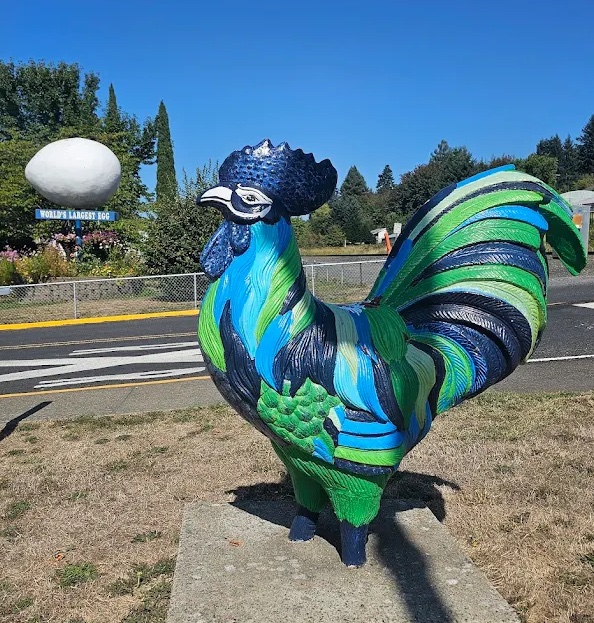
“If you remember nothing else from this trip, I hope you remember this,” prompted Kristy. Winlock historically touted itself as the “Egg and Poultry Capital of the World,” producing hundreds of thousands of chicks and eggs. To prove it, the town erected the world’s largest egg, a claim affirmed by “Ripley’s Believe It Or Not!” in 1989. 

Just across the street is another statue: a brilliantly colored but much smaller chicken. As to which came first, the answer depends on what direction you’re going. Heading south, the egg comes first. Going north, it’s the chicken.

That’s US!, I realized.

As in, U.S.

As in polarized. We’re all on the same set of tracks, but our stories depend on where we’ve been and where we think we’re going — or want to go. 

Each of us is the sum and substance of the stories we tell ourselves about ourselves. Information or ideas that don’t fit into our stories bring up uncomfortable emotions — sadness, envy, anger — and we’re inclined to reject them, as if to say the chicken absolutely came first or the egg absolutely came first. In other words, we have bias. It’s inevitable, explains writer Brian McLaren. It’s how our brains work. 

We grow up being told stories that shape our own stories. As we mature and age, our stories become more complex. When we are confronted with stories, ideas and information that conflict with our story, we have a choice. We can simply reject those other stories — take the easy route. Or we can figure out how to rewrite our story, even discarding parts, to make our narrative more inclusive. Rewriting is hard and tiring work for the brain. And it’s ongoing. There’s new stuff coming down the track every day.

It’s like the Billy Frank Jr. story. If we get only a fragment, we easily jump to a skewed conclusion. 

On my return trip, from Portland to Seattle, I was sitting on the “wrong” side of the train. I missed seeing the chicken precede the egg. In fact, I missed chicken and egg altogether, thus missing half the story.

Nevertheless, when we can simply enjoy that there are chickens and there are eggs, and there are eggs and there are chickens, we won’t have to worry about which came first. When we can hear and honor each other’s stories, acknowledge where each other is coming from, we’ll be getting back on track.

It’s a matter of perspective. Winlock’s egg is really
much larger than the chicken. – Tim Bryon photo