
Having lived in wildfire country for decades, I’ve hiked many miles through burned-out forests. I grieved over fallen giants whose blackened bark served as shrouds. Now an urban dweller, I was recently meandering through a very different environment, a contemporary art gallery dominated by concrete and glass. Until … I turned a corner and was unexpectedly back in the burned forest, or a towering representative of it.
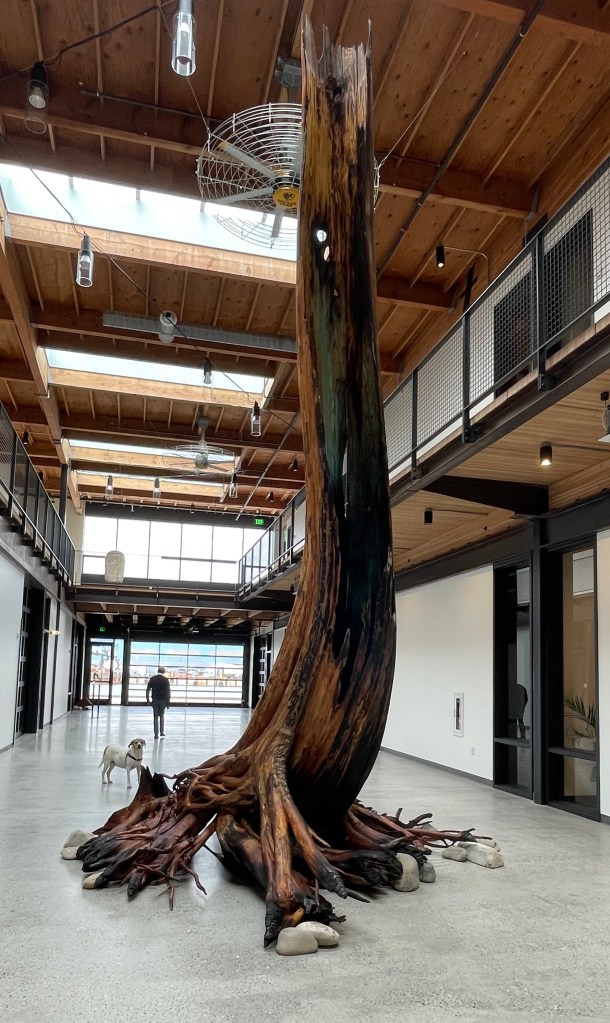
The sculpture, created from the twenty-two foot base and roots of a charred and hollowed western red cedar, is a compelling statement of destruction and resurrection. Tori Karpenko, an artist from Twisp, WA., salvaged the tree’s remains in cooperation with the U.S. Forest Service. Karpenko rubbed oil onto every inch of the massive corpse, giving it an ethereal glow, an essence of life after death.
Karpenko titled the work “Invitation.” It tells a story, Karpenko writes: “Of loss … Of fragility and the delicacy of this moment we are in … Of hope in the promise of renewal … Of community, holding everything from the bottom up.”
I’ve long marveled at the self-healing powers of Creation. Almost immediately after a forest fire, there’s a resurgence of life. Ferns emerge, burying thick ash on the forest floor beneath a lush, green carpet. Myriad seeds spring to life. Reporting on fires for our rural, weekly newspaper was inevitably a bitter-sweet experience for my husband and me. We and our staff would photograph and write about the destruction, the drama of firefighters battling to save homes, lives, property.

John and I would also give each other knowing looks. We would return to the scene the following spring to hunt for the tantalizing morel mushroom. Several species of “burn morels” hide underground for years until fire prompts them to bloom, often en masse.
It’s well known by now that practices and policies over the past century led to needless destruction of forests and wildlands. Fire is not the enemy. Human conceit is. Not that many years ago, I attended a presentation on wildfire and, for the first time, heard a government forester admit, “The Indians had it right.” For centuries, Native Americans skillfully used fire as a tool to keep the forests healthy and productive.
I’m not into romanticizing any culture over another. I’m not going to delve into whether any economic system or religious dogma is better than any other. Yet we Americans are obsessed with consumerism, materialism and status. If we were to adopt the spiritual relationship indigenous people of this continent had with Creation — understanding all lifeforms as sacred — that WOULD make America great again.
“Invitation” demonstrates the beauty that results when humans collaborate with nature, when we work in community with nature instead of exploiting or attempting to dominate. Native American writer and scientist Robin Wall Kimmerer calls this reciprocity. The word is threaded through her best-seller, “Braiding Sweetgrass.”
“One of our responsibilities as human people,” she writes, “is to find ways to enter into reciprocity with the more-than-human world. We can do it through gratitude, through ceremony, through land stewardship, science, art, and in everyday acts of practical reverence.”
As co-creator with nature, Karpenko writes: “The tree, once connected to a family of cedars, was also a community of itself. Interwoven roots growing together, strengthening in response to what was needed. The communities we build are our greatest hope of solving the problems of our time. Perhaps this has always been true, the story of human evolution. How can we forget such things?”
Not everyone has forgotten, and we continue to learn — too often the hard way, as with wildfire. Humanity is on a steep learning curve now, discovering how vitally interdependent we are, on each other, on all of Creation. Karpenko, who once had a fire burn within six feet of his bedroom, observes that we all must own it:
“Somebody else started those fires
but we are all a part of this mess
The smoke belongs to everyone
Regardless of where it came from . . .”
PHOTOS: My photo of “Invitation” does not do it justice, other than to give a sense of dimension. To appreciate its beauty, go to Karpenko’s website, https://www.torikarpenko.com/, or even better, visit the Traver Gallery, 1100 E. Ewing Street, Seattle, where the sculpture is on loan by the artist. The bottom photo was taken after a fire near Holden Village, in the North Cascade mountains of Washington state.

 Every New Season
You must be logged in to post a comment.