First Salmon

IMG_4011
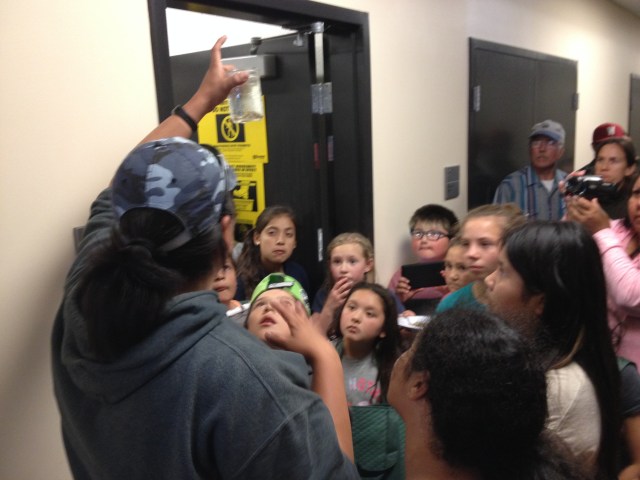
Colville Tribes fish hatchery employee shows chinook smolts to students from Inchelium

If you’re heading out on a cross-country road trip, your first stop should be at a beautiful place close to home. That way, when you discover you’ve forgotten something important, you can return for it without too much backtracking. More significant, no matter how exotic the sights on your journey, you’ll remember that home is beautiful, too.

My shakedown cruise for this year’s cross-country sojourn was a night at Bridgeport State Park on the Columbia River, just 45 minutes from my house. A friend and I spent the night in my camper van so we’d already have that drive under our belts, giving us 45 minutes more sleep before the 5:30 a.m. First Salmon ceremony at the adjacent Colville Tribes Fish Hatchery.

The park is beautiful: lush green lawns, plenty of space between camping sites, trees, birds, walking paths and views of the rugged cliffs that border Rufus Woods Lake, the reservoir behind Chief Joseph Dam.

But what caught my heart was the ceremony. An early morning sun highlighted cascades of water thundering over the dam, landing in a tumultuous spray. Prayers were sung in a language I don’t understand, yet the message of thanksgiving was as clear as mountain spring water. Elders spoke longingly of their fishing traditions before dams on the Columbia blocked fish migration. The massive concrete structure—“Chief Joe,” as the locals call it—loomed in the background as native fishermen stood on a steel platform, struggling to net that First Salmon. The scene was a pale imitation of the ancient fishery, yet it represented hope and determination.

This year’s ceremony was especially meaningful. The hatchery was promised when Grand Coulee Dam was constructed in the 1930s.  That promise wasn’t kept until this century. The hatchery was completed in 2010. The tribe released its first ocean-bound smolts —1.8 million Chinooks — in 2013. Those are the fish returning this year. Sadly, there won’t be many of them. Tribal biologists forecast a seriously diminished spring chinook run, due to a variety of environmental issues.

Ultimately, the tribe plans to release 2.9 million smolts annually.

“Mother Nature always has something to say about that,” smiled one of the tribal scientists, adding confidently, “We’ll get it figured out.”

The First Salmon ceremony is deeply spiritual, also incorporating the science, culture, history and politics of the fishery. We listened to speakers as the fish was roasted on sticks over a fire. Then a small bite was given to each of us — about 150 people.

“It is our sacrament,” a tribal member said to me. Just as that mysterious connection with the divine is celebrated through the Christian sacrament of Holy Communion.

When the dams were built, it was not simply a food supply that was lost. Salmon nurtured the soul of a culture that had thrived for thousands of years. That soul still flickers with life, just as this year’s First Salmon thrashed in the net before giving its life for the gathered people.

Passing the Torch

The Native American man was calmly describing his lifetime of encounters with prejudice, first as a little boy at the movie theater, then at school, later as a Viet Nam vet, and just last week, in the Walmart parking lot. He’d been sipping his morning coffee and reading the paper when someone yelled at him to go back where he came from. Racism is not without its irony.

As he was speaking, a student seated near me bowed her head, her long blond hair shielding her face. Even so, I could see tears streaming as she silently wept.

It’d been an emotionally fraught day — the local “Stand Against Racism” event at Wenatchee Valley College-Omak. Faculty member Livia Millard began by clarifying what race is all about: “a false classification of people … not scientifically true.”

If you live in the United States, your race is determined by your ancestry. If you live in Brazil, it’s determined by your skin color. In the U.S., said Millard, five primary racial colors — white, yellow, black, red, and brown — date from Revolutionary times. They alter like shifting sands depending on the  latest court ruling or U.S. Census Bureau decision. People of Mexican ancestry were considered “white” until the 1930s. What it took to be “black” varied from state to state.

“People considered white now may not be by the 2020 census,” suggested Millard. If race is so nebulous, how can it be so deeply ingrained?

One after another speakers reflected on the tragic results of racism from perspectives across the spectrum:

  • the near-extermination of American Indians and a culture representing 10,000 years of learned wisdom about the land and its inhabitants;
  • the struggle to overcome “imposter syndrome,” described by a high-achieving Latina who couldn’t believe she’d ever belong no matter how many degrees she’d earned;
  • xenophobia that has historically tainted immigration policy and remains alive and well today, and;
  • “environmental racism” — industrial dirty work located where marginalized populations, such as minorities, try to live. For example? We heard a first-person account of events at Standing Rock from a man who’d been there and will return.

By the end of the day, the crowd had dwindled to just a few of us watching the Oscar-nominated Netflix documentary, “13th,” a hard-hitting exploration of America’s prison system. Our land of the free has five percent of the world’s population and 25 percent of its prisoners. African Americans and Hispanics represent 25 percent of our population and 58 percent of our prison population. With privatization of those prisons, we’ve established a new era of slave labor. Literally.

Only a handful of us remained for the question and answer session after the movie. The Native American man spoke and the blond girl silently wept. As I was leaving, I touched her shoulder and murmured my thanks.

“I’m old. My eyes are hardened and dry. I fear I’ve shed all my tears,” I told her. “I’m thankful that you’re able and willing to cry.”

My Two Percent Worth

I’ve never aspired to be among the fabled “one percent” — our nation’s richest people. Thus I was surprised to learn, as the tax deadline looms, that I’m among the lesser known “two percent.” Seventy percent of tax payers qualify for Free File, a program that provides free tax preparation assistance and software. Only two percent of us take advantage of it. On average, says the IRS, taxpayers spend $261 annually for tax preparation services from companies like H&R Block or Turbotax or accounting firms.

Free File is (incredibly) provided by H&R Block, Turbotax, TaxAct — in all, 13 companies whose best interest is served by keeping our tax system as complicated as possible. Don’t look for Free File on their web sites. It’s a well-kept secret, accessible through the IRS site. It’s not like the limited free services offered from the companies’ web sites for people who are filing a 1040EZ or “simple” return. Free File users can earn up to $64,000, including investment earnings that require additional reporting forms, and they can itemize deductions. To learn why it’s such a hush-hush offering, listen to an entertaining podcast, “Out With the Old,” from On the Media. (Skip the first 12 minutes, then hang on for the full 16-minute interview, including a lively exchange with an apologist for the tax preparation industry.)

I stumbled onto Free File while trying to figure out which tax prep software to buy. I’d decided to try doing my own taxes again after giving up a couple years ago. Despite hiring someone to relieve me of tax-time frustration and stomach tension, I received a notice from the IRS last year that I owed more than $16,000 for 2014. I’d made a reporting error, which my accountant didn’t catch. I consulted a different accountant, who spotted the error within seconds and assured me that what I owed was nowhere near $16 K. She was right, and I learned that dealing with the IRS is not so scary. It requires only patience, a virtue I need to cultivate anyway.

While I chafe at the complexity and blatant inequities in our tax system, I am not, in principle, anti-tax. Taxes are the dues we pay to belong to an exclusive club. Membership in Club U.S.A. is limited to five percent of the world’s population. The many privileges I’ve enjoyed during my seven-plus decades of membership include personal safety and security, 13 years of tuition-free education, and freedom of movement (as long as I stay off airplanes).

I frequently don’t agree with how the club leadership spends my dues, but I have the right to speak up about that. And I have the power to change it — at the ballot box. So I had to smile when I hit “send” on my Free File return.

__________________

If you’ve finished your taxes, you might enjoy this speech by journalist T.R. Reid, author of “A Fine Mess: A Global Quest for a Simpler, Fairer, and More Efficient Tax System.” Could it be true that other countries know how to do this better?

If you’re still fretting over your tax return, you might find this meditation on mindful filing helpful.

Why haven’t you written?

Not long before she died at age 92, my mother described her vision of heaven: “Lots to do and plenty of time to do it.” Mother was not describing a place but a state of being. Her favorite state of being was to be doing. If Hamlet had asked Mother whether to be or not to be, her advice might’ve been, “Cut the soliloquy and do something!” Though she was a creative thinker, her retort to Descartes could’ve been, “I do, therefore I am.”

I inherited Mother’s “do” gene: her propensity for making impossibly long to-do lists, her ardor for multi-tasking, her weakness for piling just one more obligation onto a plate that is already heaping full. All this flies in the face of the current personal development movement that urges us to slow down and focus simply on “being.” I’ve attended the seminars, read the books. Still I awaken each morning thinking about all the “stuff” I’ve gotta do and wondering how I’m gonna get it done.

I’m reluctant to label myself as retired, but I surely echo the retirees’ lament: “When did I ever have time to work?” I’ve had no time to “work”—in my case work means to write—since last fall when I wrote an article for an environmental journal. My intent was to write similar pieces for other publications, but by the end of each day, I’ve had so much “stuff” to do, my brain is too tired to research, interview, and write.

And then there are these personal essays that started out as weekly newspaper columns decades ago, evolved into occasional emails to friends and family, and now I suppose qualify as a blog. The thing is, does the world really need another blog? According to technorati.com, there are more than eight million blogs online already. A new blog is created every 7.4 seconds. You can go here to watch a depressing, real-time tally of daily blog posts. The numbers spin faster than wind chimes in a hurricane.

Who has the time, much less the interest, to read all that? Who needs it?

That’s what I asked myself all winter while pretending I didn’t have writer’s block. Writing is like taking your clothes off and running naked through the public square. That’s why Facebook makes me uncomfortable. I read some of the stuff people post and wish they’d put their clothes back on. When I make a judgment like that, I have to wonder if I’m among the less-than attractive nudies. That’s the block I’ve been facing for months. Writing is scary.

My mother was a writer of Christian education materials. I wonder if it ever scared her. We never talked about that. I recall only that she didn’t appreciate being interrupted when she was writing. I’d give anything for an interruption right now. Somebody, please call. Please send an urgent text message. Otherwise I’ll have to hit “send.”

Civility

img_0940
A dike along the Okanogan River 

Two nights after The Election, I warily attended a local town hall-style meeting. It’d been organized to discuss a proposed walking trail along the river. This idea has been the subject of controversy and dispute for decades. After witnessing  a nation turn itself into an ouroboros —that mythological snake who eats its own tail — I was not eager to deal with anything political. To my astonishment, the meeting turned out to be a welcome oasis of civility amidst the week’s political maelstrom.

The Okanogan River is a placid stream that every once in a rare while goes bonkers. In 1948, 1972 and 1974, so-called “hundred year” floods submerged vast areas. I know those dates well because they’re painted on the bulkhead of the house next door to mark how high the river had risen. The Army Corps of Engineers responded in the 1970s by building broad dikes to keep the river in its “natural” channel. Ever since, there’ve been no hundred-year floods to test the dikes, but their use and maintenance have been contentious.

Various environmental and wildlife agencies want the dikes covered with native vegetation to provide habitat. The Corps wants them free of roots that supposedly undermine the dikes’ stability. Just plain folks have, for years, simply wanted the privilege of walking along those dikes to enjoy the beauty of a free-flowing river. For years, adjacent property owners strenuously objected, not wanting their privacy invaded. Thus the “no trespassing” signs on the dikes mean that only trespassers can walk there. And they do.

For several months, a small group of volunteers has worked strenuously to create a plan for developing a trail that would serve the public while protecting property owners. The meeting drew a full house. City officials and the volunteer group laid out their proposal, candidly describing both pluses and minuses.

Not far from me sat an elderly gentleman who shuffled papers and grumbled every once in a while about trespassers on his property and how he’d received the meeting notice only the day before. When it came time for questions and discussion, he raised his hand.

“Here we go,” I thought to myself. Prepared for the usual NIMBY response, I was pleasantly surprised when he spoke about how he’d enjoyed urban trails elsewhere. He outlined some of the problems that would have to be resolved if this trail were developed. He did it in a way that said, yes, there are problems, and there may be solutions. That was the tone for the entire meeting, an openness to finding solutions together.

Such a small event in a week when history was made. For me it was the most important event, an evening when I thought, yes, maybe the American experiment can work, maybe we can govern ourselves. The late U.S. House Speaker Tip O’Neill famously said, “All politics is local.” Maybe all civility is local, too. That’s where it matters most, and who knows — it just might catch on nationwide.