Embracing Life’s Lessons: From Caregiver to Patient

If life is all about learning, I’ve just earned my post-doctoral degree following hospitalization. Ouch. I know. Self-serving puns aside, it was a novel experience to be IN bed instead of bed-SIDE.

For the past three decades I’ve been doing preparatory studies by caring for loved ones during their final passage of life. Among them were my husband, mother-in-law, mother, and sisters of my heart. I’ve witnessed the grim effects of stroke, cancer, heart disease, ALS, and simple, intractable aging.

With each passing I came to the same conclusion: I’m not particularly afraid of death, but I’m terrified of the health care industry. It is to be avoided at all costs.

When I made a full frontal landing on a concrete sidewalk nearly three weeks ago, my first thought was a prayer: please, no injuries requiring medical attention. 

“Nothing broken,” I announced cheerfully to the strangers who helped me up. What did I know?! I painfully crawled into an Uber for the short ride to my apartment complex, where a nurse checked my vital signs. I was alive.

“Ambulance,” he suggested.

“Nope,” I countered. “I’ll just ice my (screaming) knee and elbow. I’ll be fine.” An hour later I was on the phone saying, “ambulance.”

Once again I assumed the role of bedside observer, but this time observing myself as patient. I consciously sought a sense of detachment, witnessing my own experience as if I were someone else, watching, not judging.

I was not at all approaching death’s door, yet right there at my side were the beloved ones with whom I’d journeyed in years past. While I thought I was caring for them, they’d actually been teaching me: how to let go, how to accept, how and where to set boundaries, when to laugh, when to cry and grieve, how to bless and move on.

My husband, who died in 2007, has been especially present. A brainstem stroke left him with the unthinkable diagnosis of Locked-In Syndrome: a fully functioning mind “locked” inside a totally paralyzed body, unable to speak or eat. Yet he lived a meaningful life for another fourteen years. His presence is palpable, reminding me how he faced adversity with courage, determination and, most important, patience.

My mother sternly warns, “DON’T!” as I start to pick up a sock that fell on the floor. Mother broke her neck by falling when she stooped to pluck an errant thread from the carpet. She survived, but it was a long, arduous recovery. She ultimately died with cancer.

“Thanks, Mom,” I respond when I hear her voice. “You paid a heavy price to teach me this lesson.” I take the time to retrieve a mechanical grabber and safely pick up the sock.

When my dear friend Sharlene was diagnosed with ALS (Lou Gehrig’s Disease), her wry and playful humor rose to the top. Told the disease is incredibly rare, she declared, “I’m one of the CHOSEN.” She taught me that we are a mixed bag of emotions, all valid. She howled volubly with grief and rage every time the advancing disease robbed her of yet another function: walking, eating, talking.

When she could no longer speak, she typed jokes into her talking laptop and played them for strangers as we rode elevators at the medical center. One delighted passenger suggested she be hired permanently. She rather liked the idea.

With death approaching Sharlene spelled out her final request to me by painstakingly moving her one functional finger across the sheet on her bed: “Mary, write my obit.” I did, but I wish I’d done it better, made it more fun, like her.

I sat for hours with my soul sister, Mary Lou, who in her final weeks often resisted pain-killing but sleep-inducing medication. “I don’t have much life left,” she protested. “I don’t want to sleep through it.” 

Walking the route to humility

Our friendship had begun decades earlier when, as office colleagues, we discovered we both played piano. We began meeting weekly to play duets. Mary Lou insisted on playing “secondo” while I played “primo.” As in dancing, someone has to lead.

Thousands of miles and a multitude of shared adventures later, as Mary Lou lay dying she asked what of her possessions I wanted to inherit. I didn’t have to think about it.

“Your humility,” I quickly answered, humility not being one of my stronger suits. She had it in abundance, along with joy, grace, and a delicious sense of irony. Mary Lou shows up all the time now, her musical chuckle echoing in my ear at every pride-punching, ego-deflating event in my life.

“This is what you asked for,” she reminds me.

Appropriately humbled, I’m returning home today after two weeks in a hospital and four days of rehab. Therapy will continue at home. I’ll be aided by a walker, a leg brace, and many well-wishers from whom a river of prayer has flowed.

Healing is not a solo venture. If we think it is, we deceive ourselves. If it were up to just me, I could not, would not fully heal. Lesson learned.

Living In Denial: There’s no ‘sure’ in medical insurance

Here’s how a person without life-threatening injuries (just two fractured bones) gets to lounge in a spacious, expensive, private hospital room for two weeks. To borrow from the “Music Man’s” warning about the game of pool, my saga starts with I and ends with E, spelled I-N-S-U-R-A-N-C-E.

At the start of my recent hospitalization following a bad fall, we called to make sure of my  insurance coverage. We were told convalescent care for therapy following hospitalization and surgery would be “automatically” approved. A few days later, with no explanation, the benefit was denied.

This is a national epidemic. As I spell out my story, I’ll bet you’ll be thinking, “Well, I can top that one.” Any time I tell this tale, the listener (especially people working in health care) inevitably comes up with something even more dramatic. A study by the Kaiser Family Foundation (KFF) determined that, on average, 17 percent of “in-network” insurance claims — some 48.3 million — were denied in 2021. Some companies denied up to half the claims that came their way.

The Washington Post reported one company even has a position with the title “denial nurse.” Some companies use computer algorithms or even AI to “review” and deny benefits without having to look at a patient’s medical chart.

“[M]edicine has become big business. Now health insurance is, too,” editorialized the podcast, The People’s Pharmacy. “These two mighty industries are battling over who can make more money from our illnesses.”

Well, okay. Isn’t that the capitalistic American way? 

But wait a minute. Aren’t we good capitalists taught not to throw money away? To get the most bang for our buck?

After the order for my rehab was denied, we immediately appealed. I’ll spare you the excruciating details of the process other than to make two observations: communicating with an insurance company is as frustrating as trying to reason with a vending machine that’s taken your money and withholds your candy bar. Second, my doctor wasted valuable time on an alleged “peer-to-peer” (doctor-to-doctor) phone call. It turned out he was talking to a mere note-taker who asked a list of generic questions.

I consider myself fortunate. The hospital wasn’t about to discharge me — still too large a fall risk. There I sat, achieving little toward my goal of full recovery that I knew would come with intense therapy. The insurance company ultimately acquiesced. After a week’s delay, I finally made it to the rehab facility. It costs $604 per night. I haven’t seen the hospital bills yet, but on average, KFF says hospital stays in Washington state cost $3,843 daily. Let’s not do the math. It’s too painful.

“The system is broken,” said my doctor, shaking his head. Yet he shows up to work every day. He and more than 20 million other health care workers show up for stress-filled jobs. They tend to patients and side-step obstacles in a system that everyone knows is broken. From CNAs to surgeons, these are the folks who matter. And the bean counters?

They’re out to lunch.

Dependence Day: Are we really free, or are we kidding ourselves?

On day No. 12 in the hospital, as my fractured bones heal I realize I’ve been given an additional break —a pause.

When I met a Seattle sidewalk up-close and personal a week-and-a-half ago, it interrupted my schedule: things to do, people to see, places to go. Since then I’ve been given long, seemingly empty hours of “doing” nothing. My arena of activity is limited to a bedside table (15 by 34 inches — I measured it using tape from my knitting bag). The table is piled with notebooks, hospital menu, a few papers relative to injury and recovery, water jug, computer, phone, maybe a snack or two. 

If something I think I want or need is beyond my reach, it’s as unavailable as breathable air on the moon. Like that pillow, just four feet away, that would feel good under my fractured elbow just now. I’m capable of wriggling out of bed, shuffling the four feet (abetted by the hip-to-ankle brace stabilizing my fractured knee), grabbing the pillow, and shuffling back to bed.

BUT I’ve been strictly ordered not to get out of bed or even off the toilet without an “assist.” If I want to move about, someone else has to be present.

Happy Dependence Day!

We love to celebrate Independence and worship at the altar of Freedom (an altar banked with fireworks). When do we celebrate the greater gift of DE-pendence? 

Such a suggestion sounds almost unAmerican. We pride ourselves as being (as my late husband liked to observe) “independent as hogs on ice.” We wanna be free to do what we wanna do. At my age especially, independence is the NO. 1 goal —even though it’s a mirage.

We choose to ignore how much we depend on others. We can’t recognize that because too often the fellow human beings we depend upon are hidden within systems — health care system, transportation system, communications system. You can name many more. Just think about your daily activities and the systems that enable them and the people within those systems who enable you.

The other night (at the risk of being overly specific) my urinary catheter malfunctioned. What a soggy, humiliating situation! Barely awake, I mumbled apologies to the aide as she efficiently got me back on dry land. English for her, like many hospital personnel, is a second language. With her beautifully lilting accent, she replied, “That’s why I’m here on the overnight shift. To help you!”

After she left, I wondered if I’d just experienced a mystical divine presence. She’d seemed uniquely certain of who she was and why she was. It was powerful — as if destiny had hurtled us both through time and space so our paths would cross in exactly that moment, this place.

The African Bantu language gives us the word ubuntu, inadequately translated as “I am because you are.” I understand that to mean, “I would have no reason to exist except that you exist.” I’m guessing our culture understands that in a romantic sense, like the song lyrics: “I was meant for you; you were meant for me.” That’s a start, but ubuntu is universal. I suspect that word or a similar one is not in our vocabulary because it’s a foreign concept. In our individualistic world, co-dependency is considered a mental illness. 

Yet the mutuality of ubuntu is at the root of our humanity, our raison d’être. Thus showing up at 2:30 a.m. to change an old lady’s sopping bed linen becomes not just a job, but a reason for being. 

Happy Dependence Day — today, tomorrow, and every day of our lives!

After the Fall: Why me?

“80-year-old fall!”

When I heard the triage nurse’s call, I realized I had a new label. I was waiting with two ambulance attendants in the ER corridor, in line for an empty bed. They can call it emergency, but hospitals in general involve a lot of waiting. That allows time for pondering.

Ponder this: How is it that Seattle citizens, accustomed to walking around prone bodies on the sidewalk without even slowing down, would rush to my assistance as I lay facedown on hard concrete?

Welcome to my world of privilege. I was nearly 20 when I began to realize that I was privileged through no fault of my own. I was born white, middle class (not a lot of money but enough), a U.S. citizen, raised in a two-parent household by parents who habitually expressed love for each other and their children. I thought that was normal. 

With every passing decade and cultural crises of domestic violence, sexual abuse, family trauma, systemic racism, homelessness, social injustice at every turn, my privilege becomes harder to bear. Not until I work through the guilt and humbly lament can my privilege be fully acknowledged and appreciated.

People fall on Seattle sidewalks all the time. I’ve watched it happen. The falls I’ve witnessed unfold in slow motion. The faller leans forward from the waist, bends their knees, and lowers their body, ever so slowly escaping into the inevitable neverland of  gravity and drug OD.

My fall occurred instantaneously, as if the uneven sidewalk suddenly rose up, smacking my body like a thousand sledge hammers. Before I could figure out what happened, people — total strangers — hurried to help. I have to ask, “Why me?” Not the victim’s why me. Not the why me of Job or anyone who disputes bad events that are supposedly unjust, undeserved. 

I suspect people rushed to my aid because I wear my 80 years of privilege like a shining coat of armor: silver-haired matron in age-appropriate, subdued clothing, walking briskly, could even be heading home from church (which I happened to be). I was safe. My needs were simple: help me up. Maybe call an ambulance. Lots of Good Samaritans on hand. 

I think the Samaritan’s story can be misinterpreted. It’s not that we’re called to assist every needy person we come across. We are to acknowledge both their needs and our ability or inability to meet those needs. I as an individual cannot help the fellow human who is comatose in the building alcove. I can, however, join with others in community who, as a community, have the power to help, to make a difference. Even the Samaritan didn’t act on his own. He took the robbery victim to an inn where he presumably was known. He trusted the innkeeper to provide appropriate care, and the innkeeper trusted him to make good on the bill. That’s community.

I declined suggestions of an ambulance and got a Lyft ride home. After an hour of icing, I had to admit my injuries were worse than I could heal on my own. Again as a privileged person with an insurance card in her wallet (10 percent of Americans STILL don’t have insurance and others are under-insured), I called an ambulance.

Diagnosis: fractures of the left radius (elbow) and right patella (kneecap) along with a colorful variety of bruises and abrasions. Next comes elbow surgery followed by rehab. Then — date uncertain — back home, all because I’m privileged. Once back home they’ll call me by my name, or occasionally “Apartment 13-A.” Just not “80-year-old fall.”

That selfie is not at all flattering, and honestly, it looks worse than it feels.

Leaf-Taking: It’s hard to let go

We were walking through downtown Seattle’s paradoxical Freeway Park. When you stroll among the park’s lush trees, flowering shrubs and patches of green grass, you’re actually on a lid covering a concrete parking lot and the hectic traffic of Interstate 5.

Two friends and I had just toured the collection of Northwest art at the Arch Convention Center. We were savoring the experience when one of my companions picked up a leaf that had been lying on top of a concrete barrier, as if someone or some spirit had carefully placed it there.

“Look at this!” she exclaimed. “How beautiful!”

Moments earlier we’d been engaging with larger-than-life abstract paintings representing scenes of the Northwest. Now here was nature’s own abstract: exquisitely colored patterns on a six-inch leaf. Nature imitating art imitating nature. 

The design reminded me of antique maps. When they were produced centuries ago, the maps were more products of speculation than settled geography. I recall standing in a British museum, staring at a supposed map of the world, drawn around 1100 CE. It was wildly different from global maps of today but suggested a planet I’d like to visit. Imagined continents were colored in nature’s hues and sharply outlined, surrounded by pale blue seas.

I held the leaf in the palm of my hand, and considered its rust-hued archipelago floating on a multi-shaded green sea. The islands were outlined in thick black, as if one of nature’s elves had laboriously drawn their ragged shorelines with a Sharpie.

Our other companion observed that if I wanted to keep the leaf, I’d have to coat it in wax. I couldn’t imagine struggling with melted wax in my compact kitchen. Maybe, I thought, I could laminate it. I shook my head at the irony. I’m earnestly trying to reduce my use of plastics, yet here I was, considering shrouding nature’s art in that toxic substance?! Yes, I’d like to keep the leaf, but … but … but

Oh, how we battle to not let go — until we have no choice. 

I was pretty sure it was a laurel leaf, but I checked it out with the “Picture This” app on my phone. The app informed me it’s a species of magnolias, also known as “Big laurel,” and declared an alarm in bright-red letters: THIS PLANT IS SICK!

I looked around at the grove of tall, graceful magnolias. I’m no arborist, but they appear healthy. New green foliage seems to be pushing the old brown leaves onto the ground. Or maybe the old leaves are voluntarily making space for the next generation. Are the beautiful images on the dying leaves a last-gasp aria?

As captives of a death-denying culture, it’s difficult for us to see any beauty in dying. Yet much great art through the centuries has depicted exactly that. J.S. Bach’s compelling chorale, “Komm, süsser Tod,” pleads: Come, sweet death, come, blessed rest! Come lead me to peace for I am weary of the world, O come! 

Even though I recently turned eighty, I’m not ready to embrace Bach’s sentiments just yet. I’m more in league with Robert Frost whose poem “Birches” celebrates his boyhood delight in swinging on tree branches, up, up towards heaven. But, he cautions, “May no fate willfully misunderstand me … and snatch me away/ Not to return. Earth’s the right place for love …”

At least for now. 

The colored leaf lay on my table for several days, a temporary totem. Then I gently, reverently put it to rest in the compost bin. Ashes to ashes, dust to dust.

For Earth Day: Keep an Eye on the Sky

With Earth Day approaching, I find myself thinking less about the planet that grounds us and more about the sky beyond. Today’s clear blue sky is living proof of how our human family, when properly motivated, can solve problems.

I remember that first Earth Day in 1970. A 25-year-old naive idealist, I was living on Vashon Island in Puget Sound. A few of us islanders marched down our rural highway in protest of pollution, pollutants, and polluters. We didn’t exactly attract a crowd.

Sunsets in those days were spectacular because the air from Tacoma to Seattle and beyond was dense with industrial and vehicular emissions. A college friend, who’d just earned his business degree, worked at the St. Regis mill on Tacoma’s tide flats, source of the notorious “Tacoma aroma.” He’d make a point of drawing a deep breath and declaring, “Ah, the smell of money!”

After all these years, the Tacoma aroma is no more. I still enjoy sunsets over Puget Sound, but the colors are more delicate, splayed across clear blue skies. What happened? In that year, the Clean Air Act was passed and the Environmental Protection Agency created. By the 1990s, Americans were getting on board with recycling, and in 2010, a billion people participated globally in Earth Day events.

This year’s worldwide Earth Day challenge is “Planet vs. Plastics.” If you want to get hyped and have 48 seconds to spare, catch the video on the Earth Day website: https://www.earthday.org/.

Plastic is a tragic legacy of my generation. Remember the one word of advice offered to Dustin Hoffman’s character in “The Graduate”? 

“Plastics!” It might as well have been a snake hissing, “Eat the apple!”

But I was speaking of air quality. Stay with me, if you would, because Washington state has one of the most advanced programs in the nation to curtail green house gases — the Climate Commitment Act. Yet on Earth Day, instead of celebrating progress, we’ll be hunkering down to withstand a predictably noisy campaign to repeal that law. It’s one of those confusing ballot issues: if you’re for something, like clean air, you have to vote against.

The CCA is a cap-and-trade program. Simply put, a hundred or so major polluters in the state are required to pay for polluting above a certain level. The law went into effect just last year, yet already raised $1.5 billion. That money is designated for a vast array of programs, such as assisting communities that are overburdened by their industrial neighbors, combatting wildfires, and making public transportation available to more of the public.

The repeal effort started with one wealthy hedge fund manager who poured a million bucks into putting six initiatives before the Legislature. He was the single largest backer. Thus, along with other complex issues, we voters will be asked to consider Initiative 2117, repealing the CCA. Given that many millions will be spent on the campaign, those numbers — 2117 — will likely be imprinted deep into our brains. Bill Gates, who easily has as much money to toss around as any hedge fund manager, has already contributed a million to defeat the initiative.

Another opponent includes — astonishingly — one of the bigger polluters, oil company BP, which operates the largest refinery at Cherry Point. Apparently BP accepts paying for the cap-and-trade allowances as an inevitable cost of doing business. The company issued a statement saying the law “helps companies develop climate strategies.”

As my college buddy all those years back in Tacoma said, “Ah, the smell of money!” As the barrage of 2117 and all the other political advertising gets underway, I’m sensing a coma aroma. 

A Response to Thomas Wolfe: You can indeed go home again

“You Can’t Go Home Again” author Thomas Wolfe warned in the title of his classic American novel. Heeding his advice, I was careful not to say — or even think — I was going back “home.” I’d rented a car to drive to the Okanogan Valley, where I’d lived for forty-five years. It was my first return trip since moving to Seattle five months ago.

Wolfe’s title was based (says Wiktionary) on a proverb: past times that are fondly remembered are “irrecoverably in the past” and cannot be relived. We’re better off embracing the present. For me, that’s a 340-square-foot studio apartment at the base of Seattle’s First Hill neighborhood. I’m glad I made the move, but I’d been anxiously wondering if I’ll ever feel like it’s home.

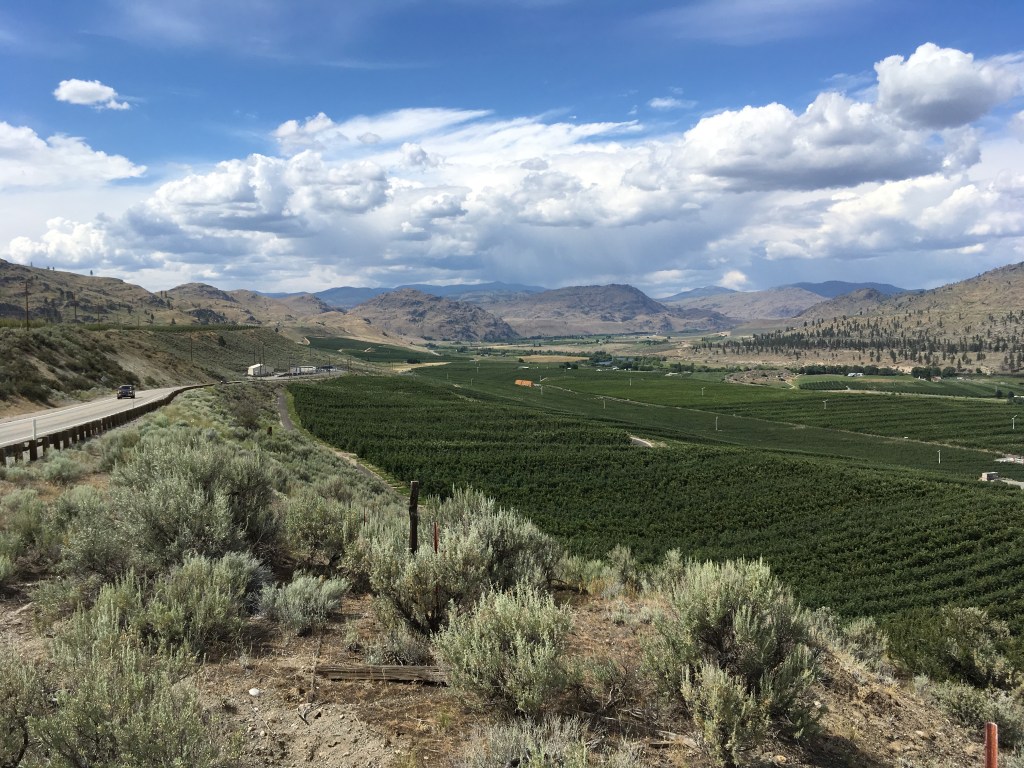
Approaching the valley, I had a choice. I could drive at river level along the delta where the modest Okanogan River is swallowed by the mighty Columbia. Or I could climb to Brewster Flat to get an overview of the valley as it stretches north toward Canada. I’ve long favored that elevated route even though the view northward is limited. Valley walls turn and bend, shaped by glaciers eons ago. Entering the valley from above feels something like approaching C.S. Lewis’s wardrobe with its mysterious portal into the unknown.

Sure enough, as I descended and drove along the valley floor, there was a significant difference — not in what I was seeing but in what I was feeling. For all those years of frequent trips to and from Seattle, I’d enter the valley after four or five hours of driving with a sense of relief. Home and rest were mere minutes away. This time it all looked familiar — the ribbon of river winding through orchards and pastures, cattle grazing with calves at their sides, sagebrush steppes with occasional pine trees forming valley walls. Yet it felt strange. Strangely familiar.

I was apprehensive. If I no longer officially resided here, did that mean I no longer belonged? 

I have long maintained that the state of Washington is really two states — of mind. We are divided — east from west — by the Cascade mountain range, often referred to as the “Cascade Curtain,” reminiscent of the Iron Curtain of the Cold War. I’ve lived on both sides of the divide. Economic, cultural, and political differences between east and west are sharp. Doesn’t matter which side of the mountains you’re on, you’re going to hear unfair stereotypes and prejudices against the other side.

The Okanogan is one of the more economically deprived regions of the state. Before I moved, I’d become accustomed to symbols of what my late husband described as a “thin soil economy.” Substandard houses, junked cars, abandoned marijuana farms. Now I was seeing them with fresh eyes. It was a slap in the face, even though I also drove past lovely ranches and residential developments. Rich or poor, people stubbornly thrive. Most wouldn’t trade their single-wide for all the high-rises in Seattle. It takes grit and heart to survive in the Okanogan. 

I needn’t have worried about belonging. The embraces and deep conversations with friends all weekend long assured me that even though it was no longer “home,” I can and will continue to return and connect. 

Back in Seattle, I opened the door to my apartment and was surprised to feel a rush of relief: that sense of “I’m home!” I told that to a wise friend who has never lost her Texas way of speaking. “Well, honey,” she started out. “That’s because your home is inside of you.” I recall another old parable that says pretty much the same thing. Home is where …

Driving north into the Okanogan Valley
Photo from my files taken in June 2019

A Few Steps to Compassion

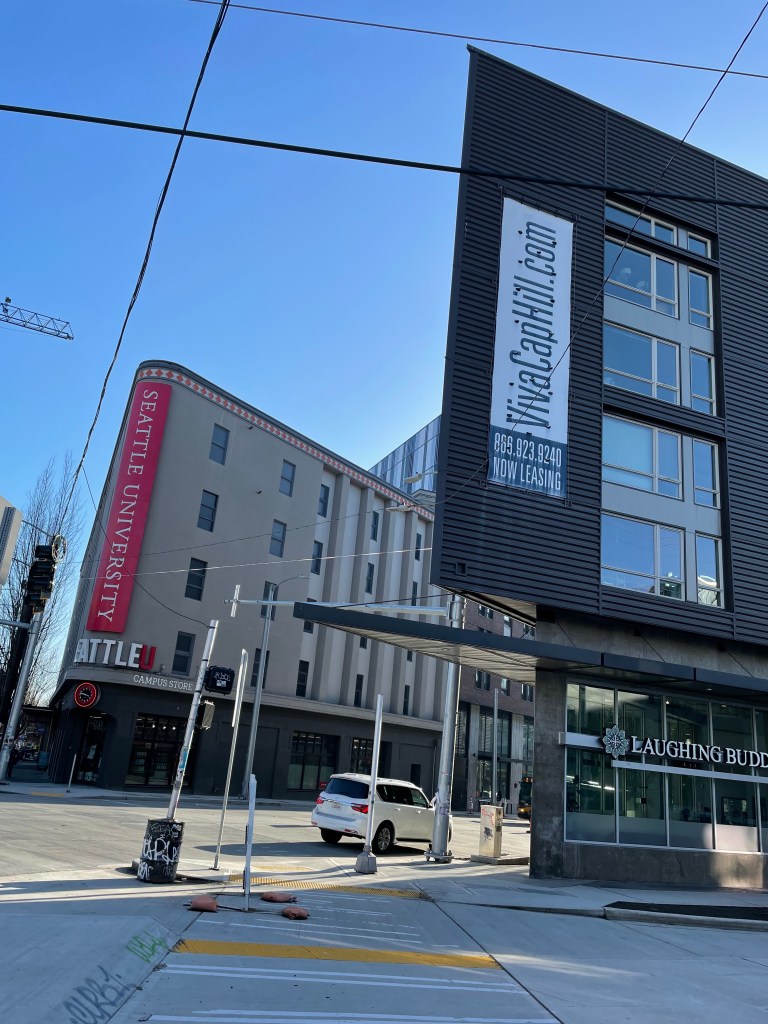
I stepped from the little neighborhood shoe shop on East Madison Street, breaking in my brand new pair of Brooks (well cushioned for walking). Maybe that’s why I took special notice of the shoes on the young person who was passed out on the sidewalk in the next block. 

The sidewalk slightly  narrows in that block, making room for venerable trees that are the legacy of an earlier, possibly more gracious generation. The narrower sidewalk makes it an inconvenient place for passing out. Inconvenient for other pedestrians, that is.

In downtown Seattle, where sidewalks are really wide, the pedestrian flow is uninterrupted by the occasional drugged body languishing on the concrete. There’s room for all, and for some it’s the only room available. Away from downtown on Madison, pedestrians had to sidestep to the curb, pausing to let oncoming walkers by. We almost needed a flagger, like at a highway construction site. We politely made room for each other, seemingly oblivious to the obstruction we were avoiding.

I remember the first time — in the early days of the fentanyl epidemic — I came upon someone passed out on the ground in broad daylight. It was in Omak, the small eastern Washington town that I moved from last year. I was on my daily walk with my dogs in the park along the river. When I saw the man sprawled out on the grass, I pulled out my phone and called 9-1-1. To call 9-1-1 these days, whether in that small town or this big city, would be a gesture of naiveté and probably futile.

Perhaps we pedestrians pretended to ignore the human obstruction because it would be unseemly to stop and stare at someone who is suffering a personal crisis in such a public way. Still, as I edged to the curb (my balance assured with those new shoes), I noticed a few things.

The individual was not supine but in a contorted position, halfway between sitting and curled. Gender and race were undetectable, but youth was apparent along with stylish clothing and shoes. The black shoes were of that exaggerated, clunky platform style with the highest of heels. I could imagine their wearer getting carefully dressed, preparing for a … well, high time.

A lot of people are afraid to walk in the city these days. I too am afraid. I’m afraid that I will become so accustomed to inert bodies on the sidewalk that I will stop seeing them. I fear that I will stop noticing their humanity, their individuality — expressed in small, simple ways, like a pair of shoes. I’m afraid I will stop feeling the deep sorrow in my heart, that I will cease breathing a silent prayer of compassion. Each and every time.

I have no insights, no magic one-size-fits-all policy to suggest as we confront the intertwined issues of poverty, drugs, mental illness and homelessness. But there is a way out of this snarled tangle of hopelessness. Once we rid ourselves of disgust, judgment and indifference, what remains for those of us who are still walking around is the power of love.

There was a fellow human being on that sidewalk who, just like me, desires a good pair of shoes.

Ups and Downs of Urban Hiking

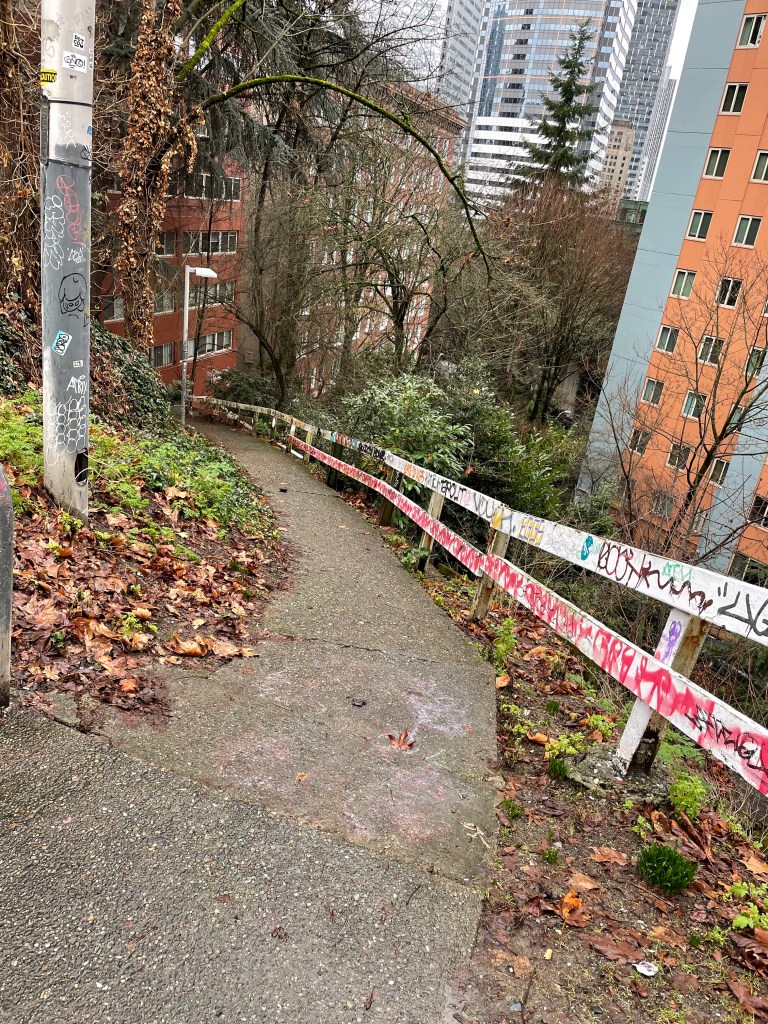
“Take the steps on your right,” GPS instructed via my phone. I looked at the steps with skepticism bordering on apprehension. They dissolved into a steeply declining, forested urban trail.

It should not have been a concern. I’ve hiked in the Glacier Peak and Pasayten wildernesses, the Cascade Crest Trail (parts thereof), and the coastal trail of Wales (parts thereof). I walk at least a couple miles daily. This time, though, I was on a scouting mission. A friend, who was planning to visit with her eighty-something mother, texted she’d found an Airbnb just a block from my apartment. I checked the address and thought, “Yeah, just a block as the crow flies, maybe.”

In Seattle, it can be difficult to get from Point A to Point B without circling via points Q through Z. Look at a map of Seattle’s core, and it has all the puzzling disjointedness of an Escher print. There are a couple of reasons for this. Seattle’s founders built on a series of hills, some quite steep. My roundtrip walk to the grocery store is only a mile, but no matter which route I take, it’s uphill both coming and going. 

The real confusion, though, evolved when three early developers couldn’t agree on which direction the streets should follow: north-and-south, as the compass would dictate, or northwest-to-southeast, following the Puget Sound shoreline. Each went his own way so that when streets ultimately meet, they zig or zag, sometimes even criss-cross. It’s not unusual for streets to intersect at an acute rather than the usual right angle. Seattle architects have excelled in designing buildings that come to a point.

As if all that weren’t sufficiently problematic, interstate freeway construction in the 1960s plowed through Seattle’s core, bisecting the city and blocking streets that long had been thoroughfares between neighborhoods. A “lid” over a small portion of the freeway affords some access via Freeway Park.  The retirement complex I live in abuts the park, but even pathways in the park wind and wander. As far as I can tell, GPS has yet to figure out those trails.

All of which led to my scouting venture. My friend’s Airbnb was indeed just a block from my apartment complex loading dock. Visitors are not welcome there. The front door is still another block beyond. Since visitors can’t go through the buildings, they pretty much reach the main entry via points Q and Z.

I’d put my friend’s Airbnb address into my phone as I exited my apartment building. GPS directed me along a side street to the top of the before-mentioned trail, where I found squalid remains of a campsite, apparently vacated by homeless persons. The trail was paved, but the wooden handrail was covered with graffiti and appeared less than sturdy.

I headed downward, gingerly stepping over broken glass, noting an abandoned grocery cart in the bushes. Bulbs were pushing up initial green spikes of spring flowers through last fall’s dead leaves. At some point, this must have been a lovely urban pathway. Now, I texted my friend, it was more of an urban jungle. 

“Hmmm, what do you mean an urban jungle?” she texted back. “Is it not safe?” 

“Back-alley aura,” I answered. 

My friend is a determined, undaunted world traveler. She found another route via a stable staircase. From there she cajoled her mother into climbing two blocks up a rigorously steep sidewalk. They could’ve driven, but with one-way and dead-end streets, multiple construction detours, and parking issues, it would’ve taken much longer.

Ah, wilderness. Right here in my urban backyard.

A Concert is More Than the Music

A free concert at Benaroya, Seattle’s premier performance venue. Knowing there’d be a crowd, my neighbor and I left plenty early for our walk to the event commemorating International Holocaust Remembrance Day (Jan. 27). We ended up with time to visit the Garden of Remembrance, which stretches along the west side of Benaroya.

More than eight thousand names of Washington State citizens who died in service to our country since 1941 are etched into the granite walls. Names include people who served in World War II, the Korean War, Vietnam, Gulf War and continuing through post-9/11. I immediately went to the Vietnam section and gently placed my fingertips on the name Keith Henrickson, a high school friend. It’s a gesture I’ve made before, first at the Vietnam memorial wall in Washington, D.C., and again when a traveling replica of that wall visited the Colville Indian Reservation, near my former home. 

I thought about how I’ve lived fifty-five years longer than Keith, who was killed at age twenty-four in Quang Tri province. Yet his name, etched in granite, is an enduring presence that will last long after I’m gone. His and all the other names are an ongoing witness to the tragedies of war. 

Scattered raindrops accented my somber mood as we left the garden and entered the hall. The concert was presented by Music of Remembrance, a nonprofit organization that addresses issues of human rights and social justice through music. As I read the program, I readied myself to shed tears. Many of the pieces were attributed to poets and composers who perished in Nazi concentration camps. 

I wondered about the quartet of pre- and teen siblings a couple rows ahead of me. Would they “get” it? They were jostling and elbowing each other in normal but disruptive ways. Their parents were seated like bookends with their offspring between. I hoped that Mom and Dad could/would keep the kids under control. Then, just as the lights were dimming, I heard the rustle of newcomers settling into the row directly behind us. I looked around to spot a young couple with two children, ages about three and one. 

I immediately flashed back to a free, noon organ concert that my late husband and I attended decades ago at the Mormon Tabernacle in Salt Lake City. The place was packed with tourists. The organist began with a brief welcome and firm direction: “If your child becomes disruptive or makes any kind of noise, do not hesitate to remove them immediately.” I don’t recall the organist’s name, but I have silently evoked his instruction whenever concerts get disrupted by crying or rambunctious children.

The audience dropped into silence for the opening “Intermezzo for Strings,” a floating, ethereal piece performed by The University of Washington Chamber Orchestra. The Jewish composer, Franz Schreker, had been forced from his position as director of an important music conservatory. But he cheated the Nazis out of killing him by dying after a stroke in 1933. 

The program continued, the youngsters in front of me quietly absorbed, the baby behind uttering only an occasional coo that was quickly muffled by her mother. About halfway through came a duet for violin and cello by Gideon Klein, a brilliant musicology student who died in the Fürstengrube camp at age twenty-two. The mournful, longing music ends suddenly mid-phrase, as did Klein’s incomplete life. In the silence that followed, before the audience could gather itself to applaud, the baby let out an anguished wail. Her cry said far more than our applause. Nonetheless, Mom gathered her up and exited the hall.

She missed the grand finale, “Farewell, Auschwitz,” a defiantly jubilant piece commissioned by Music of Remembrance. It was performed by The Seattle Girls Choir and Northwest Boychoir, along with instrumentalists and adult soloists. I was heartened by the discipline and beauty of the young voices. They were learning in a powerful way about an historical truth that too many try to deny.

Upon leaving the hall, I spotted Mom and baby seated on a bench. I perched next to them, the baby giving me a bouncing grin as I told her mom, “I’m sorry you had to miss the end of the concert. She was so good for so long, and I’m glad you brought her. She has that music embedded in her soul now.” Just as I finished speaking, another woman approached.

“Good for you for bringing the children to the concert,” she said. “They’re never too young.” 

Never too young — nor too old — to learn, to change, to grow, to remember.