Featured

Savor

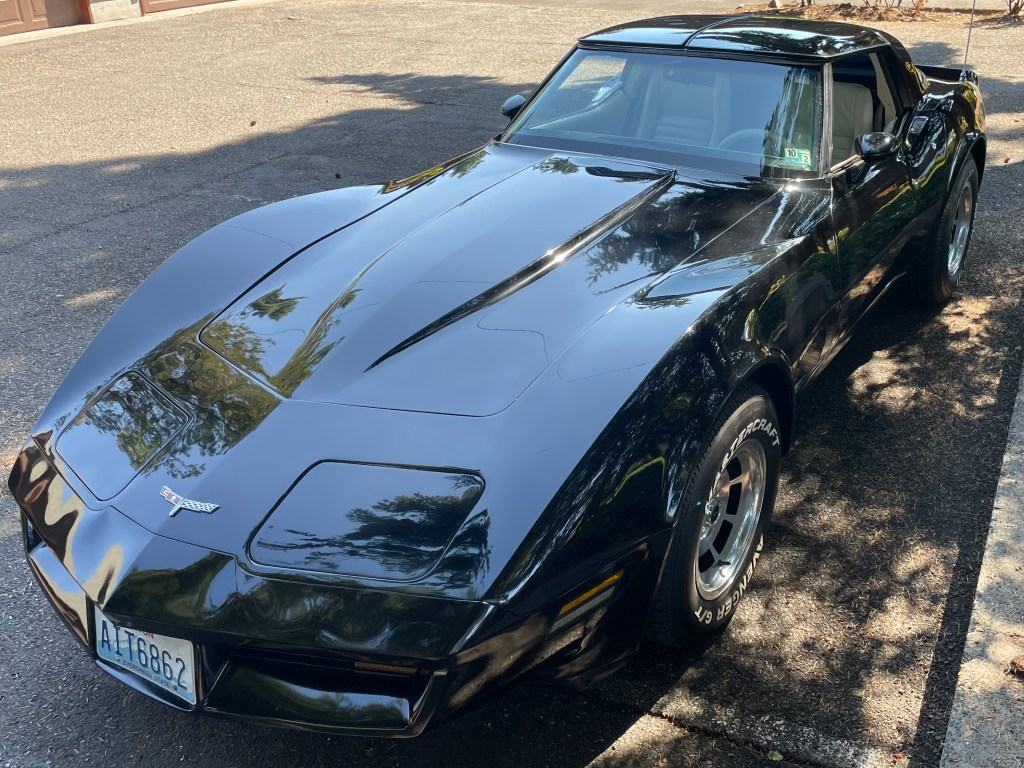
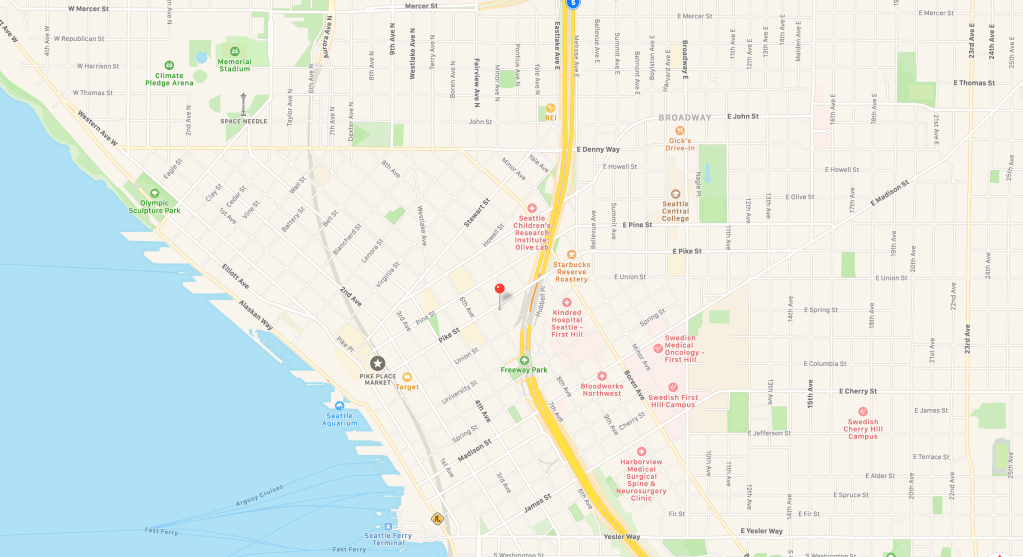
Let’s call it pro-active aging: making the big decisions for ourselves before the inevitability of time and age compel others to make them for us. It’s why I’m selling my car, my home, most of my possessions, and moving 250 miles to Horizon House, a retirement community in the heart of Seattle.

It’s a “Continuing Care Retirement Community” or CCRC. There are about 1,900 CCRCs nationwide, says AARP, offering “a long-term care option for older people who want to stay in the same place through different phases of the aging process.”

At seventy-nine, I consider myself barely into Phase One of “the aging process.” This is a pretty typical age for moving into a CCRC, I’m told. Residents are still young and agile enough to enjoy the long list of amenities: gym and swimming pool, hobby and entertainment rooms, library, special events, lectures, etc. I’ll be able to walk to theaters, restaurants, museums. Routine health services are provided in-house. Nearby are several of Seattle’s primary health care facilities. No more overnight, 200-mile round trips from my rural home for ordinary procedures like cataract surgery. 

I’ll reduce my carbon footprint as I turn to public transportation and squeeze into 340 square feet of a studio apartment. Is this easy? Absolutely not. Is it an adventure? Absolutely.

Not everyone around my age or in my situation would choose the same. I hope all of us, as we age, are given the freedom and dignity to make our own choices. Sharing this decision with friends and neighbors has been the toughest part. Most agree it’s a good choice, but they (and I) lament my soon-to-be absence from the Okanogan Valley, my home for more than half my life.

Tawny, a people-loving pooch, and I must part ways as we each set off on our next adventure

I’ll leave behind people I admire and cherish. I’ll leave behind the Okanogan River, which every day inspires me with its steady flow and diverse wildlife. I also must leave behind Tawny, my eight-year-old rescue dog of many breeds. He’s a charmer who deserves better than confinement in a high-rise city apartment — even if he were allowed there, which he’s not.

Still, it is possible to thrive in a season of transition. With only a few months left here, my default mode is to savor. First thing in the morning, I step outside to savor river-scented air and murmuring ducks. At bedtime I step out again to say goodnight to a waxing moon and its reflected path across the glassy water. 

I savor each and every encounter with friends. A quick “hi” in the post office lobby. A meandering conversation over a game of cards. Deep discussion during a three-hour lunch at the Mexican restaurant while the waiter patiently, continually refreshes our coffee.

I savor all the ordinary, everydayness of small-town living, like making an early Sunday morning run to the grocery store, where the only other soul is the owner, who rings up my forgotten carton of milk. 

I savor the thought of another new season in my life while maintaining the illusion that I’m in charge of me. I’m sure there’ll be sunny days and a few gloomy hours to come. I intend to share those joys and sorrows, and so, dear reader, please savor this adventure with me.

RITES OF PASSAGE: They Come at Any Age

Cataract surgery, it seems, is a rite of passage required with age. Kinda like a similar rite of passage that often occurs in adolescence — braces on the teeth. Up to 75 percent of people could benefit from orthodontic treatment, claims the American Association of Orthodontics. Nearly everyone ultimately requires cataract surgery, says the National Institutes of Health.

Me with the pre-orthodontic tooth gap

Both involve a degree of discomfort: an orthodontist cranking away in your mouth or a surgeon poking into your eyeball. We undergo such rites expecting a brighter smile in the first instance and clearer vision in the second. Sixty-six years later, I’m still grateful to my parents for financing the process that eliminated a wide gap between my front two teeth.

Given modern anesthetics, discomfort from the eye surgery comes more from thinking about it than actually undergoing it. “Piece of cake,” was the most common description I heard from cataract veterans when I mentioned my upcoming procedure. 

Because my local hospital doesn’t offer the service, travel logistics — 200 miles round trip and overnight lodging — were more complex than the surgery itself, which can best be described as a medical assembly line. Cataract extraction is the most prevalent surgical procedure of all medical specialties in our country, says the NIH.

What happens if you don’t get your cataracts removed? Pretty much, you go blind. The NIH reports that globally, the number of people blind from cataracts is increasing by approximately one million per year. The number of people who qualify for cataract surgery is increasing by four to five million per year. Knowing that, I had no complaints about landing in the assembly line.

For my surgery day, the clinic required that I be accompanied by a “responsible adult.” A friend volunteered and was given a tag with my patient number. She could sit in the waiting room and keep track of me remotely. Patient numbers flashing on a large screen show who’s in pre-op, operating, or post-op. We chose for my friend to accompany me during the pre-op portion, which occurs in a banquet-sized room where gurneys are scattered about with minimal privacy. Nurses roam the room, hooking folks up to the vital tubes and instruments, each time affirming name, date of birth, and which eye was being operated on. Ultimately the surgeon stopped by to place a mark above my left eye — the one that had become especially blurry.

I have no idea what went on during surgery, other than awareness of a brilliant kaleidoscope of color. Finally, I felt adhesive tape being pulled off my face — the only real ouch of the morning. In post-op, the nurse offered coffee, tea or juice. I opted for coffee, since I’d been required to bypass my usual wake-up java. It was the best/worst cup of coffee ever.

Some two hours after we’d entered the clinic, a nurse was pushing me in a wheelchair to the exit. In the elevator she chatted with another nurse, who was also wheeling an outgoing patient.

“What’re you doing today?” asked the other nurse.

“Cataracts,” was the reply.

“Oh, today?”

“Every day is cataract day,” answered my nurse.

Sure enough, because Creator doubly blessed us, I get to do it all over again in two weeks. Maybe not a rite of passage. Next time the right of passage.

NEIGHBORS ARE THE FOLKS WHO SHOW UP – Even For False Alarms

Floating the Okanogan River on a hot summer day. What could possibly go wrong?

You know you live in a safe neighborhood when your car alarm goes off and your neighbors come running, fully armed — with cell phones, all Googling variations of “shut off car alarm.”

It’d been a quiet afternoon in my relatively crime-free neighborhood. I’d gone out to the carport, key in hand, and was about five feet from the driver’s door when the car threw a hissy-fit. Locking itself down tight, it refused to acknowledge any commands I entered on the keypad, ignored all the neighbors’ Google-advised maneuvers, and trumpeted an ear-splitting tirade. 

Every once in a while, the car would wear itself out, like a child throwing a temper tantrum who finally has to stop and gasp for breath. My neighborhood consortium would consult in whispers. Then someone would try to turn a key or open a door, and BLA-A-A-T!, the horn would start again.

Google provided the final diagnosis: my car was “brain” dead, in a self-imposed coma. The solution was like rebooting your computer. Simply disconnect, then reconnect, the battery. 

Google this: who were the nincompoop engineers who designed my Dodge Journey so that you have to remove the front left tire just to get to the battery? Ultimately my mechanic graciously made a house call, removed tire and battery, recharged the latter, put it all together again, and peace reigned in my neighborhood.

Until last week. 

People floating, swimming, and wading in the river that runs past my house are a common sight on these hot days. But it was nearly 9 p.m. with only remnants of daylight left when I spotted three youngsters in the river. In most places at this time of year, the water is shallow enough so that people who can’t swim “ride” the current. Their toes briefly bounce off the bottom, the current pulls them for a few yards, and then they bounce again. Bounce. Float. Bounce. Float. The children had already bounced/floated past my house when I spotted them.

This lazy, shallow river is deceptive. It has an insistent current and an inconsistent bottom. You can happily wade in the shallows and suddenly you’re in over your head. People drown in this river.

The youngsters (about twelve, ten, and eight years old, I’m guessing) had no flotation devices and no adults in view.  The current was carrying them into the river bend, where the water would be too deep for the youngest especially. I grabbed my car keys and ran outside. My neighbors were buttoning up their evening’s yard work.

“I’m worried about some kids in the river!” I called. As I pulled out of my carport, a neighbor jumped into the passenger seat. I drove the one block to a spot where we’d be able to access the dike. The neighbor reached into his pocket.

“I’ll leave my phone here,” he said, certain that he’d be getting wet. I held onto my phone, ready to dial 9-1-1. We ran to the top of the dike and spotted the kids. In the mere minute it’d taken us to get there, they’d somehow made it across the current into shallow water on the other side. The eldest was holding her hands aloft in a triumphant gesture. From there they’d be able to clamber up the bank and, I hoped, head home.

I apologized to my neighbor for yet again issuing a false alarm. He shook his head. He’s an experienced fisherman who grew up along this river. “These currents can be tricky,” he said.

A long time ago a wise man was asked, “Who is my neighbor?” Two thousand years later, whether you’re a Bible reader or not, you understand the meaning of “good Samaritans.” They still exist, they show up, and more than likely, they carry a cell phone.

Close Encounters with the Fourth Grade

I stepped on the brake, did a u-turn in a vacant parking lot and drove back the way I’d come. Who wouldn’t stop at a kid’s lemonade stand on a hot July day?

In truth, I wasn’t certain it was a lemonade stand. I’d been on a quick errand, driving south out of town when I spotted the youngster playing tug-of-war with persistent wind gusts as he struggled to erect a shade umbrella. A few minutes later, errand completed, I was driving back home when I again spotted the kid. He’d given up on the umbrella and was grappling a large, hand-printed sign that threatened to fly off with the wind. 

I couldn’t read the sign, but I had to turn back. Maybe he was selling huckleberries — hope springs eternal. Or any kind of berry. Or cherry. As I walked toward his table, he pulled a gallon of pink lemonade from his cooler. Oh, well.

Before I could even express interest, he was pouring me a glass. 

“How much is it?” I asked. He didn’t hand me the glass but put it on the table and pointedly shoved it in my direction.

“Free,” he responded. 

“Why are you giving away lemonade?”

“Sumthin’ to do.”

As I sipped, he reached into his cooler to pull out a tall bottle of Coca Cola. He took a swig, and I couldn’t help myself. 

“Why are you drinking Coke when you have all this lemonade?” Dumb adult question that got the answer it warranted. He shrugged.

Probing further, I learned that his name was Wyatt, his grandmother had made the lemonade, he’ll go into the fourth grade next year, he knows who his teacher will be but has no opinion whether he’ll like her. About this time, a man walked up.

“How much for a glass?” he asked.

“Free.”

“How’re you gonna make money that way?”

In a rebuke to capitalism, Wyatt poured another glass of lemonade. The man turned to me and said, “Hi, Mary.” I looked at him questioningly with only the merest inkling of recognition. He grinned, told me his name, and I realized I hadn’t seen him for at least a dozen years, when he’d done some work on my old house. As we chatted, Wyatt disappeared into the adjacent shop — apparently headquarters for his enterprise. He returned with a pickle jar bearing the sign, “TIPS.” It was suggestively seeded with dollar bills. The man and I both stuffed in more folding money. Long gone are the days of ten-cent lemonade stands.

The man left, and I continued my inquisition.

“Tomorrow’s the Fourth!” I declared in that bright, patronizing adult tone that must make kids want to flee for their lives. “Do you have fireworks?” I persisted.

“I have three mortars,” he declared, barely concealing his pride. In a burst of loquaciousness he added: “We’re going to the park.”

In this dry valley of sagebrush and highly flammable grasses, folks eagerly patronize the fireworks stands and then — in deference to the wildfire danger — bring the explosives to our large city park on the Colville Indian Reservation. The city obliges by having ambulance and fire truck at the ready as well as putting out dozens of empty oil barrels for the resulting trash. Around nightfall the skyline erupts with utterly spontaneous, un-choreographed bursts of color and noise that continue until midnight or so. Insanely entertaining.

“I live across the river from the park,” I told Wyatt. “I’ll watch for your mortars.”

He nodded solemnly, my attempt at humor unnoticed. When I drove away, he did what I least expected from a shy, about-to-be fourth grader. He waved.

Miles To Go

I just bought four new “premium” all-weather tires, on sale, guaranteed for 80,000 miles. Seemed like a good idea at the time. Back home, breathing fresh air instead of brain-stifling tire store fumes, I did the numbers. I’m about to celebrate my seventy-ninth birthday. I drive a fourteen-year-old car with 111,000 miles on the odometer. I calculate I’ll be eighty-nine or older before I need new tires again — assuming my car and I are both still functioning — a lot to assume. Not to mention, electric vehicles will probably own the road by then.

But this is not a question of life expectancy, either mine or the car’s. The National Institutes of Health says that only twenty-two percent of women over age eighty-five are still driving. (Fifty-five percent of men — let’s just set aside the obvious conclusion that women come to their senses sooner than men.) Drivers over age sixty-five are three times more likely to get into an accident than middle-age drivers per mile driven, and — take a breath — three times more likely to die from a car crash. We older folks are simply more vulnerable.

Exiting the driver’s seat is, for a lot of folks, as traumatic as death itself. My dad, a Lutheran pastor, was one of the most patient, kind, good-humored, compassionate people ever to walk God’s green earth. Thus I gasped when he — well into his eighties — referred to a driver licensing examiner as “that Nazi!” Despite his several physical infirmities, Dad waged an ongoing battle with the Department of Licensing to renew his license. I don’t know if it was Divine Intervention or just weariness on the part of DOL bureaucrats — they finally gave him a provisional license, allowing him to drive a prescribed route between home and church, nowhere else.

Mother, on the other hand, quit voluntarily. Well, kinda. It was after she totaled her car. She was driving home from visiting Dad’s grave one quiet morning when she blew a stop sign and crashed into another car in the intersection. No one was injured, but it was clearly her fault. For the next couple days, she followed her usual course when she had a Big Decision to make: she prayed, then wrote out a pro/con list. Finally, she called her grown children, confessed her sad story and sadder decision. The administrator of the retirement community where she lived thanked her effusively. He hated having to demand that a resident hand over their car keys. I eventually asked her if she missed driving. “All the time,” she sighed. 

Last week a friend told me she’d been diagnosed with dementia. “Of course, I quit driving immediately,” she added. We talked about her cherished pickup truck, which is more than a mere vehicle. The truck, itself older than most drivers on the road today, was her partner in decades of adventure. “I bet you wish you could be buried in it,” I said. She chuckled and agreed.

I have long promised myself that I’ll make the choice to quit driving well before some poor family member is tasked with wrestling the keys from my grip. My current license will expire on my seventy-ninth birthday. I have an appointment to get it renewed next week. Most drivers can do that online, but in this state, you have to show up in person if you’re over seventy.

Quoting Robert Frost, “I have miles to go before I sleep,” but probably not 80,000.

Beyond Urban Energy

Late at night, lost in the cavernous and empty Seattle Convention Center parking garage, I realized the truth of an old adage: You can’t go home again. This was a while ago, before we had smart phones to tell us where we’d left our cars. Even when I finally located the car, I couldn’t find an exit that wasn’t blocked by an unyielding mechanical gate. 

Seattle once was MY city, where I’d studied, worked, romanced, played, and prayed. Except I never lived within Seattle city limits but on Vashon Island, which was then an affordable fifteen-minute ferry ride across Puget Sound. My life style would be impossible today. It was the ’70s, before Microsoft and Amazon. I owned a ramshackle house with a grandiose view of the sound, both Olympic and Cascade mountain ranges, and the Seattle skyline. I’d walk to the ferry and commute to class or job or whatever.

My nostalgia was provoked this week by the opening of a new, two billion dollar Seattle convention center. It’s pretty much next door to the “old” center, which opened in 1988, was doubled in size by 2001, and will continue to operate. The hope is that new center will reverse the dismaying decline of the downtown core. Its event and meeting spaces equal ten football fields. That doesn’t include the public parking garage, into which I surely won’t venture. I never figured out the old one.

Navigation aid: J-C-M-S-U-P

I once was a master of Seattle navigation, knew the back streets, shortcuts, escape routes. I learned from one of the best. As an Associated Press editor, I rode along with an AP photographer who I swear invented alleys and byways that didn’t exist for regular drivers.

Even though I was working for the world’s largest news gathering organization, I didn’t want to go anywhere else in the world. I turned down any and all promotions that would require moving. I smiled as I read reports from along the Iditarod trail, written by a colleague who accepted the job in Alaska that I’d declined. Didn’t matter that I was working the crummy overnight shift in Seattle. I could watch the Space Needle’s glittering lights through the office window.

Slowly, though, the idyll was fading. Commuting, even by ferry, was becoming unreasonable as gridlock strangled the city. Eventually I got an offer I couldn’t refuse. It came from the owner of a weekly newspaper in a gritty little eastern Washington town. He was striving for five thousand paid circulation and figured I could help get him there. It was a package deal: a significant cut in pay, a marriage proposal, and a pledge that we’d visit Seattle monthly for my vital infusion of urban energy — theaters, restaurants, and salt air.

In 1994 we dallied for four months in the city following my husband’s paralyzing stroke. John was a rehab patient at the University of Washington Medical Center. I lived in an aging residential hotel on Capitol Hill, cheering him on, terrified of the future, seeking solace in all that urban energy.

Even after John’s death in 2007, I’ve surprised myself by returning to Seattle only rarely. Certain landmarks are still there. No one’s going to move Mount Rainier. They did move the bus depot without telling me.  A couple years ago, thinking about that gridlock, I parked my car in Wenatchee and rode the bus the remaining hundred and fifty miles to Seattle. I was stunned to disembark in a strange area on a rainy night, multiple blocks from the hotel that I’d thought would be just a short walk away.

My long-ago favorite restaurants, hotels, hangouts are either boarded up or replaced with something weirdly nouveau, gleaming towers, and that new convention center. Still unchanged are the names of downtown’s strangely angled streets, laid out — so the story goes — by a couple of drunken city founders. To navigate the grid, one is advised to memorize an irreverent rhyme using something of a stutter: “Jesus Christ Made Seattle Under Protest” (Jefferson, James, Cherry, Columbia, Marion, Madison, Spring, Seneca, University, Union, Pike, Pine). 

It’s unsettling to be a tourist in a place that once was yours. Unsettling and yet okay. The nouveau may be better, maybe not. The future will figure it out. I no longer require doses of urban energy. I fill up each morning with the silence of my neighbor — a slow-flowing river — and the occasional quack of a duck, chirp of a bird. It’s all the energy I require.

A Tale of Two Christmases

Yesterday (January 5) was Twelfth Night, in olden days recognized as the final day in the Christmas season. Ignored by most people now, Twelfth Night may have a ring of Shakespearean familiarity. It is the occasion for which his comedy of that name was meant to entertain.

I still cling to a Twelfth Night observation. Otherwise, it seems as if we catapult our way from Christmas to New Year’s, landing with a thud on January 2. The party is over. We’re befuddled by the new year’s reality, which feels an awful lot like the old year’s. 

Twelfth Night offers a more gentle landing, like reading a good book, coming to the end and closing the cover with a satisfied pat. It’s a lovely day for lighting candles one more time, listening to carols before tucking them away for another year, packing up decorations, and reflecting on lingering joy. I celebrated this year by lunching with two friends who described their Christmases.

“I boycotted Christmas,” announced Friend No. 1. So much for my gentle landing. She sounded both defiant and liberated. And really, if I’d had a December like  hers, I would’ve boycotted not only Christmas but the entire world. She had demands for year-end reports piling high on her desk when (a) both of the family’s two cars quit running, which maybe wasn’t that big a problem because (b) two family members were stuck at home with Covid, which was anxiety-producing because (c) this year’s especially heavy snow load has resulted in their home’s cracked ceiling.

Because they have offspring, my friend’s boycott was not total. There was a small tree and gifts. Otherwise, she advised extended family and friends that there’d be no packages or cards in the mail, no cookies in the oven.

And then there was Friend No. 2, who began by listing her Christmas dinner guests. They were a variety of ages, religious backgrounds, interests, etc., with one thing in common — they all would have been alone for Christmas dinner. (May I digress: there’s nothing wrong with peaceful solitude on Christmas if you enjoy it, and I do, but that’s another story.) 

Friend No. 2 admitted she was two hours behind schedule getting her guests seated at the table. The meal was delayed by numerous side dishes. I’m not talking about the mashed potatoes, vegetables, salads, etc. Her side dishes were plates of food she and her guests delivered to folks who couldn’t make it to her house for various reasons. I would have found the combination of guests in my home AND deliveries a hair-pulling logistical challenge. She  made it sound as if it’d been no more complicated than buttering toast. She adopted just the right tone of humility, telling us everyone proclaimed her meal delicious.

After our luncheon, I considered the many ways people celebrate Christmas, including — maybe especially — the self-proclaimed “boycotter.” Her day job involves helping people solve problems that are too often unsolvable. She’s overworked, underpaid, under-appreciated and above all, compassionate. Boycott Christmas? Nah, she observes Christmas — the REAL Christmas — every day of the year.

A Light in the Dark

I learned a new-to-me Christmas carol this year. Or maybe it’s a Hanukkah or Solstice carol. It’s pretty universal.

For the first time since Covid, I was back to narrating the annual Christmas recital for a music teacher friend. Every year she writes a story based on the various pieces her students will perform. I read the story — with a modicum of dramatic effect.

I was feeling the holiday spirit as I drove the thirty-miles up our snow-blanketed valley to her studio. Echoing one of my favorite carols, “In the Deep Midwinter,” there was “snow on snow on snow.” The hills and mountains shimmered with whiteness under thin ribbons of blue sky, like remnants of some extravagant gift-wrap.

It was nearly dark when I entered the studio with its two grand pianos nestled into each others’ curves. The audience waited with a hushed, almost reverent expectancy. As a long-ago music teacher I can tell you with authority, the primary element in any student recital is not music, but courage. Every student has practiced hard and long, conquering the challenge of memorization, playing the piece just once more before leaving home, praying to be spared public humiliation.

My friend teaches students of all ages, and I’ve always assumed that adult students must feel especially nervous. They have, after all, their dignity at stake. The first performer allayed that assumption. I don’t know her age but I’m pretty sure she — like me — will never see seventy again. In a brief post-recital chat she acknowledged she’d taken a fifty-five year hiatus from piano lessons. She nevertheless approached the Yamaha unflinchingly, methodically exchanged her bifocals or trifocals for her music-reading glasses (a ritual with which I’m VERY familiar), and played a simple Chopin waltz with adult authority.

When it was the youngest student’s turn, the tiny girl in a ruffled dress was gently nudged forward by her mother. The teacher escorted her to the piano with a whispered reminder, “Say it aloud.”

Starting from the lowest end of the keyboard, the child played a rhythmic counterpoint, two black keys with one hand, the white key between them with the other, while chanting: “D’s in the MID-dle of TWO— BLACK— KEYS.” Then up an octave: “D’s in the MID-dle of TWO— BLACK— KEYS.” Up and up, octave by octave, all seven of them, until she reached the clanging high notes at the top, and then … all the way back down. She ended to thunderous applause. I felt as if we’d scaled Everest and back. What a great way to teach navigation of the keyboard: look for the two black keys and D will always be in the middle. A surefire compass for beginners.

I drove home under a moonless night sky, way slower than the speed limit, peering into the darkness beyond my headlights, watching for deer who frequent this stretch of highway. I was willing my memory to replay Vince Guaraldi’s “Christmas Time Is Here” from “A Charlie Brown Christmas.” A young man had performed it admirably, melting my heart. But a persistent ear worm blocked it. I kept hearing, “D’s in the MID-dle of TWO— BLACK— KEYS.”

Of course. That’s what this time of year is all about. We stare directly into the darkness — the black keys — and we find the light. On that very Sunday, Christians were lighting the fourth candle on their Advent wreaths, Jews were lighting the first Menorah candle of Hanukkah, and tonight — winter solstice — people will repeat an ancient tradition, defying the darkest night of the year by lighting brilliant bonfires.

“D’s in the MID-dle of TWO— BLACK— KEYS.” Or as the writer of the Gospel of John said — a bit more poetically: “The light shines in the darkness, and the darkness has not overcome it.”

(Image thanks to pixabay.com.)

What Goes Around

I’m down for the count, if someone could just figure out what the count is. I’m on Day Eight of whatever-is-going-around. A friend told me another friend told her this stuff hangs on for twelve days. Great. The Twelve Days of Crudness.

“On the first day of Crudness, my true love brought to me, a carton of nose tissues!” On the second day, two bottles of cough syrup. Third day, three gallons of chicken soup. No, wait! Adding insult to injury, while I was slurping chicken soup an upper left molar cracked and crumbled. The dentist’s office asked if I was taking anything for the pain. The stupid tooth is the only part of my body that DOESN’T hurt, I answered. They’ll try to get me in before Christmas.

Whatever is bugging so many of us is apparently a multiplicity of infectiousness. I’m fully boosted against Covid and consistently test negative. I got my flu shot. Still I wheeze and sneeze. My cough sounds like a Washington State ferry signaling distress. I have no fever, yet no energy and even less motivation. Further assaulting my otherwise cheerful facade was a headline in the Washington Post: “How a viral siege is making some people sick for weeks, even months.”

The article lists all the stuff that’s going around: “Parainfluenza, respiratory syncytial virus, rhinovirus, adenovirus, influenza A and influenza B. Respiratory enterovirus and human metapneumovirus, too. And then, there’s the rebounding coronavirus …”

I’d been feeling particularly sorry for myself because this is the second time this year I’ve been flattened by an extreme version of what we used to call the “common cold.” But the article cites a CDC determination that normal adults can hit the mat two or three times a year and still be considered healthy overall.

Enough of my wheezy whining. For me this has been an uncomfortable inconvenience. For too many it’s deadly serious. Yesterday the daughter of a dear friend called to tell me her mom is under hospice care, deeply sedated, death imminent. She wanted me to know in advance so I could be “with” her mom in these final hours, even though I’m a hundred and fifty miles away.

Life on the edge of thin ice

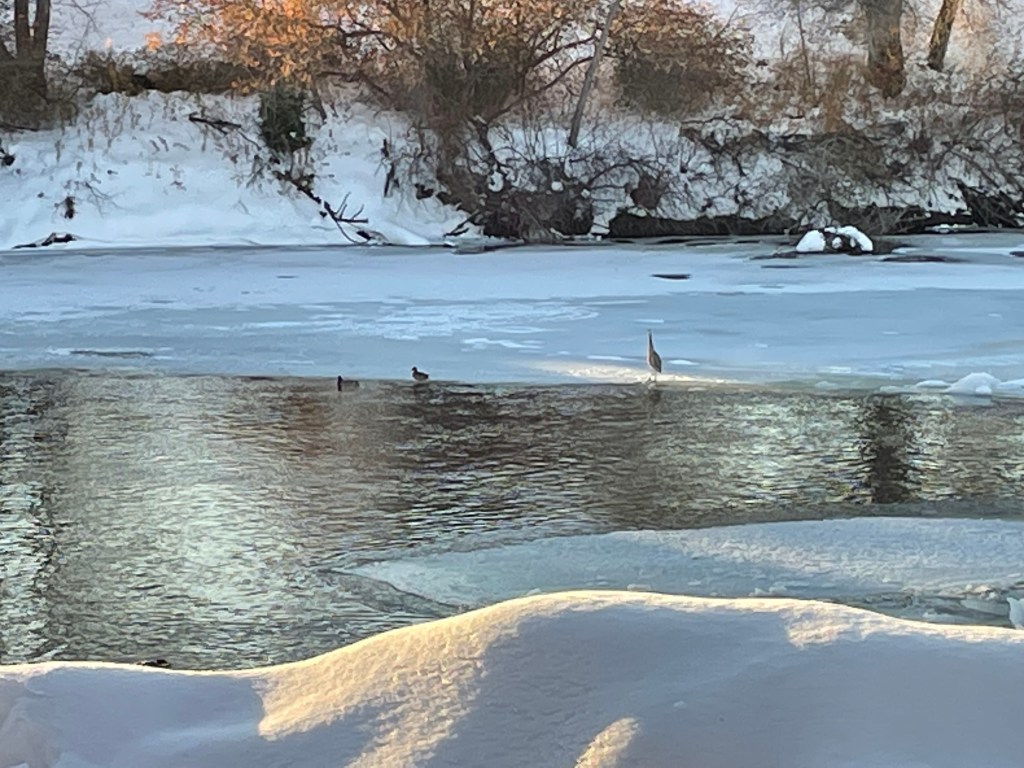
In truth her mom is with me. She was a frequent visitor for many years, especially during the holidays, exuberant over being here by the river. With her in my heart, I’ve been watching the spectacle of life and drama of death that unfolds especially now with the river partially shielded under ice. 

Ducks and geese — those sometime swimmers and frequent flyers — land for a while, drift a bit, then lift off, first one or two at a time, finally an entire flock swooping skyward, the ducks’ wings beating frantically, geese honking their irritation (or maybe exasperation?), only to return again minutes or hours later. Their reasons for leaving or returning are known only to them.

Two river otters scamper across the ice before sliding into open water; wild turkeys step gingerly along the brink as if wondering why they’re there; a lone great blue heron stands regally, stretching its elegant neck. 

At one point, a Canada goose isolated itself on the large shelf of ice, settled down, and died. I was depressed, thinking I’d be distracted by the sight of its corpse for some time to come. Then a bald eagle arrived and made quick work of the cleanup. Nature’s own undertaking.

Life is brutal, and it’s beautiful. Pain amidst pleasure, loss after loss, yet ever flowing. Goodbye for now, my dear one. No one ever lived life more fully than you.

Winter’s Here: Time for Inaction

A storm is brewing, possibly a foot of new snow, we’re told. After a lifetime of confronting winter’s challenges, I still love it, but in a different way.

I can’t predict the weather, but I can predict what will happen when it snows. The city snowplow will begin its rounds at o’dark in the morning. Snug under the covers, I will awaken to the scrape and rattle of plow on my street, knowing what will greet me when I get up. In addition to the beauty of a crystal white blanket as far as the eye can see, there’ll be a plow-created berm of snow and ice blocking the end of my driveway. 

Not a real recent photo, but a celebration of snow

There’s a reason I live in a four-season environment. Winter feeds my soul as it nurtures the earth beneath our feet. Since childhood I’ve viewed snow as an opportunity for play, from building snow people to skiing down mountain slopes. Even the task of moving snow from an inconvenient place to somewhere out of the way made me a happy warrior. I would don layers of clothing, woolen hats, scarves, and mittens, and fire up the snowblower.

My trusty little snowblower had an electric starter, but I took macho pride in setting the choke, pulling the cord and thrilling to the roar of its instantaneous response. I relished guiding clouds of snow onto ever-higher banks lining the driveway. It was so much fun, I cleared not only the driveway but sidewalks, parking space along the street, and the broad concrete patio on the river side of my house. 

Things change. Just as we cannot deny our reality of climate change bringing wetter, heavier snow, I cannot deny my reality of osteoporosis, resulting in a series of spinal compression fractures. My snow removing days are done. Reluctantly, I gave the blower away last fall, removing temptation. The glacial berms were impenetrable for the little machine anyway, and there are safer ways for me to exercise.

The early snow storm a few weeks ago resulted in a solid berm that kept me housebound for a couple days. I’m within walking distance of grocery store, library, post office, and yarn shop, but the daily cycle of melting and refreezing made walking too treacherous. I was perfectly comfortable in a warm house with well-stocked kitchen. Only the dog gets cabin fever. 

We were ultimately liberated with the help of attentive neighbors and my yard guy. I hadn’t even tried to call the commercial snow removers. I’m told they were so besieged they quit answering their phones.

It’s about to happen all over again. I used to prepare for snowstorms with an action plan, and I still do. My action was a voicemail message to the yard guy, who will show up eventually, probably later than sooner. I’m settling in like at the theater, waiting for the drama to unfold.

I’m content. It’s the first week of Advent, my favorite liturgical season, a time of anticipation and preparation. In my younger years the preparation was external, now it’s internal. I’m learning that life is amply rich when we do less and be more.

Henry David Thoreau wrote about times when he “could not afford to sacrifice the bloom of the present moment to any work, whether of head or hands.” He described endless hours of simply sitting, time not wasted, hours not “subtracted from my life, but so much over and above my usual allowance.” 

Need more time, a longer day? Let it snow, and then let it be.