
A friend in her early nineties is moving into an assisted living apartment this week. Nothing unusual about that, except: unlike most of us, in her long life she has never before moved. When she was born, her parents brought her home from the hospital, and she never left. She continued to live in her parental abode after her siblings moved away and her parents died.
It’s not that she’s a shrinking violet. Creative and talented, she had a good career, is loved by friends and families, still socially active. But this business of never moving makes her exceptional. The U.S Census Bureau says the average American moves eleven times in their life. Every year, 14 percent of the population is on the move.
We move because we get a better job, we want a nicer apartment, we need a larger house — and then after a few decades, a smaller one. With each move, we’re anticipating something better. Despite the upheaval, we’re excited and happy. Until that last move, the one that says we can’t live independently any longer. You’d think my friend would be devastated, leaving the only home she’s ever known. But she’s approaching it with her characteristic combination of practicality and grace.
Just think of the moving adventures she has missed all these years: the scrounging for cardboard boxes in which to stuff your stuff, the trauma of deciding what stuff to go and what stuff to throw, the renting of the U-Haul, the drafting of friends to tote that carton, lift that sofa!
I’m above average, having moved fourteen times. Most of my moves have involved an extra element of adventure: a quarter-ton behemoth, my piano. Anyone who’s ever owned a piano has piano-moving horror stories. My worst experience involved a lovely man, with whom I was romantically involved, and three other fellows who hadn’t been able to come up with credible excuses when asked to help.
The four were jockeying the piano through the front door, my guy in the lead, when somehow they knocked the storm door window loose. It fell onto the head of my beloved, shattered, and rested on his shoulders, jagged pieces of glass pointing at his jugular and other vulnerable areas of his neck.
“Don’t move,” whispered one of the men.
“I don’t intend to,” answered my beau, barely moving even his lips.
I was inside the house. The piano, halfway in and halfway out, blocked the doorway. I flew through the living room, dining room, kitchen, out the back door, around the outside to the front porch, where my sweetheart and his buddies were standing, frozen statues. Gingerly, ever so slowly, I lifted the broken window from around his neck. The men set the piano down, and we proceeded to pick glass shards from his clothing.
He was good-natured about it, but it was the beginning of the end. I heard later that he eventually got married, undoubtedly to a woman who did NOT own a piano. I no longer own one either. I make do with a professional-level keyboard. If there’s a fifteenth move in my future, I’ll pack the keyboard –– all fifty-two pounds, eight ounces of it –– into its case and simply roll it away.



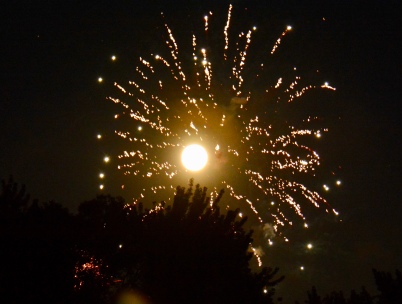 East Side Park, on the Colville Indian Reservation across the river from my home, is the designated shoot-em-up area for a DIY pyrotechnics show. The spectacle begins as the sky darkens, around nine p.m., and lasts until nearly midnight. There’s plenty of space in the park, some seventy acres or so, for people to spread out and fill the sky with a thoroughly impromptu but dazzling show.
 A full moon provided an elegant backdrop to the bursts of color. Not only a full moon, but one in “penumbral eclipse.” That, explains the Farmer’s Almanac is “when the Moon crosses through the faint outer edge of Earth’s shadow (the penumbra), making part of the Moon appear ever-so-slightly darker than usual.” I could not discern any darker shades of moon, particularly when it was illuminated by fireworks.

 Which is why an event coming up Saturday, June 20, is so vital. More than fifty years later, we have a new version of the Poor People’s Campaign. There won’t be a massive march and encampment on the National Mall, but as these times would have it, a “digital justice gathering” nationwide. It’s a “moral march” on Washington, say organizers, who hope to attract tens of thousands of people online. Details are at
 The piano lessons were of secondary importance to that walk back to the bus depot. My route took me through Dayton’s Department Store, where I was dazzled by elegant goods. I’d drop into Woolworth’s to munch on a slice of pizza while watching demonstrations of the latest gadgetry. Various little shops along the way specialized in trinkets or roasted nuts. Nobody at home worried whether I caught the 2:40 bus or the 3:30—just so I made it home for dinner by six.
 This inconsequential question floats through my mind as I approach my seventy-sixth birthday amidst a pandemic.
  It was a heady time. Fifty years ago, at age twenty-five, while living on an idyllic island in Puget Sound, I participated in the first-ever “Earth Day.”
 Every New Season
You must be logged in to post a comment.