Driven To Drive: An Identity Crisis?

An update of Rene Descartes’ declaration, “I think therefore I am,” is long overdue. For my generation the existential truth is, “I drive, therefore I am.”

I still vividly recall the freedom and power I felt on May 12, 1960, my sixteenth birthday, when I passed my driver’s license test. As drivers, we not only have the liberty to go wherever, whenever we want, our vehicles become integrated with our persona. Watch any car commercial.The ads are not about the vehicle but about how you’ll feel driving it. We’ll feel forever youthful driving that sleek sports car. Or forever in charge steering that rugged 4×4 pickup through hostile environments. Those vehicles cruising across our TV screens are an elixir of power and eternal youth. 

Until we’re too old to drive. And just how old IS too old?

Traffic safety experts sidestep a precise answer. So does AI. When I typed in the question, AI offered a laundry list of primarily subjective guidelines: declining physical or cognitive ability, slow reaction times, getting lost easily, frequent close calls, or loved ones expressing concern. Oftentimes, those “loved ones” will be less loved if they start harping about Grandpa’s driving.

Kaiser-Permanente, in a helpful online guide to “Healthy Aging,” offers cold, hard data:

  • People age seventy and older are more likely to crash than any other age group besides drivers age twenty-five and younger. In other words, driving skills improve with age, then regress. We’re no safer now than when we were air-headed teens, oblivious to our mortality.
  • Because older drivers are more fragile, they are more likely to get hurt or die from these crashes.

A joint study by the American Society on Aging and National Highway Traffic Safety Administration offers this chilling observation: “Most people drive seven to ten years longer than they should.”

Giving up your car is life changing. I did so two years ago, BUT I had no intention of giving up driving. When I moved to Seattle from rural eastern Washington, my motivations were to save money and reduce my carbon footprint. I gave my 2009 Dodge to public radio. I planned to use mass transit when possible, and rent a car when necessary. 

Public transit — busses, light rail, ride shares — are great. Rental cars not so much. I’ve rarely needed them, but when I do, they come equipped with recently developed, high tech amenities that I can’t readily figure out — like how to START the darn thing. 

I was delighted when my retirement community, Horizon House, recently introduced a car-sharing plan. For a nominal expense, residents can rent an electric vehicle, fully insured, and be trained to drive it before we hit the road. Because I’m past age eighty, I’d have to take a driving test to participate. I think that’s an excellent idea. I’d like to be assured that I’m as good a driver as I think I am — a veteran, after all, of several solo cross-country road trips.

A no-injury accident last year, just after I turned eighty, sowed a seed of doubt. I was driving a rental car in an unfamiliar town. Looking for a place to pull over to make a phone call, I blew through a stop sign and collided with another car — which had a student driver at the wheel. Both cars required towing.

A more experienced driver might have spotted me and taken defensive action. Several people who gathered round the crunched cars claimed it was a notorious intersection with frequent collisions. Still, I was clearly at fault. I acknowledged as much to the police officer, and readily paid my fine. 

And still, there was that traumatized wanna-be driver. I sent her a gift and a note of encouragement. My insurance readily paid for damages to the rental car. I was further grieved to learn that her family’s insurance company stalled for months before paying up. 

I’m sure her dad had plenty to say about eighty-year-old drivers. While I waited for the tow truck, he showed up with his work rig to tow away the family car. Grim-faced, he grunted as we were introduced and maintained a glum silence while hooking up the vehicles. It was Memorial Day. I imagine he’d been home, tending the barbecue. I’d ruined their holiday. 

That’s the thing about our roadways. Most of us do not work in the realm of public safety. Yet our roads and streets — open to all — are where we are most responsible for the safety and well-being of our fellow citizens. It’s where we have true community, where our very lives depend on the skills and consideration of our fellow travelers.

Why is it, then, that I’m struggling with the question: do I keep driving? I enjoy walking and using public transit. I’ve needed to rent a car only a handful of times over the past  two years, and maybe those trips weren’t all that essential. Could it be — and here, dear reader, I’ll reveal the naked truth — that my ego still clings to that steering wheel? Could it be that my ego — my false self — is deflecting any suggestion that I’m “too old” to drive? 

For now, I’m side-stepping the issue. I have no immediate need to drive anywhere. The car-share program will wait. My driver’s license is still in my wallet, valid until May 12, 2031. It is merely a plastic ID card. I’m working on making it not who I am.
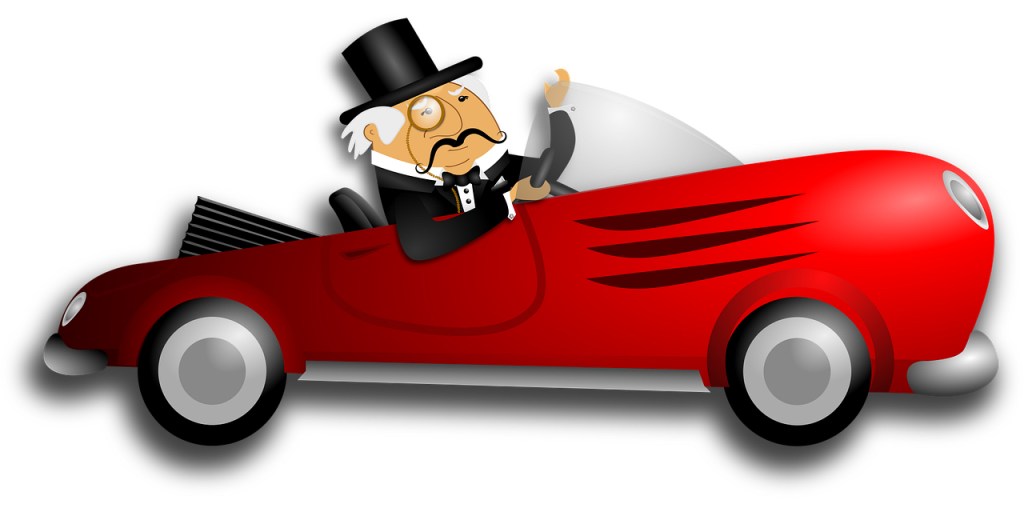
Is that Descartes at the wheel?

Pro-Active Aging: Mapping a path toward the inevitable

November 5 marked one year since I moved to an “old folks’ home,” as a friend patronizingly describes it. I neglected to observe the anniversary. Apparently other events on November 5 distracted me.

Now I’m taking a breath, reflecting on that decision to turn my life upside down one year plus one month ago. I exchanged a rural riverside home that I loved for a city studio apartment in — NOT an old folks’ home — but what the industry prefers to call a CCRC — Continuing Care Retirement Community. I live independently in my own apartment until, until … I no longer can. Then I’ll be appropriately cared for.

Do I miss my previous life, the people and place I left behind? Every moment of every day. Did I do the right thing? Absolutely.

I carry this paradoxical load of joy and sorrow by embracing both present and past with gratitude. I’m thrilled to be where I am: in a vibrant community, soaking up the energy and culture of a large metropolis. All the while, I revel in memories of rich relationships and events that once were and can be no more.

During the final hectic weeks of preparing to move last year, seeds of doubt threatened to erupt into full-blown angst. To ward off inner explosions, I kept a list in my journal under the heading,“Reasons For Moving.” No. 1 on that list was “Pro-Active Aging.” More than anything else, I wanted to make my own decisions while I still had the capacity to make them. Above all, I didn’t want to reach the point when family and friends would debate, “What should we do with/for/about dear old Mary?”

I’m not interested in denying the effects of aging. There’s no debate. Our bodies and our mental capacities change. I’m interested in acknowledging those changes, accommodating them, even savoring them. Age is a convenient avenue for setting boundaries: No thank you. Not interested in going there. Not doing that. And the world shrugs its shoulders. What d’ya expect? She’s old!

Even as my own Earth-bound future grows shorter, I care about the future of our world. No. 3 on my “Reasons” list (after No. 2 — financial) was “Lower My Carbon Footprint.” That could’ve been a sub-head under No. 1. One of the most vexing issues for families with aging members is convincing them to stop driving. For too many, losing the freedom to drive is the death of independence. 

I recall a friend at age 90 gleefully maneuvering England’s country roads, one leather gloved hand on the wheel, the other briskly shifting gears as we sped from curve to corner. “They’re going to have to pry my cold, dead fingers from around the steering wheel,” she declared. They didn’t have to. A paralyzing stroke ended her driving days.

I gave away my car before it became an issue. I revel in the true independence offered by mass transit. No hassles with parking, gas prices, insurance, maintenance and repair bills. And, oh my, the interesting people one can engage with on the bus.

“Want little: you’ll have everything,” advises Portuguese poet Ricardo Reis. He continues, “Want nothing: you’ll be free.”

I’m not suggesting everyone should follow my path of aging. We each find our own route, which is why some folks call it (s)aging. We don’t have a choice. Aging begins with that first breath and continues throughout our lives. I’ll not quote that old saw — the one that says growing old beats the alternative. 

Oh. I guess I just did. A sign of age?

Ferry Tales: Scandalous events at last revealed

Among the joys of old age: you finally get to reveal long-held, sometimes scandalous secrets. Either those involved have passed on, or the events were so far back, they can no longer embarrass. 

This thought came to mind as I read a Seattle Times story about the retirement of two venerable Washington state ferries: the Elwha and Klahowya. Both are headed to the scrap heap.

I was a frequent commuter aboard the Klahowya in the 1970s, when I lived on Vashon Island. A sedate, hard-working vessel, the Klahowya received little notice as she sailed a triangular route between Southworth on the Olympic Peninsula, Vashon Island’s north end, and Fauntleroy in West Seattle. 

The Elwha was another matter, involved in one maritime scrape after another. The Times piece quotes Steven Pickens, Puget Sound ferry historian: “I will not be sorry to see the Elwha go. In fact I’d probably give it a kick on the way out if I could. I’ll miss the Klahowya.”

Likely the Elwha’s most infamous incident was in 1983, when she went off-course sailing from Anacortes to Orcas Island. She hit a reef, causing a quarter-million dollars worth of damage and a major interruption of service. Reason for the stray? Turned out the captain had a passenger in the wheelhouse to whom he’d “taken a shine.” He’d rerouted so the passenger could see her house from the water. Both the skipper and the head of the state ferry system lost their jobs over that one.

By 1983 I was living in the drylands of Eastern Washington, my ferry commuting days behind me. Yet I wasn’t at all surprised with the news of shenanigans in the wheelhouse.

Besides commuting aboard the Klahowya, I frequently was a passenger on the much smaller Hiyu II. She ferried islanders from the south end to Tacoma throughout the 1970s. She was a small boat on a short run, serving a tight community. Everyone knew everyone. Passengers were commonly invited to the wheelhouse to chat with the skipper and crew. Understandable. Steering a boat back and forth, forth and back, back and forth, could get pretty tedious.

Hiyu II ferried islanders between Vashon and Tacoma

One sunny afternoon, my parents my and I boarded the Hiyu for their first island visit. The deck crew ushered us to the wheelhouse. My mother was especially thrilled. In her college years, she worked as a waitress aboard a cruise ship on the Great Lakes. Yet I doubt she’d ever made it to the wheelhouse. 

For decorative reasons, the builders of the Hiyu had installed old-fashioned wooden steering wheels. It was a wheelhouse, after all. The vessel was actually steered by toggle switches on a kind of horizontal dashboard. The skipper, who had total control of the ferry at all times, asked Mom if she’d like to steer, pointing to the fake wooden wheel. Thrilled, she took the wheel, standing straight and tall as the ferry held its course. 

“I can’t believe he let me do that!” she later exclaimed as we descended the stairs to the car deck. She was excited, yet a little dubious. Was it really appropriate for a common citizen to steer the boat? Obviously that particular skipper (who, I emphasize, is no longer in this realm) enjoyed playing that trick for special passengers. I’m sure that kind of “hospitality” ended as of 1983.

The Hiyu II has been refurbished as an entertainment venue on Lake Union. I could rent it for three hours of sailing for a mere $10,000. I doubt any party I could dream up would be as much fun as that afternoon cruise when my mother skippered a Washington state ferry.

When Fate Turns the Page: Time to start a new chapter

The thunder of U.S. Navy “Blue Angels” skimming the tops of Seattle skyscrapers reminded me it was a one-year anniversary. On the morning of Aug. 2, 2023, I was in Portland, saying that impossible, final goodbye to Lee, my soul brother for more than fifty years. 

“We’re both going on a journey, but in different directions,” I said to him, leaning close to kiss his cheek. He whispered something I couldn’t understand, but words no longer mattered. We both knew that. I got in my car, dry-eyed with a sobbing heart, and drove north to Seattle. A chapter in my life had just ended. Maybe the whole book. Maybe I was driving into the epilogue. 

All those years ago, Lee and wife Mary Lou had stood as witnesses when John and I married. It was like a marriage of marriages, a foursome. As couples, we never lived close to each other, often thousands of miles apart. Yet we’d travel those miles to share slices of life. Our foursome dwindled as John died in 2007, Mary Lou in 2020. Lee and I soldiered on. Frequent phone calls. Occasional visits. We’d talk idly about road trips we might take together, but we’d both seen plenty of road. And now, here I was, back on the road, the lone survivor. 

I had an appointment to see an apartment in Horizon House, a retirement community on Seattle’s First Hill. I’d visited a few months earlier and fell in love with the location, energy and philosophy. People move here not to retire and die but to live, contribute, and matter. Still, I was skeptical. I’d been invited to look at a studio apartment. I couldn’t imagine a studio large enough for me, much less my “stuff.”

I asked my niece Sandy to join me. A savvy realtor, she poses the questions that never occur to me. The sales rep unlocked the door to 13-A, and I walked straight to the window, all of twelve paces. Windows have always been the most important feature of anywhere I’ve lived. What would I be viewing? An urban valley of rooftops in the foreground ringed by a horizon of office and apartment towers. Columbia Center, Seattle’s tallest building at 72 floors, loomed above the rest, piercing an endless blue sky.

That’s when we heard the thunder. Not a rain cloud to be seen but jets skimming through the air with gasp-inducing precision. Seattle’s annual Seafair celebration, complete with aerial show. I teased the sales rep about arranging a spectacle as part of her marketing ploy.

With or without jets — especially without, I decided the view would keep me adequately absorbed. After decades of living on a riverbank, I’d be watching a different kind of wildlife on the busy streets thirteen floors down. The studio was big enough for me, and the storage unit in the basement large enough for my stuff. For the next three months I lived in an emotional vortex as I prepared to  move. I celebrated and mourned the ties with people and place that had bound me to the Okanogan country of eastern Washington for forty-four years. I’ll never become untied.

While I’ve lived in Horizon House only nine months (an appropriate gestation period), I’m convinced I made the right decision. And here again are the Blue Angels. Thrilling as the aerial shows are, a growing number of voices object to the noise and environmental consequences. Protesters argue that each jet burns about 1,500 gallons of fuel per hour. Each air show puts some 650 metric tons of CO2 into the atmosphere of an earth desperate to reduce carbon emissions. The Blue Angels may not be around forever, nor will I. But I’m here for at least another chapter.

If A Hippopotamus Can Fly: Why, oh why, can’t I?

News item: “…researchers discovered that hippopotamuses — which can weigh up to 8,000 pounds — become airborne with all four feet off the ground for up to 15 percent of the time while running at full speed, or for about 0.3 seconds.” (The Week, July 19, 2024)

I reckon I was airborne for about 0.003 seconds before my recent bone-shattering crash on a Seattle sidewalk. I weigh — well, a lot less than 8,000 pounds — and I had only one foot off the ground at a time as I walked at a reasonable pace. Yet there I was, flattened, while the hippopotamus continues to soar through the air. It’s a miscarriage of justice —an unequal application of the law of gravity.

Gravity is out to get us humans. We teeter around on two legs, at a distinct disadvantage to four-legged critters. Scientists tell us that our long-ago ancestors switched from four- to two-legged travel to save calories. We use less energy when walking than our relatives, the chimpanzees, who employ both knuckles and toes as they stride through the jungle. 

The World Health Organization reports that globally, 684,000 people die from falls each year. In this country, says the Center for Disease Control, falls are the leading cause of injury for adults 65 years or older and, even more frightening, the leading cause of injury-related death in that same age group. 

My friends and family offered all sorts of kindly advice during my two-week hospital stay, followed by a few days in rehab, and now as I continue therapy at home. “You don’t want to fall again,” they lovingly caution. Fact is, I didn’t want to fall in the first place. I’ve long been pro-active to avoid falling. I own and used a balance board; I stood on one leg while brushing my teeth; I continually engaged in core strengthening exercise; I wore sturdy walking shoes, and just FOUR DAYS before my fall, I completed a balance/fall-prevention class. 

“Perfect score,” the instructor told me, happily adding: “but of course, you had a perfect score at the start.”

The reasons we fall are complex. The CDC lists lower body weakness, vitamin D deficiency, difficulties with walking and balance, medications that affect balance, vision problems, foot pain or poor footwear, home hazards or dangers such as broken or uneven steps, throw rugs or clutter, etc. In my case, it was an uneven bit of concrete sidewalk. Gravity happens.

Reading through the CDC brochure, “Staying Independent,” I checked a definite “yes” next to the statement, “I am worried about falling.” The brochure commentary is not particularly helpful: “People who are worried about falling are more likely to fall.”

In his book “Falling Upward,” spiritual writer Richard Rohr offers a more encouraging point of view. In this “second half” of life, he suggests, we are free to fall, although not in a physical sense. We no longer have to protect our fragile egos, no longer must we “push the river,” no longer must we strive to have what we love, instead, we love what we have. Rohr cites St. Francis, who “spent his life falling, and falling many times into the good, the true, and the beautiful.” I’m willing to take that kind of fall.

I’m convinced my fall prevention work saved me from worse injuries and speeded my recovery. The CDC says one in every four older adults reports falling each year. I count as one this year, which means three others are off the hook. I hope, dear reader, you’re among the three.

Dependence Day: Are we really free, or are we kidding ourselves?

On day No. 12 in the hospital, as my fractured bones heal I realize I’ve been given an additional break —a pause.

When I met a Seattle sidewalk up-close and personal a week-and-a-half ago, it interrupted my schedule: things to do, people to see, places to go. Since then I’ve been given long, seemingly empty hours of “doing” nothing. My arena of activity is limited to a bedside table (15 by 34 inches — I measured it using tape from my knitting bag). The table is piled with notebooks, hospital menu, a few papers relative to injury and recovery, water jug, computer, phone, maybe a snack or two. 

If something I think I want or need is beyond my reach, it’s as unavailable as breathable air on the moon. Like that pillow, just four feet away, that would feel good under my fractured elbow just now. I’m capable of wriggling out of bed, shuffling the four feet (abetted by the hip-to-ankle brace stabilizing my fractured knee), grabbing the pillow, and shuffling back to bed.

BUT I’ve been strictly ordered not to get out of bed or even off the toilet without an “assist.” If I want to move about, someone else has to be present.

Happy Dependence Day!

We love to celebrate Independence and worship at the altar of Freedom (an altar banked with fireworks). When do we celebrate the greater gift of DE-pendence? 

Such a suggestion sounds almost unAmerican. We pride ourselves as being (as my late husband liked to observe) “independent as hogs on ice.” We wanna be free to do what we wanna do. At my age especially, independence is the NO. 1 goal —even though it’s a mirage.

We choose to ignore how much we depend on others. We can’t recognize that because too often the fellow human beings we depend upon are hidden within systems — health care system, transportation system, communications system. You can name many more. Just think about your daily activities and the systems that enable them and the people within those systems who enable you.

The other night (at the risk of being overly specific) my urinary catheter malfunctioned. What a soggy, humiliating situation! Barely awake, I mumbled apologies to the aide as she efficiently got me back on dry land. English for her, like many hospital personnel, is a second language. With her beautifully lilting accent, she replied, “That’s why I’m here on the overnight shift. To help you!”

After she left, I wondered if I’d just experienced a mystical divine presence. She’d seemed uniquely certain of who she was and why she was. It was powerful — as if destiny had hurtled us both through time and space so our paths would cross in exactly that moment, this place.

The African Bantu language gives us the word ubuntu, inadequately translated as “I am because you are.” I understand that to mean, “I would have no reason to exist except that you exist.” I’m guessing our culture understands that in a romantic sense, like the song lyrics: “I was meant for you; you were meant for me.” That’s a start, but ubuntu is universal. I suspect that word or a similar one is not in our vocabulary because it’s a foreign concept. In our individualistic world, co-dependency is considered a mental illness. 

Yet the mutuality of ubuntu is at the root of our humanity, our raison d’être. Thus showing up at 2:30 a.m. to change an old lady’s sopping bed linen becomes not just a job, but a reason for being. 

Happy Dependence Day — today, tomorrow, and every day of our lives!

Ups and Downs of Urban Hiking

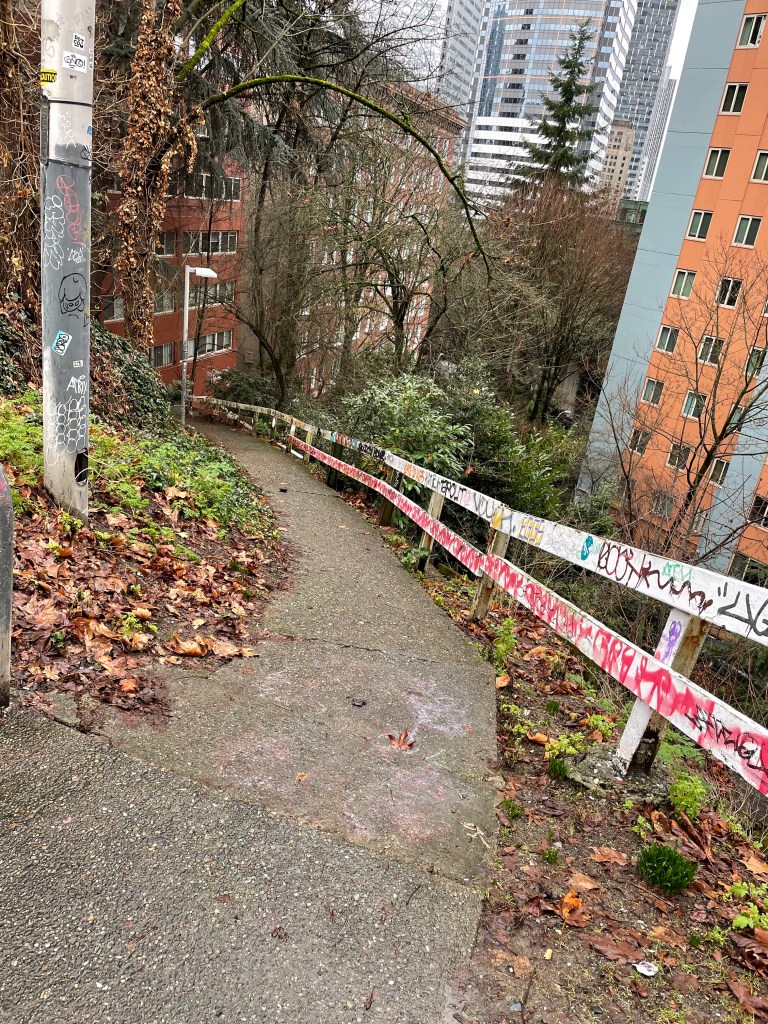
“Take the steps on your right,” GPS instructed via my phone. I looked at the steps with skepticism bordering on apprehension. They dissolved into a steeply declining, forested urban trail.

It should not have been a concern. I’ve hiked in the Glacier Peak and Pasayten wildernesses, the Cascade Crest Trail (parts thereof), and the coastal trail of Wales (parts thereof). I walk at least a couple miles daily. This time, though, I was on a scouting mission. A friend, who was planning to visit with her eighty-something mother, texted she’d found an Airbnb just a block from my apartment. I checked the address and thought, “Yeah, just a block as the crow flies, maybe.”

In Seattle, it can be difficult to get from Point A to Point B without circling via points Q through Z. Look at a map of Seattle’s core, and it has all the puzzling disjointedness of an Escher print. There are a couple of reasons for this. Seattle’s founders built on a series of hills, some quite steep. My roundtrip walk to the grocery store is only a mile, but no matter which route I take, it’s uphill both coming and going. 

The real confusion, though, evolved when three early developers couldn’t agree on which direction the streets should follow: north-and-south, as the compass would dictate, or northwest-to-southeast, following the Puget Sound shoreline. Each went his own way so that when streets ultimately meet, they zig or zag, sometimes even criss-cross. It’s not unusual for streets to intersect at an acute rather than the usual right angle. Seattle architects have excelled in designing buildings that come to a point.

As if all that weren’t sufficiently problematic, interstate freeway construction in the 1960s plowed through Seattle’s core, bisecting the city and blocking streets that long had been thoroughfares between neighborhoods. A “lid” over a small portion of the freeway affords some access via Freeway Park.  The retirement complex I live in abuts the park, but even pathways in the park wind and wander. As far as I can tell, GPS has yet to figure out those trails.

All of which led to my scouting venture. My friend’s Airbnb was indeed just a block from my apartment complex loading dock. Visitors are not welcome there. The front door is still another block beyond. Since visitors can’t go through the buildings, they pretty much reach the main entry via points Q and Z.

I’d put my friend’s Airbnb address into my phone as I exited my apartment building. GPS directed me along a side street to the top of the before-mentioned trail, where I found squalid remains of a campsite, apparently vacated by homeless persons. The trail was paved, but the wooden handrail was covered with graffiti and appeared less than sturdy.

I headed downward, gingerly stepping over broken glass, noting an abandoned grocery cart in the bushes. Bulbs were pushing up initial green spikes of spring flowers through last fall’s dead leaves. At some point, this must have been a lovely urban pathway. Now, I texted my friend, it was more of an urban jungle. 

“Hmmm, what do you mean an urban jungle?” she texted back. “Is it not safe?” 

“Back-alley aura,” I answered. 

My friend is a determined, undaunted world traveler. She found another route via a stable staircase. From there she cajoled her mother into climbing two blocks up a rigorously steep sidewalk. They could’ve driven, but with one-way and dead-end streets, multiple construction detours, and parking issues, it would’ve taken much longer.

Ah, wilderness. Right here in my urban backyard.

When It’s Time to Take Flight

Inquiring minds have been asking: with dozens of retirement communities to choose from, how did I select Horizon House on Seattle’s First Hill? Simple. When I moved here two months ago, I was following Raven, who’s a significant totem in Northwest native stories. A stunning yet obstreperous bird, Raven has magical power — both good and bad. In my case, all good.

I refer to Raven as represented in a magnificent mask created by British Columbia native carver Garry Rice. I first saw the mask when it hung in the oceanside home of my longtime friend Jill. Despite the hypnotizing view of the vast Pacific, it was the raven mask that dominated her living room. Extending five feet from thatched topknot to forceful beak, its eyes declare “you are being watched.” The beak agape suggests an oracle about to speak.

The late writer and clairvoyant Ted Andrews, in his book “Animal-Speak,” said Raven was credited with bringing forth life and order by stealing the sunlight “from one who would keep the world in darkness.” 

Winter is an ideal season for people whose totem is Raven, Andrews wrote. After Winter Solstice, the light lingers a little longer each day — symbolic of Raven’s influence: “It teaches how to go into the dark and bring forth the light. With each trip in, we develop the ability to bring more light out.” Raven’s black feathers are especially significant, Andrews suggested: “In blackness, everything mingles until drawn forth, out into the light. Because of this, raven can help you shape-shift your life or your being.”

Apropos for carver Rice, who was originally a fisherman and logger. Injuries forced a career-change at midlife, and he became a respected and renowned creator of indigenous art. Last year it was time for me, too, to shape-shift my life and being.

A few years ago Jill had left the ocean and moved to a retirement community. Her new apartment was too small for the mask, but that establishment declined her offer to hang it for public viewing. She decided to donate it to Horizon House, which boasts a stunning, curated collection of art throughout all public areas. Much of it has been donated by residents who faced the same pickle as Jill. She mentioned the donation to me at the time. I’d never heard of Horizon House, but the seed was planted. Some day, I thought, I might want to live there. 

When that some day dawned last year, I knew I might be inclined to make a hasty or emotional decision. I invited my niece — a wise and successful businesswoman — to tour Horizon House with me. While I repeatedly veered off-course to study yet another sculpture or painting, Sandy stayed on-point, asking significant questions I’d never thought of. Ultimately we reached the corridor where Raven once again is a dominating force. Exquisite lighting allows the mask’s reflection to appear on interior windows across the hall. A few steps away from Raven, our tour guide opened the door to the serene aqua of a salt-water swimming pool. 

Art! Raven! Salt-water pool! Where do I sign?

Twice since I moved into my thirteenth story apartment, a crow has landed on the air conditioner ledge outside my window. Crows and ravens are cousins in the Corvidae family. On both those visits, the crow peered through the window just long enough to observe, “Okay. You seem to be settling in,” before flying off. 

***

NOTE: For those who may want more, uhm, straightforward information about choosing a retirement community, I recommend (for Washington residents) this information page on the Washington Continuing Care Residents Association site or outside Washington, the National Continuing Care Residents Association.

Be It Ever So Humble

“Money must be a consideration,” said the drop-in visitor as she glanced around my 340-square-foot studio apartment. I was just moving into our downtown Seattle retirement community of 378 apartments (another 152 to come in five or six years). Mine is one of the smallest, least expensive. She was right. Money was a consideration, but probably not in the way she was thinking.

For years I’ve used a coin purse featuring a cartoon character pulling green dollars out of her billfold. My coin purse is so well worn that the caption is becoming unreadable, but still memorable: “Mo’ Money, Mo’ Problems.” 

Snug, liveable, and more than adequate

Those “mo’ problems” were a factor but not the driving motivation for giving up the home and community I loved to move here. I want to reduce my footprint on our Mother Earth as I age. I want to use fewer resources, live in community, take up less space, and spend less money to maintain house, car, etc. Not yet two months into this venture, I occasionally feel unsettled, mourning what I’ve given up, suppressing envy over larger apartments. So I go for a walk. 

From the west wing, I walk across Freeway Park, where I see two camping tents. There are no signs of life but I’m certain the tents are occupied. I walk past a man who is seated, holding a crutch, staring at nothing. He’ll still be there hours later when I return.

I enter the glass-encased Convention Center, take escalators down four floors, and I’m in the heart of downtown. Heading to Pike Place Market I notice a mummy-style sleeping bag stretched out on the sidewalk in an alcove. It appears to have a body in it. I pray that it’s a live body, though I wonder if life itself is any kind of blessing for this mummified soul. 

That same day the Seattle Times reported that both nationally and in Washington state, homelessness is “growing at a rate never seen before.” The official national count is a 12 percent increase over 2022, and in this state 11 percent. That’s based on the annual Point-In-Time Count. I helped with that count as a volunteer at the Okanogan homeless shelter. We simply recorded the number of folks sheltering on the appointed evening. Shelter populations can vary wildly depending on weather, time of month, and other factors. Nevertheless, we know that on a given night there were at least 28,000 people in Washington who had no place to be. That’s higher than the populations of Mercer Island or Moses Lake.

But those are only numbers that don’t really tell the stories — except for some stunning numbers offered the next day, again in the Times, by columnist Danny Westneat. There’s a building boom downtown. Some 7,200 living units (aka apartments) are under construction. Help for people with no homes? Not so much.

“This boomlet isn’t visible at street level,” Westneat writes. “It’s in the sky.” Once again Seattle has more construction cranes dotting the skyline — forty-five of ’em — than any other U.S. city. The columnist warns that high-rise apartments are likely to turn downtown into a “gated community … only vertical.”  He cites the example of a penthouse atop the 58-story Rainier Tower, renting for $19,999 per MONTH. 

I can’t imagine what it would feel like to drive my luxury car from the garage below my $20K-a-month apartment and spot a homeless person, wrapped in a sleeping bag in the sidewalk. It’s hard enough for me, having just left my snug studio, to walk on by, even with a prayer in my heart.

Carried away by the spirit of the season, I bought more than I intended at the Market. The walk back, with awkward packages, was a slog. Arriving home, I was more grateful than ever for a home to arrive to. Gratitude guarantees contentment. 

I’m not so naive to believe that moving into a tiny apartment or giving up my car is going to solve climate issues or homelessness or myriad other problems. But isn’t that a basic message of Christmas? Just another baby born in an insignificant town, and everything changed. It’s clear — to me, anyway — that if enough of us care a little more, live with a little less, we too can make a significant difference. That’s my prayer for 2024.

Uneasily At Ease

A question frequently asked by we who are s-aging is: “How (*insert) did I get here?”

(*Insert whatever exclamatory phrase you prefer, e.g., “How in the world …” or, “How on earth …” or, “How the hell,” etc.)

The “here,” when that question floated into my head, was the lobby of the retirement community that I’d moved into a few weeks earlier. The lobby is nicely furnished, not ornate but more like a mid-priced boutique hotel. On that particular day, the start of the holiday season, it was buzzing with activity and people. The automatic glass doors would barely whoosh shut before they’d glide open again, admitting a constant flow of family delegations coming either to visit or whisk away “Granny,” or “Gramps,” or in my case, “Auntie.”

It’s a significant part of family celebrations — thoughtful inclusion of the oldest generation. Often it requires extra effort, like going out of one’s way to provide transportation, figuring out how to cram a walker or wheelchair into the car trunk, altering the dinner menu in consideration of special diets, arranging chairs and tables just so. I’d done it all many times and loved doing it. 

“What we have once enjoyed we can never lose,” suggests Helen Keller. “All that we love deeply becomes a part of us.”

I believe she was talking about nostalgia, which was striking a resounding chord as I sat waiting in the lobby, feeling out of place. How (*) did I get there? I would no longer be providing for the senior generation. I’m now part of it. My niece and grand-niece would be picking me up, their car loaded with desserts and salads that I had no part in preparing. Arriving at the celebration, I would eye the kitchen filled with busy folks, leave them to it and sit, casually conversing with other elders. Uneasily at ease.

If “My Generation” is uneasy with old age, we have only ourselves to blame. We’ve been in denial since the turbulent ‘60s, when The Who released their signature song. Peter Townshend, who penned the line, “Hope I die before I get old,” is now 78. Roger Daltrey, who — as one critic wrote, “sneeringly” sang it — is 79. 

“Don’t trust anyone over 30.” Jack Weinberg, whose comment went viral before there was such a thing as viral, is now 83. Weinberg has devoted his life to social and environmental activism. In an interview he observed, “I’ve done some things in my life I think are very important, and my one sentence in history turns out to be something I said off the top of my head which became completely distorted and misunderstood. But I’ve become more accepting of fate as I get older.”

The wisdom of age: to more become accepting. Even to welcome, as in the classic Welcoming Prayer, written by contemplative Mary Mrozowski: “I welcome everything that comes to me in this moment because I know it is for my healing.”

Thus I welcomed the opportunity at the end of Thanksgiving dinner to roll up my sleeves and sink my hands into hot, soapy dishwater — no longer feeling out of place, because when it’s time to clean up, there’s ample room in the kitchen for helpers of all ages.