Cast in Concrete: Solid Footing in Treacherous Times

“Cast in concrete” is a metaphor for something permanent, unchangeable. And yet, “nothing is forever,” my late husband John once observed.

Cast aluminum, not concrete, was a favored medium for sculptor Richard Beyer. At least one time, however, he did make his mark in concrete.  It was a fond gesture, a gift beyond value honoring John, me, and the community newspaper we published in Washington state’s spacious Okanogan County.  John’s observation became all too true. Not even art cast in concrete is safe from willful destruction.

The Seattle Times recently published a retrospective of Beyer and his work. Reading it, I nearly drowned in a tsunami of memory and emotion. The piece by veteran journalist Erik Lacitis described Beyer as controversial and largely unrecognized. I have to agree. A recent show at the Seattle Art Museum celebrating contemporary West Coast artists omitted Beyer, even though there are more Richard Beyer public sculptures in Greater Seattle than by any other artist, Lacitis notes. That includes “Waiting for the Interurban” in the Fremont District, which after it was installed took on a life of its own. Many would claim it to be Seattle’s most popular piece of public art. Lacitis tallied more than ninety Beyer art works scattered throughout the Northwest and as far as Uzbekistan in Central Asia.

Beyer expressed his outsized humor in satirical creations that were met with consternation and adoration, fury and fun. He was either amused or indifferent when art snobs or critics spurned his folksy work. Since he died in 2012, his sculptures have not only endured but become even more endeared. 
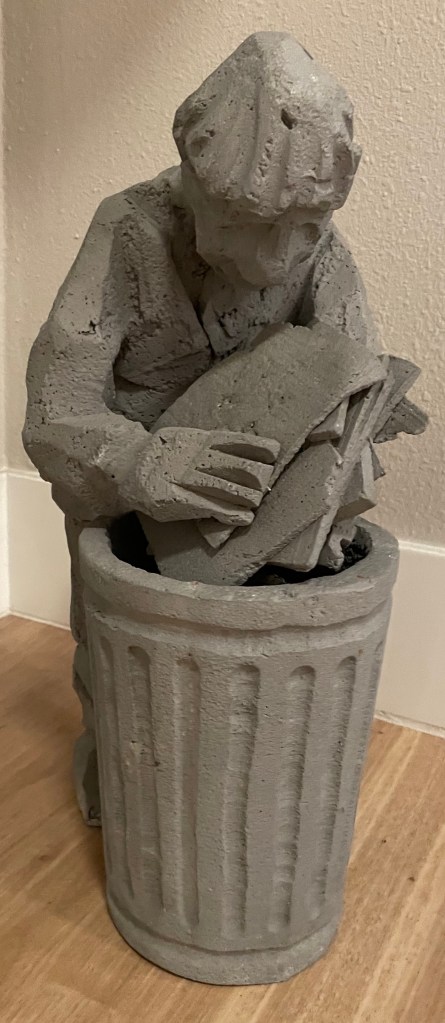
A Beyer fan long before we met, I was excited when he and his wife Margaret moved to Okanogan County in the late 1980s. I eagerly attended a show featuring some of Beyer’s smaller pieces at Sun Mountain resort in the Methow Valley. As I studied an eighteen-inch high, cast aluminum figure entitled, “Man Throwing Newspapers into Garbage Can,” I became aware of someone standing next to me. I looked up and instantly recognized Rich. My first words blurted to this man whose work I so admired were: “You could at least have him recycle them!”

Rich was momentarily taken aback before releasing his characteristic guffaw. We became friends, and I bought the sculpture for my husband. John proudly displayed it on the front counter of our newspaper office. Rich, who had so often been skewered in print, was no fan of newspapers. He made an exception in our case, frequently complimenting our paper’s brand of community journalism.

In late 1993, my husband suffered a brainstem stroke. Unable to speak, he was diagnosed as “Locked-In,” a syndrome described as a fully functioning brain locked inside a totally paralyzed body. Despite the gloomy medical prognosis, I was convinced John could and would recover. To accommodate John’s wheelchair, I had a ramp built to the front door of our newspaper office.

The contractor was Gary Headlee, also an artist and Rich’s friend. He convinced Rich to etch and paint a mural onto the side of our concrete ramp. Rich dreamed up a whimsical story that, as he worked, changed with every telling. He titled it “The Precious Jewel.” 

By 1996, I had to face reality. Trying to do both John and my jobs, largely from home, while providing twenty-four/seven care for him, was not sustainable. We sold the paper, careful to put on a happy face in public. In private, I wept. I’d sold a chunk of my soul and pretty much all of my identity.

Not long after, Margaret got in touch with me. She wanted to write Rich’s biography and asked for my help. She arrived at our house with a shopping bag full of notes, photos, and a title for her imagined book: “The Art People Love.” I went to work on the opening chapters, but time was not on our side. I had too little of it, and Margaret wanted the book published ASAP. She ultimately retrieved the unfinished manuscript, the rest of her notes, completed the book, and found donors to fund its publication in 1999.
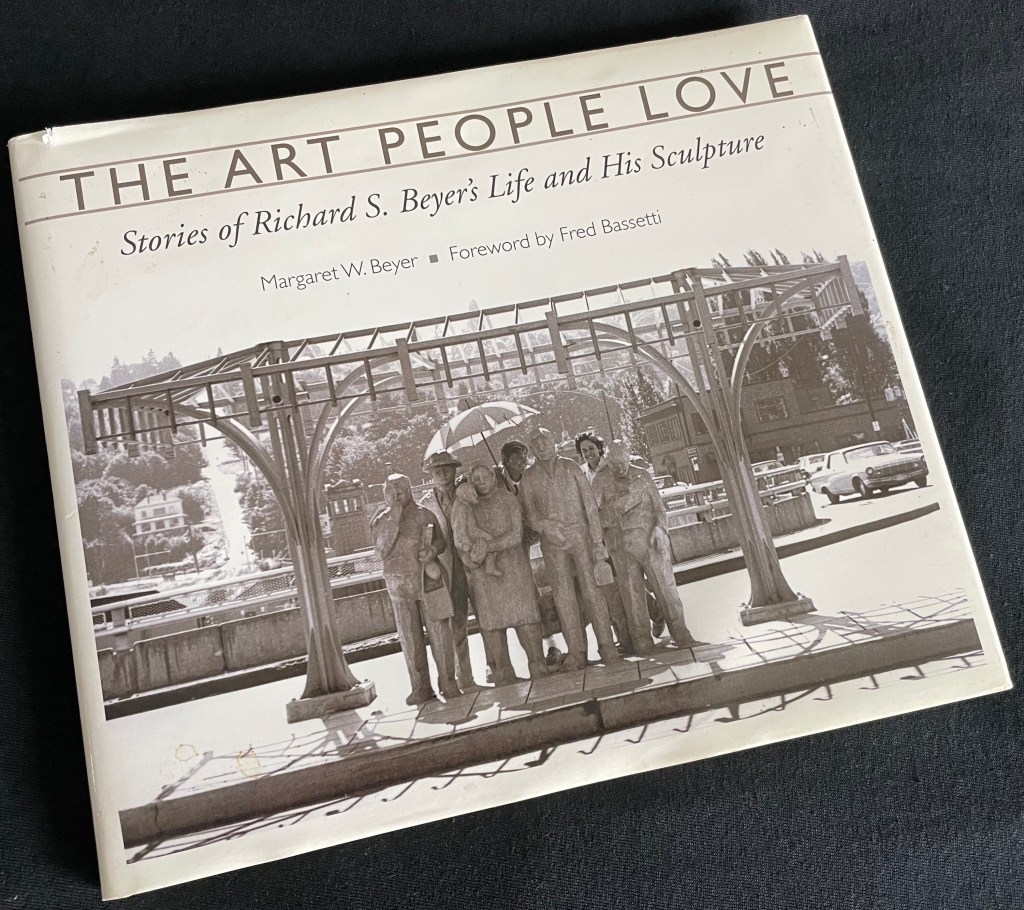
“Mary: you showed me the way!” she graciously wrote in my copy. One beautiful May morning in 2004, Rich called. Margaret was nearing the end of her journey with cancer. Would I come visit? 

I’ve always described spring in the Okanogan as the five minutes when snowmelt colors our brown hills a delicate green. That day, throughout my forty-five minute drive to Margaret’s bedside, the green shone more brilliantly than I’d ever seen, before or since.

I don’t know if Margaret was aware of my presence. I prayed, seeking forgiveness for not having done more for her. She’d been the rock, the firm foundation that allowed Rich freedom to create. She was equally as brilliant and creative, yet self-effacing. I treasure a small watercolor that Rich gave to me. Margaret had painted it. I also treasure “Man Throwing Newspapers into Garbage Can,” which stands at my apartment door. 

But “The Precious Jewel?” The new owners of the newspaper decided to remodel the building. The Beyer mural didn’t fit into their plans. They brought in heavy equipment, turning a work of art into a heap of rubble. I was shocked and horrified. Gary retrieved some of the larger chunks of brightly painted concrete and piled them next to a building he owned on Main Street. Every time I drove by, they reminded me that my dreams and expectations had also been shattered. Even the legacy of art I thought we were leaving to the community was destroyed.

After reading the Lacitis article, I had a sleepless night. Why, I wondered, had such a beautiful tribute left me so troubled? A hundred-or-so tosses and turns later I realized: some wounds never heal. We must tend to them, care for them and avoid infection. Bitterness will only contaminate ourselves and others.

The capacity to destroy is within us all. Some feel empowered by envy, greed or fear to rationalize acts of destruction. Others counter the darkness of destruction through love, creativity and compassion. 

We are experiencing an epic era of destruction. Mouths agape, stunned, we daily witness attempts to demolish essential institutions — art, science, public education, and — this especially hurts — venomous attacks on freedom of speech and ethical journalism. We grieve as people’s lives are ruined. We gasp at the erasure of values we thought were cast in concrete in the U.S. Constitution. People are marching in the streets, yet in our hearts, how do we confront this darkness?

Spiritual writer Rabbi Brian Zachary Mayer recently offered advice in one of his emails: “Forgive and forget. And if you can’t, pick one.” I can forgive. I long ago forgave the destruction of “Precious Jewel.” Empathy for another paves the path toward forgiveness. Maybe I can forget the pile of concrete rubble, but no amount of heavy equipment can smash my memories of the artists’ generosity, joy, and love.

I realize now that those memories nurture a confidence that is cast in something more solid than concrete. It is a confidence in Martin Luther King Jr.’s “long arc” toward justice. It is a confidence to resist, to seek truth, perhaps even to hope. It is vital not to forget.
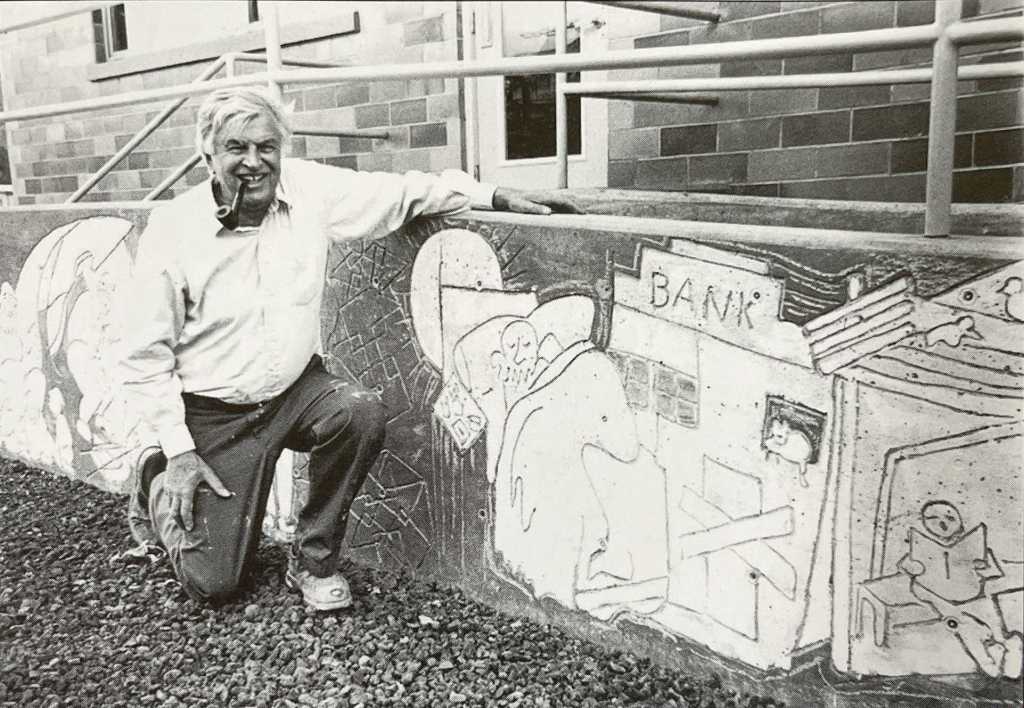
Richard Beyer with a portion of “The Precious Jewel” mural — Al Camp photo

An old man tells a story:
A man mines the sky
and finds a beautiful blue gem.
Holding it to the light he sees the world anew,
in 4 dimensions
The governor is asleep,
The banks are closed,
Cattle have moons in their horns,
Children ride flying horses,
Angels fill the trees,
Rocks speak,
Coyotes dress in Wal-mart suits,
The snake pipes and the rabbits dance,
Fish and the wapato dance too.
He gives the stone to his wife to look through,
To see what he is seeing.
After The Burn

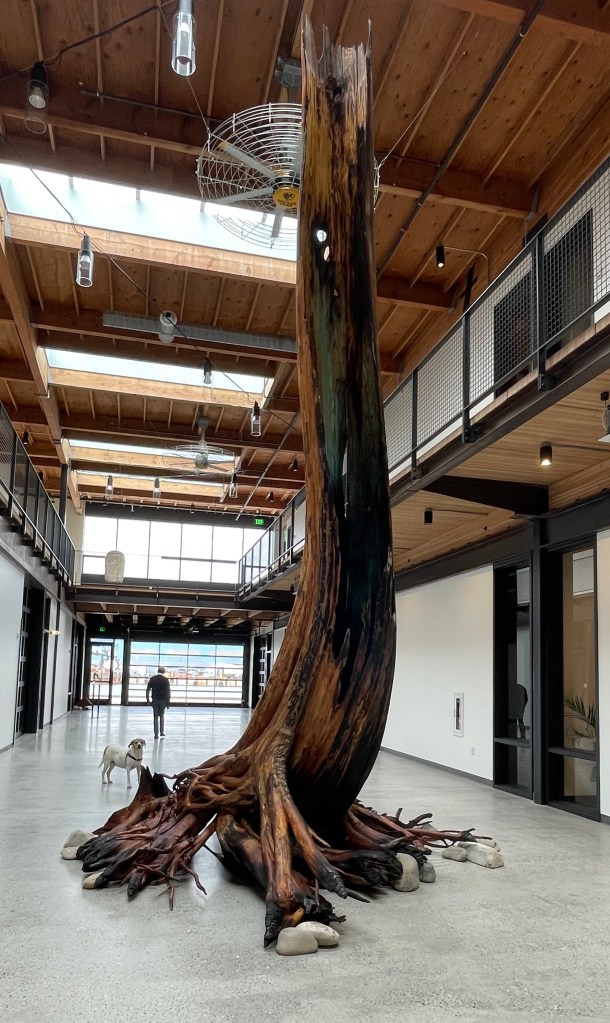
Having lived in wildfire country for decades, I’ve hiked many miles through burned-out forests. I grieved over fallen giants whose blackened bark served as shrouds. Now an urban dweller, I was recently meandering through a very different environment, a contemporary art gallery dominated by concrete and glass. Until … I turned a corner and was unexpectedly back in the burned forest, or a towering representative of it.

The sculpture, created from the twenty-two foot base and roots of a charred and hollowed western red cedar, is a compelling statement of destruction and resurrection. Tori Karpenko, an artist from Twisp, WA., salvaged the tree’s remains in cooperation with the U.S. Forest Service. Karpenko rubbed oil onto every inch of the massive corpse, giving it an ethereal glow, an essence of life after death.

Karpenko titled the work “Invitation.” It tells a story, Karpenko writes: “Of loss … Of fragility and the delicacy of this moment we are in … Of hope in the promise of renewal … Of community, holding everything from the bottom up.”

I’ve long marveled at the self-healing powers of Creation. Almost immediately after a forest fire, there’s a resurgence of life. Ferns emerge, burying thick ash on the forest floor beneath a lush, green carpet. Myriad seeds spring to life. Reporting on fires for our rural, weekly newspaper was inevitably a bitter-sweet experience for my husband and me. We and our staff would photograph and write about the destruction, the drama of firefighters battling to save homes, lives, property. 

John and I would also give each other knowing looks. We would return to the scene the following spring to hunt for the tantalizing morel mushroom. Several species of “burn morels” hide underground for years until fire prompts them to bloom, often en masse.

It’s well known by now that practices and policies over the past century led to needless destruction of forests and wildlands. Fire is not the enemy. Human conceit is. Not that many years ago, I attended a presentation on wildfire and, for the first time, heard a government forester admit, “The Indians had it right.” For centuries, Native Americans skillfully used fire as a tool to keep the forests healthy and productive. 

I’m not into romanticizing any culture over another. I’m not going to delve into whether any economic system or religious dogma is better than any other. Yet we Americans are obsessed with consumerism, materialism and status.  If we were to adopt the spiritual relationship indigenous people of this continent had with Creation — understanding all lifeforms as sacred — that WOULD make America great again.

“Invitation” demonstrates the beauty that results when humans collaborate with nature, when we work in community with nature instead of exploiting or attempting to dominate. Native American writer and scientist Robin Wall Kimmerer calls this reciprocity. The word is threaded through her best-seller, “Braiding Sweetgrass.”

“One of our responsibilities as human people,” she writes, “is to find ways to enter into reciprocity with the more-than-human world. We can do it through gratitude, through ceremony, through land stewardship, science, art, and in everyday acts of practical reverence.”

As co-creator with nature, Karpenko writes: “The tree, once connected to a family of cedars, was also a community of itself. Interwoven roots growing together, strengthening in response to what was needed. The communities we build are our greatest hope of solving the problems of our time. Perhaps this has always been true, the story of human evolution. How can we forget such things?”

Not everyone has forgotten, and we continue to learn — too often the hard way, as with wildfire. Humanity is on a steep learning curve now, discovering how vitally interdependent we are, on each other, on all of Creation. Karpenko, who once had a fire burn within six feet of his bedroom, observes that we all must own it:

“Somebody else started those fires

but we are all a part of this mess

The smoke belongs to everyone

Regardless of where it came from . . .”

PHOTOS: My photo of “Invitation” does not do it justice, other than to give a sense of dimension. To appreciate its beauty, go to Karpenko’s website, https://www.torikarpenko.com/, or even better, visit the Traver Gallery, 1100 E. Ewing Street, Seattle, where the sculpture is on loan by the artist. The bottom photo was taken after a fire near Holden Village, in the North Cascade mountains of Washington state.

Leaf-Taking: It’s hard to let go

We were walking through downtown Seattle’s paradoxical Freeway Park. When you stroll among the park’s lush trees, flowering shrubs and patches of green grass, you’re actually on a lid covering a concrete parking lot and the hectic traffic of Interstate 5.

Two friends and I had just toured the collection of Northwest art at the Arch Convention Center. We were savoring the experience when one of my companions picked up a leaf that had been lying on top of a concrete barrier, as if someone or some spirit had carefully placed it there.

“Look at this!” she exclaimed. “How beautiful!”

Moments earlier we’d been engaging with larger-than-life abstract paintings representing scenes of the Northwest. Now here was nature’s own abstract: exquisitely colored patterns on a six-inch leaf. Nature imitating art imitating nature. 

The design reminded me of antique maps. When they were produced centuries ago, the maps were more products of speculation than settled geography. I recall standing in a British museum, staring at a supposed map of the world, drawn around 1100 CE. It was wildly different from global maps of today but suggested a planet I’d like to visit. Imagined continents were colored in nature’s hues and sharply outlined, surrounded by pale blue seas.

I held the leaf in the palm of my hand, and considered its rust-hued archipelago floating on a multi-shaded green sea. The islands were outlined in thick black, as if one of nature’s elves had laboriously drawn their ragged shorelines with a Sharpie.

Our other companion observed that if I wanted to keep the leaf, I’d have to coat it in wax. I couldn’t imagine struggling with melted wax in my compact kitchen. Maybe, I thought, I could laminate it. I shook my head at the irony. I’m earnestly trying to reduce my use of plastics, yet here I was, considering shrouding nature’s art in that toxic substance?! Yes, I’d like to keep the leaf, but … but … but

Oh, how we battle to not let go — until we have no choice. 

I was pretty sure it was a laurel leaf, but I checked it out with the “Picture This” app on my phone. The app informed me it’s a species of magnolias, also known as “Big laurel,” and declared an alarm in bright-red letters: THIS PLANT IS SICK!

I looked around at the grove of tall, graceful magnolias. I’m no arborist, but they appear healthy. New green foliage seems to be pushing the old brown leaves onto the ground. Or maybe the old leaves are voluntarily making space for the next generation. Are the beautiful images on the dying leaves a last-gasp aria?

As captives of a death-denying culture, it’s difficult for us to see any beauty in dying. Yet much great art through the centuries has depicted exactly that. J.S. Bach’s compelling chorale, “Komm, süsser Tod,” pleads: Come, sweet death, come, blessed rest! Come lead me to peace for I am weary of the world, O come! 

Even though I recently turned eighty, I’m not ready to embrace Bach’s sentiments just yet. I’m more in league with Robert Frost whose poem “Birches” celebrates his boyhood delight in swinging on tree branches, up, up towards heaven. But, he cautions, “May no fate willfully misunderstand me … and snatch me away/ Not to return. Earth’s the right place for love …”

At least for now. 

The colored leaf lay on my table for several days, a temporary totem. Then I gently, reverently put it to rest in the compost bin. Ashes to ashes, dust to dust.

A Concert is More Than the Music

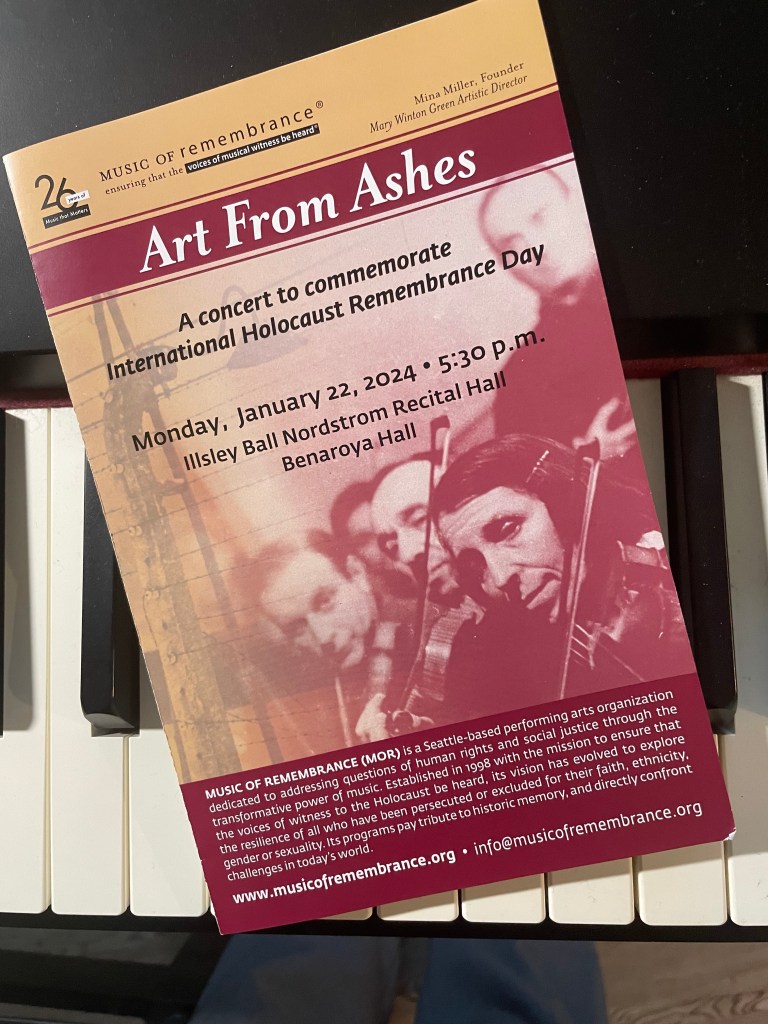
A free concert at Benaroya, Seattle’s premier performance venue. Knowing there’d be a crowd, my neighbor and I left plenty early for our walk to the event commemorating International Holocaust Remembrance Day (Jan. 27). We ended up with time to visit the Garden of Remembrance, which stretches along the west side of Benaroya.

More than eight thousand names of Washington State citizens who died in service to our country since 1941 are etched into the granite walls. Names include people who served in World War II, the Korean War, Vietnam, Gulf War and continuing through post-9/11. I immediately went to the Vietnam section and gently placed my fingertips on the name Keith Henrickson, a high school friend. It’s a gesture I’ve made before, first at the Vietnam memorial wall in Washington, D.C., and again when a traveling replica of that wall visited the Colville Indian Reservation, near my former home. 

I thought about how I’ve lived fifty-five years longer than Keith, who was killed at age twenty-four in Quang Tri province. Yet his name, etched in granite, is an enduring presence that will last long after I’m gone. His and all the other names are an ongoing witness to the tragedies of war. 

Scattered raindrops accented my somber mood as we left the garden and entered the hall. The concert was presented by Music of Remembrance, a nonprofit organization that addresses issues of human rights and social justice through music. As I read the program, I readied myself to shed tears. Many of the pieces were attributed to poets and composers who perished in Nazi concentration camps. 

I wondered about the quartet of pre- and teen siblings a couple rows ahead of me. Would they “get” it? They were jostling and elbowing each other in normal but disruptive ways. Their parents were seated like bookends with their offspring between. I hoped that Mom and Dad could/would keep the kids under control. Then, just as the lights were dimming, I heard the rustle of newcomers settling into the row directly behind us. I looked around to spot a young couple with two children, ages about three and one. 

I immediately flashed back to a free, noon organ concert that my late husband and I attended decades ago at the Mormon Tabernacle in Salt Lake City. The place was packed with tourists. The organist began with a brief welcome and firm direction: “If your child becomes disruptive or makes any kind of noise, do not hesitate to remove them immediately.” I don’t recall the organist’s name, but I have silently evoked his instruction whenever concerts get disrupted by crying or rambunctious children.

The audience dropped into silence for the opening “Intermezzo for Strings,” a floating, ethereal piece performed by The University of Washington Chamber Orchestra. The Jewish composer, Franz Schreker, had been forced from his position as director of an important music conservatory. But he cheated the Nazis out of killing him by dying after a stroke in 1933. 

The program continued, the youngsters in front of me quietly absorbed, the baby behind uttering only an occasional coo that was quickly muffled by her mother. About halfway through came a duet for violin and cello by Gideon Klein, a brilliant musicology student who died in the Fürstengrube camp at age twenty-two. The mournful, longing music ends suddenly mid-phrase, as did Klein’s incomplete life. In the silence that followed, before the audience could gather itself to applaud, the baby let out an anguished wail. Her cry said far more than our applause. Nonetheless, Mom gathered her up and exited the hall.

She missed the grand finale, “Farewell, Auschwitz,” a defiantly jubilant piece commissioned by Music of Remembrance. It was performed by The Seattle Girls Choir and Northwest Boychoir, along with instrumentalists and adult soloists. I was heartened by the discipline and beauty of the young voices. They were learning in a powerful way about an historical truth that too many try to deny.

Upon leaving the hall, I spotted Mom and baby seated on a bench. I perched next to them, the baby giving me a bouncing grin as I told her mom, “I’m sorry you had to miss the end of the concert. She was so good for so long, and I’m glad you brought her. She has that music embedded in her soul now.” Just as I finished speaking, another woman approached.

“Good for you for bringing the children to the concert,” she said. “They’re never too young.” 

Never too young — nor too old — to learn, to change, to grow, to remember.