After The Burn

Having lived in wildfire country for decades, I’ve hiked many miles through burned-out forests. I grieved over fallen giants whose blackened bark served as shrouds. Now an urban dweller, I was recently meandering through a very different environment, a contemporary art gallery dominated by concrete and glass. Until … I turned a corner and was unexpectedly back in the burned forest, or a towering representative of it.
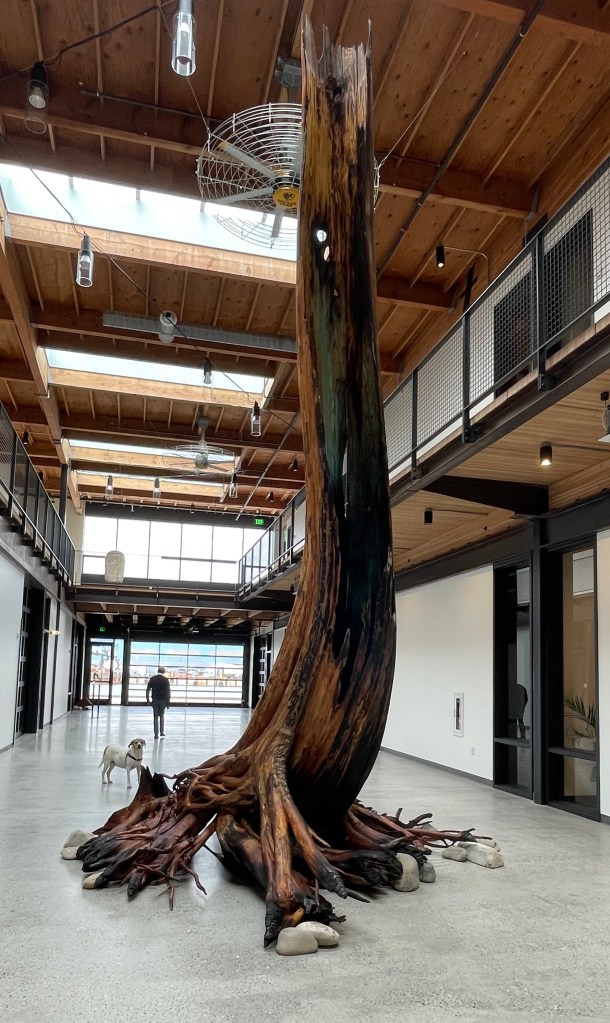
The sculpture, created from the twenty-two foot base and roots of a charred and hollowed western red cedar, is a compelling statement of destruction and resurrection. Tori Karpenko, an artist from Twisp, WA., salvaged the tree’s remains in cooperation with the U.S. Forest Service. Karpenko rubbed oil onto every inch of the massive corpse, giving it an ethereal glow, an essence of life after death.

Karpenko titled the work “Invitation.” It tells a story, Karpenko writes: “Of loss … Of fragility and the delicacy of this moment we are in … Of hope in the promise of renewal … Of community, holding everything from the bottom up.”

I’ve long marveled at the self-healing powers of Creation. Almost immediately after a forest fire, there’s a resurgence of life. Ferns emerge, burying thick ash on the forest floor beneath a lush, green carpet. Myriad seeds spring to life. Reporting on fires for our rural, weekly newspaper was inevitably a bitter-sweet experience for my husband and me. We and our staff would photograph and write about the destruction, the drama of firefighters battling to save homes, lives, property. 

John and I would also give each other knowing looks. We would return to the scene the following spring to hunt for the tantalizing morel mushroom. Several species of “burn morels” hide underground for years until fire prompts them to bloom, often en masse.

It’s well known by now that practices and policies over the past century led to needless destruction of forests and wildlands. Fire is not the enemy. Human conceit is. Not that many years ago, I attended a presentation on wildfire and, for the first time, heard a government forester admit, “The Indians had it right.” For centuries, Native Americans skillfully used fire as a tool to keep the forests healthy and productive. 

I’m not into romanticizing any culture over another. I’m not going to delve into whether any economic system or religious dogma is better than any other. Yet we Americans are obsessed with consumerism, materialism and status.  If we were to adopt the spiritual relationship indigenous people of this continent had with Creation — understanding all lifeforms as sacred — that WOULD make America great again.

“Invitation” demonstrates the beauty that results when humans collaborate with nature, when we work in community with nature instead of exploiting or attempting to dominate. Native American writer and scientist Robin Wall Kimmerer calls this reciprocity. The word is threaded through her best-seller, “Braiding Sweetgrass.”

“One of our responsibilities as human people,” she writes, “is to find ways to enter into reciprocity with the more-than-human world. We can do it through gratitude, through ceremony, through land stewardship, science, art, and in everyday acts of practical reverence.”

As co-creator with nature, Karpenko writes: “The tree, once connected to a family of cedars, was also a community of itself. Interwoven roots growing together, strengthening in response to what was needed. The communities we build are our greatest hope of solving the problems of our time. Perhaps this has always been true, the story of human evolution. How can we forget such things?”

Not everyone has forgotten, and we continue to learn — too often the hard way, as with wildfire. Humanity is on a steep learning curve now, discovering how vitally interdependent we are, on each other, on all of Creation. Karpenko, who once had a fire burn within six feet of his bedroom, observes that we all must own it:

“Somebody else started those fires

but we are all a part of this mess

The smoke belongs to everyone

Regardless of where it came from . . .”

PHOTOS: My photo of “Invitation” does not do it justice, other than to give a sense of dimension. To appreciate its beauty, go to Karpenko’s website, https://www.torikarpenko.com/, or even better, visit the Traver Gallery, 1100 E. Ewing Street, Seattle, where the sculpture is on loan by the artist. The bottom photo was taken after a fire near Holden Village, in the North Cascade mountains of Washington state.

For Earth Day: Keep an Eye on the Sky

With Earth Day approaching, I find myself thinking less about the planet that grounds us and more about the sky beyond. Today’s clear blue sky is living proof of how our human family, when properly motivated, can solve problems.

I remember that first Earth Day in 1970. A 25-year-old naive idealist, I was living on Vashon Island in Puget Sound. A few of us islanders marched down our rural highway in protest of pollution, pollutants, and polluters. We didn’t exactly attract a crowd.

Sunsets in those days were spectacular because the air from Tacoma to Seattle and beyond was dense with industrial and vehicular emissions. A college friend, who’d just earned his business degree, worked at the St. Regis mill on Tacoma’s tide flats, source of the notorious “Tacoma aroma.” He’d make a point of drawing a deep breath and declaring, “Ah, the smell of money!”

After all these years, the Tacoma aroma is no more. I still enjoy sunsets over Puget Sound, but the colors are more delicate, splayed across clear blue skies. What happened? In that year, the Clean Air Act was passed and the Environmental Protection Agency created. By the 1990s, Americans were getting on board with recycling, and in 2010, a billion people participated globally in Earth Day events.

This year’s worldwide Earth Day challenge is “Planet vs. Plastics.” If you want to get hyped and have 48 seconds to spare, catch the video on the Earth Day website: https://www.earthday.org/.

Plastic is a tragic legacy of my generation. Remember the one word of advice offered to Dustin Hoffman’s character in “The Graduate”? 

“Plastics!” It might as well have been a snake hissing, “Eat the apple!”

But I was speaking of air quality. Stay with me, if you would, because Washington state has one of the most advanced programs in the nation to curtail green house gases — the Climate Commitment Act. Yet on Earth Day, instead of celebrating progress, we’ll be hunkering down to withstand a predictably noisy campaign to repeal that law. It’s one of those confusing ballot issues: if you’re for something, like clean air, you have to vote against.

The CCA is a cap-and-trade program. Simply put, a hundred or so major polluters in the state are required to pay for polluting above a certain level. The law went into effect just last year, yet already raised $1.5 billion. That money is designated for a vast array of programs, such as assisting communities that are overburdened by their industrial neighbors, combatting wildfires, and making public transportation available to more of the public.

The repeal effort started with one wealthy hedge fund manager who poured a million bucks into putting six initiatives before the Legislature. He was the single largest backer. Thus, along with other complex issues, we voters will be asked to consider Initiative 2117, repealing the CCA. Given that many millions will be spent on the campaign, those numbers — 2117 — will likely be imprinted deep into our brains. Bill Gates, who easily has as much money to toss around as any hedge fund manager, has already contributed a million to defeat the initiative.

Another opponent includes — astonishingly — one of the bigger polluters, oil company BP, which operates the largest refinery at Cherry Point. Apparently BP accepts paying for the cap-and-trade allowances as an inevitable cost of doing business. The company issued a statement saying the law “helps companies develop climate strategies.”

As my college buddy all those years back in Tacoma said, “Ah, the smell of money!” As the barrage of 2117 and all the other political advertising gets underway, I’m sensing a coma aroma. 

Roads Less Traveled By

Coyote Falls in the foreground, Enloe Dam in the background

My late husband John could recite from memory Robert Frost’s poem, “The Road Not Taken.” I too relish roads “less traveled by,” sometimes to my peril.

Just last week, I started off innocently enough. Destination: Coyote Falls on the Similkameen River, near the Canadian border, less than an hour’s drive from home. I planned to attend the traditional Native American salmon ceremony, when fish are invited to return to their spawning grounds. Tribes have been doing this for millennia, although these days the ceremony is pretty much symbolic with a soupçon of politics. Just above Coyote Falls, salmon are blocked from proceeding upriver by the defunct Enloe Dam. The dam hasn’t produced power in half-a-century. Indian tribes on both sides of the border and various environmental groups are campaigning to have it removed.

There’s a fine hiking trail on the other side of the river, but the ceremony was to be held on the road side. In my case the wrong road. The river flows through a deep canyon. High on the canyon wall, a two-lane, paved road snakes around multiple curves. I knew I’d have to turn onto a gravel road to reach the canyon bottom at some point, but I couldn’t remember where that turnoff was. I’d noticed a bright blue car in my rearview mirror and then, after one of the curves, that car had disappeared. By then I’d driven beyond the falls and dam and decided I must have missed the turn-off.

After a quick u-turn, I spotted a flash of blue making its way down a steep, winding gravel road. You don’t usually follow someone who’s behind you. That alone should have been a warning. Slowly, cautiously I proceeded downward, noting the “Primitive Road” warning sign that the county posts on back roads that are not maintained. This one should have had a skull and crossbones at the bottom.

By the time I realized I had no business on that road, it was too late. With barely a single lane, I clung to the canyon wall that brushed my car on the left, trying not to think about the sheer drop-off on my right. The ruts were troughs, littered with rocks and shards that threatened to high-center the car. Downward I crept in low gear, wishing I had a lower than low-low gear. I tried to calm myself by talking to John, pleading with his spirit to intervene, rescue me.

Finally, miraculously, halfway down the canyon, I reached a wide spot. The blue car had pulled off and parked, as did I. Thank you, John! I noticed the other driver, whom I didn’t know, had started walking downward and then stopped to wait for me. 

“I’m so sorry I took that road,” I said as I got out of my car. “Me, too,” he admitted. Turned out he was a tribal member from British Columbia. He asked where I was from. When I answered “Omak,” he asked, “You Colville?” Never before has anyone confused this blue-eyed blonde as Native. I was deeply flattered. I explained that I’ve lived for a long time along the Okanogan River, which is fed by the Similkameen. “I love the river and all its inhabitants,” I continued, as if I expected the cast of characters from “Wind in the Willows” to join us at any moment. 

Despite my lack of tribal bona fides, he treated me as the elder that I am, generously offering his arm to steady me as we scrambled downward. At this point, the road was pretty impassable even on foot. I gasped when we finally reached a large, flat area, where a dozen or more cars were parked.

“How did they get here?!” I exclaimed. That’s when we noticed the other road — the one MORE traveled by. We could have taken it had we gone up the canyon a little further.

I never did make it all the way down to the river but watched the ceremony from the bank above. The drum beat and chanting were inaudible above the roar of the falls. Still, I joined others in rhythmic clicking of rocks, calling to the salmon. Tribal biologists tell us that native fish returning to our river are pitifully few and far between. Eliminating the dam, one biologist said at a recent meeting, is “their only chance.”

I walked away from the river, wondering if my own chances of getting my car back up that road were equal to salmon butting heads against a concrete dam. But a combination of prayer, John’s encouragement, and front-wheel drive pulled me slowly, safely upward. Back on pavement, I was heading home when a coyote ran across the road ahead of me. I slowed and noticed that he stopped in the middle of an alfalfa field, turning back to watch me. In Native legend, the coyote is a trickster, a mischief-maker.

“Yeah, you thought you had me back there at Coyote Falls,” I said. “But all you did was teach me a lesson. From here on, I’ll be taking the roads more traveled by.”