Ferry Tales: Scandalous events at last revealed

Among the joys of old age: you finally get to reveal long-held, sometimes scandalous secrets. Either those involved have passed on, or the events were so far back, they can no longer embarrass. 

This thought came to mind as I read a Seattle Times story about the retirement of two venerable Washington state ferries: the Elwha and Klahowya. Both are headed to the scrap heap.

I was a frequent commuter aboard the Klahowya in the 1970s, when I lived on Vashon Island. A sedate, hard-working vessel, the Klahowya received little notice as she sailed a triangular route between Southworth on the Olympic Peninsula, Vashon Island’s north end, and Fauntleroy in West Seattle. 

The Elwha was another matter, involved in one maritime scrape after another. The Times piece quotes Steven Pickens, Puget Sound ferry historian: “I will not be sorry to see the Elwha go. In fact I’d probably give it a kick on the way out if I could. I’ll miss the Klahowya.”

Likely the Elwha’s most infamous incident was in 1983, when she went off-course sailing from Anacortes to Orcas Island. She hit a reef, causing a quarter-million dollars worth of damage and a major interruption of service. Reason for the stray? Turned out the captain had a passenger in the wheelhouse to whom he’d “taken a shine.” He’d rerouted so the passenger could see her house from the water. Both the skipper and the head of the state ferry system lost their jobs over that one.

By 1983 I was living in the drylands of Eastern Washington, my ferry commuting days behind me. Yet I wasn’t at all surprised with the news of shenanigans in the wheelhouse.

Besides commuting aboard the Klahowya, I frequently was a passenger on the much smaller Hiyu II. She ferried islanders from the south end to Tacoma throughout the 1970s. She was a small boat on a short run, serving a tight community. Everyone knew everyone. Passengers were commonly invited to the wheelhouse to chat with the skipper and crew. Understandable. Steering a boat back and forth, forth and back, back and forth, could get pretty tedious.

Hiyu II ferried islanders between Vashon and Tacoma

One sunny afternoon, my parents my and I boarded the Hiyu for their first island visit. The deck crew ushered us to the wheelhouse. My mother was especially thrilled. In her college years, she worked as a waitress aboard a cruise ship on the Great Lakes. Yet I doubt she’d ever made it to the wheelhouse. 

For decorative reasons, the builders of the Hiyu had installed old-fashioned wooden steering wheels. It was a wheelhouse, after all. The vessel was actually steered by toggle switches on a kind of horizontal dashboard. The skipper, who had total control of the ferry at all times, asked Mom if she’d like to steer, pointing to the fake wooden wheel. Thrilled, she took the wheel, standing straight and tall as the ferry held its course. 

“I can’t believe he let me do that!” she later exclaimed as we descended the stairs to the car deck. She was excited, yet a little dubious. Was it really appropriate for a common citizen to steer the boat? Obviously that particular skipper (who, I emphasize, is no longer in this realm) enjoyed playing that trick for special passengers. I’m sure that kind of “hospitality” ended as of 1983.

The Hiyu II has been refurbished as an entertainment venue on Lake Union. I could rent it for three hours of sailing for a mere $10,000. I doubt any party I could dream up would be as much fun as that afternoon cruise when my mother skippered a Washington state ferry.

If A Hippopotamus Can Fly: Why, oh why, can’t I?

News item: “…researchers discovered that hippopotamuses — which can weigh up to 8,000 pounds — become airborne with all four feet off the ground for up to 15 percent of the time while running at full speed, or for about 0.3 seconds.” (The Week, July 19, 2024)

I reckon I was airborne for about 0.003 seconds before my recent bone-shattering crash on a Seattle sidewalk. I weigh — well, a lot less than 8,000 pounds — and I had only one foot off the ground at a time as I walked at a reasonable pace. Yet there I was, flattened, while the hippopotamus continues to soar through the air. It’s a miscarriage of justice —an unequal application of the law of gravity.

Gravity is out to get us humans. We teeter around on two legs, at a distinct disadvantage to four-legged critters. Scientists tell us that our long-ago ancestors switched from four- to two-legged travel to save calories. We use less energy when walking than our relatives, the chimpanzees, who employ both knuckles and toes as they stride through the jungle. 

The World Health Organization reports that globally, 684,000 people die from falls each year. In this country, says the Center for Disease Control, falls are the leading cause of injury for adults 65 years or older and, even more frightening, the leading cause of injury-related death in that same age group. 

My friends and family offered all sorts of kindly advice during my two-week hospital stay, followed by a few days in rehab, and now as I continue therapy at home. “You don’t want to fall again,” they lovingly caution. Fact is, I didn’t want to fall in the first place. I’ve long been pro-active to avoid falling. I own and used a balance board; I stood on one leg while brushing my teeth; I continually engaged in core strengthening exercise; I wore sturdy walking shoes, and just FOUR DAYS before my fall, I completed a balance/fall-prevention class. 

“Perfect score,” the instructor told me, happily adding: “but of course, you had a perfect score at the start.”

The reasons we fall are complex. The CDC lists lower body weakness, vitamin D deficiency, difficulties with walking and balance, medications that affect balance, vision problems, foot pain or poor footwear, home hazards or dangers such as broken or uneven steps, throw rugs or clutter, etc. In my case, it was an uneven bit of concrete sidewalk. Gravity happens.

Reading through the CDC brochure, “Staying Independent,” I checked a definite “yes” next to the statement, “I am worried about falling.” The brochure commentary is not particularly helpful: “People who are worried about falling are more likely to fall.”

In his book “Falling Upward,” spiritual writer Richard Rohr offers a more encouraging point of view. In this “second half” of life, he suggests, we are free to fall, although not in a physical sense. We no longer have to protect our fragile egos, no longer must we “push the river,” no longer must we strive to have what we love, instead, we love what we have. Rohr cites St. Francis, who “spent his life falling, and falling many times into the good, the true, and the beautiful.” I’m willing to take that kind of fall.

I’m convinced my fall prevention work saved me from worse injuries and speeded my recovery. The CDC says one in every four older adults reports falling each year. I count as one this year, which means three others are off the hook. I hope, dear reader, you’re among the three.

Letting Go

One reason for moving from my house to a studio apartment is to simplify life: live with less. But living on the light side is counter-cultural if not downright unpatriotic. After all, the “Consumer Confidence Index” — meaning our willingness to buy — is vital to the nation’s economic well-being. We Americans cooperate. We’re apparently more eager to buy than to vote.

The late comedian George Carlin, in a now-classic standup routine, summarized Americans’ obsession with acquisition in one word: “stuff.” The “whole meaning of life,” Carlin claims in oft-viewed videos, is “finding a place for your stuff.” That may be true until you reach a certain age. Then the meaning of life revolves around letting go of your stuff.

It’s painful, but it can be profitable. If you hold a yard or garage sale, you’re part of a grassroots market that puts an estimated $1.5 to $2 billion into American pockets annually. That’s a guesstimate by encyclopedia.com. The 6.5 to 9 million garage/yard sales held throughout the year are largely unofficial, unreported — and untaxed.

You can always let stuff go without letting go, but it’ll cost. Some ten percent of Americans pay an average upwards of $100 monthly to hang on to whatever. The booming storage rental industry makes $38 billion a year, including $65 million from auctioning off contents of units when renters forget to pay the rent, run out of money, no longer care, die, or whatever. 

If you try to salve your letting-go wounds by recycling, sorry, but it may not be all that effective. A  recent study, “America’s Broken Recycling System,” concludes that less than a third of the items left at recycling centers actually do get recycled or composted. Nonetheless, the recycling and/or landfill industry ballooned from $82 billion in 2021 to $91 billion last year. (Those figures are national and do not reflect the efficiency of local recycling efforts.)

I opted for a three-day moving sale, held on a sunny weekend, made entirely possible by volunteer workers from the Okanogan Valley Orchestra and Chorus, which got half the proceeds. Thanks to them, it was a heap of fun. In a rural community where everybody knows everybody, shoppers learned even more about me — A to Z — from my taste in Art to Zippered storage bags. I celebrated with grinning shoppers who strolled out with a new-to-them treasure that I had long treasured. “What a steal,” they were thinking. “For both of us,” I was thinking.

Alternative D — donating — satisfies the soul, especially if it’s really good stuff. I dreaded the thought of selling my car online, so I donated it to public radio. They’ll pick up your car at your door and give you a tax write-off.

I like to believe that I have winnowed my possessions so I no longer have mere “stuff,” but a higher class of items: “things.” It required only a pickup truck pulling a twelve-foot trailer to haul my “things” to my new apartment in Seattle. Carefully labeled boxes are stacked in a corner, leaving just enough space for bed and chairs. Uh, but I sold those.

Right. Gotta go shopping.

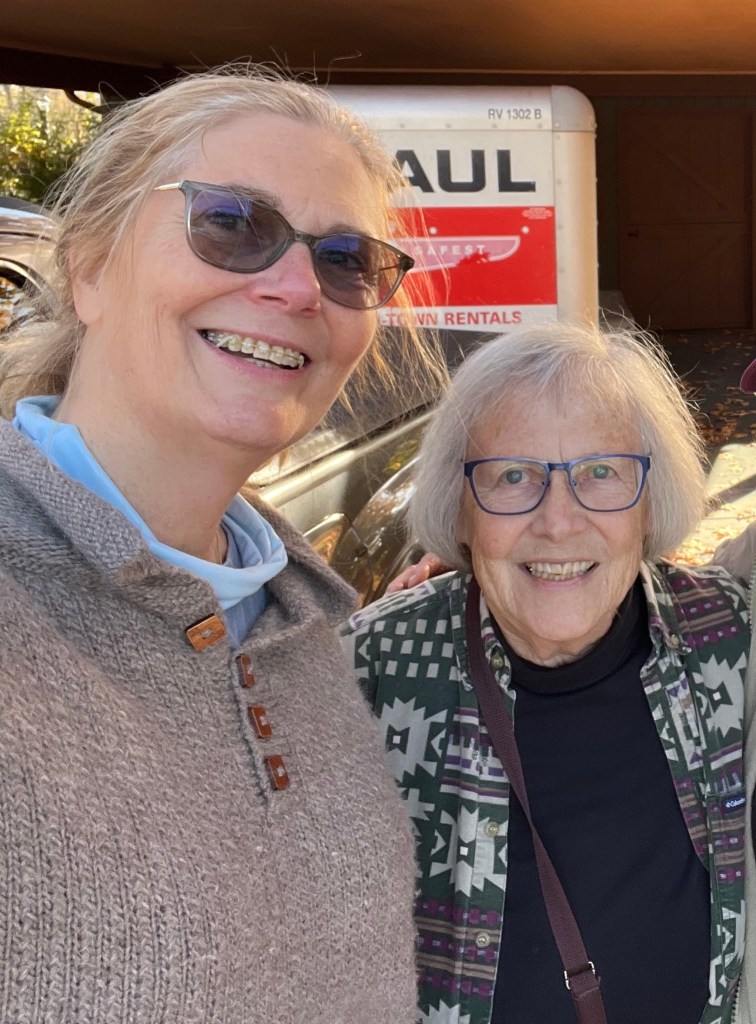
Moving day: All it takes is a rental trailer and ace truck driver, my niece Sandy

NEIGHBORS ARE THE FOLKS WHO SHOW UP – Even For False Alarms

Floating the Okanogan River on a hot summer day. What could possibly go wrong?

You know you live in a safe neighborhood when your car alarm goes off and your neighbors come running, fully armed — with cell phones, all Googling variations of “shut off car alarm.”

It’d been a quiet afternoon in my relatively crime-free neighborhood. I’d gone out to the carport, key in hand, and was about five feet from the driver’s door when the car threw a hissy-fit. Locking itself down tight, it refused to acknowledge any commands I entered on the keypad, ignored all the neighbors’ Google-advised maneuvers, and trumpeted an ear-splitting tirade. 

Every once in a while, the car would wear itself out, like a child throwing a temper tantrum who finally has to stop and gasp for breath. My neighborhood consortium would consult in whispers. Then someone would try to turn a key or open a door, and BLA-A-A-T!, the horn would start again.

Google provided the final diagnosis: my car was “brain” dead, in a self-imposed coma. The solution was like rebooting your computer. Simply disconnect, then reconnect, the battery. 

Google this: who were the nincompoop engineers who designed my Dodge Journey so that you have to remove the front left tire just to get to the battery? Ultimately my mechanic graciously made a house call, removed tire and battery, recharged the latter, put it all together again, and peace reigned in my neighborhood.

Until last week. 

People floating, swimming, and wading in the river that runs past my house are a common sight on these hot days. But it was nearly 9 p.m. with only remnants of daylight left when I spotted three youngsters in the river. In most places at this time of year, the water is shallow enough so that people who can’t swim “ride” the current. Their toes briefly bounce off the bottom, the current pulls them for a few yards, and then they bounce again. Bounce. Float. Bounce. Float. The children had already bounced/floated past my house when I spotted them.

This lazy, shallow river is deceptive. It has an insistent current and an inconsistent bottom. You can happily wade in the shallows and suddenly you’re in over your head. People drown in this river.

The youngsters (about twelve, ten, and eight years old, I’m guessing) had no flotation devices and no adults in view.  The current was carrying them into the river bend, where the water would be too deep for the youngest especially. I grabbed my car keys and ran outside. My neighbors were buttoning up their evening’s yard work.

“I’m worried about some kids in the river!” I called. As I pulled out of my carport, a neighbor jumped into the passenger seat. I drove the one block to a spot where we’d be able to access the dike. The neighbor reached into his pocket.

“I’ll leave my phone here,” he said, certain that he’d be getting wet. I held onto my phone, ready to dial 9-1-1. We ran to the top of the dike and spotted the kids. In the mere minute it’d taken us to get there, they’d somehow made it across the current into shallow water on the other side. The eldest was holding her hands aloft in a triumphant gesture. From there they’d be able to clamber up the bank and, I hoped, head home.

I apologized to my neighbor for yet again issuing a false alarm. He shook his head. He’s an experienced fisherman who grew up along this river. “These currents can be tricky,” he said.

A long time ago a wise man was asked, “Who is my neighbor?” Two thousand years later, whether you’re a Bible reader or not, you understand the meaning of “good Samaritans.” They still exist, they show up, and more than likely, they carry a cell phone.

Remember those “American Graffiti” teenagers? We’re seventy-eight

“You have five months to lose twenty pounds and get your teeth whitened.”

That was my friend Sally after I told her I’d registered for my high school class reunion — sixtieth! As the date draws ever closer, I still haven’t followed her advice, including item three on her list: buy an underwire bra with power uplift. Solitary life following Covid lock-downs freed my girls to hang loose. We’ll never go back.

This will be my first reunion since the twentieth. That was a noisy, crowded cocktail party — the kind of event I like to avoid. Conversely, I enjoyed my late husband’s reunions. His small-town graduating class numbered fewer than a hundred; they got together for convivial, laid-back dinners. Everyone knew everyone, unlike my graduating class of some five hundred. 

My graduation photo

The Class of ’62 was comically and accurately depicted in the film “American Graffiti,” whose high school seniors were obsessed with rock ’n roll, cruisin’ and hormonal confusion. George Lucas, who wrote and directed the movie, also graduated in 1962, in Modesto, California. My high school was Woodrow Wilson, Tacoma, Washington. I travelled across the country the summer after I graduated and found that my fellow eighteen-year-olds were pretty much the same nationwide. I wonder, as we confront the deep polarization in our country now, if the Class of ’62 is still so homogenous.

No question these sixty years have been tumultuous, shaking our very foundations. We’ve weathered Vietnam and draft card burning, the fight for women’s rights and bra burning, racial protests and entire neighborhoods burning, and now our mother — Earth — burning. There’ve been assassinations, the technology revolution, 9-11, the longest war in American history, climate change, global shifts toward authoritarian governments, and a pandemic. Not even Lucas could’ve dreamed up such a sequence of events in one lifetime.

As just a slight tremor among all those earthquakes, Woodrow Wilson High School no longer exists by that name. Given our twenty-eighth President’s dubious record on issues such as racial equality, school district powers-that-be changed the name to Dr. Dolores Silas High School. She was the district’s first black woman administrator and also sat on the city council. We’re told students have shortened that to “SIHI,” which sounds like everyone’s taking a deep breath. Advisable.

I likely wouldn’t attend this reunion except that I promised Nick, one of the handful of classmates I’d kept in touch with. After the fifty-fifth reunion, Nick scolded me for missing — again! — and made me swear I’d be at the sixtieth. Last year Nick, the picture of health, keeled over and died of an apparent heart attack while running a weed-eater in his yard.

The reunion invitation was accompanied by a list of classmates who have died. I got out my yearbook and looked up the graduation photo for each name. Given our class size, there were many I didn’t remember. For those I did know, looking at their eighteen-year-old faces felt like they’d died way too young. By skipping all those reunions, I knew nothing about their lives after high school. I missed a lot of good stories. Everyone has at least one.

Catching up on those stories is reason enough to attend the reunion. That, and my promise to Nick.

Ah! The patina of age

Flushed With Success

Seven a.m. My first thought as I awaken this perfect summer morning, a cool breeze gently lifting my eyelids, is of the clogged drains in my kitchen sink. No! I inwardly moan. I don’t want to think about plumbing issues first thing. I want to wake up with gratitude, with joyful expectations for the gift of a  new day.

But what can I expect when the last thing I encountered the previous night was a sink half full of backed-up, icky gray water, a sight as welcome as a slug in the garden but draining at nowhere near a slug’s pace. I’d spent the evening as YouTube instructed, dosing the drains with boiling water, baking soda and white vinegar. While the soda and vinegar combo created a satisfying froth, they did nothing to clear the blockage. 

It’s early, but with a twinge of hope I call The Plumber. The answering machine gives me his cell phone number “in case of an emergency.” One person’s emergency is another person’s mere inconvenience. I won’t call the cell phone because I want to be in good graces with The Plumber, because I want him to come THIS day, because it’s Friday and because I’m expecting a house guest this weekend.

Seven-thirty a.m. My dog and I head out for our morning walk, basking in 70 degree temperatures, knowing it will be in the 90s by this afternoon. The dog is basking, at least. My mind is going round and round, practicing words of entreaty for The Plumber. Stop it! I interrupt myself. And I scold: you should just be thankful you have pure, safe water that runs, even if it doesn’t drain. Think of all the people who don’t have the conveniences of kitchen, bathroom, laundry. And when you’re done with that, pay attention to the pastel blue sky, the floating clouds, the swaying trees, the sweet air, the bird songs, the river’s persistent flow … oh! that my drains would flow as freely as the river.

Eight-thirty-two a.m. I call again and a real live human answers. I explain my plight. “Okay, I’ll tell them,” she says, carefully making no promises. I babble some more. “Yup,” she says. “I’ll let ‘em know.” I envision The Plumber and his crew casually discussing triage over their morning coffee. Which of the callers have a bona fide emergency and which are merely inconvenienced?

My neighbor and his son happen by and chide me for not calling them first. The son would’ve freed the drains with a plunger (at this point the son makes plunging motions in the air) and would’ve saved me a lot of money. 

Eight-forty-five-ish. Plumber and helper arrive! They go to work as quickly and efficiently as an ambulance crew. While the assistant operates the electric rooter, The Plumber explains why plunging wouldn’t have been sufficient. In older houses like mine, he says, the pipes slowly deteriorate, the metal chipping off in flakes that need to be ground up with the rotating rooter head. As he lectures, he too is demonstrating with his hands so I can envision the chipping metal and rotating machinery. The eroding bits of metal and other gunk need to be forced through my pipes and carried away into the city sewer.

In his own home, The Plumber continues, once a month he fills his sinks with hot water, then pulls open the drains simultaneously to create a tsunami that will push accumulated debris onward to the ultimate destination, the city water treatment plant. Suddenly my mind is swirling as fast as the rooting device, only I’m moving backward, through decades, to The Big Flush! 

My late husband and I lived in a house twice as old and three times as big as my current home. Every once in a while, when the aged drains began to balk, he would announce, “It’s time for The Big Flush!” He’d fill all the sinks, stationing me downstairs, poised for action, with him upstairs at Command Central. When all was ready, he would yell, “FLUSH!” We’d run around opening sink drains and flushing toilets.

I thought it was hilariously fun. I didn’t understand the mechanics, but it worked. As far as I knew, he was employing some kind of metaphysical incantation. I never knew how he knew what he knew. He had an uncanny genius for solving household problems, maybe the result of growing up on a farm.

Nine-thirty-two a.m. Plumber and helper have cleaned up and left. Drains are draining. I’m  reliving cherished memories of my problem-solving beloved. I learned so much from him, and — fifteen years after he’s gone — still I learn. I open my calendar, click on the date one month from today and type in a reminder: FLUSH!

shiny kitchen sink
Happiness is a well-drained sink

Roads Less Traveled By

Coyote Falls in the foreground, Enloe Dam in the background

My late husband John could recite from memory Robert Frost’s poem, “The Road Not Taken.” I too relish roads “less traveled by,” sometimes to my peril.

Just last week, I started off innocently enough. Destination: Coyote Falls on the Similkameen River, near the Canadian border, less than an hour’s drive from home. I planned to attend the traditional Native American salmon ceremony, when fish are invited to return to their spawning grounds. Tribes have been doing this for millennia, although these days the ceremony is pretty much symbolic with a soupçon of politics. Just above Coyote Falls, salmon are blocked from proceeding upriver by the defunct Enloe Dam. The dam hasn’t produced power in half-a-century. Indian tribes on both sides of the border and various environmental groups are campaigning to have it removed.

There’s a fine hiking trail on the other side of the river, but the ceremony was to be held on the road side. In my case the wrong road. The river flows through a deep canyon. High on the canyon wall, a two-lane, paved road snakes around multiple curves. I knew I’d have to turn onto a gravel road to reach the canyon bottom at some point, but I couldn’t remember where that turnoff was. I’d noticed a bright blue car in my rearview mirror and then, after one of the curves, that car had disappeared. By then I’d driven beyond the falls and dam and decided I must have missed the turn-off.

After a quick u-turn, I spotted a flash of blue making its way down a steep, winding gravel road. You don’t usually follow someone who’s behind you. That alone should have been a warning. Slowly, cautiously I proceeded downward, noting the “Primitive Road” warning sign that the county posts on back roads that are not maintained. This one should have had a skull and crossbones at the bottom.

By the time I realized I had no business on that road, it was too late. With barely a single lane, I clung to the canyon wall that brushed my car on the left, trying not to think about the sheer drop-off on my right. The ruts were troughs, littered with rocks and shards that threatened to high-center the car. Downward I crept in low gear, wishing I had a lower than low-low gear. I tried to calm myself by talking to John, pleading with his spirit to intervene, rescue me.

Finally, miraculously, halfway down the canyon, I reached a wide spot. The blue car had pulled off and parked, as did I. Thank you, John! I noticed the other driver, whom I didn’t know, had started walking downward and then stopped to wait for me. 

“I’m so sorry I took that road,” I said as I got out of my car. “Me, too,” he admitted. Turned out he was a tribal member from British Columbia. He asked where I was from. When I answered “Omak,” he asked, “You Colville?” Never before has anyone confused this blue-eyed blonde as Native. I was deeply flattered. I explained that I’ve lived for a long time along the Okanogan River, which is fed by the Similkameen. “I love the river and all its inhabitants,” I continued, as if I expected the cast of characters from “Wind in the Willows” to join us at any moment. 

Despite my lack of tribal bona fides, he treated me as the elder that I am, generously offering his arm to steady me as we scrambled downward. At this point, the road was pretty impassable even on foot. I gasped when we finally reached a large, flat area, where a dozen or more cars were parked.

“How did they get here?!” I exclaimed. That’s when we noticed the other road — the one MORE traveled by. We could have taken it had we gone up the canyon a little further.

I never did make it all the way down to the river but watched the ceremony from the bank above. The drum beat and chanting were inaudible above the roar of the falls. Still, I joined others in rhythmic clicking of rocks, calling to the salmon. Tribal biologists tell us that native fish returning to our river are pitifully few and far between. Eliminating the dam, one biologist said at a recent meeting, is “their only chance.”

I walked away from the river, wondering if my own chances of getting my car back up that road were equal to salmon butting heads against a concrete dam. But a combination of prayer, John’s encouragement, and front-wheel drive pulled me slowly, safely upward. Back on pavement, I was heading home when a coyote ran across the road ahead of me. I slowed and noticed that he stopped in the middle of an alfalfa field, turning back to watch me. In Native legend, the coyote is a trickster, a mischief-maker.

“Yeah, you thought you had me back there at Coyote Falls,” I said. “But all you did was teach me a lesson. From here on, I’ll be taking the roads more traveled by.”