Chicken or Egg: Where Are You Comin’ From?

If you’ve ever puzzled over the chicken/egg primacy issue (which came first?), you might find your answer aboard the Coast Starlight Seattle-Portland train route. 

Or do I mean Portland-Seattle?

As part of “Trails and Rails,” a cooperative venture between Amtrak and the National Park Service, knowledgeable volunteers spend their summers entertaining passengers with stories about Pacific Northwest environment, history and culture.  (At least they did last summer. Who knows whether this admirable program will survive?)

Kristy and Phil, volunteers on my journey, were armed with notebooks full of facts and figures. But it was their story-telling skill that hooked passengers who filled the glass-domed observation car.

Approaching the Billy Frank Jr. Wildlife Refuge, just north of the state capitol, Phil described Frank as the “man who was arrested more times than anyone else in the state of Washington.” 

“What would you say about such a person?!” he continued, feigning dismay. Tourists murmured, disconcerted. Those in the know smiled at this introduction to one of the state’s most honored Native American activists and environmentalists. True, Frank (1931-2014) was arrested more than fifty times. The first time, at the age of fourteen, was the beginning of his decades-long fight to reestablish native fishing rights. His persistence led to the landmark Boldt Decision of 1974, upholding guarantees that had been set in an 1854 treaty but ignored. Frank’s numerous honors include the Presidential Medal of Freedom.

More stories flowed as the train whistled us through cities and towns until we approached Winlock, a small, agricultural community.

“If you remember nothing else from this trip, I hope you remember this,” prompted Kristy. Winlock historically touted itself as the “Egg and Poultry Capital of the World,” producing hundreds of thousands of chicks and eggs. To prove it, the town erected the world’s largest egg, a claim affirmed by “Ripley’s Believe It Or Not!” in 1989. 

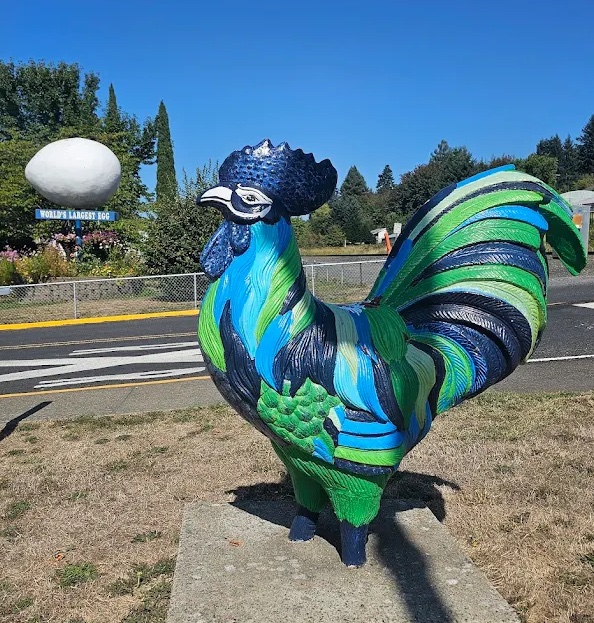
Just across the street is another statue: a brilliantly colored but much smaller chicken. As to which came first, the answer depends on what direction you’re going. Heading south, the egg comes first. Going north, it’s the chicken.

That’s US!, I realized.

As in, U.S.

As in polarized. We’re all on the same set of tracks, but our stories depend on where we’ve been and where we think we’re going — or want to go. 

Each of us is the sum and substance of the stories we tell ourselves about ourselves. Information or ideas that don’t fit into our stories bring up uncomfortable emotions — sadness, envy, anger — and we’re inclined to reject them, as if to say the chicken absolutely came first or the egg absolutely came first. In other words, we have bias. It’s inevitable, explains writer Brian McLaren. It’s how our brains work. 

We grow up being told stories that shape our own stories. As we mature and age, our stories become more complex. When we are confronted with stories, ideas and information that conflict with our story, we have a choice. We can simply reject those other stories — take the easy route. Or we can figure out how to rewrite our story, even discarding parts, to make our narrative more inclusive. Rewriting is hard and tiring work for the brain. And it’s ongoing. There’s new stuff coming down the track every day.

It’s like the Billy Frank Jr. story. If we get only a fragment, we easily jump to a skewed conclusion. 

On my return trip, from Portland to Seattle, I was sitting on the “wrong” side of the train. I missed seeing the chicken precede the egg. In fact, I missed chicken and egg altogether, thus missing half the story.

Nevertheless, when we can simply enjoy that there are chickens and there are eggs, and there are eggs and there are chickens, we won’t have to worry about which came first. When we can hear and honor each other’s stories, acknowledge where each other is coming from, we’ll be getting back on track.

It’s a matter of perspective. Winlock’s egg is really
much larger than the chicken. – Tim Bryon photo

Two Powerful Words

A commonly used two-word phrase can make you either despondent or hopeful, depending on how you use it. The two words are “what” and “if.” What if … ? And we speculate.

“I got caught up in ‘what-ifs,’” a friend recently moaned. Just a few days earlier she’d made a life-changing decision. She was heading toward an exciting new future until the “what-ifs” attacked. By the time I returned her phone call, she’d recovered, her initial decision intact. That was a close one.

Another friend, confronted with protracted legal issues, nervously asked, “What if I go bankrupt?” I’m confident that’s not going to happen, but the specter haunts him.

These days it can feel as if we’re well beyond any nightmarish what-if. Events in our nation and around the world are more appalling than we could ever have imagined. It’s hard to find hope when the meanness quotient increases on a daily basis. 

Yet “what if” can lead to hope, when it’s aspirational. Not ridiculously so, such as “what if I win the lottery” or “what if I lose 20 pounds so I can wear that outfit again.” I’m talking about realistic aspirations, like “what if I take a break from the news (or Facebook, or whatever) one day a week, because it depresses/angers me so much” or, “what if I find a way to be kind to my neighbor/in-law/co-worker whose politics make me crazy.”

In fact, what if we all found a way to be kind to our neighbors, family members, strangers whose politics — or other choices — annoy us. We may think they have bricks for brains; all the more reason to be kind. What if instead of polarized, we were simply polite? What if our whole country abandoned our culture of consumerism? (I’ve never recovered from the counsel President Bush offered to the American people after 9/11: “Go shopping.”) What if instead of consumerism we opted for a culture of kindness?

While some dispute the science behind vaccines and climate change, I’ve heard no one question the abundance of science measuring the very real, positive effects of kindness. Several studies tell us that when we witness or participate in acts of kindness our brain produces oxytocin (the “love” hormone), serotonin (a “feel-good” chemical), and endorphins that naturally relieve discomfort, while cortisol (the stress hormone) decreases. Overall results are lowered blood pressure, healthier hearts, increased energy and extended life expectancy.

All that just by — for example — when in heavy traffic, allowing another vehicle to move into your lane instead of stubbornly hugging the bumper ahead of you!

We don’t have to rely on government policies, programs or grants to increase our level of kindness. Kindness doesn’t have to trickle down from above. It’s most powerful at the grassroots. You don’t have to be authorized, licensed, documented, diploma’d, or even rich, to be kind.

Moreover, scientists at the University of Wisconsin-Madison have established that compassion, aka kindness, can be taught! Rogers and Hammerstein figured out years ago that the opposite was true. The song “You’ve Got to be Carefully Taught” in their musical “South Pacific” insisted people aren’t born to be racist — or hateful. They learn it. Science has caught up with common sense. We can learn and teach kindness. Teach by example, in fact. 

A pandemic can begin with just one obscure virus unleashed from one obscure place. What if kindness became viral? What if our world experienced a pandemic of kindness? What if it took only you and me to unleash the power of kindness, right here, right now?

What if?

Some Things Endure: Like Joy

Every once in a while, to borrow from C.S. Lewis, I’m surprised by joy.

Saturday morning another Horizon House resident and I attended the GSBA (Greater Seattle Business Association) “Scholars Celebration.” My companion and I were representing Horizon House’s Community Relations and Diversity Committee. DEI is alive and well in our retirement community. 

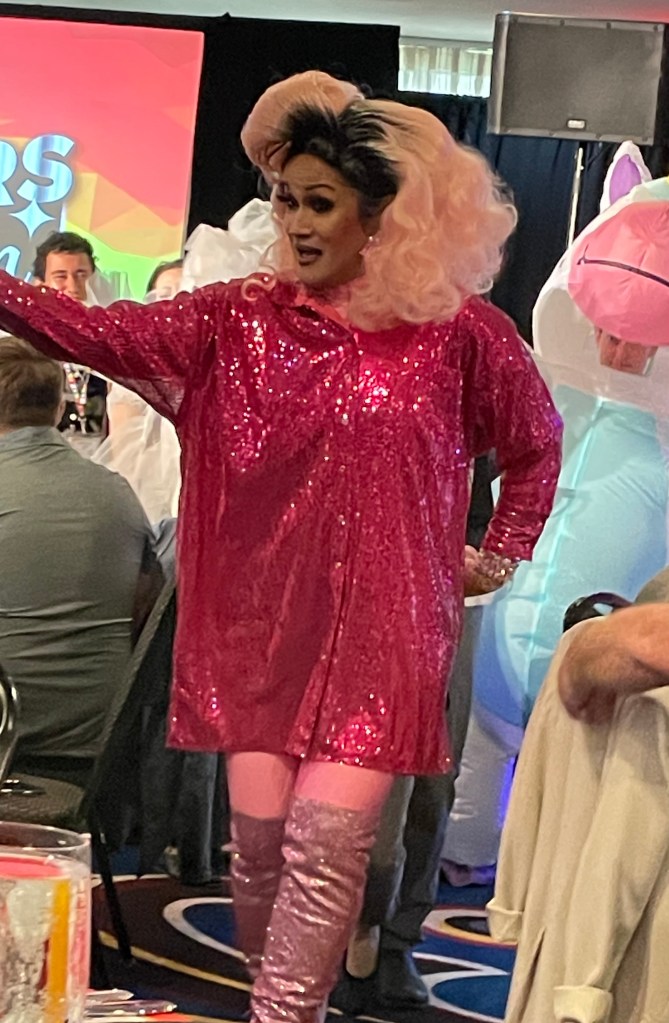
EMCEE FULLY IN COMMAND OF JOY

GSBA lays claim to being the nation’s largest LGBTQ+ chamber of commerce. Counting affiliates, there are more than 1,300 members. Given our national emotional chaos, I anticipated a crowd of fearful, angry people. Surprise! The emcee — a flamboyant and outrageously funny drag queen — set the tone. We were a crowd diverse in age, ethnicity and sundry other varieties, but uniformly joyful.

The program highlighted GSBA’s impressive record of handing out scholarships: $7 million during thirty-four years of operation. Of six hundred or so recipients, 49 percent lived with a disability, 51 percent had experienced housing insecurity, 45 percent are from rural areas, and 49 percent are first generation college students. Their graduation rate exceeds the national average.

It’s not just about the numbers. This year’s graduates lined up before us and told us their post-college plans. All of them will make impressive contributions. One of the grads was chosen to tell her story. Older than the average college student and a single mom with an autistic son, she was determined to be the first in her family to attend college. She said she repeatedly bumped into closed doors, “no” after “no,” until she found GBSA’s program and finally heard a “yes.” GBSA scholars not only receive financial assistance, but ongoing encouragement and emotional support. Armed with her bachelor’s degree, this mom is headed to graduate school and a career in public health policy. Sounds dry? Our country desperately needs intelligent, dedicated people setting health care policy. When she finished speaking, there may have been a few dry eyes in the room, but there were none at our table.

Only one GSBA leader briefly addressed the current political situation, not naming names but referring to “that little weasel.” Nonetheless, she said, “They can’t take our joy away.”

I was reminded of Jesus calling Herod “that fox.” In both cases, I think the critters were maligned. Weasels and foxes simply live as they were created to live. We humans manufacture our own brand of meanness and evil. 

We’re also responsible for nurturing our joy, which is not the same as happiness. Happiness comes and goes. Joy is a state of being.

I haven’t written in this space since the new administration took over. I’ve been too dumbstruck. Besides, there’s been a torrent of words: in print, online, over the air. More than enough analyses, assessments, judgments and predictions. One commentator’s observation stuck with me: “If you think you know what’s going to happen in the future, you’re wrong.” Absorbing what is happening in the present is agitating enough.

Last weekend I sat at a friend’s kitchen table while she put felt marker to butcher paper, fashioning a protest sign for a demonstration she would attend that afternoon. She wanted a pithy but meaningful statement. I don’t recall what she ended up with, but I finally have the six words that will help me navigate this challenging time: “They can’t take our joy away.”

Pro-Active Aging: Mapping a path toward the inevitable

November 5 marked one year since I moved to an “old folks’ home,” as a friend patronizingly describes it. I neglected to observe the anniversary. Apparently other events on November 5 distracted me.

Now I’m taking a breath, reflecting on that decision to turn my life upside down one year plus one month ago. I exchanged a rural riverside home that I loved for a city studio apartment in — NOT an old folks’ home — but what the industry prefers to call a CCRC — Continuing Care Retirement Community. I live independently in my own apartment until, until … I no longer can. Then I’ll be appropriately cared for.

Do I miss my previous life, the people and place I left behind? Every moment of every day. Did I do the right thing? Absolutely.

I carry this paradoxical load of joy and sorrow by embracing both present and past with gratitude. I’m thrilled to be where I am: in a vibrant community, soaking up the energy and culture of a large metropolis. All the while, I revel in memories of rich relationships and events that once were and can be no more.

During the final hectic weeks of preparing to move last year, seeds of doubt threatened to erupt into full-blown angst. To ward off inner explosions, I kept a list in my journal under the heading,“Reasons For Moving.” No. 1 on that list was “Pro-Active Aging.” More than anything else, I wanted to make my own decisions while I still had the capacity to make them. Above all, I didn’t want to reach the point when family and friends would debate, “What should we do with/for/about dear old Mary?”

I’m not interested in denying the effects of aging. There’s no debate. Our bodies and our mental capacities change. I’m interested in acknowledging those changes, accommodating them, even savoring them. Age is a convenient avenue for setting boundaries: No thank you. Not interested in going there. Not doing that. And the world shrugs its shoulders. What d’ya expect? She’s old!

Even as my own Earth-bound future grows shorter, I care about the future of our world. No. 3 on my “Reasons” list (after No. 2 — financial) was “Lower My Carbon Footprint.” That could’ve been a sub-head under No. 1. One of the most vexing issues for families with aging members is convincing them to stop driving. For too many, losing the freedom to drive is the death of independence. 

I recall a friend at age 90 gleefully maneuvering England’s country roads, one leather gloved hand on the wheel, the other briskly shifting gears as we sped from curve to corner. “They’re going to have to pry my cold, dead fingers from around the steering wheel,” she declared. They didn’t have to. A paralyzing stroke ended her driving days.

I gave away my car before it became an issue. I revel in the true independence offered by mass transit. No hassles with parking, gas prices, insurance, maintenance and repair bills. And, oh my, the interesting people one can engage with on the bus.

“Want little: you’ll have everything,” advises Portuguese poet Ricardo Reis. He continues, “Want nothing: you’ll be free.”

I’m not suggesting everyone should follow my path of aging. We each find our own route, which is why some folks call it (s)aging. We don’t have a choice. Aging begins with that first breath and continues throughout our lives. I’ll not quote that old saw — the one that says growing old beats the alternative. 

Oh. I guess I just did. A sign of age?

Naming Names: A list you wouldn’t want to be on

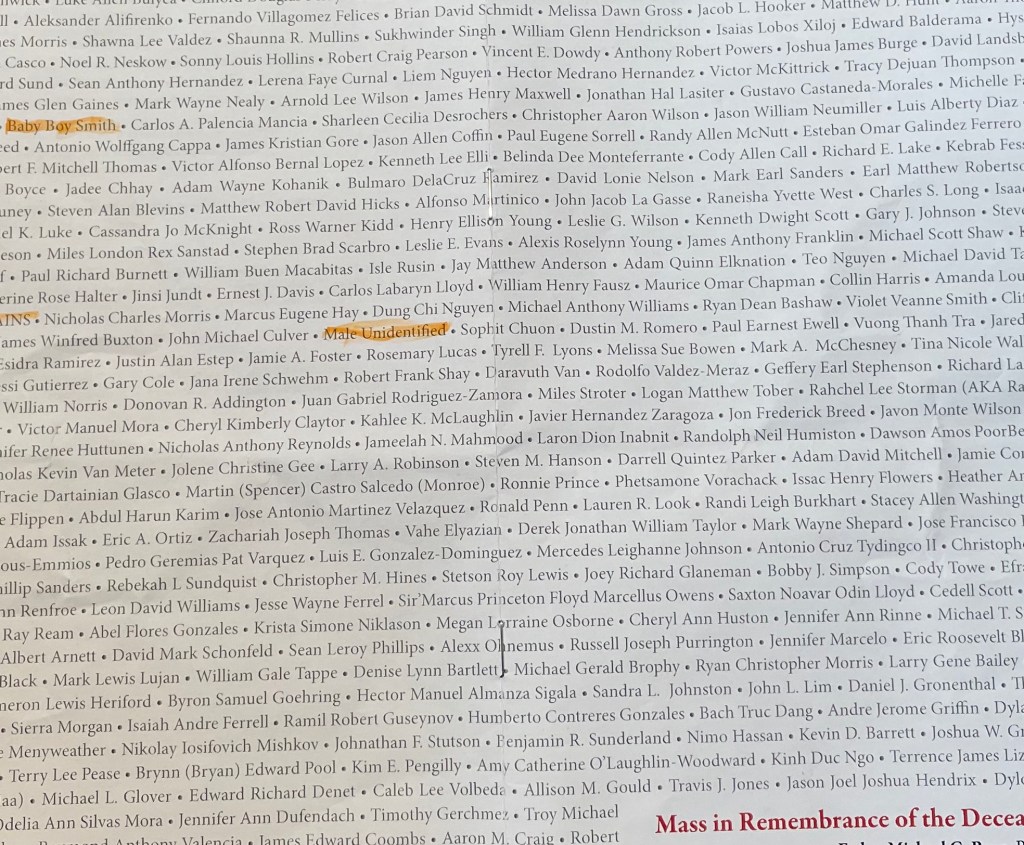
We stood in the cathedral courtyard, some hundred or more of us holding small lighted candles  that flickered in the November night. The bell above rang a solemn funeral toll. One by one the names were read of 410 homeless people who have died in Seattle over the past year.

“Clifford … David … William … Roberto … Fernando … Brian … Melissa … Matthew … Nabil … Shawna … Sukhwinder … Isaias … Edward … Hyshyn … Sirisopha …”

We were observing the annual “Mass in Remembrance of the Deceased Homeless of Seattle,” offered by St. James Cathedral. Inside the cathedral, we had sung, prayed, heard scripture and sermon, communed, and prayed some more. Finally the mournful tones of a bagpipe led us outside. We processed along the street and into the courtyard, where a sculpture of Madonna, cuddling the Child, presides.

“Santos … Noel … Sonny … Timothy … Thomas … Sean … Liem … Hector … Tracy … Jesse … Pedro … Mark … Arnold … Gustavo … Michelle … Nathan … Carlos … Sharleen …”

The rumble of planes overhead made us strain a bit to hear the names. Only a few hours earlier, I’d been aboard one of those planes, flying across the state after a brief visit to Spokane. Officials in Washington’s second largest city report a decline in homelessness, but that is of little comfort to the two thousand-or-so folks sleeping on or under cardboard while I nestled in my hotel bed.

“Martin … Isaac … Kathy … Gary … Tina … Logan … Martha … Phetsamone … Nimo …”

It’d been a gloriously clear day to fly. The fertile fields of eastern Washington spread quilt-like below. The Columbia River and its tributaries embroidered meandering designs in brilliant blue threads. 

“Wayne … Brad … Adam … Earl … Kim … Paul … Randy … Esteban … Steven … Matthew … Alexia … Cassandra … Ross … Henry … Leslie … Christopher … Katherine … Ernest …”

The Columbia River defines the southern border of Okanogan County, where I lived for forty-five years before returning to Seattle last year. I recalled the homeless individuals I’d met while volunteering at a shelter in Okanogan. Each was unique, their stories fascinating, more often than not carrying a common thread: the struggle to stay “clean and sober.” Homeless people died on the streets and under the bridges in the Okanogan Valley, too. There was no mass to honor their lives, but we spoke their names regretfully, in sorrow. What more could we’ve done?

“Vuong … Violet … Collin … Teo … James … Gary … Charles … Kebereseb … Mohammed … William … Patrick … Maria … Justin … Cheryl … Jennifer … Jameelah … Larry …”

The wail of a passing ambulance sounded as a counterpoint to the tolling bell. The reading of names had become a chant, a rhythm that matched my breathing. A dozen names, a dozen breaths, each minute. I list only first names here but full names were intoned, including middle names, if known. A few of the names stopped my breath.

“Baby Boy Smith … Baby Boy Green … Unidentified Remains … Male Unidentified …”

I focussed on the Madonna sculpture, pondering the miracle of birth that she represents. At birth, all of us were “created equal.” That’s what our nation’s founders proclaimed. With hands over heart, we pledge that we are a nation with “liberty and justice for all.” Both statements are more aspirational than reality. The signs of inequality, beginning from birth, are all around us, when we care to look. 

“Ivan … Anthony … Jason … Travis … Jennifer … Terry … Cynthia … Sean … Sompheth … Doreen … Krista … Eric … Faisal … Randolph … Sandra …”

Our candles burned to nubbins, then sputtered out. Still the names continued. I recalled the verse from John’s Gospel: “The light shines in the darkness, and the darkness cannot overcome it.”

“Olivia … Michael … Charles … Shannon.” At last we’d heard all 408 names and two Unknowns. The bell stopped tolling; the bagpipe played “Taps.” A reception followed, but I couldn’t do that. I walked home in silence, oblivious to the noise of city traffic. As a student, I strived to be on the honor roll, the dean’s list. My name likely won’t appear on this list of homelessness. I’m grateful, humbled. For this list, the roll has been “called up yonder.” These too are names, people, lives to be honored.

Embracing Life’s Lessons: From Caregiver to Patient

If life is all about learning, I’ve just earned my post-doctoral degree following hospitalization. Ouch. I know. Self-serving puns aside, it was a novel experience to be IN bed instead of bed-SIDE.

For the past three decades I’ve been doing preparatory studies by caring for loved ones during their final passage of life. Among them were my husband, mother-in-law, mother, and sisters of my heart. I’ve witnessed the grim effects of stroke, cancer, heart disease, ALS, and simple, intractable aging.

With each passing I came to the same conclusion: I’m not particularly afraid of death, but I’m terrified of the health care industry. It is to be avoided at all costs.

When I made a full frontal landing on a concrete sidewalk nearly three weeks ago, my first thought was a prayer: please, no injuries requiring medical attention. 

“Nothing broken,” I announced cheerfully to the strangers who helped me up. What did I know?! I painfully crawled into an Uber for the short ride to my apartment complex, where a nurse checked my vital signs. I was alive.

“Ambulance,” he suggested.

“Nope,” I countered. “I’ll just ice my (screaming) knee and elbow. I’ll be fine.” An hour later I was on the phone saying, “ambulance.”

Once again I assumed the role of bedside observer, but this time observing myself as patient. I consciously sought a sense of detachment, witnessing my own experience as if I were someone else, watching, not judging.

I was not at all approaching death’s door, yet right there at my side were the beloved ones with whom I’d journeyed in years past. While I thought I was caring for them, they’d actually been teaching me: how to let go, how to accept, how and where to set boundaries, when to laugh, when to cry and grieve, how to bless and move on.

My husband, who died in 2007, has been especially present. A brainstem stroke left him with the unthinkable diagnosis of Locked-In Syndrome: a fully functioning mind “locked” inside a totally paralyzed body, unable to speak or eat. Yet he lived a meaningful life for another fourteen years. His presence is palpable, reminding me how he faced adversity with courage, determination and, most important, patience.

My mother sternly warns, “DON’T!” as I start to pick up a sock that fell on the floor. Mother broke her neck by falling when she stooped to pluck an errant thread from the carpet. She survived, but it was a long, arduous recovery. She ultimately died with cancer.

“Thanks, Mom,” I respond when I hear her voice. “You paid a heavy price to teach me this lesson.” I take the time to retrieve a mechanical grabber and safely pick up the sock.

When my dear friend Sharlene was diagnosed with ALS (Lou Gehrig’s Disease), her wry and playful humor rose to the top. Told the disease is incredibly rare, she declared, “I’m one of the CHOSEN.” She taught me that we are a mixed bag of emotions, all valid. She howled volubly with grief and rage every time the advancing disease robbed her of yet another function: walking, eating, talking.

When she could no longer speak, she typed jokes into her talking laptop and played them for strangers as we rode elevators at the medical center. One delighted passenger suggested she be hired permanently. She rather liked the idea.

With death approaching Sharlene spelled out her final request to me by painstakingly moving her one functional finger across the sheet on her bed: “Mary, write my obit.” I did, but I wish I’d done it better, made it more fun, like her.

I sat for hours with my soul sister, Mary Lou, who in her final weeks often resisted pain-killing but sleep-inducing medication. “I don’t have much life left,” she protested. “I don’t want to sleep through it.” 

Walking the route to humility

Our friendship had begun decades earlier when, as office colleagues, we discovered we both played piano. We began meeting weekly to play duets. Mary Lou insisted on playing “secondo” while I played “primo.” As in dancing, someone has to lead.

Thousands of miles and a multitude of shared adventures later, as Mary Lou lay dying she asked what of her possessions I wanted to inherit. I didn’t have to think about it.

“Your humility,” I quickly answered, humility not being one of my stronger suits. She had it in abundance, along with joy, grace, and a delicious sense of irony. Mary Lou shows up all the time now, her musical chuckle echoing in my ear at every pride-punching, ego-deflating event in my life.

“This is what you asked for,” she reminds me.

Appropriately humbled, I’m returning home today after two weeks in a hospital and four days of rehab. Therapy will continue at home. I’ll be aided by a walker, a leg brace, and many well-wishers from whom a river of prayer has flowed.

Healing is not a solo venture. If we think it is, we deceive ourselves. If it were up to just me, I could not, would not fully heal. Lesson learned.

Dependence Day: Are we really free, or are we kidding ourselves?

On day No. 12 in the hospital, as my fractured bones heal I realize I’ve been given an additional break —a pause.

When I met a Seattle sidewalk up-close and personal a week-and-a-half ago, it interrupted my schedule: things to do, people to see, places to go. Since then I’ve been given long, seemingly empty hours of “doing” nothing. My arena of activity is limited to a bedside table (15 by 34 inches — I measured it using tape from my knitting bag). The table is piled with notebooks, hospital menu, a few papers relative to injury and recovery, water jug, computer, phone, maybe a snack or two. 

If something I think I want or need is beyond my reach, it’s as unavailable as breathable air on the moon. Like that pillow, just four feet away, that would feel good under my fractured elbow just now. I’m capable of wriggling out of bed, shuffling the four feet (abetted by the hip-to-ankle brace stabilizing my fractured knee), grabbing the pillow, and shuffling back to bed.

BUT I’ve been strictly ordered not to get out of bed or even off the toilet without an “assist.” If I want to move about, someone else has to be present.

Happy Dependence Day!

We love to celebrate Independence and worship at the altar of Freedom (an altar banked with fireworks). When do we celebrate the greater gift of DE-pendence? 

Such a suggestion sounds almost unAmerican. We pride ourselves as being (as my late husband liked to observe) “independent as hogs on ice.” We wanna be free to do what we wanna do. At my age especially, independence is the NO. 1 goal —even though it’s a mirage.

We choose to ignore how much we depend on others. We can’t recognize that because too often the fellow human beings we depend upon are hidden within systems — health care system, transportation system, communications system. You can name many more. Just think about your daily activities and the systems that enable them and the people within those systems who enable you.

The other night (at the risk of being overly specific) my urinary catheter malfunctioned. What a soggy, humiliating situation! Barely awake, I mumbled apologies to the aide as she efficiently got me back on dry land. English for her, like many hospital personnel, is a second language. With her beautifully lilting accent, she replied, “That’s why I’m here on the overnight shift. To help you!”

After she left, I wondered if I’d just experienced a mystical divine presence. She’d seemed uniquely certain of who she was and why she was. It was powerful — as if destiny had hurtled us both through time and space so our paths would cross in exactly that moment, this place.

The African Bantu language gives us the word ubuntu, inadequately translated as “I am because you are.” I understand that to mean, “I would have no reason to exist except that you exist.” I’m guessing our culture understands that in a romantic sense, like the song lyrics: “I was meant for you; you were meant for me.” That’s a start, but ubuntu is universal. I suspect that word or a similar one is not in our vocabulary because it’s a foreign concept. In our individualistic world, co-dependency is considered a mental illness. 

Yet the mutuality of ubuntu is at the root of our humanity, our raison d’être. Thus showing up at 2:30 a.m. to change an old lady’s sopping bed linen becomes not just a job, but a reason for being. 

Happy Dependence Day — today, tomorrow, and every day of our lives!

After the Fall: Why me?

“80-year-old fall!”

When I heard the triage nurse’s call, I realized I had a new label. I was waiting with two ambulance attendants in the ER corridor, in line for an empty bed. They can call it emergency, but hospitals in general involve a lot of waiting. That allows time for pondering.

Ponder this: How is it that Seattle citizens, accustomed to walking around prone bodies on the sidewalk without even slowing down, would rush to my assistance as I lay facedown on hard concrete?

Welcome to my world of privilege. I was nearly 20 when I began to realize that I was privileged through no fault of my own. I was born white, middle class (not a lot of money but enough), a U.S. citizen, raised in a two-parent household by parents who habitually expressed love for each other and their children. I thought that was normal. 

With every passing decade and cultural crises of domestic violence, sexual abuse, family trauma, systemic racism, homelessness, social injustice at every turn, my privilege becomes harder to bear. Not until I work through the guilt and humbly lament can my privilege be fully acknowledged and appreciated.

People fall on Seattle sidewalks all the time. I’ve watched it happen. The falls I’ve witnessed unfold in slow motion. The faller leans forward from the waist, bends their knees, and lowers their body, ever so slowly escaping into the inevitable neverland of  gravity and drug OD.

My fall occurred instantaneously, as if the uneven sidewalk suddenly rose up, smacking my body like a thousand sledge hammers. Before I could figure out what happened, people — total strangers — hurried to help. I have to ask, “Why me?” Not the victim’s why me. Not the why me of Job or anyone who disputes bad events that are supposedly unjust, undeserved. 

I suspect people rushed to my aid because I wear my 80 years of privilege like a shining coat of armor: silver-haired matron in age-appropriate, subdued clothing, walking briskly, could even be heading home from church (which I happened to be). I was safe. My needs were simple: help me up. Maybe call an ambulance. Lots of Good Samaritans on hand. 

I think the Samaritan’s story can be misinterpreted. It’s not that we’re called to assist every needy person we come across. We are to acknowledge both their needs and our ability or inability to meet those needs. I as an individual cannot help the fellow human who is comatose in the building alcove. I can, however, join with others in community who, as a community, have the power to help, to make a difference. Even the Samaritan didn’t act on his own. He took the robbery victim to an inn where he presumably was known. He trusted the innkeeper to provide appropriate care, and the innkeeper trusted him to make good on the bill. That’s community.

I declined suggestions of an ambulance and got a Lyft ride home. After an hour of icing, I had to admit my injuries were worse than I could heal on my own. Again as a privileged person with an insurance card in her wallet (10 percent of Americans STILL don’t have insurance and others are under-insured), I called an ambulance.

Diagnosis: fractures of the left radius (elbow) and right patella (kneecap) along with a colorful variety of bruises and abrasions. Next comes elbow surgery followed by rehab. Then — date uncertain — back home, all because I’m privileged. Once back home they’ll call me by my name, or occasionally “Apartment 13-A.” Just not “80-year-old fall.”

That selfie is not at all flattering, and honestly, it looks worse than it feels.

A Concert is More Than the Music

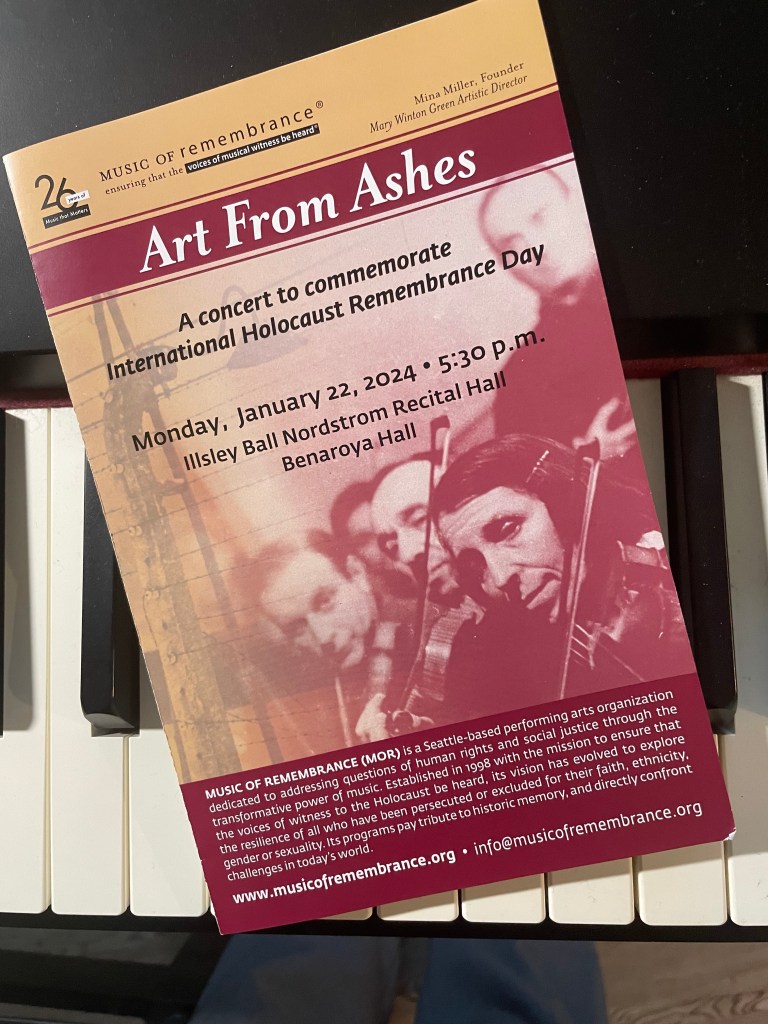
A free concert at Benaroya, Seattle’s premier performance venue. Knowing there’d be a crowd, my neighbor and I left plenty early for our walk to the event commemorating International Holocaust Remembrance Day (Jan. 27). We ended up with time to visit the Garden of Remembrance, which stretches along the west side of Benaroya.

More than eight thousand names of Washington State citizens who died in service to our country since 1941 are etched into the granite walls. Names include people who served in World War II, the Korean War, Vietnam, Gulf War and continuing through post-9/11. I immediately went to the Vietnam section and gently placed my fingertips on the name Keith Henrickson, a high school friend. It’s a gesture I’ve made before, first at the Vietnam memorial wall in Washington, D.C., and again when a traveling replica of that wall visited the Colville Indian Reservation, near my former home. 

I thought about how I’ve lived fifty-five years longer than Keith, who was killed at age twenty-four in Quang Tri province. Yet his name, etched in granite, is an enduring presence that will last long after I’m gone. His and all the other names are an ongoing witness to the tragedies of war. 

Scattered raindrops accented my somber mood as we left the garden and entered the hall. The concert was presented by Music of Remembrance, a nonprofit organization that addresses issues of human rights and social justice through music. As I read the program, I readied myself to shed tears. Many of the pieces were attributed to poets and composers who perished in Nazi concentration camps. 

I wondered about the quartet of pre- and teen siblings a couple rows ahead of me. Would they “get” it? They were jostling and elbowing each other in normal but disruptive ways. Their parents were seated like bookends with their offspring between. I hoped that Mom and Dad could/would keep the kids under control. Then, just as the lights were dimming, I heard the rustle of newcomers settling into the row directly behind us. I looked around to spot a young couple with two children, ages about three and one. 

I immediately flashed back to a free, noon organ concert that my late husband and I attended decades ago at the Mormon Tabernacle in Salt Lake City. The place was packed with tourists. The organist began with a brief welcome and firm direction: “If your child becomes disruptive or makes any kind of noise, do not hesitate to remove them immediately.” I don’t recall the organist’s name, but I have silently evoked his instruction whenever concerts get disrupted by crying or rambunctious children.

The audience dropped into silence for the opening “Intermezzo for Strings,” a floating, ethereal piece performed by The University of Washington Chamber Orchestra. The Jewish composer, Franz Schreker, had been forced from his position as director of an important music conservatory. But he cheated the Nazis out of killing him by dying after a stroke in 1933. 

The program continued, the youngsters in front of me quietly absorbed, the baby behind uttering only an occasional coo that was quickly muffled by her mother. About halfway through came a duet for violin and cello by Gideon Klein, a brilliant musicology student who died in the Fürstengrube camp at age twenty-two. The mournful, longing music ends suddenly mid-phrase, as did Klein’s incomplete life. In the silence that followed, before the audience could gather itself to applaud, the baby let out an anguished wail. Her cry said far more than our applause. Nonetheless, Mom gathered her up and exited the hall.

She missed the grand finale, “Farewell, Auschwitz,” a defiantly jubilant piece commissioned by Music of Remembrance. It was performed by The Seattle Girls Choir and Northwest Boychoir, along with instrumentalists and adult soloists. I was heartened by the discipline and beauty of the young voices. They were learning in a powerful way about an historical truth that too many try to deny.

Upon leaving the hall, I spotted Mom and baby seated on a bench. I perched next to them, the baby giving me a bouncing grin as I told her mom, “I’m sorry you had to miss the end of the concert. She was so good for so long, and I’m glad you brought her. She has that music embedded in her soul now.” Just as I finished speaking, another woman approached.

“Good for you for bringing the children to the concert,” she said. “They’re never too young.” 

Never too young — nor too old — to learn, to change, to grow, to remember.

Heart Medicine

Six p.m. Time to feed the dog. Except that the dog’s absence is the loudest presence in my silent house. Giving up my canine companion is one of the sadder parts of moving from my small-town, riverside house to a thirteenth floor studio apartment in downtown Seattle.

Tawny arrived at my front door in the arms of a friend eight years ago. She’d found him abandoned in the park across the river from my home. I named him for his tawny color, a mix of gold and amber. He’s also a mix of whatever breeds you want to assign him. 

I should’ve named him Coyote after the mythical coyote trickster of Native American lore. Tawny would play his little tricks, like tearing around the house with an illicitly acquired shoe in his mouth. At my command he’d drop the shoe, perk up his big ears, and give me a wide-mouthed grin as if to say, “Wasn’t that fun?!” The dog trainer said he had an “attitude,” but that’s a lousy name for a dog.

I’d always thought I’d stay in this house at least through the end of Tawny’s life — surely another five years, or more. Recently, it became increasingly clear that the time to move was now. I made the decision sooner and more quickly than I ever imagined. With that decision came the certainty (the hope?) that there would be a good new home for Tawny.

As weeks went by, my certainty wavered. Friends repeatedly sighed,  “We’d love to take him, but …” My ear-worm kept repeating that beautiful Bernstein/Sondheim song from “West Side Story:” Someday, somewhere … there’s a place for us. 

Somehow, somewhere, there’d be a place for Tawny. I envisioned plenty of space for him to run around — within a sturdy fence.

The call came shortly before the Feast of St. Francis of Assisi. It’s Francis’ sculpture you see in gardens, most often with a bird perched on his shoulder. He wrote the poem celebrating “all creatures of our God and King.” Many Christian churches celebrate St. Francis’ feast day by inviting people to bring their pets to church for a blessing. On the Feast of St. Francis, Tawny was invited not to church but to a new home, inhabited by a dog-adoring human and surrounded by two beautiful acres of fenced green grass. 

Tawny’s new human partner recently lost her longtime canine companion, leaving her with a hole in her heart — a hole that Tawny is snuggling into. He can’t fill that hole — nothing could — but he can make it feel less huge. 

Adopting out a healthy dog is not as heart-breaking as making the end-of-life decision for a cherished animal who’s in pain. Still, I’m bereft because Tawny is the last in a long line of faithful dogs — and occasional cats — who have enriched my life, grounded, entertained, and inspired me. Each, in their departure, left a hole in my heart. And each made my heart a little fuller, a little stronger.