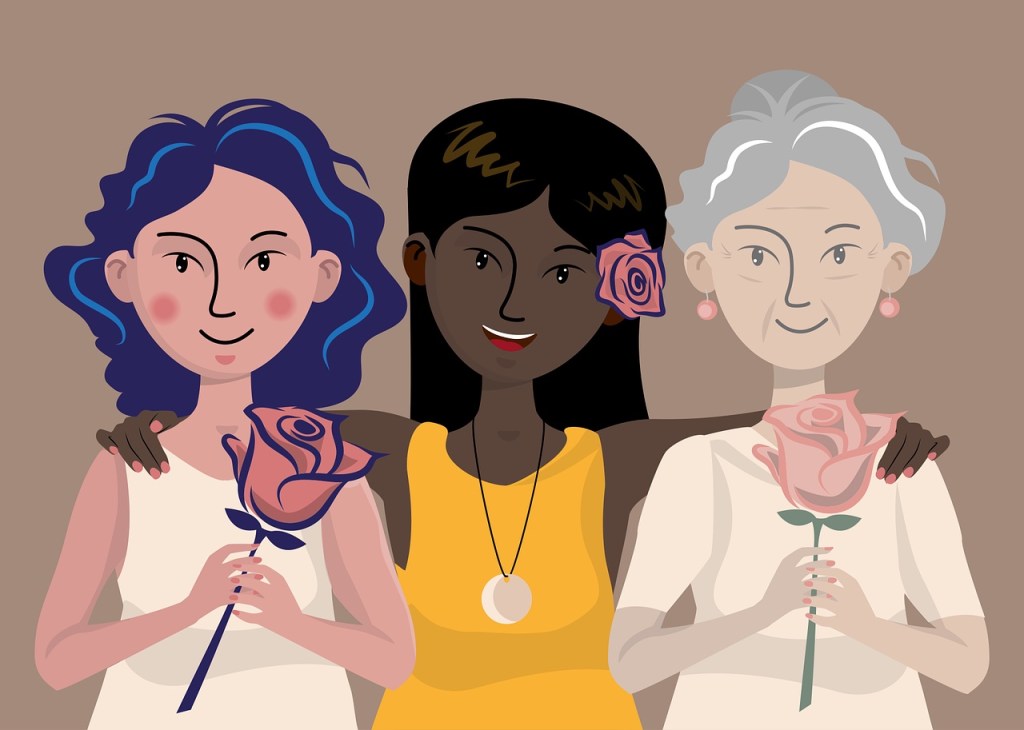
What’s With the Three Wise Gals?

During my many decades as a church musician, I’d take a deep breath of gratitude at the arrival of Twelfth Night, either January 5 or 6, depending on who’s counting. Having plowed my way through the annual blizzard of Christmas pageants, carol sing-alongs, renditions of Handle’s “Messiah” and midnight masses, I welcomed the church’s Epiphany — official end of the Christmas season.

In the secular world, Christmas has long since been forgotten by now, buried under New Year’s Eve revelry and (resulting?) “Dry January” resolutions. Meanwhile, in churches Epiphany marks the arrival of the Three Kings. Now a new tradition is taking hold, designating January 6 as “Women’s Christmas.” 

Methodist minister Jan Richardson explains that Women’s Christmas originated in Ireland as Nollaig na mBan, a day when the women, “who often carried the domestic responsibilities all year, took Epiphany as an occasion to celebrate together at the end of the holidays, leaving hearth and home to the men for a few hours.”

A prolific artist and writer, Richardson issues an annual collection of meditations, poetry and illustrations for Women’s Christmas. Her art includes Three Wise Women en route to the manger. (You can see it here.) As I struggle with Christianity’s two millennia of patriarchal oppression, I’m only too happy to see the women gently nudge the old guys aside with their own presence and gifts. For sure, the Kings’ gifts of gold, frankincense and myrrh are highly symbolic and precious. In her poem, “Wise Women Also Came,” Richardson notes the equally essential aspect of women’s giving:

“Wise women also came,
and they brought
useful gifts:
water for labor’s washing,
fire for warm illumination,
a blanket for swaddling.”

This past Christmas I received an unusual, unsought gift: a head cold. I’d decided already to spend the day mostly in quiet solitude. December 25 is my late husband’s birthday. I choose to devote at least part of the day in the presence of his spirit and memories of his life. This year his spirit was having to put up with my sniffles and sneezes. Had he been here in person, he’d have made me his curative hot drink of whiskey, honey and lemon. I settled for diluting my coffee with a little brandy. 

I didn’t feel the least bit sorry for myself. I live between two beautiful cathedrals, St. Mark’s and St. James. The previous Sunday — the Fourth Sunday of Advent — I’d managed to visit both. That last Sunday before Christmas, the church pays close attention to two women: Mary and her cousin Elizabeth. In the morning I heard a woman Episcopal priest sermonize on Elizabeth’s wisdom as counselor to her younger cousin. In the evening, at Catholic Vespers, I was immersed in candlelight and incense while contemplating, “Lo! How a rose e’er blooming … with Mary we behold it … ”

I was well prepared for a Christmas that was as quiet as any “Silent Night,” a Christmas that was healing and empowering. I always smile during December days when people ask the standard question: “Are you ready for Christmas?” I inevitably answer, “I’m always ready for Christmas.” Of course we’re probably talking about two very different states of readiness.

Merry Women’s Christmas. 

(Whether you’re female or male, I recommend Richardson’s free Women’s Christmas guide: https://sanctuaryofwomen.com/womenschristmas.html.  And please note, to not infringe on Jan Richardson’s copyrighted art, I’m using clip art to illustrate this post. You can see her Wise Women here.

Get to Know Your Mother With a Walk Through Time

I didn’t think a Sunday afternoon stroll through one of Seattle’s more stately neighborhoods would tire me as much as it did. But traveling through time can be exhausting. Our group of eight walkers made it through 4.6 billion years in a little over two-and-a-half hours. Every step (if you have relatively long legs) represented nearly a million years. 

It was a venture in “Deep Time,” a way of viewing Earth from a sensory perspective. More than a class in geology (although the experience would fit into a science curriculum nicely), “Deep Time” allows us to experience Earth’s story from the ground up, including how and where we humans fit in. 

You can take a “Deep Time” walk on your own with help of a free app. Instead, our small group was led by Richard Hartung, an Earth advocate. We began our walk on the grounds of St. Mark’s Cathedral on Capitol Hill. Our pace leisurely, we stopped every few billion years while covering 4.6 kilometers (a little less than three miles).

Scientists generally agree that Earth began to take shape from a mass of gas and rocks revolving around a faint sun. A billion or so years later, a huge collision threw off enough debris to form the moon, the beginning of our seasons. Not until 3.8 billion years ago did life begin to emerge in the form of single cell organisms. If the thought of humans evolving from monkeys disturbs you, rest assured. It’s those single cells, said Richard, that were “our common ancestors.”

By the time we reached Lowell Elementary School at 11th and Mercer streets, almost an hour had passed, and it was 3.1 billion years ago. That, said Richard, was when those single cells began to come together in “community.” How perfect, I thought. Lowell school is all about community. Its progressive programs serve many children from unhoused families. Students come from families speaking thirty different languages.

Soon we entered Volunteer Park, reaching the halfway point. About 2.3 billion years ago, oxygen was beginning to move into Earth’s atmosphere, for which I was thankful. We’d climbed a slight grade which had me breathing a little more deeply. Things started happening at a faster pace: endosymbiosis, a couple ice ages, earth’s revolutions slowing down and the sun brightening. As we walked past Lake View Cemetery, where Bruce Lee is buried, insects began to emerge some 425 million years ago. The coal that is mined today began forming 360 million years ago.

Millions more years flew by as we strolled: volcanic eruptions, dinosaurs, continental drift, an asteroid hit the earth and killed off the dinosaurs. Two-and-a-half hours from our starting point, the glorious Rocky Mountains and Andes emerged. Twenty-three million years ago, primates arrived, and my knee — the one I fractured earlier in the summer — was beginning to ache, just a little.

To make an unfathomably long story ridiculously short, homo sapiens appeared on Earth at the very end of our walk, just 200,000 years ago, or about eight inches from our finish line.

When we talk about history, we tend to think of it as human history, notes David Abram, one of the developers of “Deep Time.” Our “real history,” he says, is the history of the land itself, Earth, with which we are “embedded, entangled.” 

Throughout the walk, Richard noted the various times when Earth heated and cooled in cycles that lasted for eons, causing devastation. My notes on that are fuzzy because his voice was often drowned out by planes overhead, en route to and from SeaTac International Airport, burning upwards of a dozen tons of fossil fuel per hour.

I recalled a friend who tried to calm my concerns about climate change. “Mary,” he said, “there’ve always been cycles of Earth cooling and warming.” True, Richard would reply. But the change we’re experiencing now is coming one hundred times faster than any in the past. His final question to our group was a challenge: “What do we do?” We sat quietly, mulling various strategies. 

I believe we must begin by caring about our relationship with Earth. When we care, we become more aware, we ponder our daily decisions, practices, and habits that impact Earth. Ancient Greek wisdom understood Earth to be Gaia, the mother of all life. Chief Seattle echoed that insight: “The earth is our mother. Whatever befalls the earth, befalls the sons of the earth. If men spit upon the ground, they spit upon themselves.”

We must learn to appreciate Earth as the mother who has generously nurtured us. As babies we are suckled, but now we have sucked our mother dry. She is old and very sick. It’s hard work to care for the old and the sick. It demands personal sacrifice. I’ve been there and learned  that caregiving is also a joy-filled opportunity to love. Now is the time to love Earth and all her inhabitants tenderly and deeply. She is, after all, our mother.

We Don’t Know What’s Ahead (thank God)

Surely one of the greatest gifts Creator bestowed on humanity is our short-sightedness. We can celebrate New Year’s Eve with abandon because we have no idea what’s just around the corner. 

I’m thinking back to Dec. 31, 2022, when I quietly observed the passing of the year in my cozy home on the river. If I’d foreseen that 2023 would include the deaths of three of my dearest friends and that by the next New Year’s Eve I’d be living on the thirteenth floor of a Seattle high-rise — I believe I’d have gone to bed, pulled the covers over my head, and never come out again. 

When I do know of coming events, they tend to loom rather than promise. I’m pessimistic when I needn’t be. Example: plans for my massive, three-day moving sale filled me with dread. It turned out to be one of the best, most fun parties I’ve ever hosted.

I look back on this year of tumult — globally and in my personal life — with both mourning and gratitude. I mourn the loss of life and separation from friends. I’m grateful for the love that has supported and sustained me, and the Divine Love that persists in sustaining us all.

Overview of Omak, WA, a slice of the Okanogan Valley and Tiffany Mountains in the distance

In November, I expressed my gratitude in a letter meant for publication in the newspaper that my husband and I long ago owned. For unknown reasons, my words never made it into print. I’ve been assured the letter will be published in the next edition. Just in case, though, and because not everyone subscribes to that (or sad to say, any) newspaper, I decided to share it here. It’s a love letter, a fond farewell to an exquisite valley that stretches across an international boundary, a valley bordered by vital shrubsteppes that climb to forested mountains, a valley thinly populated with generous, kindly people:

“When I recently moved from the Okanogan Valley to Seattle, I left behind something important: a large part of my heart. For more than forty-four years I have been nurtured and inspired by the beauty of the Okanogan landscape and the vibrancy of her people. 

“It is a joy and honor to be part of a community that is so committed and supportive. This was especially true during the fourteen years after a devastating stroke paralyzed my late husband, former Chronicle publisher John E. Andrist. That same level of care and support prevailed as I prepared to move. Friends, family and neighbors generously stepped up to help with the many challenges. 

“I’d love to name names, but I fear leaving someone out. I especially thank members of various groups: Okanogan Valley Orchestra and Chorus (OVOC), St. Anne’s Episcopal Church, the NonViolent Communication practice group (LOLO – Language Of Life in the Okanogan), and a particular circle of women who joyfully share their creativity and love of beauty. 

“The part of my heart that I’ve managed to hang onto is deeply grateful.”

As we move into a new year, many prognosticators are planting seeds of fear and foreboding. I would remind us of Casey Stengel’s wisdom: “Never make predictions, especially about the future.” Blissfully ignorant, may we lurch onward.

Be It Ever So Humble

“Money must be a consideration,” said the drop-in visitor as she glanced around my 340-square-foot studio apartment. I was just moving into our downtown Seattle retirement community of 378 apartments (another 152 to come in five or six years). Mine is one of the smallest, least expensive. She was right. Money was a consideration, but probably not in the way she was thinking.

For years I’ve used a coin purse featuring a cartoon character pulling green dollars out of her billfold. My coin purse is so well worn that the caption is becoming unreadable, but still memorable: “Mo’ Money, Mo’ Problems.” 

Snug, liveable, and more than adequate

Those “mo’ problems” were a factor but not the driving motivation for giving up the home and community I loved to move here. I want to reduce my footprint on our Mother Earth as I age. I want to use fewer resources, live in community, take up less space, and spend less money to maintain house, car, etc. Not yet two months into this venture, I occasionally feel unsettled, mourning what I’ve given up, suppressing envy over larger apartments. So I go for a walk. 

From the west wing, I walk across Freeway Park, where I see two camping tents. There are no signs of life but I’m certain the tents are occupied. I walk past a man who is seated, holding a crutch, staring at nothing. He’ll still be there hours later when I return.

I enter the glass-encased Convention Center, take escalators down four floors, and I’m in the heart of downtown. Heading to Pike Place Market I notice a mummy-style sleeping bag stretched out on the sidewalk in an alcove. It appears to have a body in it. I pray that it’s a live body, though I wonder if life itself is any kind of blessing for this mummified soul. 

That same day the Seattle Times reported that both nationally and in Washington state, homelessness is “growing at a rate never seen before.” The official national count is a 12 percent increase over 2022, and in this state 11 percent. That’s based on the annual Point-In-Time Count. I helped with that count as a volunteer at the Okanogan homeless shelter. We simply recorded the number of folks sheltering on the appointed evening. Shelter populations can vary wildly depending on weather, time of month, and other factors. Nevertheless, we know that on a given night there were at least 28,000 people in Washington who had no place to be. That’s higher than the populations of Mercer Island or Moses Lake.

But those are only numbers that don’t really tell the stories — except for some stunning numbers offered the next day, again in the Times, by columnist Danny Westneat. There’s a building boom downtown. Some 7,200 living units (aka apartments) are under construction. Help for people with no homes? Not so much.

“This boomlet isn’t visible at street level,” Westneat writes. “It’s in the sky.” Once again Seattle has more construction cranes dotting the skyline — forty-five of ’em — than any other U.S. city. The columnist warns that high-rise apartments are likely to turn downtown into a “gated community … only vertical.”  He cites the example of a penthouse atop the 58-story Rainier Tower, renting for $19,999 per MONTH. 

I can’t imagine what it would feel like to drive my luxury car from the garage below my $20K-a-month apartment and spot a homeless person, wrapped in a sleeping bag in the sidewalk. It’s hard enough for me, having just left my snug studio, to walk on by, even with a prayer in my heart.

Carried away by the spirit of the season, I bought more than I intended at the Market. The walk back, with awkward packages, was a slog. Arriving home, I was more grateful than ever for a home to arrive to. Gratitude guarantees contentment. 

I’m not so naive to believe that moving into a tiny apartment or giving up my car is going to solve climate issues or homelessness or myriad other problems. But isn’t that a basic message of Christmas? Just another baby born in an insignificant town, and everything changed. It’s clear — to me, anyway — that if enough of us care a little more, live with a little less, we too can make a significant difference. That’s my prayer for 2024.

NEIGHBORS ARE THE FOLKS WHO SHOW UP – Even For False Alarms

Floating the Okanogan River on a hot summer day. What could possibly go wrong?

You know you live in a safe neighborhood when your car alarm goes off and your neighbors come running, fully armed — with cell phones, all Googling variations of “shut off car alarm.”

It’d been a quiet afternoon in my relatively crime-free neighborhood. I’d gone out to the carport, key in hand, and was about five feet from the driver’s door when the car threw a hissy-fit. Locking itself down tight, it refused to acknowledge any commands I entered on the keypad, ignored all the neighbors’ Google-advised maneuvers, and trumpeted an ear-splitting tirade. 

Every once in a while, the car would wear itself out, like a child throwing a temper tantrum who finally has to stop and gasp for breath. My neighborhood consortium would consult in whispers. Then someone would try to turn a key or open a door, and BLA-A-A-T!, the horn would start again.

Google provided the final diagnosis: my car was “brain” dead, in a self-imposed coma. The solution was like rebooting your computer. Simply disconnect, then reconnect, the battery. 

Google this: who were the nincompoop engineers who designed my Dodge Journey so that you have to remove the front left tire just to get to the battery? Ultimately my mechanic graciously made a house call, removed tire and battery, recharged the latter, put it all together again, and peace reigned in my neighborhood.

Until last week. 

People floating, swimming, and wading in the river that runs past my house are a common sight on these hot days. But it was nearly 9 p.m. with only remnants of daylight left when I spotted three youngsters in the river. In most places at this time of year, the water is shallow enough so that people who can’t swim “ride” the current. Their toes briefly bounce off the bottom, the current pulls them for a few yards, and then they bounce again. Bounce. Float. Bounce. Float. The children had already bounced/floated past my house when I spotted them.

This lazy, shallow river is deceptive. It has an insistent current and an inconsistent bottom. You can happily wade in the shallows and suddenly you’re in over your head. People drown in this river.

The youngsters (about twelve, ten, and eight years old, I’m guessing) had no flotation devices and no adults in view.  The current was carrying them into the river bend, where the water would be too deep for the youngest especially. I grabbed my car keys and ran outside. My neighbors were buttoning up their evening’s yard work.

“I’m worried about some kids in the river!” I called. As I pulled out of my carport, a neighbor jumped into the passenger seat. I drove the one block to a spot where we’d be able to access the dike. The neighbor reached into his pocket.

“I’ll leave my phone here,” he said, certain that he’d be getting wet. I held onto my phone, ready to dial 9-1-1. We ran to the top of the dike and spotted the kids. In the mere minute it’d taken us to get there, they’d somehow made it across the current into shallow water on the other side. The eldest was holding her hands aloft in a triumphant gesture. From there they’d be able to clamber up the bank and, I hoped, head home.

I apologized to my neighbor for yet again issuing a false alarm. He shook his head. He’s an experienced fisherman who grew up along this river. “These currents can be tricky,” he said.

A long time ago a wise man was asked, “Who is my neighbor?” Two thousand years later, whether you’re a Bible reader or not, you understand the meaning of “good Samaritans.” They still exist, they show up, and more than likely, they carry a cell phone.

Miles To Go

I just bought four new “premium” all-weather tires, on sale, guaranteed for 80,000 miles. Seemed like a good idea at the time. Back home, breathing fresh air instead of brain-stifling tire store fumes, I did the numbers. I’m about to celebrate my seventy-ninth birthday. I drive a fourteen-year-old car with 111,000 miles on the odometer. I calculate I’ll be eighty-nine or older before I need new tires again — assuming my car and I are both still functioning — a lot to assume. Not to mention, electric vehicles will probably own the road by then.

But this is not a question of life expectancy, either mine or the car’s. The National Institutes of Health says that only twenty-two percent of women over age eighty-five are still driving. (Fifty-five percent of men — let’s just set aside the obvious conclusion that women come to their senses sooner than men.) Drivers over age sixty-five are three times more likely to get into an accident than middle-age drivers per mile driven, and — take a breath — three times more likely to die from a car crash. We older folks are simply more vulnerable.

Exiting the driver’s seat is, for a lot of folks, as traumatic as death itself. My dad, a Lutheran pastor, was one of the most patient, kind, good-humored, compassionate people ever to walk God’s green earth. Thus I gasped when he — well into his eighties — referred to a driver licensing examiner as “that Nazi!” Despite his several physical infirmities, Dad waged an ongoing battle with the Department of Licensing to renew his license. I don’t know if it was Divine Intervention or just weariness on the part of DOL bureaucrats — they finally gave him a provisional license, allowing him to drive a prescribed route between home and church, nowhere else.

Mother, on the other hand, quit voluntarily. Well, kinda. It was after she totaled her car. She was driving home from visiting Dad’s grave one quiet morning when she blew a stop sign and crashed into another car in the intersection. No one was injured, but it was clearly her fault. For the next couple days, she followed her usual course when she had a Big Decision to make: she prayed, then wrote out a pro/con list. Finally, she called her grown children, confessed her sad story and sadder decision. The administrator of the retirement community where she lived thanked her effusively. He hated having to demand that a resident hand over their car keys. I eventually asked her if she missed driving. “All the time,” she sighed. 

Last week a friend told me she’d been diagnosed with dementia. “Of course, I quit driving immediately,” she added. We talked about her cherished pickup truck, which is more than a mere vehicle. The truck, itself older than most drivers on the road today, was her partner in decades of adventure. “I bet you wish you could be buried in it,” I said. She chuckled and agreed.

I have long promised myself that I’ll make the choice to quit driving well before some poor family member is tasked with wrestling the keys from my grip. My current license will expire on my seventy-ninth birthday. I have an appointment to get it renewed next week. Most drivers can do that online, but in this state, you have to show up in person if you’re over seventy.

Quoting Robert Frost, “I have miles to go before I sleep,” but probably not 80,000.

A Tale of Two Christmases

Yesterday (January 5) was Twelfth Night, in olden days recognized as the final day in the Christmas season. Ignored by most people now, Twelfth Night may have a ring of Shakespearean familiarity. It is the occasion for which his comedy of that name was meant to entertain.

I still cling to a Twelfth Night observation. Otherwise, it seems as if we catapult our way from Christmas to New Year’s, landing with a thud on January 2. The party is over. We’re befuddled by the new year’s reality, which feels an awful lot like the old year’s. 

Twelfth Night offers a more gentle landing, like reading a good book, coming to the end and closing the cover with a satisfied pat. It’s a lovely day for lighting candles one more time, listening to carols before tucking them away for another year, packing up decorations, and reflecting on lingering joy. I celebrated this year by lunching with two friends who described their Christmases.

“I boycotted Christmas,” announced Friend No. 1. So much for my gentle landing. She sounded both defiant and liberated. And really, if I’d had a December like  hers, I would’ve boycotted not only Christmas but the entire world. She had demands for year-end reports piling high on her desk when (a) both of the family’s two cars quit running, which maybe wasn’t that big a problem because (b) two family members were stuck at home with Covid, which was anxiety-producing because (c) this year’s especially heavy snow load has resulted in their home’s cracked ceiling.

Because they have offspring, my friend’s boycott was not total. There was a small tree and gifts. Otherwise, she advised extended family and friends that there’d be no packages or cards in the mail, no cookies in the oven.

And then there was Friend No. 2, who began by listing her Christmas dinner guests. They were a variety of ages, religious backgrounds, interests, etc., with one thing in common — they all would have been alone for Christmas dinner. (May I digress: there’s nothing wrong with peaceful solitude on Christmas if you enjoy it, and I do, but that’s another story.) 

Friend No. 2 admitted she was two hours behind schedule getting her guests seated at the table. The meal was delayed by numerous side dishes. I’m not talking about the mashed potatoes, vegetables, salads, etc. Her side dishes were plates of food she and her guests delivered to folks who couldn’t make it to her house for various reasons. I would have found the combination of guests in my home AND deliveries a hair-pulling logistical challenge. She  made it sound as if it’d been no more complicated than buttering toast. She adopted just the right tone of humility, telling us everyone proclaimed her meal delicious.

After our luncheon, I considered the many ways people celebrate Christmas, including — maybe especially — the self-proclaimed “boycotter.” Her day job involves helping people solve problems that are too often unsolvable. She’s overworked, underpaid, under-appreciated and above all, compassionate. Boycott Christmas? Nah, she observes Christmas — the REAL Christmas — every day of the year.

Winter’s Here: Time for Inaction

A storm is brewing, possibly a foot of new snow, we’re told. After a lifetime of confronting winter’s challenges, I still love it, but in a different way.

I can’t predict the weather, but I can predict what will happen when it snows. The city snowplow will begin its rounds at o’dark in the morning. Snug under the covers, I will awaken to the scrape and rattle of plow on my street, knowing what will greet me when I get up. In addition to the beauty of a crystal white blanket as far as the eye can see, there’ll be a plow-created berm of snow and ice blocking the end of my driveway. 

Not a real recent photo, but a celebration of snow

There’s a reason I live in a four-season environment. Winter feeds my soul as it nurtures the earth beneath our feet. Since childhood I’ve viewed snow as an opportunity for play, from building snow people to skiing down mountain slopes. Even the task of moving snow from an inconvenient place to somewhere out of the way made me a happy warrior. I would don layers of clothing, woolen hats, scarves, and mittens, and fire up the snowblower.

My trusty little snowblower had an electric starter, but I took macho pride in setting the choke, pulling the cord and thrilling to the roar of its instantaneous response. I relished guiding clouds of snow onto ever-higher banks lining the driveway. It was so much fun, I cleared not only the driveway but sidewalks, parking space along the street, and the broad concrete patio on the river side of my house. 

Things change. Just as we cannot deny our reality of climate change bringing wetter, heavier snow, I cannot deny my reality of osteoporosis, resulting in a series of spinal compression fractures. My snow removing days are done. Reluctantly, I gave the blower away last fall, removing temptation. The glacial berms were impenetrable for the little machine anyway, and there are safer ways for me to exercise.

The early snow storm a few weeks ago resulted in a solid berm that kept me housebound for a couple days. I’m within walking distance of grocery store, library, post office, and yarn shop, but the daily cycle of melting and refreezing made walking too treacherous. I was perfectly comfortable in a warm house with well-stocked kitchen. Only the dog gets cabin fever. 

We were ultimately liberated with the help of attentive neighbors and my yard guy. I hadn’t even tried to call the commercial snow removers. I’m told they were so besieged they quit answering their phones.

It’s about to happen all over again. I used to prepare for snowstorms with an action plan, and I still do. My action was a voicemail message to the yard guy, who will show up eventually, probably later than sooner. I’m settling in like at the theater, waiting for the drama to unfold.

I’m content. It’s the first week of Advent, my favorite liturgical season, a time of anticipation and preparation. In my younger years the preparation was external, now it’s internal. I’m learning that life is amply rich when we do less and be more.

Henry David Thoreau wrote about times when he “could not afford to sacrifice the bloom of the present moment to any work, whether of head or hands.” He described endless hours of simply sitting, time not wasted, hours not “subtracted from my life, but so much over and above my usual allowance.” 

Need more time, a longer day? Let it snow, and then let it be.

Looking Out

Covid has not impacted socializing among my neighbors all that much. Truth is, we don’t socialize all that much. In this quiet neighborhood of modest homes, we simply look out for each other.

I’ve lived here by the river for thirty-eight years. All the neighbors who were here when I arrived have moved on or passed on. I even moved: from the house I lived in for thirty years to a smaller one next door. The population change has not changed the culture: no block parties, no multi-family yard sales. We mind our own business but pay attention.

One time neighbors noticed a side door to my house was wide open. I was out of town. They called police, who entered the premises with guns drawn and found no intruders. I’d apparently not latched the door adequately and it blew open. I was embarrassed when I heard about it later, and at the same time gratified that neighbors were paying attention.

Usually, looking out is more simple, like watering plants for vacationers, or picking up their mail. At this time of year, especially after a snowstorm, my neighbors not only look out but help out.

In the 1990s, after my husband was paralyzed by stroke, neighbor Doug cleared our driveway after each snowfall. Neighbor Jerry shoveled the front walk. One winter, Doug was recuperating from surgery and realized he couldn’t handle both his driveway and mine. He found a snowblower for me. I never did as meticulous a job as Doug, but I felt so macho, so in control running that little single-stage blower. By that time, Jerry was slowing down. After clearing my driveway, I happily steered my snow-blower to his place, clearing out the entry to his carport, which is now my carport.

Snow removal becomes particularly daunting after the city snowplow clears our street, leaving densely-packed snow berms that block our driveways. My snowblower cannot chew through that stuff. A couple winters ago, I was attacking the berm when a neighbor I’d  never really met — a single mom — pulled up in her truck. Leaving the motor running with heater on for her toddler strapped inside, she ran home, grabbed her shovel and had the berm cleared within minutes. 

As we grow older, we find ourselves more often on the receiving rather than the giving end of kindness. It’s humbling, and a little uncomfortable, an acknowledgment that our independence is waning.

After the first snowfall this year, Doug called to say his son Josh was on his way and instructed: “Do. Not. Pay. Him.” Josh has been on the job, gratis, all winter. I remember how Jerry used to venture out to the carport while I blew away his snow. He too must have felt humble, uncomfortable. He compensated with his penchant for irony. “I’ll send you a bill!” he’d call after I’d finished. I’d laugh.

I doubt Josh would understand if I tried Jerry’s line. I compensate with a humble thank you.

A great teacher was asked: “Who is my neighbor?” Here’s one of mine

Homelessness Is Not Hopelessness

“Mac died, y’know.”

No, I hadn’t known. Will and I were chatting in the newly constructed main room of the Okanogan Community Homeless Shelter. Will probably has an official title. I just know him as the driving energy and organizer of the all-volunteer, local effort to help homeless people.

Mac had been a regular guest during annual shelter operations from November through March, the cold months. He’d be waiting at six p.m., when the shelter opens, when I’d arrive once or twice a week with a hot casserole for the evening meal. He was eager to carry the casserole inside, eager to tell me about his efforts to find a job, eager to show me his wife’s photo — cracked and creased inside his otherwise empty wallet.

Mac taught me a profound lesson. The shelter strictly requires guests to be clean (of drugs) and sober. Guests spend the first thirty minutes in conversation with screeners before they’re admitted for the night. As far as I knew, Mac never failed the screening. 

After the shelter closed each season, I would see Mac hanging out by the gazebo in Pioneer Park, near my home. My dog and I frequently walk through the small park, which is a way-stop for homeless folks. We’re usually greeted cordially and rarely asked for money — which I never carry. 

One day Mac, alone at the gazebo, surprised me by asking if I could spare a few bucks. I assured him I don’t carry cash and continued home, troubled as I walked. I thought about Mac’s willingness to follow the shelter’s rules, his futile efforts to find work, his estrangement from family. I grabbed a twenty dollar bill, got in my car, and drove back to the gazebo. 

“I know you, Mac,” I said, “and I know you’ll spend this the right way.” 

The next day I again saw Mac in the park, drunk out of his mind. That was last spring. I’ve been thinking about it ever since. I’d taken the easy way out, thrown money at the problem. At the very least, I could’ve driven to a fast food joint and bought a gift card. Mac ultimately died of acute alcohol poisoning. I am sadder and wiser.

All the money in the world couldn’t help Mac, but don’t misunderstand me. It’s vital that we invest in ways to help, both through private charities and public (tax) dollars. There are no quick, one-size-fits-all solutions. Obviously, homelessness is symptomatic of deeper problems. More than a half-million people in our country are homeless any given night. Washington’s homeless population ranks us among the nation’s top ten problem states. 

Still, homelessness is not hopelessness. I’ve witnessed repeatedly how shelter guests move onward and upward — with help: help from friends or families, help from nonprofit or government programs, help from a combination of efforts, from a willingness to give and receive help. Homelessness is not hopelessness, as long as we — all of us neighbors — are willing to help.