Chicken or Egg: Where Are You Comin’ From?

If you’ve ever puzzled over the chicken/egg primacy issue (which came first?), you might find your answer aboard the Coast Starlight Seattle-Portland train route. 

Or do I mean Portland-Seattle?

As part of “Trails and Rails,” a cooperative venture between Amtrak and the National Park Service, knowledgeable volunteers spend their summers entertaining passengers with stories about Pacific Northwest environment, history and culture.  (At least they did last summer. Who knows whether this admirable program will survive?)

Kristy and Phil, volunteers on my journey, were armed with notebooks full of facts and figures. But it was their story-telling skill that hooked passengers who filled the glass-domed observation car.

Approaching the Billy Frank Jr. Wildlife Refuge, just north of the state capitol, Phil described Frank as the “man who was arrested more times than anyone else in the state of Washington.” 

“What would you say about such a person?!” he continued, feigning dismay. Tourists murmured, disconcerted. Those in the know smiled at this introduction to one of the state’s most honored Native American activists and environmentalists. True, Frank (1931-2014) was arrested more than fifty times. The first time, at the age of fourteen, was the beginning of his decades-long fight to reestablish native fishing rights. His persistence led to the landmark Boldt Decision of 1974, upholding guarantees that had been set in an 1854 treaty but ignored. Frank’s numerous honors include the Presidential Medal of Freedom.

More stories flowed as the train whistled us through cities and towns until we approached Winlock, a small, agricultural community.

“If you remember nothing else from this trip, I hope you remember this,” prompted Kristy. Winlock historically touted itself as the “Egg and Poultry Capital of the World,” producing hundreds of thousands of chicks and eggs. To prove it, the town erected the world’s largest egg, a claim affirmed by “Ripley’s Believe It Or Not!” in 1989. 

Just across the street is another statue: a brilliantly colored but much smaller chicken. As to which came first, the answer depends on what direction you’re going. Heading south, the egg comes first. Going north, it’s the chicken.

That’s US!, I realized.

As in, U.S.

As in polarized. We’re all on the same set of tracks, but our stories depend on where we’ve been and where we think we’re going — or want to go. 

Each of us is the sum and substance of the stories we tell ourselves about ourselves. Information or ideas that don’t fit into our stories bring up uncomfortable emotions — sadness, envy, anger — and we’re inclined to reject them, as if to say the chicken absolutely came first or the egg absolutely came first. In other words, we have bias. It’s inevitable, explains writer Brian McLaren. It’s how our brains work. 

We grow up being told stories that shape our own stories. As we mature and age, our stories become more complex. When we are confronted with stories, ideas and information that conflict with our story, we have a choice. We can simply reject those other stories — take the easy route. Or we can figure out how to rewrite our story, even discarding parts, to make our narrative more inclusive. Rewriting is hard and tiring work for the brain. And it’s ongoing. There’s new stuff coming down the track every day.

It’s like the Billy Frank Jr. story. If we get only a fragment, we easily jump to a skewed conclusion. 

On my return trip, from Portland to Seattle, I was sitting on the “wrong” side of the train. I missed seeing the chicken precede the egg. In fact, I missed chicken and egg altogether, thus missing half the story.

Nevertheless, when we can simply enjoy that there are chickens and there are eggs, and there are eggs and there are chickens, we won’t have to worry about which came first. When we can hear and honor each other’s stories, acknowledge where each other is coming from, we’ll be getting back on track.
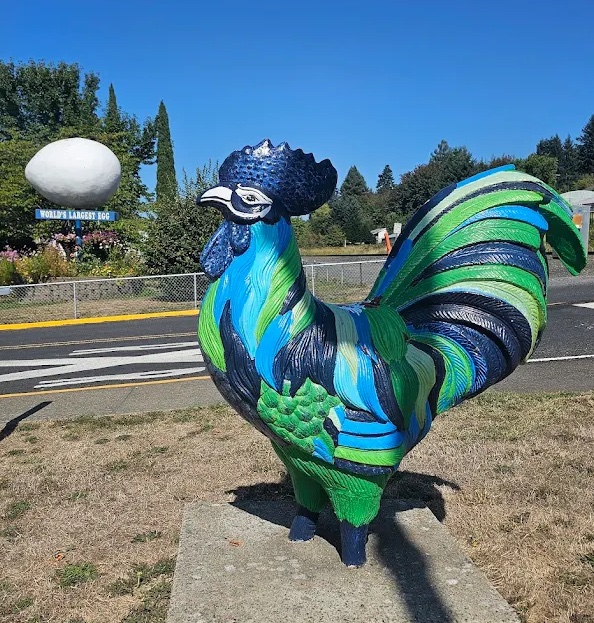
It’s a matter of perspective. Winlock’s egg is really
much larger than the chicken. – Tim Bryon photo
Cast in Concrete: Solid Footing in Treacherous Times

“Cast in concrete” is a metaphor for something permanent, unchangeable. And yet, “nothing is forever,” my late husband John once observed.

Cast aluminum, not concrete, was a favored medium for sculptor Richard Beyer. At least one time, however, he did make his mark in concrete.  It was a fond gesture, a gift beyond value honoring John, me, and the community newspaper we published in Washington state’s spacious Okanogan County.  John’s observation became all too true. Not even art cast in concrete is safe from willful destruction.

The Seattle Times recently published a retrospective of Beyer and his work. Reading it, I nearly drowned in a tsunami of memory and emotion. The piece by veteran journalist Erik Lacitis described Beyer as controversial and largely unrecognized. I have to agree. A recent show at the Seattle Art Museum celebrating contemporary West Coast artists omitted Beyer, even though there are more Richard Beyer public sculptures in Greater Seattle than by any other artist, Lacitis notes. That includes “Waiting for the Interurban” in the Fremont District, which after it was installed took on a life of its own. Many would claim it to be Seattle’s most popular piece of public art. Lacitis tallied more than ninety Beyer art works scattered throughout the Northwest and as far as Uzbekistan in Central Asia.

Beyer expressed his outsized humor in satirical creations that were met with consternation and adoration, fury and fun. He was either amused or indifferent when art snobs or critics spurned his folksy work. Since he died in 2012, his sculptures have not only endured but become even more endeared. 

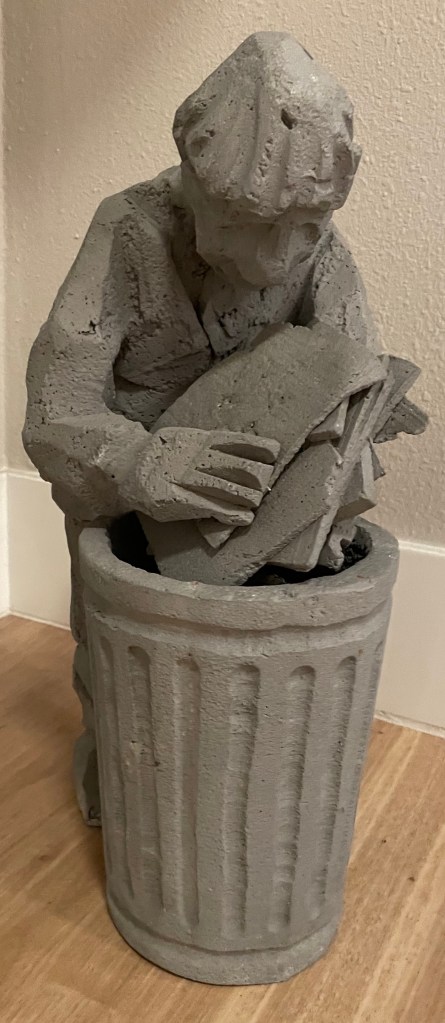
A Beyer fan long before we met, I was excited when he and his wife Margaret moved to Okanogan County in the late 1980s. I eagerly attended a show featuring some of Beyer’s smaller pieces at Sun Mountain resort in the Methow Valley. As I studied an eighteen-inch high, cast aluminum figure entitled, “Man Throwing Newspapers into Garbage Can,” I became aware of someone standing next to me. I looked up and instantly recognized Rich. My first words blurted to this man whose work I so admired were: “You could at least have him recycle them!”

Rich was momentarily taken aback before releasing his characteristic guffaw. We became friends, and I bought the sculpture for my husband. John proudly displayed it on the front counter of our newspaper office. Rich, who had so often been skewered in print, was no fan of newspapers. He made an exception in our case, frequently complimenting our paper’s brand of community journalism.

In late 1993, my husband suffered a brainstem stroke. Unable to speak, he was diagnosed as “Locked-In,” a syndrome described as a fully functioning brain locked inside a totally paralyzed body. Despite the gloomy medical prognosis, I was convinced John could and would recover. To accommodate John’s wheelchair, I had a ramp built to the front door of our newspaper office.

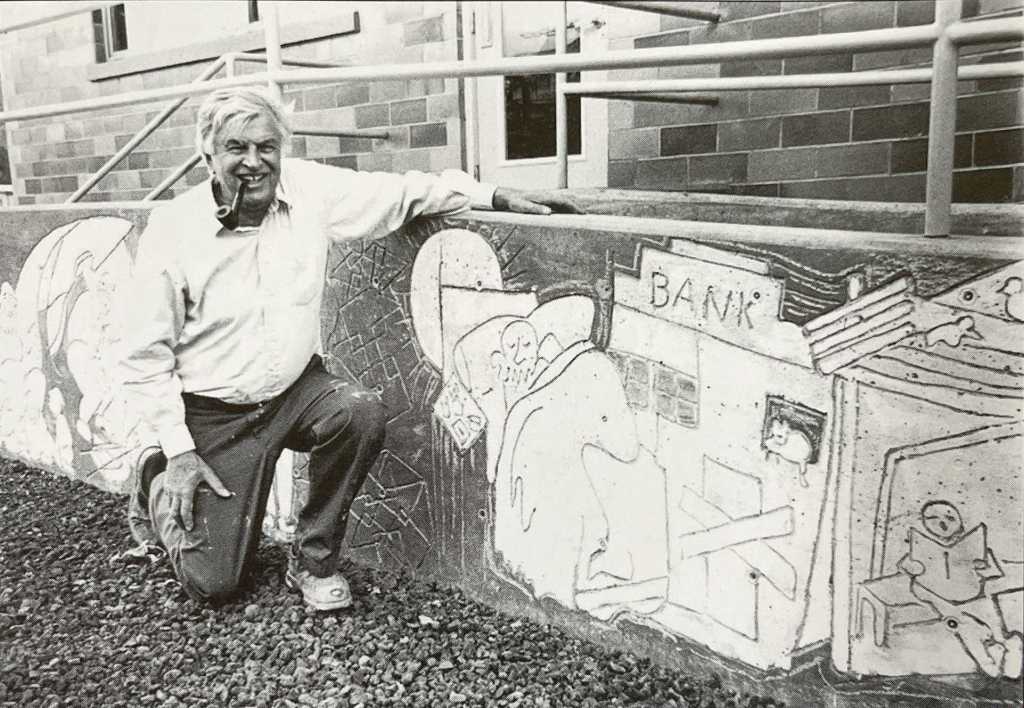
The contractor was Gary Headlee, also an artist and Rich’s friend. He convinced Rich to etch and paint a mural onto the side of our concrete ramp. Rich dreamed up a whimsical story that, as he worked, changed with every telling. He titled it “The Precious Jewel.” 

By 1996, I had to face reality. Trying to do both John and my jobs, largely from home, while providing twenty-four/seven care for him, was not sustainable. We sold the paper, careful to put on a happy face in public. In private, I wept. I’d sold a chunk of my soul and pretty much all of my identity.

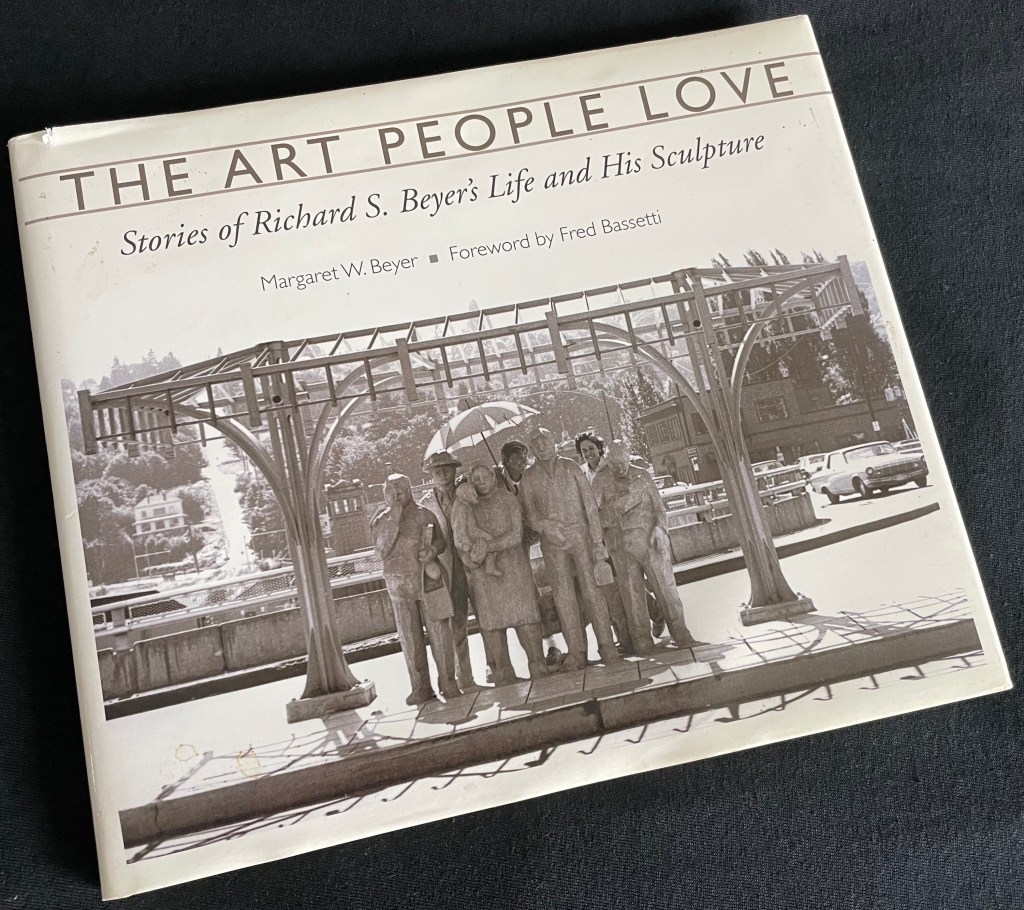
Not long after, Margaret got in touch with me. She wanted to write Rich’s biography and asked for my help. She arrived at our house with a shopping bag full of notes, photos, and a title for her imagined book: “The Art People Love.” I went to work on the opening chapters, but time was not on our side. I had too little of it, and Margaret wanted the book published ASAP. She ultimately retrieved the unfinished manuscript, the rest of her notes, completed the book, and found donors to fund its publication in 1999.

“Mary: you showed me the way!” she graciously wrote in my copy. One beautiful May morning in 2004, Rich called. Margaret was nearing the end of her journey with cancer. Would I come visit? 

I’ve always described spring in the Okanogan as the five minutes when snowmelt colors our brown hills a delicate green. That day, throughout my forty-five minute drive to Margaret’s bedside, the green shone more brilliantly than I’d ever seen, before or since.

I don’t know if Margaret was aware of my presence. I prayed, seeking forgiveness for not having done more for her. She’d been the rock, the firm foundation that allowed Rich freedom to create. She was equally as brilliant and creative, yet self-effacing. I treasure a small watercolor that Rich gave to me. Margaret had painted it. I also treasure “Man Throwing Newspapers into Garbage Can,” which stands at my apartment door. 

But “The Precious Jewel?” The new owners of the newspaper decided to remodel the building. The Beyer mural didn’t fit into their plans. They brought in heavy equipment, turning a work of art into a heap of rubble. I was shocked and horrified. Gary retrieved some of the larger chunks of brightly painted concrete and piled them next to a building he owned on Main Street. Every time I drove by, they reminded me that my dreams and expectations had also been shattered. Even the legacy of art I thought we were leaving to the community was destroyed.

After reading the Lacitis article, I had a sleepless night. Why, I wondered, had such a beautiful tribute left me so troubled? A hundred-or-so tosses and turns later I realized: some wounds never heal. We must tend to them, care for them and avoid infection. Bitterness will only contaminate ourselves and others.

The capacity to destroy is within us all. Some feel empowered by envy, greed or fear to rationalize acts of destruction. Others counter the darkness of destruction through love, creativity and compassion. 

We are experiencing an epic era of destruction. Mouths agape, stunned, we daily witness attempts to demolish essential institutions — art, science, public education, and — this especially hurts — venomous attacks on freedom of speech and ethical journalism. We grieve as people’s lives are ruined. We gasp at the erasure of values we thought were cast in concrete in the U.S. Constitution. People are marching in the streets, yet in our hearts, how do we confront this darkness?

Spiritual writer Rabbi Brian Zachary Mayer recently offered advice in one of his emails: “Forgive and forget. And if you can’t, pick one.” I can forgive. I long ago forgave the destruction of “Precious Jewel.” Empathy for another paves the path toward forgiveness. Maybe I can forget the pile of concrete rubble, but no amount of heavy equipment can smash my memories of the artists’ generosity, joy, and love.

I realize now that those memories nurture a confidence that is cast in something more solid than concrete. It is a confidence in Martin Luther King Jr.’s “long arc” toward justice. It is a confidence to resist, to seek truth, perhaps even to hope. It is vital not to forget.

Richard Beyer with a portion of “The Precious Jewel” mural — Al Camp photo

An old man tells a story:
A man mines the sky
and finds a beautiful blue gem.
Holding it to the light he sees the world anew,
in 4 dimensions
The governor is asleep,
The banks are closed,
Cattle have moons in their horns,
Children ride flying horses,
Angels fill the trees,
Rocks speak,
Coyotes dress in Wal-mart suits,
The snake pipes and the rabbits dance,
Fish and the wapato dance too.
He gives the stone to his wife to look through,
To see what he is seeing.

When Fate Turns the Page: Time to start a new chapter

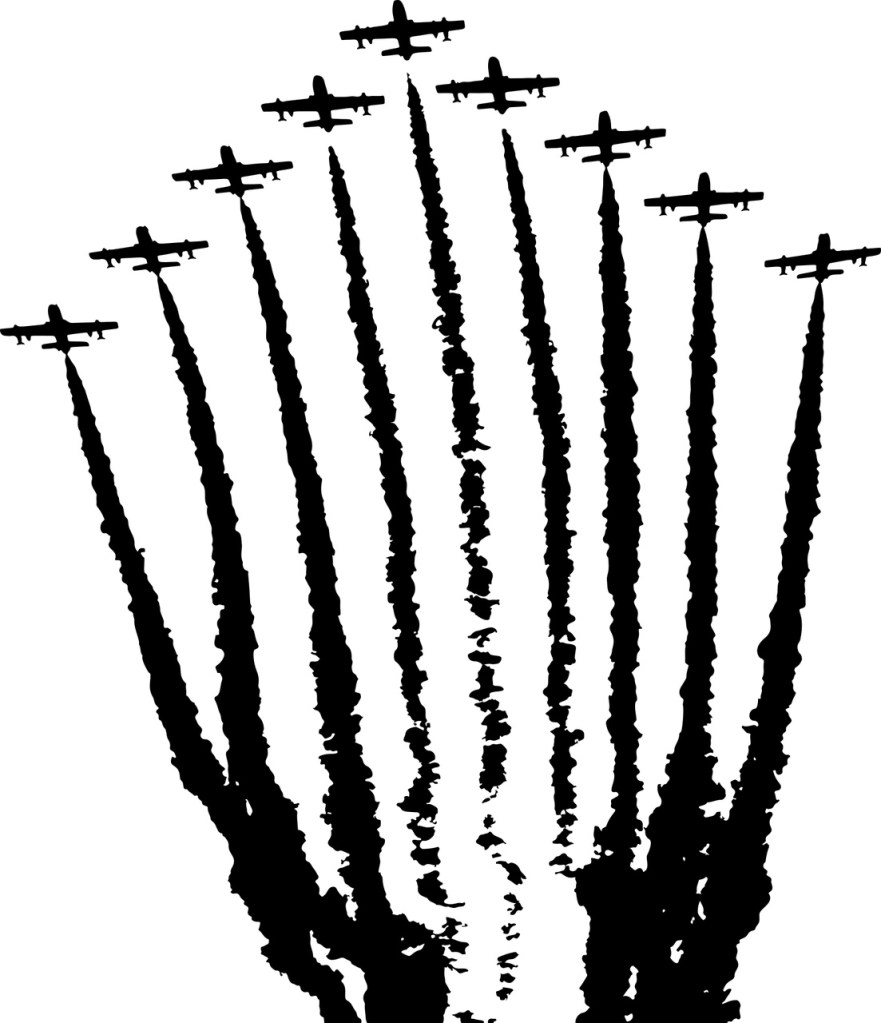
The thunder of U.S. Navy “Blue Angels” skimming the tops of Seattle skyscrapers reminded me it was a one-year anniversary. On the morning of Aug. 2, 2023, I was in Portland, saying that impossible, final goodbye to Lee, my soul brother for more than fifty years. 

“We’re both going on a journey, but in different directions,” I said to him, leaning close to kiss his cheek. He whispered something I couldn’t understand, but words no longer mattered. We both knew that. I got in my car, dry-eyed with a sobbing heart, and drove north to Seattle. A chapter in my life had just ended. Maybe the whole book. Maybe I was driving into the epilogue. 

All those years ago, Lee and wife Mary Lou had stood as witnesses when John and I married. It was like a marriage of marriages, a foursome. As couples, we never lived close to each other, often thousands of miles apart. Yet we’d travel those miles to share slices of life. Our foursome dwindled as John died in 2007, Mary Lou in 2020. Lee and I soldiered on. Frequent phone calls. Occasional visits. We’d talk idly about road trips we might take together, but we’d both seen plenty of road. And now, here I was, back on the road, the lone survivor. 

I had an appointment to see an apartment in Horizon House, a retirement community on Seattle’s First Hill. I’d visited a few months earlier and fell in love with the location, energy and philosophy. People move here not to retire and die but to live, contribute, and matter. Still, I was skeptical. I’d been invited to look at a studio apartment. I couldn’t imagine a studio large enough for me, much less my “stuff.”

I asked my niece Sandy to join me. A savvy realtor, she poses the questions that never occur to me. The sales rep unlocked the door to 13-A, and I walked straight to the window, all of twelve paces. Windows have always been the most important feature of anywhere I’ve lived. What would I be viewing? An urban valley of rooftops in the foreground ringed by a horizon of office and apartment towers. Columbia Center, Seattle’s tallest building at 72 floors, loomed above the rest, piercing an endless blue sky.

That’s when we heard the thunder. Not a rain cloud to be seen but jets skimming through the air with gasp-inducing precision. Seattle’s annual Seafair celebration, complete with aerial show. I teased the sales rep about arranging a spectacle as part of her marketing ploy.

With or without jets — especially without, I decided the view would keep me adequately absorbed. After decades of living on a riverbank, I’d be watching a different kind of wildlife on the busy streets thirteen floors down. The studio was big enough for me, and the storage unit in the basement large enough for my stuff. For the next three months I lived in an emotional vortex as I prepared to  move. I celebrated and mourned the ties with people and place that had bound me to the Okanogan country of eastern Washington for forty-four years. I’ll never become untied.

While I’ve lived in Horizon House only nine months (an appropriate gestation period), I’m convinced I made the right decision. And here again are the Blue Angels. Thrilling as the aerial shows are, a growing number of voices object to the noise and environmental consequences. Protesters argue that each jet burns about 1,500 gallons of fuel per hour. Each air show puts some 650 metric tons of CO2 into the atmosphere of an earth desperate to reduce carbon emissions. The Blue Angels may not be around forever, nor will I. But I’m here for at least another chapter.

If A Hippopotamus Can Fly: Why, oh why, can’t I?

News item: “…researchers discovered that hippopotamuses — which can weigh up to 8,000 pounds — become airborne with all four feet off the ground for up to 15 percent of the time while running at full speed, or for about 0.3 seconds.” (The Week, July 19, 2024)

I reckon I was airborne for about 0.003 seconds before my recent bone-shattering crash on a Seattle sidewalk. I weigh — well, a lot less than 8,000 pounds — and I had only one foot off the ground at a time as I walked at a reasonable pace. Yet there I was, flattened, while the hippopotamus continues to soar through the air. It’s a miscarriage of justice —an unequal application of the law of gravity.

Gravity is out to get us humans. We teeter around on two legs, at a distinct disadvantage to four-legged critters. Scientists tell us that our long-ago ancestors switched from four- to two-legged travel to save calories. We use less energy when walking than our relatives, the chimpanzees, who employ both knuckles and toes as they stride through the jungle. 

The World Health Organization reports that globally, 684,000 people die from falls each year. In this country, says the Center for Disease Control, falls are the leading cause of injury for adults 65 years or older and, even more frightening, the leading cause of injury-related death in that same age group. 

My friends and family offered all sorts of kindly advice during my two-week hospital stay, followed by a few days in rehab, and now as I continue therapy at home. “You don’t want to fall again,” they lovingly caution. Fact is, I didn’t want to fall in the first place. I’ve long been pro-active to avoid falling. I own and used a balance board; I stood on one leg while brushing my teeth; I continually engaged in core strengthening exercise; I wore sturdy walking shoes, and just FOUR DAYS before my fall, I completed a balance/fall-prevention class. 

“Perfect score,” the instructor told me, happily adding: “but of course, you had a perfect score at the start.”

The reasons we fall are complex. The CDC lists lower body weakness, vitamin D deficiency, difficulties with walking and balance, medications that affect balance, vision problems, foot pain or poor footwear, home hazards or dangers such as broken or uneven steps, throw rugs or clutter, etc. In my case, it was an uneven bit of concrete sidewalk. Gravity happens.

Reading through the CDC brochure, “Staying Independent,” I checked a definite “yes” next to the statement, “I am worried about falling.” The brochure commentary is not particularly helpful: “People who are worried about falling are more likely to fall.”

In his book “Falling Upward,” spiritual writer Richard Rohr offers a more encouraging point of view. In this “second half” of life, he suggests, we are free to fall, although not in a physical sense. We no longer have to protect our fragile egos, no longer must we “push the river,” no longer must we strive to have what we love, instead, we love what we have. Rohr cites St. Francis, who “spent his life falling, and falling many times into the good, the true, and the beautiful.” I’m willing to take that kind of fall.

I’m convinced my fall prevention work saved me from worse injuries and speeded my recovery. The CDC says one in every four older adults reports falling each year. I count as one this year, which means three others are off the hook. I hope, dear reader, you’re among the three.

Embracing Life’s Lessons: From Caregiver to Patient

If life is all about learning, I’ve just earned my post-doctoral degree following hospitalization. Ouch. I know. Self-serving puns aside, it was a novel experience to be IN bed instead of bed-SIDE.

For the past three decades I’ve been doing preparatory studies by caring for loved ones during their final passage of life. Among them were my husband, mother-in-law, mother, and sisters of my heart. I’ve witnessed the grim effects of stroke, cancer, heart disease, ALS, and simple, intractable aging.

With each passing I came to the same conclusion: I’m not particularly afraid of death, but I’m terrified of the health care industry. It is to be avoided at all costs.

When I made a full frontal landing on a concrete sidewalk nearly three weeks ago, my first thought was a prayer: please, no injuries requiring medical attention. 

“Nothing broken,” I announced cheerfully to the strangers who helped me up. What did I know?! I painfully crawled into an Uber for the short ride to my apartment complex, where a nurse checked my vital signs. I was alive.

“Ambulance,” he suggested.

“Nope,” I countered. “I’ll just ice my (screaming) knee and elbow. I’ll be fine.” An hour later I was on the phone saying, “ambulance.”

Once again I assumed the role of bedside observer, but this time observing myself as patient. I consciously sought a sense of detachment, witnessing my own experience as if I were someone else, watching, not judging.

I was not at all approaching death’s door, yet right there at my side were the beloved ones with whom I’d journeyed in years past. While I thought I was caring for them, they’d actually been teaching me: how to let go, how to accept, how and where to set boundaries, when to laugh, when to cry and grieve, how to bless and move on.

My husband, who died in 2007, has been especially present. A brainstem stroke left him with the unthinkable diagnosis of Locked-In Syndrome: a fully functioning mind “locked” inside a totally paralyzed body, unable to speak or eat. Yet he lived a meaningful life for another fourteen years. His presence is palpable, reminding me how he faced adversity with courage, determination and, most important, patience.

My mother sternly warns, “DON’T!” as I start to pick up a sock that fell on the floor. Mother broke her neck by falling when she stooped to pluck an errant thread from the carpet. She survived, but it was a long, arduous recovery. She ultimately died with cancer.

“Thanks, Mom,” I respond when I hear her voice. “You paid a heavy price to teach me this lesson.” I take the time to retrieve a mechanical grabber and safely pick up the sock.

When my dear friend Sharlene was diagnosed with ALS (Lou Gehrig’s Disease), her wry and playful humor rose to the top. Told the disease is incredibly rare, she declared, “I’m one of the CHOSEN.” She taught me that we are a mixed bag of emotions, all valid. She howled volubly with grief and rage every time the advancing disease robbed her of yet another function: walking, eating, talking.

When she could no longer speak, she typed jokes into her talking laptop and played them for strangers as we rode elevators at the medical center. One delighted passenger suggested she be hired permanently. She rather liked the idea.

With death approaching Sharlene spelled out her final request to me by painstakingly moving her one functional finger across the sheet on her bed: “Mary, write my obit.” I did, but I wish I’d done it better, made it more fun, like her.

I sat for hours with my soul sister, Mary Lou, who in her final weeks often resisted pain-killing but sleep-inducing medication. “I don’t have much life left,” she protested. “I don’t want to sleep through it.” 

Walking the route to humility

Our friendship had begun decades earlier when, as office colleagues, we discovered we both played piano. We began meeting weekly to play duets. Mary Lou insisted on playing “secondo” while I played “primo.” As in dancing, someone has to lead.

Thousands of miles and a multitude of shared adventures later, as Mary Lou lay dying she asked what of her possessions I wanted to inherit. I didn’t have to think about it.

“Your humility,” I quickly answered, humility not being one of my stronger suits. She had it in abundance, along with joy, grace, and a delicious sense of irony. Mary Lou shows up all the time now, her musical chuckle echoing in my ear at every pride-punching, ego-deflating event in my life.

“This is what you asked for,” she reminds me.

Appropriately humbled, I’m returning home today after two weeks in a hospital and four days of rehab. Therapy will continue at home. I’ll be aided by a walker, a leg brace, and many well-wishers from whom a river of prayer has flowed.

Healing is not a solo venture. If we think it is, we deceive ourselves. If it were up to just me, I could not, would not fully heal. Lesson learned.

After the Fall: Why me?

“80-year-old fall!”

When I heard the triage nurse’s call, I realized I had a new label. I was waiting with two ambulance attendants in the ER corridor, in line for an empty bed. They can call it emergency, but hospitals in general involve a lot of waiting. That allows time for pondering.

Ponder this: How is it that Seattle citizens, accustomed to walking around prone bodies on the sidewalk without even slowing down, would rush to my assistance as I lay facedown on hard concrete?

Welcome to my world of privilege. I was nearly 20 when I began to realize that I was privileged through no fault of my own. I was born white, middle class (not a lot of money but enough), a U.S. citizen, raised in a two-parent household by parents who habitually expressed love for each other and their children. I thought that was normal. 

With every passing decade and cultural crises of domestic violence, sexual abuse, family trauma, systemic racism, homelessness, social injustice at every turn, my privilege becomes harder to bear. Not until I work through the guilt and humbly lament can my privilege be fully acknowledged and appreciated.

People fall on Seattle sidewalks all the time. I’ve watched it happen. The falls I’ve witnessed unfold in slow motion. The faller leans forward from the waist, bends their knees, and lowers their body, ever so slowly escaping into the inevitable neverland of  gravity and drug OD.

My fall occurred instantaneously, as if the uneven sidewalk suddenly rose up, smacking my body like a thousand sledge hammers. Before I could figure out what happened, people — total strangers — hurried to help. I have to ask, “Why me?” Not the victim’s why me. Not the why me of Job or anyone who disputes bad events that are supposedly unjust, undeserved. 

I suspect people rushed to my aid because I wear my 80 years of privilege like a shining coat of armor: silver-haired matron in age-appropriate, subdued clothing, walking briskly, could even be heading home from church (which I happened to be). I was safe. My needs were simple: help me up. Maybe call an ambulance. Lots of Good Samaritans on hand. 

I think the Samaritan’s story can be misinterpreted. It’s not that we’re called to assist every needy person we come across. We are to acknowledge both their needs and our ability or inability to meet those needs. I as an individual cannot help the fellow human who is comatose in the building alcove. I can, however, join with others in community who, as a community, have the power to help, to make a difference. Even the Samaritan didn’t act on his own. He took the robbery victim to an inn where he presumably was known. He trusted the innkeeper to provide appropriate care, and the innkeeper trusted him to make good on the bill. That’s community.

I declined suggestions of an ambulance and got a Lyft ride home. After an hour of icing, I had to admit my injuries were worse than I could heal on my own. Again as a privileged person with an insurance card in her wallet (10 percent of Americans STILL don’t have insurance and others are under-insured), I called an ambulance.

Diagnosis: fractures of the left radius (elbow) and right patella (kneecap) along with a colorful variety of bruises and abrasions. Next comes elbow surgery followed by rehab. Then — date uncertain — back home, all because I’m privileged. Once back home they’ll call me by my name, or occasionally “Apartment 13-A.” Just not “80-year-old fall.”

That selfie is not at all flattering, and honestly, it looks worse than it feels.

A Response to Thomas Wolfe: You can indeed go home again

“You Can’t Go Home Again” author Thomas Wolfe warned in the title of his classic American novel. Heeding his advice, I was careful not to say — or even think — I was going back “home.” I’d rented a car to drive to the Okanogan Valley, where I’d lived for forty-five years. It was my first return trip since moving to Seattle five months ago.

Wolfe’s title was based (says Wiktionary) on a proverb: past times that are fondly remembered are “irrecoverably in the past” and cannot be relived. We’re better off embracing the present. For me, that’s a 340-square-foot studio apartment at the base of Seattle’s First Hill neighborhood. I’m glad I made the move, but I’d been anxiously wondering if I’ll ever feel like it’s home.

Approaching the valley, I had a choice. I could drive at river level along the delta where the modest Okanogan River is swallowed by the mighty Columbia. Or I could climb to Brewster Flat to get an overview of the valley as it stretches north toward Canada. I’ve long favored that elevated route even though the view northward is limited. Valley walls turn and bend, shaped by glaciers eons ago. Entering the valley from above feels something like approaching C.S. Lewis’s wardrobe with its mysterious portal into the unknown.

Sure enough, as I descended and drove along the valley floor, there was a significant difference — not in what I was seeing but in what I was feeling. For all those years of frequent trips to and from Seattle, I’d enter the valley after four or five hours of driving with a sense of relief. Home and rest were mere minutes away. This time it all looked familiar — the ribbon of river winding through orchards and pastures, cattle grazing with calves at their sides, sagebrush steppes with occasional pine trees forming valley walls. Yet it felt strange. Strangely familiar.

I was apprehensive. If I no longer officially resided here, did that mean I no longer belonged? 

I have long maintained that the state of Washington is really two states — of mind. We are divided — east from west — by the Cascade mountain range, often referred to as the “Cascade Curtain,” reminiscent of the Iron Curtain of the Cold War. I’ve lived on both sides of the divide. Economic, cultural, and political differences between east and west are sharp. Doesn’t matter which side of the mountains you’re on, you’re going to hear unfair stereotypes and prejudices against the other side.

The Okanogan is one of the more economically deprived regions of the state. Before I moved, I’d become accustomed to symbols of what my late husband described as a “thin soil economy.” Substandard houses, junked cars, abandoned marijuana farms. Now I was seeing them with fresh eyes. It was a slap in the face, even though I also drove past lovely ranches and residential developments. Rich or poor, people stubbornly thrive. Most wouldn’t trade their single-wide for all the high-rises in Seattle. It takes grit and heart to survive in the Okanogan. 

I needn’t have worried about belonging. The embraces and deep conversations with friends all weekend long assured me that even though it was no longer “home,” I can and will continue to return and connect. 

Back in Seattle, I opened the door to my apartment and was surprised to feel a rush of relief: that sense of “I’m home!” I told that to a wise friend who has never lost her Texas way of speaking. “Well, honey,” she started out. “That’s because your home is inside of you.” I recall another old parable that says pretty much the same thing. Home is where …

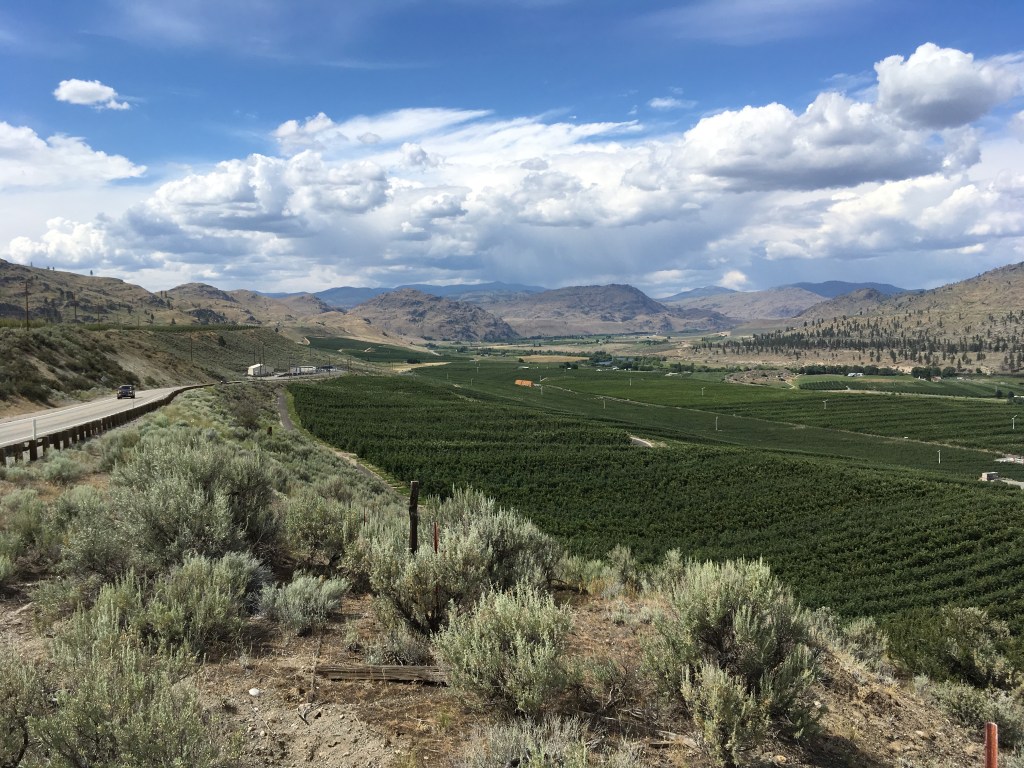
Driving north into the Okanogan Valley
Photo from my files taken in June 2019

A Few Steps to Compassion

I stepped from the little neighborhood shoe shop on East Madison Street, breaking in my brand new pair of Brooks (well cushioned for walking). Maybe that’s why I took special notice of the shoes on the young person who was passed out on the sidewalk in the next block. 

The sidewalk slightly  narrows in that block, making room for venerable trees that are the legacy of an earlier, possibly more gracious generation. The narrower sidewalk makes it an inconvenient place for passing out. Inconvenient for other pedestrians, that is.

In downtown Seattle, where sidewalks are really wide, the pedestrian flow is uninterrupted by the occasional drugged body languishing on the concrete. There’s room for all, and for some it’s the only room available. Away from downtown on Madison, pedestrians had to sidestep to the curb, pausing to let oncoming walkers by. We almost needed a flagger, like at a highway construction site. We politely made room for each other, seemingly oblivious to the obstruction we were avoiding.

I remember the first time — in the early days of the fentanyl epidemic — I came upon someone passed out on the ground in broad daylight. It was in Omak, the small eastern Washington town that I moved from last year. I was on my daily walk with my dogs in the park along the river. When I saw the man sprawled out on the grass, I pulled out my phone and called 9-1-1. To call 9-1-1 these days, whether in that small town or this big city, would be a gesture of naiveté and probably futile.

Perhaps we pedestrians pretended to ignore the human obstruction because it would be unseemly to stop and stare at someone who is suffering a personal crisis in such a public way. Still, as I edged to the curb (my balance assured with those new shoes), I noticed a few things.

The individual was not supine but in a contorted position, halfway between sitting and curled. Gender and race were undetectable, but youth was apparent along with stylish clothing and shoes. The black shoes were of that exaggerated, clunky platform style with the highest of heels. I could imagine their wearer getting carefully dressed, preparing for a … well, high time.

A lot of people are afraid to walk in the city these days. I too am afraid. I’m afraid that I will become so accustomed to inert bodies on the sidewalk that I will stop seeing them. I fear that I will stop noticing their humanity, their individuality — expressed in small, simple ways, like a pair of shoes. I’m afraid I will stop feeling the deep sorrow in my heart, that I will cease breathing a silent prayer of compassion. Each and every time.

I have no insights, no magic one-size-fits-all policy to suggest as we confront the intertwined issues of poverty, drugs, mental illness and homelessness. But there is a way out of this snarled tangle of hopelessness. Once we rid ourselves of disgust, judgment and indifference, what remains for those of us who are still walking around is the power of love.

There was a fellow human being on that sidewalk who, just like me, desires a good pair of shoes.

A Concert is More Than the Music

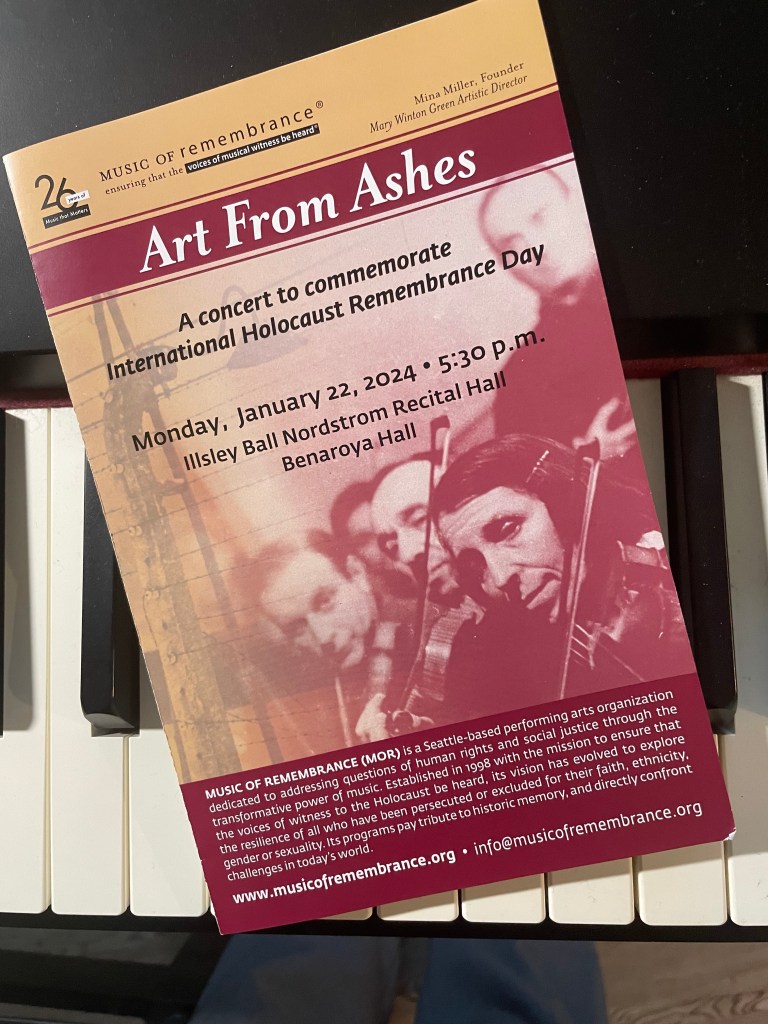
A free concert at Benaroya, Seattle’s premier performance venue. Knowing there’d be a crowd, my neighbor and I left plenty early for our walk to the event commemorating International Holocaust Remembrance Day (Jan. 27). We ended up with time to visit the Garden of Remembrance, which stretches along the west side of Benaroya.

More than eight thousand names of Washington State citizens who died in service to our country since 1941 are etched into the granite walls. Names include people who served in World War II, the Korean War, Vietnam, Gulf War and continuing through post-9/11. I immediately went to the Vietnam section and gently placed my fingertips on the name Keith Henrickson, a high school friend. It’s a gesture I’ve made before, first at the Vietnam memorial wall in Washington, D.C., and again when a traveling replica of that wall visited the Colville Indian Reservation, near my former home. 

I thought about how I’ve lived fifty-five years longer than Keith, who was killed at age twenty-four in Quang Tri province. Yet his name, etched in granite, is an enduring presence that will last long after I’m gone. His and all the other names are an ongoing witness to the tragedies of war. 

Scattered raindrops accented my somber mood as we left the garden and entered the hall. The concert was presented by Music of Remembrance, a nonprofit organization that addresses issues of human rights and social justice through music. As I read the program, I readied myself to shed tears. Many of the pieces were attributed to poets and composers who perished in Nazi concentration camps. 

I wondered about the quartet of pre- and teen siblings a couple rows ahead of me. Would they “get” it? They were jostling and elbowing each other in normal but disruptive ways. Their parents were seated like bookends with their offspring between. I hoped that Mom and Dad could/would keep the kids under control. Then, just as the lights were dimming, I heard the rustle of newcomers settling into the row directly behind us. I looked around to spot a young couple with two children, ages about three and one. 

I immediately flashed back to a free, noon organ concert that my late husband and I attended decades ago at the Mormon Tabernacle in Salt Lake City. The place was packed with tourists. The organist began with a brief welcome and firm direction: “If your child becomes disruptive or makes any kind of noise, do not hesitate to remove them immediately.” I don’t recall the organist’s name, but I have silently evoked his instruction whenever concerts get disrupted by crying or rambunctious children.

The audience dropped into silence for the opening “Intermezzo for Strings,” a floating, ethereal piece performed by The University of Washington Chamber Orchestra. The Jewish composer, Franz Schreker, had been forced from his position as director of an important music conservatory. But he cheated the Nazis out of killing him by dying after a stroke in 1933. 

The program continued, the youngsters in front of me quietly absorbed, the baby behind uttering only an occasional coo that was quickly muffled by her mother. About halfway through came a duet for violin and cello by Gideon Klein, a brilliant musicology student who died in the Fürstengrube camp at age twenty-two. The mournful, longing music ends suddenly mid-phrase, as did Klein’s incomplete life. In the silence that followed, before the audience could gather itself to applaud, the baby let out an anguished wail. Her cry said far more than our applause. Nonetheless, Mom gathered her up and exited the hall.

She missed the grand finale, “Farewell, Auschwitz,” a defiantly jubilant piece commissioned by Music of Remembrance. It was performed by The Seattle Girls Choir and Northwest Boychoir, along with instrumentalists and adult soloists. I was heartened by the discipline and beauty of the young voices. They were learning in a powerful way about an historical truth that too many try to deny.

Upon leaving the hall, I spotted Mom and baby seated on a bench. I perched next to them, the baby giving me a bouncing grin as I told her mom, “I’m sorry you had to miss the end of the concert. She was so good for so long, and I’m glad you brought her. She has that music embedded in her soul now.” Just as I finished speaking, another woman approached.

“Good for you for bringing the children to the concert,” she said. “They’re never too young.” 

Never too young — nor too old — to learn, to change, to grow, to remember.

Who Keeps Us Safe? (sometimes we never know)

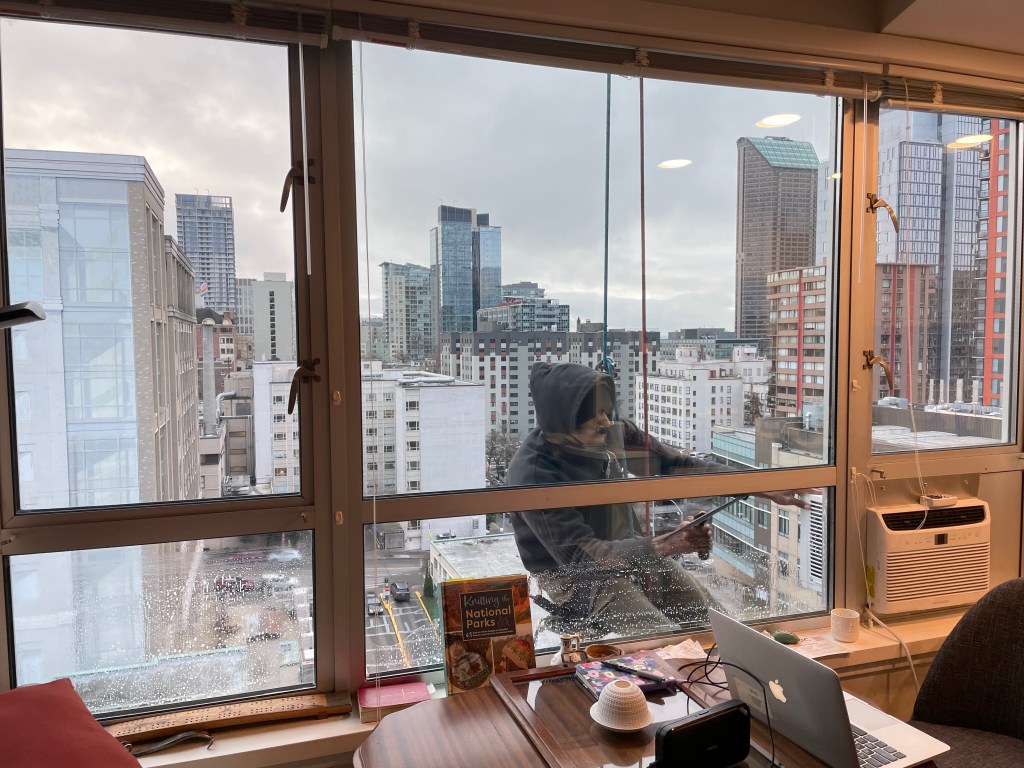
Savoring my morning coffee, scrolling through email, I suddenly became aware of a red rope slowly snaking downward outside my thirteenth floor window. What the …!? No way of telling where it came from or where it was going. Before long it was joined by a blue rope, the two of them swaying in the breeze, a sinuous tango, occasionally touching, then parting.

Mystified, I went about my morning ablutions. When I emerged from my bathroom, I discovered a man in a boatswain’s chair outside my window, expertly clearing away soap with his squeegee. I’ve long admired the efficiency of professional window washers. With just a few graceful swoops, they make the world brighter and more clear than it was. Still, I prefer to watch them work when they have both feet planted on the ground, or on a low ladder. Because of my own exaggerated fear of heights, I don’t like to see anyone in precariously high locations.

The window washer, noticing me, smiled and waved. I placed my hands over my heart to signal both apprehension and appreciation. He put his hands together and gave a bow. Then, as he began to lower himself to the twelfth floor, he pantomimed falling, first with a startled expression that gave way to a big grin. Obviously an act he’s perfected over the years.

I can’t shake from my mind how relaxed, at ease he was, trusting his life to just two ropes. No doubt he regularly scrutinizes them with an eagle eye. Still, it’s a leap of faith, not only in his equipment, but faith in whoever ran the machine that braided those ropes in the first place. He’s vitally connected with someone he’ll likely never meet.

Window cleaning isn’t on the list of the hundred most dangerous occupations, compiled by the National Institute for Occupational Safety and Health. OSHA reports eighty-eight window cleaning accidents over a fifteen-year period, sixty-two of them fatal. That’s out of millions and millions of windows washed. Squeegee Squad, a commercial window cleaning firm, claims that “statistically speaking, it’s safer to be a high rise window cleaner than it is to drive a cab.”

Or, safer than driving on rural two-lane highways, which is where I’ve driven most of my life. A federal safety initiative reports that more than twelve thousand deaths occur each year on rural roadways because drivers cross the center line or run off the road. That’s about a third of all annual highway fatalities, even though the interstates and city roads handle way more vehicles.

I used to think about that in my frequent travels along SR97, the north-south highway that bisects Washington state. I’d watch vehicles hurtling toward me at sixty mph (usually more) and think, I’ll never meet that driver, but my life depends entirely on their sobriety and attention. I’d silently message them: be aware, be safe. Then there were the occasional heart-in-throat moments when drivers passed recklessly, forcing others to brake and pull onto the shoulder. My messages were less silent and not kind.

“We are caught in an inescapable network of mutuality, tied in a single garment of destiny,” wrote Martin Luther King Jr. in his remarkable Letter from Birmingham Jail. “What affects one directly, affects all indirectly.”

We think we’re such independent individuals. But whether we’re washing windows on the thirteenth floor or driving along a two-lane highway or just reading words on a screen, we’re all as closely connected as one heart beat, one breath.