Chicken or Egg: Where Are You Comin’ From?

If you’ve ever puzzled over the chicken/egg primacy issue (which came first?), you might find your answer aboard the Coast Starlight Seattle-Portland train route. 

Or do I mean Portland-Seattle?

As part of “Trails and Rails,” a cooperative venture between Amtrak and the National Park Service, knowledgeable volunteers spend their summers entertaining passengers with stories about Pacific Northwest environment, history and culture.  (At least they did last summer. Who knows whether this admirable program will survive?)

Kristy and Phil, volunteers on my journey, were armed with notebooks full of facts and figures. But it was their story-telling skill that hooked passengers who filled the glass-domed observation car.

Approaching the Billy Frank Jr. Wildlife Refuge, just north of the state capitol, Phil described Frank as the “man who was arrested more times than anyone else in the state of Washington.” 

“What would you say about such a person?!” he continued, feigning dismay. Tourists murmured, disconcerted. Those in the know smiled at this introduction to one of the state’s most honored Native American activists and environmentalists. True, Frank (1931-2014) was arrested more than fifty times. The first time, at the age of fourteen, was the beginning of his decades-long fight to reestablish native fishing rights. His persistence led to the landmark Boldt Decision of 1974, upholding guarantees that had been set in an 1854 treaty but ignored. Frank’s numerous honors include the Presidential Medal of Freedom.

More stories flowed as the train whistled us through cities and towns until we approached Winlock, a small, agricultural community.

“If you remember nothing else from this trip, I hope you remember this,” prompted Kristy. Winlock historically touted itself as the “Egg and Poultry Capital of the World,” producing hundreds of thousands of chicks and eggs. To prove it, the town erected the world’s largest egg, a claim affirmed by “Ripley’s Believe It Or Not!” in 1989. 

Just across the street is another statue: a brilliantly colored but much smaller chicken. As to which came first, the answer depends on what direction you’re going. Heading south, the egg comes first. Going north, it’s the chicken.

That’s US!, I realized.

As in, U.S.

As in polarized. We’re all on the same set of tracks, but our stories depend on where we’ve been and where we think we’re going — or want to go. 

Each of us is the sum and substance of the stories we tell ourselves about ourselves. Information or ideas that don’t fit into our stories bring up uncomfortable emotions — sadness, envy, anger — and we’re inclined to reject them, as if to say the chicken absolutely came first or the egg absolutely came first. In other words, we have bias. It’s inevitable, explains writer Brian McLaren. It’s how our brains work. 

We grow up being told stories that shape our own stories. As we mature and age, our stories become more complex. When we are confronted with stories, ideas and information that conflict with our story, we have a choice. We can simply reject those other stories — take the easy route. Or we can figure out how to rewrite our story, even discarding parts, to make our narrative more inclusive. Rewriting is hard and tiring work for the brain. And it’s ongoing. There’s new stuff coming down the track every day.

It’s like the Billy Frank Jr. story. If we get only a fragment, we easily jump to a skewed conclusion. 

On my return trip, from Portland to Seattle, I was sitting on the “wrong” side of the train. I missed seeing the chicken precede the egg. In fact, I missed chicken and egg altogether, thus missing half the story.

Nevertheless, when we can simply enjoy that there are chickens and there are eggs, and there are eggs and there are chickens, we won’t have to worry about which came first. When we can hear and honor each other’s stories, acknowledge where each other is coming from, we’ll be getting back on track.
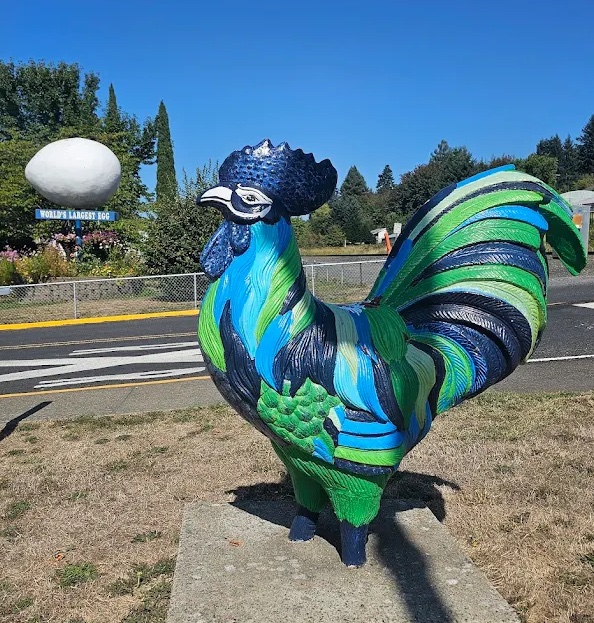
It’s a matter of perspective. Winlock’s egg is really
much larger than the chicken. – Tim Bryon photo
Pro-Active Aging: Mapping a path toward the inevitable

November 5 marked one year since I moved to an “old folks’ home,” as a friend patronizingly describes it. I neglected to observe the anniversary. Apparently other events on November 5 distracted me.

Now I’m taking a breath, reflecting on that decision to turn my life upside down one year plus one month ago. I exchanged a rural riverside home that I loved for a city studio apartment in — NOT an old folks’ home — but what the industry prefers to call a CCRC — Continuing Care Retirement Community. I live independently in my own apartment until, until … I no longer can. Then I’ll be appropriately cared for.

Do I miss my previous life, the people and place I left behind? Every moment of every day. Did I do the right thing? Absolutely.

I carry this paradoxical load of joy and sorrow by embracing both present and past with gratitude. I’m thrilled to be where I am: in a vibrant community, soaking up the energy and culture of a large metropolis. All the while, I revel in memories of rich relationships and events that once were and can be no more.

During the final hectic weeks of preparing to move last year, seeds of doubt threatened to erupt into full-blown angst. To ward off inner explosions, I kept a list in my journal under the heading,“Reasons For Moving.” No. 1 on that list was “Pro-Active Aging.” More than anything else, I wanted to make my own decisions while I still had the capacity to make them. Above all, I didn’t want to reach the point when family and friends would debate, “What should we do with/for/about dear old Mary?”

I’m not interested in denying the effects of aging. There’s no debate. Our bodies and our mental capacities change. I’m interested in acknowledging those changes, accommodating them, even savoring them. Age is a convenient avenue for setting boundaries: No thank you. Not interested in going there. Not doing that. And the world shrugs its shoulders. What d’ya expect? She’s old!

Even as my own Earth-bound future grows shorter, I care about the future of our world. No. 3 on my “Reasons” list (after No. 2 — financial) was “Lower My Carbon Footprint.” That could’ve been a sub-head under No. 1. One of the most vexing issues for families with aging members is convincing them to stop driving. For too many, losing the freedom to drive is the death of independence. 

I recall a friend at age 90 gleefully maneuvering England’s country roads, one leather gloved hand on the wheel, the other briskly shifting gears as we sped from curve to corner. “They’re going to have to pry my cold, dead fingers from around the steering wheel,” she declared. They didn’t have to. A paralyzing stroke ended her driving days.

I gave away my car before it became an issue. I revel in the true independence offered by mass transit. No hassles with parking, gas prices, insurance, maintenance and repair bills. And, oh my, the interesting people one can engage with on the bus.

“Want little: you’ll have everything,” advises Portuguese poet Ricardo Reis. He continues, “Want nothing: you’ll be free.”

I’m not suggesting everyone should follow my path of aging. We each find our own route, which is why some folks call it (s)aging. We don’t have a choice. Aging begins with that first breath and continues throughout our lives. I’ll not quote that old saw — the one that says growing old beats the alternative. 

Oh. I guess I just did. A sign of age?

When Fate Turns the Page: Time to start a new chapter

The thunder of U.S. Navy “Blue Angels” skimming the tops of Seattle skyscrapers reminded me it was a one-year anniversary. On the morning of Aug. 2, 2023, I was in Portland, saying that impossible, final goodbye to Lee, my soul brother for more than fifty years. 

“We’re both going on a journey, but in different directions,” I said to him, leaning close to kiss his cheek. He whispered something I couldn’t understand, but words no longer mattered. We both knew that. I got in my car, dry-eyed with a sobbing heart, and drove north to Seattle. A chapter in my life had just ended. Maybe the whole book. Maybe I was driving into the epilogue. 

All those years ago, Lee and wife Mary Lou had stood as witnesses when John and I married. It was like a marriage of marriages, a foursome. As couples, we never lived close to each other, often thousands of miles apart. Yet we’d travel those miles to share slices of life. Our foursome dwindled as John died in 2007, Mary Lou in 2020. Lee and I soldiered on. Frequent phone calls. Occasional visits. We’d talk idly about road trips we might take together, but we’d both seen plenty of road. And now, here I was, back on the road, the lone survivor. 

I had an appointment to see an apartment in Horizon House, a retirement community on Seattle’s First Hill. I’d visited a few months earlier and fell in love with the location, energy and philosophy. People move here not to retire and die but to live, contribute, and matter. Still, I was skeptical. I’d been invited to look at a studio apartment. I couldn’t imagine a studio large enough for me, much less my “stuff.”

I asked my niece Sandy to join me. A savvy realtor, she poses the questions that never occur to me. The sales rep unlocked the door to 13-A, and I walked straight to the window, all of twelve paces. Windows have always been the most important feature of anywhere I’ve lived. What would I be viewing? An urban valley of rooftops in the foreground ringed by a horizon of office and apartment towers. Columbia Center, Seattle’s tallest building at 72 floors, loomed above the rest, piercing an endless blue sky.

That’s when we heard the thunder. Not a rain cloud to be seen but jets skimming through the air with gasp-inducing precision. Seattle’s annual Seafair celebration, complete with aerial show. I teased the sales rep about arranging a spectacle as part of her marketing ploy.

With or without jets — especially without, I decided the view would keep me adequately absorbed. After decades of living on a riverbank, I’d be watching a different kind of wildlife on the busy streets thirteen floors down. The studio was big enough for me, and the storage unit in the basement large enough for my stuff. For the next three months I lived in an emotional vortex as I prepared to  move. I celebrated and mourned the ties with people and place that had bound me to the Okanogan country of eastern Washington for forty-four years. I’ll never become untied.

While I’ve lived in Horizon House only nine months (an appropriate gestation period), I’m convinced I made the right decision. And here again are the Blue Angels. Thrilling as the aerial shows are, a growing number of voices object to the noise and environmental consequences. Protesters argue that each jet burns about 1,500 gallons of fuel per hour. Each air show puts some 650 metric tons of CO2 into the atmosphere of an earth desperate to reduce carbon emissions. The Blue Angels may not be around forever, nor will I. But I’m here for at least another chapter.

After the Fall: Why me?

“80-year-old fall!”

When I heard the triage nurse’s call, I realized I had a new label. I was waiting with two ambulance attendants in the ER corridor, in line for an empty bed. They can call it emergency, but hospitals in general involve a lot of waiting. That allows time for pondering.

Ponder this: How is it that Seattle citizens, accustomed to walking around prone bodies on the sidewalk without even slowing down, would rush to my assistance as I lay facedown on hard concrete?

Welcome to my world of privilege. I was nearly 20 when I began to realize that I was privileged through no fault of my own. I was born white, middle class (not a lot of money but enough), a U.S. citizen, raised in a two-parent household by parents who habitually expressed love for each other and their children. I thought that was normal. 

With every passing decade and cultural crises of domestic violence, sexual abuse, family trauma, systemic racism, homelessness, social injustice at every turn, my privilege becomes harder to bear. Not until I work through the guilt and humbly lament can my privilege be fully acknowledged and appreciated.

People fall on Seattle sidewalks all the time. I’ve watched it happen. The falls I’ve witnessed unfold in slow motion. The faller leans forward from the waist, bends their knees, and lowers their body, ever so slowly escaping into the inevitable neverland of  gravity and drug OD.

My fall occurred instantaneously, as if the uneven sidewalk suddenly rose up, smacking my body like a thousand sledge hammers. Before I could figure out what happened, people — total strangers — hurried to help. I have to ask, “Why me?” Not the victim’s why me. Not the why me of Job or anyone who disputes bad events that are supposedly unjust, undeserved. 

I suspect people rushed to my aid because I wear my 80 years of privilege like a shining coat of armor: silver-haired matron in age-appropriate, subdued clothing, walking briskly, could even be heading home from church (which I happened to be). I was safe. My needs were simple: help me up. Maybe call an ambulance. Lots of Good Samaritans on hand. 

I think the Samaritan’s story can be misinterpreted. It’s not that we’re called to assist every needy person we come across. We are to acknowledge both their needs and our ability or inability to meet those needs. I as an individual cannot help the fellow human who is comatose in the building alcove. I can, however, join with others in community who, as a community, have the power to help, to make a difference. Even the Samaritan didn’t act on his own. He took the robbery victim to an inn where he presumably was known. He trusted the innkeeper to provide appropriate care, and the innkeeper trusted him to make good on the bill. That’s community.

I declined suggestions of an ambulance and got a Lyft ride home. After an hour of icing, I had to admit my injuries were worse than I could heal on my own. Again as a privileged person with an insurance card in her wallet (10 percent of Americans STILL don’t have insurance and others are under-insured), I called an ambulance.

Diagnosis: fractures of the left radius (elbow) and right patella (kneecap) along with a colorful variety of bruises and abrasions. Next comes elbow surgery followed by rehab. Then — date uncertain — back home, all because I’m privileged. Once back home they’ll call me by my name, or occasionally “Apartment 13-A.” Just not “80-year-old fall.”

That selfie is not at all flattering, and honestly, it looks worse than it feels.

A Tale of Two Christmases

Yesterday (January 5) was Twelfth Night, in olden days recognized as the final day in the Christmas season. Ignored by most people now, Twelfth Night may have a ring of Shakespearean familiarity. It is the occasion for which his comedy of that name was meant to entertain.

I still cling to a Twelfth Night observation. Otherwise, it seems as if we catapult our way from Christmas to New Year’s, landing with a thud on January 2. The party is over. We’re befuddled by the new year’s reality, which feels an awful lot like the old year’s. 

Twelfth Night offers a more gentle landing, like reading a good book, coming to the end and closing the cover with a satisfied pat. It’s a lovely day for lighting candles one more time, listening to carols before tucking them away for another year, packing up decorations, and reflecting on lingering joy. I celebrated this year by lunching with two friends who described their Christmases.

“I boycotted Christmas,” announced Friend No. 1. So much for my gentle landing. She sounded both defiant and liberated. And really, if I’d had a December like  hers, I would’ve boycotted not only Christmas but the entire world. She had demands for year-end reports piling high on her desk when (a) both of the family’s two cars quit running, which maybe wasn’t that big a problem because (b) two family members were stuck at home with Covid, which was anxiety-producing because (c) this year’s especially heavy snow load has resulted in their home’s cracked ceiling.

Because they have offspring, my friend’s boycott was not total. There was a small tree and gifts. Otherwise, she advised extended family and friends that there’d be no packages or cards in the mail, no cookies in the oven.

And then there was Friend No. 2, who began by listing her Christmas dinner guests. They were a variety of ages, religious backgrounds, interests, etc., with one thing in common — they all would have been alone for Christmas dinner. (May I digress: there’s nothing wrong with peaceful solitude on Christmas if you enjoy it, and I do, but that’s another story.) 

Friend No. 2 admitted she was two hours behind schedule getting her guests seated at the table. The meal was delayed by numerous side dishes. I’m not talking about the mashed potatoes, vegetables, salads, etc. Her side dishes were plates of food she and her guests delivered to folks who couldn’t make it to her house for various reasons. I would have found the combination of guests in my home AND deliveries a hair-pulling logistical challenge. She  made it sound as if it’d been no more complicated than buttering toast. She adopted just the right tone of humility, telling us everyone proclaimed her meal delicious.

After our luncheon, I considered the many ways people celebrate Christmas, including — maybe especially — the self-proclaimed “boycotter.” Her day job involves helping people solve problems that are too often unsolvable. She’s overworked, underpaid, under-appreciated and above all, compassionate. Boycott Christmas? Nah, she observes Christmas — the REAL Christmas — every day of the year.

You Know You’re Old When You’ve Outlived the Trees You Planted

The chainsaw massacre was about to begin when the normally docile young woman intervened. Later, she described the episode during our Zoom call. For years she and her roommate had been ideal tenants, quiet, tidy, paying their rent on time. But when she spotted the crew preparing to remove a stately tree in front of their house, she vehemently protested to her landlord. A conference with arborist, crew and others ensued. The tree survived. Neighbors quietly praised her intervention, admitting they’d been reluctant to get involved. 

“This was so unlike me,” she told her Zoom audience. The chat box filled with congratulatory notes and emoji applause. My emotions were mixed. Trees tend to live a long time and deservedly so, for all the benefits they offer. Yet just like us, trees have a life cycle, an inevitable end.

 I once was that young woman, what the cynical call a “tree hugger.” A love for trees is still deeply rooted in my heart. No pun there; a simple truth. I also know — even without seeing this particular  tree — that its reprieve is temporary. The USDA says urban trees tend to live only twenty-eight years at most — about twenty percent of a normal tree life span. Their congested environment makes them susceptible to pests, disease, inadequate care, inappropriate placement, improper planting, asphalt generated heat, etc., etc.

Living where I do, in a rural, desert-like shrub steppe environment, I’ve been a rabid defender of trees. While I was still editing the local newspaper, the city superintendent knew me well enough to call in advance whenever a tree had to be removed from the public domain. He’d explain the detection of disease and consequent threat to human health should the tree keel over on its own or topple in a windstorm. 

My town boasts a luxurious canopy of green, none of it native, and has been officially declared a “Tree City U.S.A.” by the Arbor Day Foundation. This small urban forest is a legacy of pioneer women, who a century or more ago planted the first deciduous trees, hauling water in buckets to nurture them in this arid country. More recently, volunteers tore up sidewalks to provide irrigation for trees along Main Street.

I’ve planted my share of trees over the years. I remember how eager I was the day we planted red maples in the front yard — anxious for them to grow and give luxurious shade. What I hadn’t figured on was that I’d be aging right along with those trees.

Once, my husband and I made an impulse buy in support of a newly established nursery. We brought home the tiny pine and scouted the yard for a place to plant it. While I looked around for available open space in the lawn, my wiser husband looked upward. He nixed my first choice because eventually the tree would get tangled in wires. Pines generally live at least fifty and often hundreds of years. This one gave us three beautiful decades before it became mortally diseased. 

Even as I mourned, I marveled at the skill of the sawyer who limb by limb denuded the tree and finally sawed off the naked trunk. He was, I hate to admit, graceful.

“I make it look easy, don’t I,” he boasted with a grin. I witnessed the deafening process as tree limbs and trunk were chopped into chips that would become mulch that would eventually fade back into Mother Earth. All is temporary, yet circular.

My diseased pine on his way back to Mother Earth

How’s This for a New Year’s Resolution: Share less; shred more

It’s so tempting, so easy. Just click “share” or point your cursor to “forward” and you poison your universe with derogatory satire, derisive cartoons, contemptuous commentary that seemed so funny when they initially appeared on your screen. Gleefully you pollute the screens of those you call friends. And they share with others who in turn share, and we all share ad infinitum, ad nauseum.

Entertainment? Self-expression? Really? Does the world need more snarkiness?

We common, everyday folk have more opportunity to join the global conversation than ever before in human history. In the 1970s I was an editor for the Associated Press, the largest news-gathering agency in the world. Yet I had nowhere near the unchecked power that I hold now as an old lady in a remote town with a computer and high-speed internet. 

What can I, what should I, be sharing with the world? We have infinite opportunities to  share beauty, extend love. That also means each one of us is individually responsible for taming this wild internet beast. It’s a responsibility we dare not cede to politicians or corporate executives.

Indulge me. Next time you’re tempted to click, sit on your hands for a moment. Ask yourself three questions inspired by mystery writer Louise Penny’s fictional character, Chief Inspector Armand Gamache. Before speaking, the admirable Gamache asks himself:

  • Is it kind?
  • Is it true?
  • Is it necessary?

The first question would eliminate a lot of sharing right off the bat. The second is trickier in an era when so many get to choose what flavor of “truth” they prefer; you can “prove” anything online. But if the first two don’t stop you, the third one probably will.

But I’m so angry! Well you should be. There’s much to be angry about. Mental health counselors and self-help experts tell us that anger is a natural, normal emotion. What we do with it makes all the difference.

A Seattle orthopedic surgeon prescribes a pain-free, cost-free treatment for addressing anger and negativity. Dr. David Hanscom, author of Back In Control, calls his treatment “expressive writing.” Take paper and pen and let the words flow: all the challenges, the doubts, the frustrations, irritations, the “insurmountable problems.” He suggests about fifteen minutes of writing every day. Not all that much time away from the screen. 

Ah yes, writing is to be done by hand, not on the computer. Clutching that pen or pencil and pushing it across the page fires up a broader spectrum of neurons in your brain. You’re getting more bang for your buck. Plus, the really important part of the treatment is the next step: shredding what you’ve written. Ripping it up and throwing it away is liberating, says the doc. Clicking that scowling emoji on Facebook won’t give you near the relief.

“It is that physical act of squashing, tearing, destroying negativity that makes all the difference,” Hanscom declares. For 2022: share less, shred more.

P.S. Feel free to share this post.

Simply Christmas

Old folks, I decided as a child, don’t know how to celebrate Christmas. I occasionally accompanied my parents visiting elderly church members, most of whom had no Christmas trees or decorations, no apparent interest in presents. Cookies, if offered, came from a tin and tasted weird.

Now after nearly eight decades of Christmases, I get it. At a certain age (varies for each of us), we let go of futile attempts to recreate the Christmas magic that can happen only when we’re children. 

When it comes to remembering childhood Christmases, no writer can outdo Dylan Thomas’s “A Child’s Christmas in Wales.” My memories of a child’s Christmas in Minnesota echo Thomas’s opening passage: “One Christmas was so  much like another … that I can never remember whether it snowed for six days and six nights when I was twelve or whether it snowed for twelve days and twelve nights when I was six.” 

Probably both.

In my childhood, certain traditions were sacrosanct. The main course on Christmas Eve, in deference to my Swedish father, was the notorious Scandinavian seafood dish, lutefisk. It was the only meal of the year when we children were allowed to pass up what was placed on the table. As an adult, I finally developed a taste for the pickled-in-lye white fish, but where I live, it’s impossible to find.

My memories of unique Christmases have to do with presents — which for a child is the whole point. There was the year I was given a Rudolph the red-nosed reindeer lapel pin for my coat. His nose lighted up — a handy way to illuminate the hymnbook during our candlelight worship service. 

There was the year I received a much-longed-for doll with REAL hair. I immediately gave her a shampoo and set. As a result, every day was a bad-hair day for the rest of her existence.

There was the year the gift from my mother’s “rich” aunt arrived in a large carton, too heavy for just one person to lift. We kids were intoxicated with anticipation: it was the size of a TV console, and we were the only home in town without a TV. Or so it seemed. Finally, the moment arrived. As the carton was slit open, we spotted a lovely mahogany case, containing? 

An entire set of Encyclopedia Britannica. 

Even my adult Christmas memories have a childlike flavor, such as watching my husband meticulously place his favorite, bubbling lights on the lower branches of our tree where his tiny grandchildren could enjoy them.

Now my favorite Christmas present is the presence of Christmas. We open that gift simply by opening our hearts. Because my late husband was born on Christmas day, the high point of my celebration is laying a blanket of greens on his grave. Any self-respecting kid would roll her eyes, but that’s okay. Kids have important work to do, living the magic that will become precious Christmas memories decades from now.

The Joy of Solitude

A friend asked if I went on a silent retreat during Thanksgiving. True, I spent the week at Holden Village, a spiritual retreat center where I lived from 2011-2014. A former mining town high in the North Cascade Mountains, Holden was once described by a former director as “a retreat for extroverts.”

Holden Village dining hall decked out for the Christmas feast. (File photo from a previous year.)

I, like most people who live alone, have been on pretty much of a silent retreat since spring of 2020. I generally read during my silent, solo meals. Thanksgiving dinner in the Holden dining hall was served to about a hundred folks, all masked unless fork was en route to mouth. Masks did little to muffle the crowd’s chatter and musical laughter, accompanied by the percussion of clanging pots and pans in the kitchen and metronomic beat from the ping pong table in a corner of the large hall. Music less symphonic, more heavy metal rock to my ears. Unnerving, which is exactly why I needed to be there. Solitude had been getting altogether too comfortable. 

Last summer a few friends and I, gathered outdoors, admitted to each other that we were thriving in social isolation. We felt almost guilty, enjoying ourselves when many people are suffering and grieving. All of us in that group live close to nature. I’m sure I’d feel differently if I were stuck in an urban apartment with a view of concrete and asphalt. I know I’d feel differently if I didn’t have the companionship of my dog.

“Don’t fear solitude,” advised writer Paulo Coelho. “If you are never alone, you cannot know yourself. But don’t get too attached to it — it may become an addiction.”

Besides which, snarked another writer, Erica Jong, “Solitude is un-American.” Indeed, we loners are under a lot of pressure not to enjoy solitude on that thoroughly American holiday, Thanksgiving. The pressure will only increase as we move toward Christmas, a day not even Scrooge was allowed to spend alone.

Being alone does not equate with loneliness, and loneliness is not the same as solitude, noted a lovely essay in Psychology Today — in 2003! That was long before “social distancing” became common to our vocabulary.

“Loneliness is marked by a sense of isolation,” the magazine explained. “Solitude, on the other hand, is a state of being alone without being lonely and can lead to self-awareness.” 

If solitude were to have a patron saint, a likely candidate would be Henry David Thoreau who observed, “I have a great deal of company in the house, especially in the morning when nobody calls.”

Even during my un-retreat, in between meals and various gatherings, I’d seek refuge in the solitude of my room, curled up with a good book. Much as I enjoyed meeting up with old friends at Holden and making new ones, I’ve gotta admit: the best part of the week was reuniting with my dog (he’d spent the week at the pet resort) and stepping into my house, embraced once again by my silent retreat. 

Thank you to Maxime Lagacé, whose web site, “Wisdom Quotes,” provided a few of the above quotes. Visit the site to read more pithy observations about wisdom.  

One Simple Move

I moved my chair. I mention this only because you may have a chair like mine. It’s your sanctum sanctorum, your refuge dedicated to comfort, relaxation and an occasional nap. On an adjacent table you may have piled books, newspapers, magazines, beverage of choice, digital devices, remote controls … whatever sedentary activities your chair accommodates. 

Your chair may be a recliner. Mine is not. It’s the old-fashioned Queen Anne wing style with a high back so I can rest my head when I feel a snooze coming on. Both chair and matching foot stool have been reupholstered twice over their many years of service. They’re looking worn and dingy yet again.

It’s discomforting, this new location. I can’t say I like it better. In fact, I may not like it at all. Yet, there are advantages. The light is better for reading. The chair previously blocked a section of bookcase that I needed to reference frequently. I could’ve moved the books, but the chair was easier. Now it blocks a closet that houses out-of-season clothes. I’ll need to shove the chair aside only a couple times a year.

The real reason for relocating is a change of perspective. I needed a new way of looking at the world, because the world itself isn’t looking at all the same. Most — maybe all of us — are experiencing that sense of unfamiliarity. A poll cited in “The Week” magazine reports that eighty-one percent of Americans do not expect life to return to normal anytime soon. Twenty-six percent say life will never return to normal. Whatever normal was. 

And was normal all that great? My dad liked to say that “the ‘good old days’ were formerly known as ‘these trying times.’”

I can still watch the Okanogan River from my chair’s new location. At the risk of overextending a metaphor, my previous view was upriver. The current, along with occasional flotsam and jetsam, headed my way. Now my view is downriver and the flow of energy pulls away from me. I trust it won’t pull from my own energy.

Whether looking upriver or down, I watch the constant activity of wildlife: birds, ducks, geese, great blue heron, eagles returning soon, the occasional leaping fish, and playful river otters. Add to that, I now face the downriver bridge with a different kind of wildlife. It’s a busy little bridge with a steady stream of trucks, cars, and buses. From this distance, I can’t make out the people inside the vehicles. I don’t know their gender identity, race, ethnicity, religion, political preferences, income level, intelligence, interests, or skill set. But I feel connected. I extend a silent blessing, because they’re people on a bridge, coming from somewhere, going somewhere.

That’s pretty much where we all are these days. On a bridge, headed somewhere even though the destination may be uncertain. Some people believe we’re headed nowhere. If that’s your point of view, it might help to move your chair.