Beyond Vanity: Admit it — You too are gifted

At the beginning of a book discussion group on Zoom, one of our members offered to sing a song he’d composed. First, he apologized, “I hope this isn’t too vain.” He’s no amateur singer/song writer, so his offer was more than welcome.

The song proved to be an ideal introduction to the evening’s topic. At the same time, his use of the word “vain” evoked a memory from my sophomore year in college. A friend had asked me to join her in visiting the family of a mutual friend. Their father had recently been killed when a shed he was dismantling collapsed on top of him. As we sat with the family, trying to share their grief, they asked me to play the piano. I hesitated. Outside of a church setting, I was uncomfortable, even fearful of “performing.” I was a victim of my own false vanity.

Nervously I sat down at the aged upright piano and played a complex piece I’d been working on. The music ended with thundering chords, after which came utter silence. I turned from the piano to see tears of gratitude on every face. The mother said simple words I would always remember: “Never withhold your gift. Always share it.”
My musical gift is relatively small. Over the years I’ve been humbled and gratified to play with musicians whose gifts are far greater. Sometimes, too, I’ve played with those whose smaller gift was enabled, maybe even enlarged, through my accompaniment.

The Bible reminds us (1 Corinthians 12) that each of us has a variety of gifts. Every one of us is a gifted individual, but gifts fall into the use-it-or-lose-it category. Gifts have to recognized and shared, or they disappear.

I’m especially appreciative of people whose hands are gifted in various ways. Too often manual labor is under-appreciated and underpaid. In recent months around my house, I’ve enjoyed watching the craftsmanship of a carpenter, the patience of painters, the efficiency of a window washer, the youthful energy of kids pulling weeds in my garden.

The joy of heaven is found on earth when we share our gifts. Back to that vanity issue, it’s a tricky maneuver, finding just the right balance between confidence and humility. For most people, honing and offering their various gifts earns a paycheck. The real reward, though — the reward that keeps our world going round — is the gratitude of those with whom we’ve shared, for whom we’ve opened our treasure chest of gifts.

This week I renewed acquaintance through email with an 85-year-old man whom I hadn’t been in touch with for more than forty years. Even then he had an uncanny gift of vision. He recognizes ideas that will impact the future in positive ways. As an entrepreneur he has launched numerous businesses and is still at it. His visionary gift has made him wealthy. More important to him, he’s created job opportunities for hundreds, probably thousands of people.

The Good Life: Making Room for Interruptions

Tuesday, according to my plan, would be a day of quiet, solitary remembrance. Then life interrupted.

A year ago, on September 26, 2020, my longtime friend, Mary Lou — more intimately known as Lou, quietly passed into her next realm of existence. She’d been a partner in music and adventure, my confessor, stalwart supporter, and exemplar of life well-lived.

As we do every morning, my dog and I greeted Tuesday by heading outside to the patio to stretch and survey life on the river. A great blue heron that had been stalking fish from the riverbank quietly lifted itself into flight. The day before it had squawked at me angrily for interrupting and flew upriver in a huff. This day it changed direction, gliding downriver, a weightless soul in the air, an invocation for this sacred day.

Thus ended my solitude and silence. The first phone call came from a friend whose widowed father had suffered two TIAs (“mini” strokes). She’s confronting the multitude of what-next questions that comes with aging parents. She doesn’t need me to tell her what to do, but she did need an ear willing to listen as she ponders her options.

Ensuing calls were less critical. The fellow who was scheduled to come last week to wash windows and didn’t show up wants to come next week. Whenever, I said. The fellow who was supposed to come last week to finish putting heat tape in my gutters and didn’t show up wanted to come Wednesday. Fine, I said. The soonest the optometrist can see me is January 13, 2022. Great, I sighed. 

An inheritance and a hug

I put my phone in my pocket and slipped into Lou’s sweater jacket. It’s a multi-colored, heavy knit, perfect for walking in autumn. She’d loved it, and her husband insisted I inherit it. I could feel the warmth of her hug through the sleeves of the sweater as the dog and I walked through the park. The trees that had been wearing a brilliant display of gold were now shedding their leaves with the insouciance of a rich woman dropping her jewelry onto the dressing table.

It was a day for homemade soup, but the black beans and rice concoction I had simmering on the stove tasted flat. I reached for “Slap Ya Mama.” Lou, a southerner from soul to drawl, introduced me to this zesty spice mixture on my first visit to New Orleans. She was, as usual, ahead of her time. It’s now available at supermarkets nationwide.

Two more phone calls. Both from fellow widows — one a few years in, the other less than a year — both, like me, figuring out where we are in life, simply wanting to chat. 

Finally, a brief visit from my neighbor and his sister to discuss the music I’m to provide for their father’s memorial service on Sunday.

By now it was past dark. I was remembering Lou’s final weeks. No matter how exhausted she was, she refused to turn away visitors. “Hey, how are ya doin’?” she’d call out cheerfully when they were barely through the door. She’d somehow muster energy her body didn’t have to chat, counsel and console. 

I thought about how she’d woven herself into the in-between spaces of a day I’d intended to be all about her. And I knew. Mary Lou wouldn’t have had it any other way.

The Final Passage: Out of time but not out of opportunity

In the late 1970s, journalist Gail Sheehy helped a lot of people understand their lives with her book “Passages.” Alas, I was not one of them. I tried to read it, but didn’t get far before setting it aside for my usual fare, a murder mystery. In those years I was more into detection than introspection.

The subtitle of Sheehy’s book is “Predictable Crises in Adult Life.” She describes those crises using the framework of decades: The Trying 20s, The Catch 30s, The Forlorn 40s, The Refreshed (or Resigned) 50s.

The Library of Congress listed “Passages” as one of the ten most influential books of modern times. But that was then. A thirtieth anniversary edition of the book was issued in 2006. In the new introduction, Sheehy (who died just last year) wrote she’d been asked to address what had changed since the book’s initial publication. 

“What hasn’t changed?” she asked rhetorically. “Passages” is steeped in the culture and mores of the ’70s. An apparently younger reviewer on the website goodreads.com declared, “I’m SO glad I didn’t grow up then. [As a woman] I’m so grateful for my ‘freedom.’”

My own adult passages did not coincide with the decades but occurred like clockwork every fourteen years with a major event in my life. At age twenty-one, I married my high school sweetheart, which he observed much later, seemed at the time “like the thing to do.” The next fourteen years included an amicable divorce, much searching and discovery.

At age thirty-five I married my soulmate, John, and settled into fourteen years of maximum productivity, a full life. When I was forty-nine, John suffered a brain stem stroke, resulting in total paralysis and catapulting us both into an era of disruption and deeper discovery. Fourteen years later, when I was sixty-three, John’s death coincided with a sense of my own maturity.

Now at seventy-seven, it’s not a personal event but a global pandemic that has ushered in what is most likely my final fourteen. I don’t know if that’s fourteen years, months, weeks, or days. Google says the number fourteen in Chinese tradition means “guaranteed death.” Well, we’re all guaranteed that. 

I do know that I’m afraid, but not of death, which Jane Goodall at age eighty-seven describes as “the next great adventure.” My fear comes with the certainty that the next fourteen years are critical for the life of our mother, Earth. She and I may be on a parallel path, and her health is already more fragile than mine. Climate crisis is not some day. Climate crisis is now. As recent months proved, our four seasons now are autumn, winter, spring, and hell. Moreover, hell is sneaking across the boundaries, invading spring and autumn. 

In the darkest of black humor columns, New Yorker writer Dennard Dayle suggests, “You’re not looking at the death of the human race. Just the death of the  human dream.” I disagree. We may be out of time, but we’re not out of opportunity. And opportunity offers passages to dreams, to hope.

We have the opportunity of choice. We each make hundreds of choices every day. Many, if not most, affect the whole of creation. When we make choices as captives of a consumer culture instead of as free children of a beloved Mother Earth, we diminish the dream. Paraphrasing theosophy writer Alice Bailey: “Let Reality govern my every thought, and Truth be the heart of my life. For so it must be for all of humanity. Please help me do ‘my part.’”

What’s Real? The Stories We Tell Ourselves

While I was waiting to get my Pfizer booster vaccine, a thirtyish woman and and her male companion entered the small pharmacy. They were first-timers, there for the single-shot Johnson vaccine.

We briefly chatted in the waiting area until the pharmacist appeared, motioning me to the curtained alcove where the shots are dispensed. He was efficient and quick. I felt only the slightest prick in my left arm.

As I settled back in my chair for the recommended post-shot wait, the woman began to murmur how worried she was about getting the shot, how needles terrified her.

“I could pinch your arm and it would hurt more than that shot did,” I tried to assure her. To no effect. She claimed she was about to have a panic attack because of her dread of needles. I suggested that she go outside, remove her mask and take some deep breaths. She agreed, and I watched through the door as she stood on the sidewalk, gasping. Within seconds she returned, although now nearly hysterical.

Soon it was her turn behind the curtain. I was astonished to hear the pharmacist say, “Oh, what’s your tattoo?”

“A butterfly,” she answered. Moments later, she emerged, glaring at me.

“That was WAY worse than a pinch!” she complained.

She returned to her chair, and I scooted over next to her.

“I’m sorry if I’m being nosy, but I heard the pharmacist say you had a tattoo. How did you manage that?”

“I was drunk.” Made sense.

“It was a bet,” she continued. 

“Did you win or lose?”

“I won,” she said. She started to explain when the pharmacist showed up with her proof-of-vaccination card. She asked where she could get the card laminated. The pharmacist replied that it wasn’t a good idea to laminate the card because he wouldn’t be able to write on it if she needed a booster shot.

“I’M NOT GETTIN’ NO BOOSTER SHOT!” she shouted as she grabbed the card and headed out the door. “I wouldn’t have got THIS shot except for [insert profanity] Inslee …” That would be Gov. Jay Inslee and his vaccine mandate. Her words trailed off as the door swung shut.

She got me thinking about the stories we tell ourselves. We might tell ourselves we’re deathly afraid of something and then find a way to anesthetize our way around that fear. Or we might tell ourselves that we’re victims, helplessly pitted against someone or something more powerful. I wonder if this woman’s story would include intense pain in her arm and side effects from the vaccine so severe that she wouldn’t be able to work the next day. It’s all the [insert profanity] governor’s fault.

Reality is subjective — subject to the stories we tell ourselves. You know the cliche? “That’s my story and I’m sticking to it!” Yet whenever I’m feeling unreasonably angry or unreasonably dejected or just plain unreasonable, most likely the fix is not “out there,” but in my own head. The story I’m telling myself could use a rewrite.

Just a pinch?

Odometer Lessons

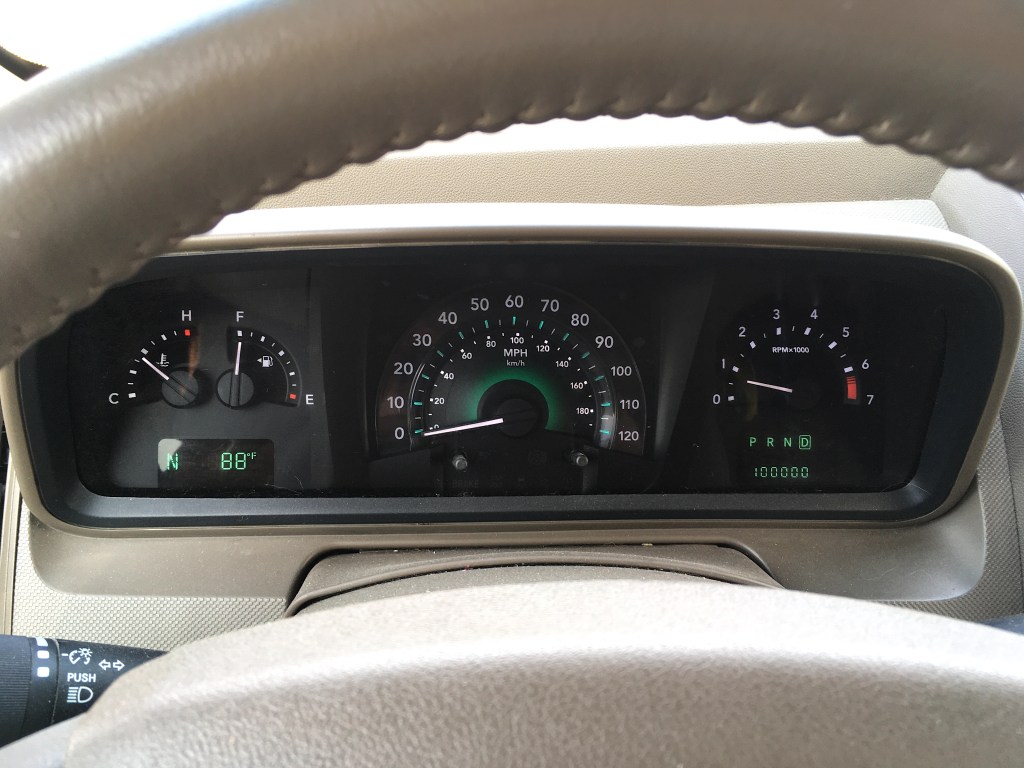
99,999. When I spotted the numbers on my car’s odometer, I pulled off the highway onto a rural road. I wanted to be out of traffic so I could celebrate 100,000 by honking the horn, a family tradition.

When I was growing up, my family never had new cars. High mileage — not miles per gallon but miles travelled — was the norm. Whenever the odometer was about to line up the zeroes, the driver would alert all aboard. We’d wait in hushed excitement. Time itself slowed as the odometer rolled out a perfect symmetry of ovals. The horn would honk and onward we’d travel, a milestone reached with jubilation and relief that the old sedan had managed to transport us across yet another ten thousand miles. 

I was a teen by the time my parents managed to achieve the status of actually having two cars — both used, of course — in their two-car garage. My mother wryly explained that we needed a car that started so we could push the one that didn’t. It was sometimes tricky to tell which was which.

My current vehicle — the one that just turned 100,000 — had fewer than thirty miles on the odometer when I bought it ten years ago. It’s a 2009 model, a special order that sat unclaimed on the dealer’s lot for two years. The original buyer apparently suffered an economic setback and forfeited their deposit. It still had the new-car warranty when a neighbor tipped me off that it was there.

“You’re the only person who could manage to buy a two-year-old new car,” a friend observed.

Those 100,000 miles are only a portion of my travels over the past decade. For three years I also owned a camper van in which my dogs and I crossed multiple states, West to East, North to South. What adventures we had! But like many RV owners, I ultimately decided maintaining the van was more burden than blessing. 

Down to one vehicle now, I ceremoniously honked the horn as the zeroes rolled into place. The road was quintessentially rural: a field of corn stalks growing tall and green on one side, a wooden fence looming tall and brown on the other. The fence shielded the sight but not the smell of one of Okanogan Valley’s more odoriferous crops, cannabis.

Instead of heading back to the highway, I meandered along the backroad, no particular destination in mind. The skunky smell of marijuana gave way to the pleasant perfume of ripening apples and pears. As I drove slowly alongside orchards, I thought about another measure of travel on my dashboard — the speedometer.

A friend recently remarked how time passed so slowly when we were children but races by as we age. Just like the speedometer. Drive slower than 10 mph, and you feel like you’re barely moving. But over 70? Hey, wait! Slow the heck down! I can see 80 on the horizon. 

With aging comes the dilemma of when to give up driving. I hope to see the zeroes line up at least a few more times before I get there.