A Season with No Merch?!

Merchandisers who’ve commandeered religious seasons such as Christmas and Easter have yet to discover the Season of Creation, thank God. There could be a run, however, on those cute little statues of St. Francis that show up in gardens. He’s the 13th century monk usually depicted with a bird or two perched on his shoulder.

The Season of Creation is a global, ecumenical movement, reminding Christians of their relationship with Creator and creation. It was launched some decades ago by the Eastern Orthodox church and now encompasses Catholics, Protestants, and who knows how many other flavors of belief. It began Sept. 1 and will end Oct. 4, the feast day for St. Francis. 

Because Francis was especially in tune with all kinds of critters, on his day many churches invite congregants to bring their pets to a special worship service: a blessing of the animals. It can get quite hilarious if not unmanageable. A church I attended ultimately gave up, asking members to simply bring a photo of their pet.

In line with this season, I’ve been reading a series of meditations about getting close to nature. The emphasis is on forests, lakes, rivers, birds, and beasts. I’m fortunate that I’ve been able to explore that part of creation through the years. But in this season of my life, I’m getting closer to another kind of nature — the human part.

For decades I looked from my riverside home across a valley whose mountainous boundaries were set by the grindingly slow movement of glaciers eons ago. Now from my thirteenth floor window I look into an urban valley bordered by modern skyscrapers, clustered to create a human-made horizon. Instead of watching the flow of river currents, I gaze at the flow of human traffic —on foot, in vehicles, riding scooters and bikes — as they navigate the busy intersection of Ninth and Seneca.

At a time when wars and political strife make us wonder if humanity can ever get along with itself, watching the rhythm of city folk coming and going can be breathtaking. It’s as inspiring as any of the mountain-top viewpoints I hiked to back in the day. For one thing, there’s a mutual agreement that a simple device changing from red to yellow to green will govern who stops and who gets to go. 

From that aspect of civility my gaze wanders to towers of concrete and glass. I ponder the complexity of conceiving, engineering, constructing such edifices. I have no idea how many buildings I can see from my window. A lot. Trying to count them would be as silly as if I’d tried to count the trees growing on the riverbank across from my former home. Clear to me  is that each building expresses human creativity, cooperation and genius, all of which I believe are Creator-given.

I’m writing this on Sept. 21, the International Day of Peace. This day launches another season that cannot be merchandised: “Campaign Nonviolence Days of Action,” which ends Oct. 2, the International Day of Nonviolence. It too is a global movement involving some 5,000 marches and rallies calling for peace, economic equality, racial justice and environmental healing. War and acrimony dominate headlines and the evening news broadcasts. But we — all of humanity — hunger and thirst for peace.

And of course we know that it must begin with us individually, each in her and his own heart. Every peace activist throughout history, from Buddha to Jesus to St. Francis, from Gandhi to Martin Luther King Jr., taught that peace begins within. Palestinian Quaker Jean Zaru describes that inner peace as “not simply being nice, or being passive, or permitting oneself to be trampled upon without protest. It is not passive nonviolence, but the nonviolence of courageous action.” It takes courage — the kind of courage couched in humility — to empathize and forgive those with whom we disagree, who may have wronged us. Yet those are the strategies that open the door to true peace, which is love. Pace e Bene.

A Few Steps to Compassion

I stepped from the little neighborhood shoe shop on East Madison Street, breaking in my brand new pair of Brooks (well cushioned for walking). Maybe that’s why I took special notice of the shoes on the young person who was passed out on the sidewalk in the next block. 

The sidewalk slightly  narrows in that block, making room for venerable trees that are the legacy of an earlier, possibly more gracious generation. The narrower sidewalk makes it an inconvenient place for passing out. Inconvenient for other pedestrians, that is.

In downtown Seattle, where sidewalks are really wide, the pedestrian flow is uninterrupted by the occasional drugged body languishing on the concrete. There’s room for all, and for some it’s the only room available. Away from downtown on Madison, pedestrians had to sidestep to the curb, pausing to let oncoming walkers by. We almost needed a flagger, like at a highway construction site. We politely made room for each other, seemingly oblivious to the obstruction we were avoiding.

I remember the first time — in the early days of the fentanyl epidemic — I came upon someone passed out on the ground in broad daylight. It was in Omak, the small eastern Washington town that I moved from last year. I was on my daily walk with my dogs in the park along the river. When I saw the man sprawled out on the grass, I pulled out my phone and called 9-1-1. To call 9-1-1 these days, whether in that small town or this big city, would be a gesture of naiveté and probably futile.

Perhaps we pedestrians pretended to ignore the human obstruction because it would be unseemly to stop and stare at someone who is suffering a personal crisis in such a public way. Still, as I edged to the curb (my balance assured with those new shoes), I noticed a few things.

The individual was not supine but in a contorted position, halfway between sitting and curled. Gender and race were undetectable, but youth was apparent along with stylish clothing and shoes. The black shoes were of that exaggerated, clunky platform style with the highest of heels. I could imagine their wearer getting carefully dressed, preparing for a … well, high time.

A lot of people are afraid to walk in the city these days. I too am afraid. I’m afraid that I will become so accustomed to inert bodies on the sidewalk that I will stop seeing them. I fear that I will stop noticing their humanity, their individuality — expressed in small, simple ways, like a pair of shoes. I’m afraid I will stop feeling the deep sorrow in my heart, that I will cease breathing a silent prayer of compassion. Each and every time.

I have no insights, no magic one-size-fits-all policy to suggest as we confront the intertwined issues of poverty, drugs, mental illness and homelessness. But there is a way out of this snarled tangle of hopelessness. Once we rid ourselves of disgust, judgment and indifference, what remains for those of us who are still walking around is the power of love.

There was a fellow human being on that sidewalk who, just like me, desires a good pair of shoes.

Ups and Downs of Urban Hiking

“Take the steps on your right,” GPS instructed via my phone. I looked at the steps with skepticism bordering on apprehension. They dissolved into a steeply declining, forested urban trail.

It should not have been a concern. I’ve hiked in the Glacier Peak and Pasayten wildernesses, the Cascade Crest Trail (parts thereof), and the coastal trail of Wales (parts thereof). I walk at least a couple miles daily. This time, though, I was on a scouting mission. A friend, who was planning to visit with her eighty-something mother, texted she’d found an Airbnb just a block from my apartment. I checked the address and thought, “Yeah, just a block as the crow flies, maybe.”

In Seattle, it can be difficult to get from Point A to Point B without circling via points Q through Z. Look at a map of Seattle’s core, and it has all the puzzling disjointedness of an Escher print. There are a couple of reasons for this. Seattle’s founders built on a series of hills, some quite steep. My roundtrip walk to the grocery store is only a mile, but no matter which route I take, it’s uphill both coming and going. 

The real confusion, though, evolved when three early developers couldn’t agree on which direction the streets should follow: north-and-south, as the compass would dictate, or northwest-to-southeast, following the Puget Sound shoreline. Each went his own way so that when streets ultimately meet, they zig or zag, sometimes even criss-cross. It’s not unusual for streets to intersect at an acute rather than the usual right angle. Seattle architects have excelled in designing buildings that come to a point.

As if all that weren’t sufficiently problematic, interstate freeway construction in the 1960s plowed through Seattle’s core, bisecting the city and blocking streets that long had been thoroughfares between neighborhoods. A “lid” over a small portion of the freeway affords some access via Freeway Park.  The retirement complex I live in abuts the park, but even pathways in the park wind and wander. As far as I can tell, GPS has yet to figure out those trails.

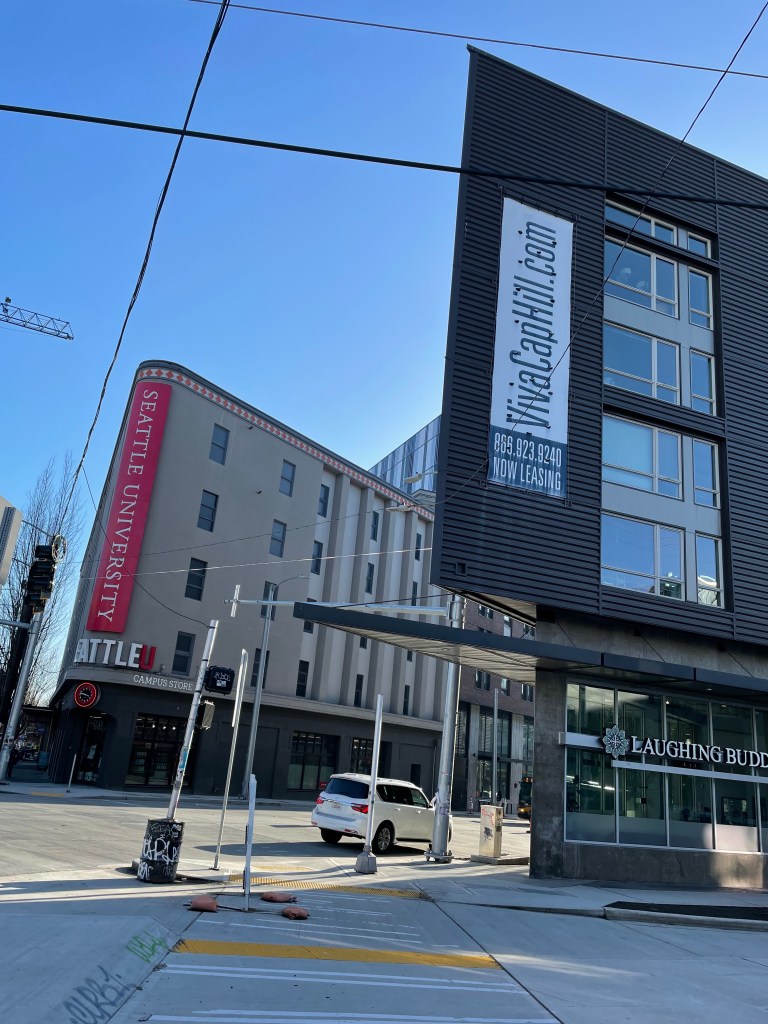
All of which led to my scouting venture. My friend’s Airbnb was indeed just a block from my apartment complex loading dock. Visitors are not welcome there. The front door is still another block beyond. Since visitors can’t go through the buildings, they pretty much reach the main entry via points Q and Z.

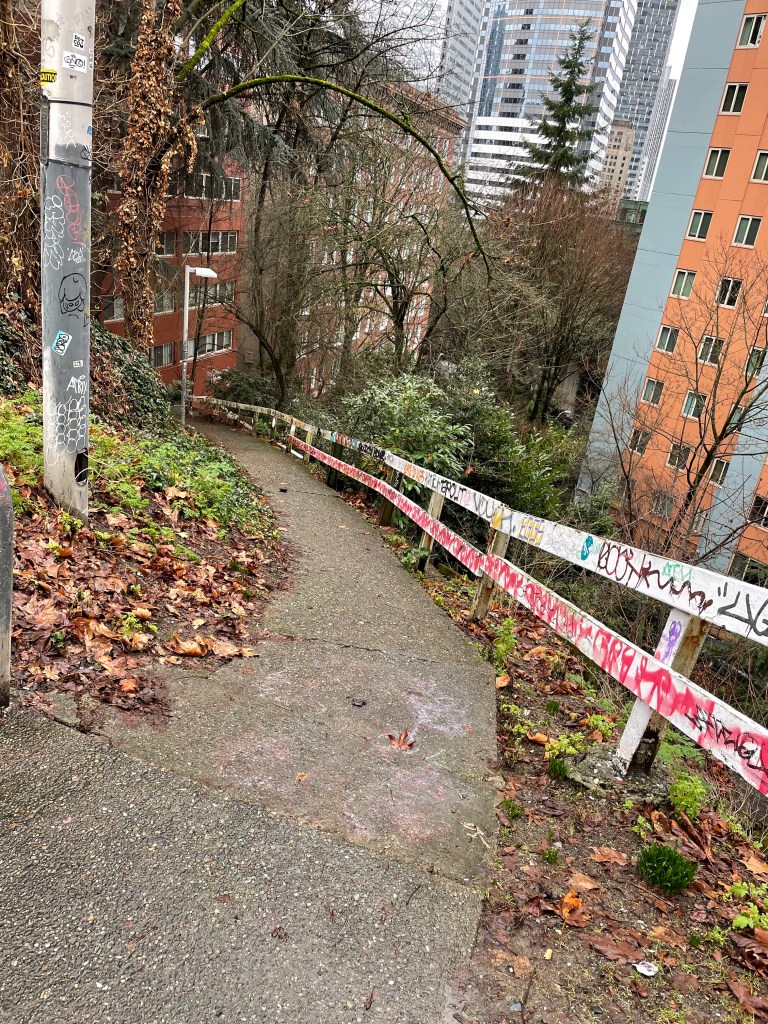
I’d put my friend’s Airbnb address into my phone as I exited my apartment building. GPS directed me along a side street to the top of the before-mentioned trail, where I found squalid remains of a campsite, apparently vacated by homeless persons. The trail was paved, but the wooden handrail was covered with graffiti and appeared less than sturdy.

I headed downward, gingerly stepping over broken glass, noting an abandoned grocery cart in the bushes. Bulbs were pushing up initial green spikes of spring flowers through last fall’s dead leaves. At some point, this must have been a lovely urban pathway. Now, I texted my friend, it was more of an urban jungle. 

“Hmmm, what do you mean an urban jungle?” she texted back. “Is it not safe?” 

“Back-alley aura,” I answered. 

My friend is a determined, undaunted world traveler. She found another route via a stable staircase. From there she cajoled her mother into climbing two blocks up a rigorously steep sidewalk. They could’ve driven, but with one-way and dead-end streets, multiple construction detours, and parking issues, it would’ve taken much longer.

Ah, wilderness. Right here in my urban backyard.