
My mother often used the word “queer.” She wasn’t referring to sexual orientation. She used the word in the same way Lewis Carroll’s Alice did while meandering “Through the Looking Glass” and in Wonderland. For Alice and my mother, “queer” meant odd, strange, weird, curious.
As the meaning of “queer” evolved in our culture, I became uncomfortable when my aging parent (she died at 92 in 2009) commented that something was queer. I worried she might be misunderstood. Yet I was hesitant to tell her the word no longer meant what she meant it to mean. Mother was a writer and educator. She objected when words and language differed from what she’d been taught as a Depression-era honors student.
She would’ve objected to the change in meaning — not the people who in this era proudly identify as LGBTQ+, or queer. While I don’t recall ever discussing gender issues with my parents, I do remember an episode in my teens involving a friend, Ann. It was around 1960. Ann was homeless after revealing she was a lesbian. It was an especially courageous revelation for a teen — for anyone! — in those years. My parents opened our home to her.
Ann had scars on her wrist from a suicide attempt. She’d spent some time in a mental institution. Keep in mind that homosexuality wasn’t depathologized (no longer viewed as a mental illness) until 1973. Mother became a mentor to Ann, who wanted to be a writer. After Ann left our home, she’d write letters to Mother, who lovingly used her red pen to correct errors and sent the letters back. I’ve no idea how long that exchange continued. Ann eventually disappeared from our lives.
The memory of my parents’ nonjudgmental hospitality remains, especially in this era when religious fundamentalists have their knickers knotted over gender issues. To be clear, my dad was a Lutheran minister and Mother wrote Christian educational materials — Bible studies, Sunday School lessons, etc.
I wonder how they would’ve reacted to the documentary “1946: The Mistranslation That Shifted Culture.” Again, it’s an issue of words and how we understand them. Or don’t. I watched the movie (available on Amazon) in June, as part of “Pride” month. It explores what happened when the word “homosexual” appeared for the first time in an English-language Bible — the Revised Standard Version, issued in 1946.
Academics ultimately agreed it was a mistranslation and a misinterpretation of the scriptural text. The documentary notes that the mistranslation was ultimately corrected in later versions, but the misuse has been repeated and is used by literalists to condemn queer love. Raised in a Lutheran parsonage, my Christian education was summed up by Jesus’ two simple and direct commandments (Matthew 22:36-40). Love God. Love others.
June 29 was my first opportunity to attend Seattle’s annual Pride Parade. The city’s biggest event of the year, it’s said to have drawn some 300,000 people. I was astounded by the crowd, the noise, the joy, the creative and oft-times bizarre apparel — or lack thereof.
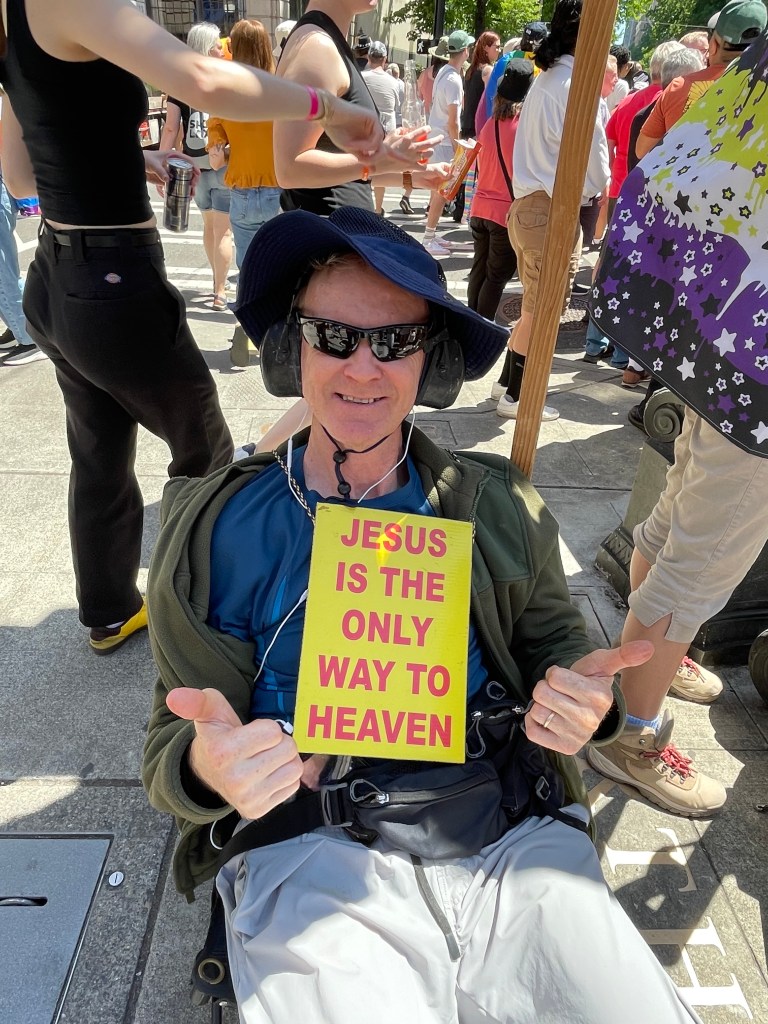
I stopped to take a photo of a fellow (with his permission) who was hunkered down in a patch of shade behind the spectators.
“But you can’t see the parade,” I said. “It’s not my priority,” he answered.
I assume his small sign proclaiming “JESUS IS THE ONLY WAY TO HEAVEN” was intended as a protest. Well, that’s one in 300,000. We’re each, in our uniquely queer way, one in 300,000, one in a million, one in a billion, quadrillion … one.
 Every New Season
You must be logged in to post a comment.