Flute Player & Listener: My Stories & Stuff May 10

fullsizeoutput_1f76
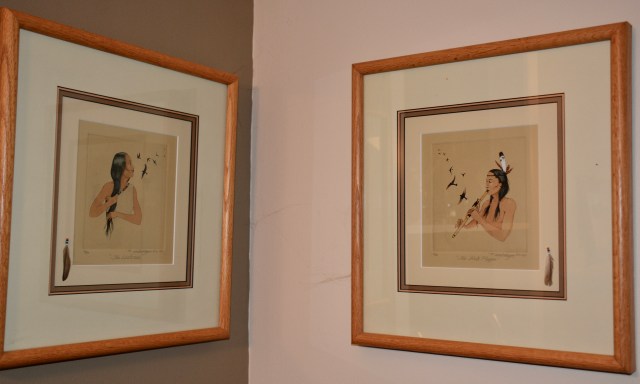
“The Flute Player” on the right and “The Listener” (left) by Laura Woolschlager

These two were awkward to photograph. I purposely have them in a corner so they can gaze at each other as “The Flute Player” sends his music flying like birds for “The Listener” to hear.

The prints are by Laura Woolschlager, a longtime friend, who showed them at a benefit art exhibit my husband and I attended in late November, 1993. John and I had already agreed beforehand that we would not buy anything. Underline not buy. Underline anything. We already had more art than walls on which to hang it, including several paintings by Laura. When I expressed delight in these two prints, John—behind my back—quietly signaled to Laura that he would buy them. Presumably as a Christmas gift for me.

Days later he suffered the stroke that would leave him totally paralyzed and unable to speak for the final fourteen years of his life. By Christmas, he was in a rehab facility in Seattle, and I was at his side. A carefully wrapped package arrived from Laura containing the two prints and a long-sleeved cashmere sweater. She refused payment for the prints and suggested that when I wore the sweater, it should feel like John embracing me.

These prints are meaningful not only because of Laura’s generosity, but because they were harbingers of what was to come in our lives. The two lovers are separated. If Laura had placed them in a single painting, the idea would have lost its power. The flutist’s music escapes beyond the frame, beyond boundaries, as birds flying to his lover, the listener.

When someone becomes caregiver to a spouse, there is a new frame of reference, a separation of sorts, dictated by new responsibilities. What was once a shared landscape becomes two islands, individually afloat. Yet love itself deepens and soars, escaping all boundaries, flying free as birds, connecting across the divide.

(To celebrate my 75th birthday this month, I’m posting daily stories about the stuff I’ve acquired over a lifetime and can’t let go of. I invite you to consider and possibly share the stories that make you treasure your own stuff.)
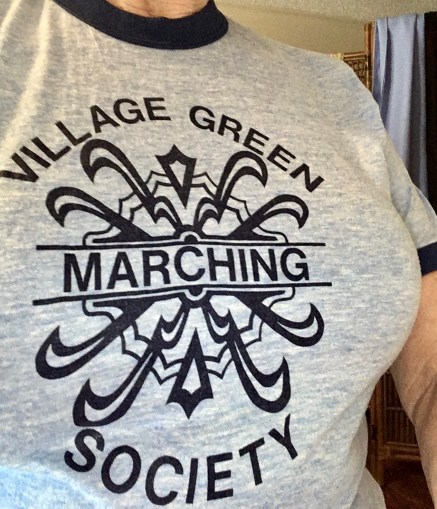
Village Green Marching Society: My Stuff & Stories May 9

fullsizeoutput_1f73I rarely wear T-shirts for the same reason I rarely take selfies: I’m rarely happy with how they look. Nonetheless, I have three of these shirts tucked away in a drawer. Maybe, just maybe, I could have a reason to wear them again someday.
The Village Green Marching Society, starting in the late 1970s and through most of the ’80s, entertained folks around Okanogan County and even into British Columbia by making music, or some semblance thereof, for small-town festivals and parades. Our motley crew were primarily people who’d played in high school and/or college marching bands, including some music teachers. They wanted to relive those glory days.

There were others: an elderly violinist who played from the bed of a small pickup (thus proceeding backwards along every parade route); a drum major who beat time with a plumber’s helper and protected her anonymity by wearing a Lone Ranger-style mask; folks who’d never learned to play an instrument but participated in a raucous kazoo section; youngsters who were drafted to carry our elegant, homemade banner, or rode on their father’s shoulders; a dog who sported a colorful bandana … pretty much whoever wanted to join in.

We were nominally good at marching in step because we had a U.S. Forest Service district ranger who beat the bass drum with federal authority. Our routines were complex. Three sharp blasts from the drum major’s whistle and band members would take off in all directions, improvising whatever step seemed to work in the moment: a little Charleston, a little can-can, maybe a do-si-do.

fullsizeoutput_1f75I played flute and piccolo; my husband played baritone horn. The band had a wide-ranging repertoire. Favorites were “I Love To Go A-wandering,” “Yankee Doodle Dandy,” and “The Stripper.” During the latter, one of the kazoo players would unleash a cascade of bubbles from an ornate bubble blower.
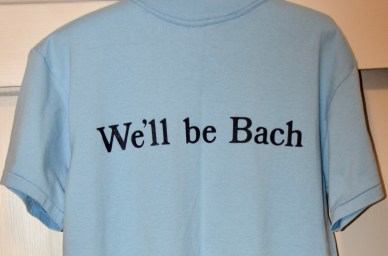
Ultimately, we were victims of our popularity. When we found ourselves scheduled to play every weekend one summer, sometimes even twice a weekend, we burned out. The back of our T-shirts promised: “We’ll be Bach.” Probably not. But I have the shirts, just in case.

(To celebrate my 75th birthday this month, I’m posting daily stories about the stuff I’ve acquired over a lifetime and can’t let go of. I invite you to consider and possibly share the stories that make you treasure your own stuff.)


A Tale of Two Boxes: My Stuff & Stories May 8

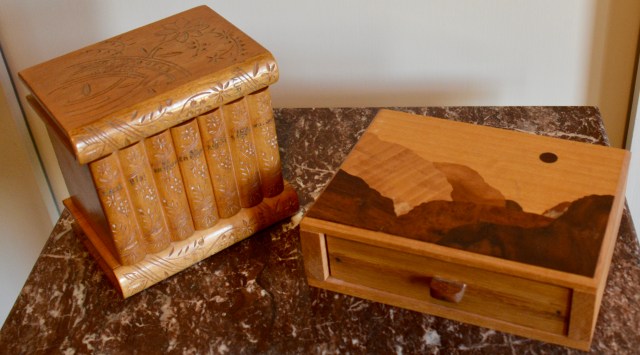
fullsizeoutput_1f68“Mary gets everything!” my brother Mark teasingly chided our parents as they were slowly downsizing, distributing items among family members. Not that our parents had heirlooms of monetary value. If we wanted anything of theirs it was purely for sentiment.
Mark wanted and was given the box on the left. Six inches tall, the hand-carved chest has a hidden lock and key—you have to know how to slide the books in order to find the key and lock. The titles on the tiny books are Hungarian classic literature. Inside is a neatly hand-written inscription, “With grateful love from the Mazanyi Family.”

Miklos Mazanyi made the box and presented it to my parents when I was quite young. He, his wife Elizabeth, and 21-year-old son Nikolas were displaced persons from war-torn Hungary. Our small-town Minnesota church sponsored the family, providing a modest home and other assistance to get them started in a new country. They were brilliant, creative people who needed just that little bit of help at the starting line to prosper.

Because of them I began to understand what it was like to be a refugee: to lose all, to face frightening uncertainties, to have to learn a new language and culture, to be dependent on the generosity of strangers. Most of all, I learned that a community is enriched when welcoming the stranger—not only with handmade gifts but with a deepening of soul. That lesson has never been more vital than now, with sixty-eight million people in the world displaced because of conflict or persecution—more than at any time in human history.

A few years back Mark apparently decided he’d had the Mazanyi box long enough. He sent it to me for my birthday and a jolly reminder that “Mary gets everything!” A few years after that he one-upped himself. A woodworker in his own right, he sent me a box he made, having mastered the art of inlay. I’m not sure if the mountains are the North Carolina Blue Ridge, where he lives, or the Okanogan range that envelops my valley. Either way, he’s right. Mary pretty much gets everything.

(To celebrate my 75th birthday this month, I’m posting daily stories about the stuff I’ve acquired over a lifetime and can’t let go of. I invite you to consider and possibly share the stories that make you treasure your own stuff.)

Five Feet of Books: My Stuff & Stories May 7

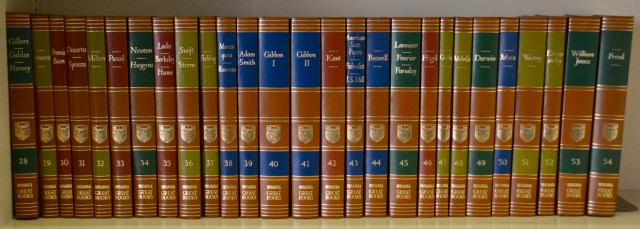
fullsizeoutput_1f66
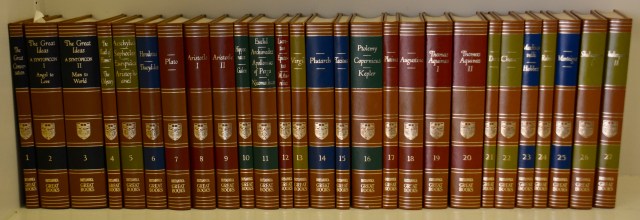
Two-and-a-half feet worth of Great Books

The home I grew up in had a goodly number of books, the most significant being the Bible. Yet more important to me in my high school years was the Harvard “Five-Foot Shelf” of classics. This fifty-one volume anthology was based on the premise (in 1909) that all the writings necessary for a liberal education could fit on a five-foot shelf.

Thanks to that five feet worth of books and their excellent index, which enabled quick research, I earned a steady stream of A’s in what were called “high achievement” English classes. (Also, kudos to my mother who typed my essays and, as a professional writer, I suspect couldn’t stop herself from correcting punctuation and syntax.)

Out on my own at age twenty, I no longer had that five-foot set of books, much less the shelf to put them on. Then a feature in the local newspaper caught my eye. Encyclopedia Britannica had come out with its own fifty-four volume anthology called “Great Books.” To promote it, the publisher provided newspapers with a weekly essay based on content from the “Great Books.” Readers were invited to send in questions, and if their question inspired an essay, they got a free set of “Great Books.”

I wanted those books. I sent in the question, “Why is there war?” not because I particularly wanted to know. I was certain it was the kind of question the essay writer could quickly research and quote several centuries worth of great minds. I won the books. They happen to take up five feet of shelf space and have been boxed and re-shelved with every one of my several moves for fifty-five years.

Have I read them all? Uh, no. Volume One includes a ten-year plan for reading the entire set. It feels a bit presumptuous, at age seventy-five, to jump into a ten-year reading plan. But I guess it’s now or never.

(To celebrate my 75th birthday this month, I’m posting daily stories about the stuff I’ve acquired over a lifetime and can’t let go of. I invite you to consider and possibly share the stories that make you treasure your own stuff.)

fullsizeoutput_1f67
The other two-and-a-half feet

Motto Ware: My Stuff & Stories May 5

mottoware
Motto Ware: Collectibles from England

What inspires people to collect things? I don’t mean amass stuff, as in hoarding. I mean honing in on a particular genre of items, such as stamps, or antique pistols, or native baskets, or sets of salt and pepper shakers. Why collect things that have no particular usefulness, other than to be looked at, admired, traded, and occasionally dusted?

I’m an accidental and almost indifferent collector of a peculiar line of pottery known as motto ware. It’s also known as Torquay pottery, coming from the town of Torquay in England. The area has a wealth of red terra cotta clay and a number of potteries sprung up in the late 1800s. For several decades—to meet the demands of the tourism trade—they produced low-priced kitchen ware like small pitchers, tea pots and cups, cream and sugar sets, candle holders, and yes, salt and pepper shakers. The items feature a rustic scene on one side and homey advice, such as “Nothing good is got by worry,” etched onto the other.

Some fifty-five years ago, when I left my parents’ home to live on my own, a friend gave me two pieces of motto ware that had been her grandmother’s. I didn’t realize they were a “thing” until I started bumping into motto ware in second-hand stores. They weren’t expensive, so I’d add to my so-called collection: a candle holder advising “Many are called but few get up” a tiny creamer declaring “Bustle is not Industry,” and my favorite, a cheese dish with the sly saying, “If you can’t be easy, be as easy as you can.” My collection of twenty-three pieces is paltry. Serious hobbyists that I found on the internet have hundreds of these preachy, dust collectors lining their shelves.

Yet the “why” is probably as true for them as it is for me. They make me smile.


(To celebrate my 75th birthday this month, I’m posting daily stories about the stuff I’ve acquired over a lifetime and can’t let go of. I invite you to consider and possibly share the stories that make you treasure your own stuff.)

Set in Concrete: My Stuff & Stories May 6

fullsizeoutput_1f65
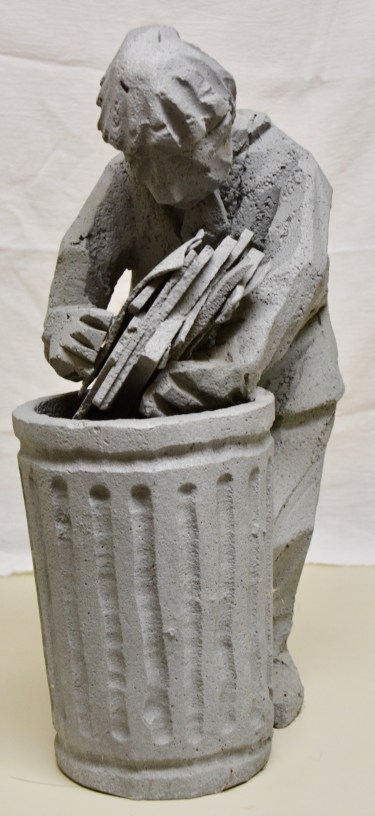
Man Throwing Newspapers Into Garbage – cast aluminum sculpture by Richard Beyer

The late Richard Beyer was internationally renown for his cast-aluminum sculptures, probably most famous for his life-size “Waiting for the Interurban” in Seattle’s Fremont District. I’d long been an admirer and was excited that I’d finally meet him at a showing of his work at Sun Mountain in the Methow Valley.

This small sculpture, only eighteen inches high entitled “Man Throwing Newspapers into Garbage,” immediately caught my eye.

“He could at least be recycling them!” I blurted to the gentleman standing next to me, who turned out to be Rich Beyer. It was the start of a good friendship. I bought the sculpture as a gift for my husband, John, who happily displayed it on the front counter at our newspaper office. It was a reminder not to take ourselves nor our work too seriously, as journalists are wont to do.

Rich generally had a low opinion of the press. He made an exception in our case. I ended up helping his wife, Margaret, with her book about Richard’s work, “The Art People Love.”

After John’s stroke, we built a concrete wheelchair ramp at the newspaper. Rich agreed to carve and paint a whimsical mural along the side of the ramp, assisted by contractor Gary Headlee. It was a colorful landmark for a few years. After we sold the building, the mural was demolished in a remodeling project. I was broken-hearted.

Yet, it’s a good reminder that nothing lasts forever, not even when set in concrete.

(To celebrate my 75th birthday this month, I’m posting daily stories about the stuff I’ve acquired over a lifetime and can’t let go of. I invite you to consider and possibly share the stories that make you treasure your own stuff.)

The Desk: My Stuff & Stories May 4

fullsizeoutput_1f5eThis little desk, just five-feet tall, has followed me around all my life. My mother told me it was made by her great-grandfather (photographed below with his wife). It must be at least 150 years old, or twice my age. Neither of my parents used it as a desk—it wasn’t sturdy enough to hold Mother’s typewriter, and my six-foot-plus dad couldn’t possibly fit his legs under the fold-down writing table. It was just an odd piece of furniture that got stuck in any available corner until ultimately it landed in my childhood bedroom.

I loved it, especially the little nooks and crannies behind the writing table, though I couldn’t and still haven’t figured out which papers and writing tools should go where. I remember storing my potato-head game in the bottom cabinet and then forgetting about it. Months later, a peculiar smell suggested I ought to clean out the desk, where I found a disgustingly wizened potato-head.

At one time, I was told, hinged glass doors covered the desk’s book shelves. When the doors broke, a gentleman in my dad’s church offered to fix them and took them away. His life got complicated when he was sent to prison for tax evasion, and the doors were never recovered.

The desk comes apart in two places so I can easily move it without help. Those moves have taken a toll. The wood protested when, after existing for ten years in the damp

environment of a Puget Sound island, it was abruptly moved to the arid Okanogan Valley. That was forty years ago. It’s still hanging in here with me, and I with it.

(To celebrate my 75th birthday this month, I’m posting daily stories about the stuff I’ve acquired over a lifetime and can’t let go of. I invite you to consider and possibly share the stories that make you treasure your own stuff.)


Quilts: My Stuff & Stories May 3

fullsizeoutput_1f5bWhen someone gives you a handmade quilt, it’s like receiving a warm, enduring embrace. I’ve been given various quilts by family and friends, some just the right size for a nap, some commodious enough to shelter against cold winter nights, and some designed purely for looks, to hang on a wall.

My grandmother made the green and yellow quilts at the top of this photo—every tiny stitch by hand. My niece inherited my grandmother’s penchant for quilt making. I did not, though I did participate in one intergenerational quilting effort.

It started years ago when, during long roads trips with my husband, I began making quilt blocks decorated with counted cross-stitch embroidery. Each block represented the official flower of states we visited. My plan was to someday make a quilt for our bed. Then John suffered a paralyzing stroke. I became a full-time caregiver with no time or energy for embroidery.

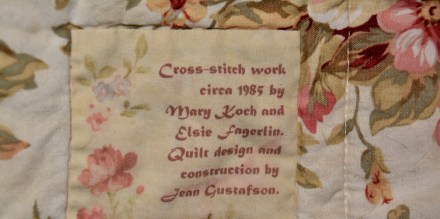
My mother also enjoyed the logistical challenge of counted cross-stitch. She begged to finish the quilt blocks, whether we’d visited the states or not. When she was done, I showed the fifty quilt squares to step-daughter Jean, who is an expert quilter.

“They’ll never get made into a quilt,” I admitted with resignation.

“We’ll just see about that,” said Jean, as she took the squares from me. Before long, she delivered a finished quilt. My mother enjoyed the quilt until she died, and now I get to sleep under it.

fullsizeoutput_1f5d
The label on our intergenerational quilt

(To celebrate my 75th birthday this month, I’m posting daily stories about the stuff I’ve acquired over a lifetime and can’t let go of—because of those stories. I invite you to consider your own stuff, maybe even share your stories.)

A photo: My Stuff & Stories May 2

jea-napping.jpg
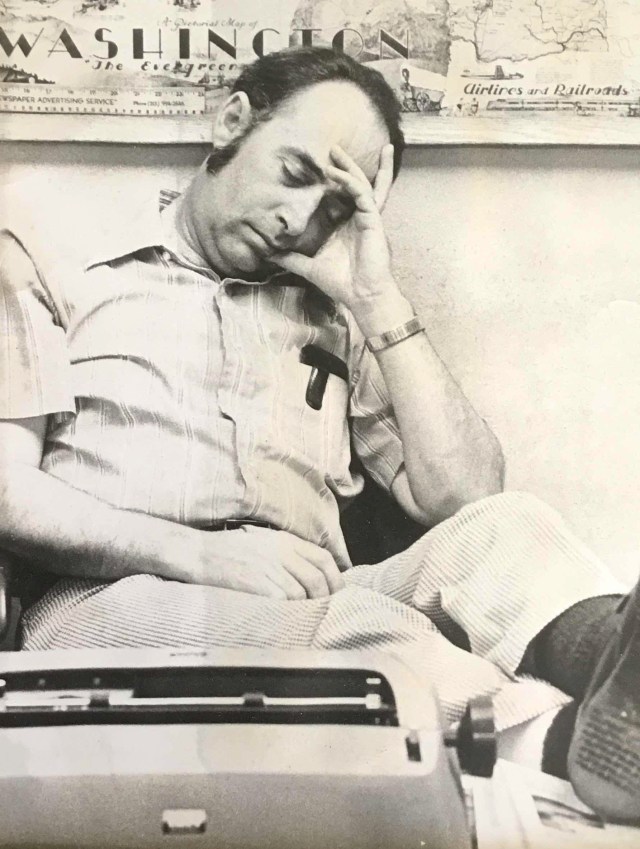
Napping on a Tuesday night?

As I ponder my life-long inventory of stuff, this photo of my late husband, John E. Andrist (better known as JEA), is high on my list of keepers. The photo was taken before I even met him. A member of his newspaper staff snuck this candid shot I’m guessing late on a Tuesday evening as the paper was in its final throes of going to press. The Selectric typewriter and pocket protector (not to mention those sideburns) date the photo somewhere in the ’70s.

For weekly newspaper editors, Tuesdays were a 36-hour working day, a flurry of writing, editing, darkroom processing, typesetting, pasting up, and proof-reading. Page layouts or plates would be transported to the press, an hour away, and the printed newspapers returned for addressing and mailing. These days everything’s done by computer and on the internet. I have no idea if that has made the process any less frantic or tiring. Probably not.

It was our mutual love of newspapers, especially community weeklies, that brought John and me together. I’d burned out as an Associated Press editor and wanted to get back to small-town journalism. I’ve often joked that John needed an editor and I needed a job, so we got married.

The photo sits on the headboard above my bed. He died in 2007, but we still sleep together.

(To celebrate my 75th birthday this month, I’m posting daily stories about the stuff I’ve acquired over a lifetime and can’t let go of. I invite you to consider and possibly share the stories that make you treasure your own stuff.)

Seventy-five Years of Stuff and Stories

Is it just me, or has this year’s orchard bloom been unusually short? Seems like the colorful blossoms lasted only days before the trees began leafing out. Or is it that every season flies by more quickly with each passing year?

This year’s May Day launches me into my birth month and my seventy-fifth birthday. I’m not planning a celebration because I held the party of a lifetime for my seventieth birthday. The joy from that gathering of family and friends still resonates.

I intend to spend my birth month contemplating the collection of stuff I’ve amassed over these seventy-five years. Shortly after my seventieth birthday, I moved from the home I’d shared with my husband for forty years to a smaller house next door. Smaller by two-thirds. Theoretically, to fit into this smaller space, all I had to do was give away two items for every one I kept. Two-thirds of my books, two-thirds of my furniture, two-thirds of my kitchenware. That was the theory.

I thought I’d done well until a friend came to see my new-to-me home. After a short tour, she remarked, “You sure have a lot of stuff.”

Mine is the stuff of stories. It’s the stories attached to my things that make me hang onto them with a python-worthy grip. I’m afraid if I let go of the things, which have little or no monetary value, I’ll no longer remember the stories, which have value beyond measure.

fullsizeoutput_1f4fLike this little weeping cherry tree—a wedding anniversary gift from my parents to my husband and me. I’m not sure which anniversary it was, but I couldn’t leave the tree behind when I moved. I had it dug up from the old yard and replanted next to my new-to-me patio. It survived the transplant and is blessing me this May Day with a full bloom, a vibrant memorial to the three most important people in my life.

A while back, I read a bit of advice to those of us who have acquired a lifetime’s worth of stuff: put a label or note on family heirlooms and personal keepsakes, explaining their significance for those who end up dealing with the things we ultimately leave behind. I’m guessing a lot of us are contemplating our abundance of stuff, which is why Marie Kondo, the guru of “tidying up,” has become such a sensation. It’s not about what you throw away, she teaches. It’s about receiving joy from the stuff you keep.

Each day this month I plan to post a short story about my treasures. I invite you to join me in contemplating what among your stuff tells a story—or gives you joy. Each of my stories will be short, and I won’t flood your inbox with emails. I’ll post them on Facebook and my website. We may even figure out that if there’s no story, no joy, we can let go of more stuff.