Reunion

MLK1962-2017
What fifty-five years can do to/for a person

A reunion can feel a lot like drowning. Supposedly, a drowning victim’s life flashes before them on the third, fatal time down. My life, or at least the past fifty-five years of it, was flashing before my eyes as I prepared to reunite with someone I’d not seen for that many years.

A junior/senior high school classmate emailed out of the blue a few months back. I’ve not attended high school reunions of late. I stayed in touch with only a handful of classmates, and she wasn’t among them. We hadn’t been close friends, but shared a few classes and played in the band. I didn’t consider myself on her level of the social strata that were implicitly delineated in that large, urban school. I saw her as popular, well-grounded, confident, coming from an affluent family, perfectly dressed and coiffed. Me? Less so. She was the classmate I most wanted to be like and be liked by. I’m sure she’d be surprised—or maybe even amused— to know that, then and now.

I responded to her email, and we ultimately made a date to have lunch on my next trip to Tacoma. That’s when I began mulling the past fifty-five years and wondering how I’d ever describe them to her. How to avoid a boring monologue of “and then I . . . and then I . . . and then I”? Besides, what I most wanted was to hear about her life. It would be, I guessed, a story of success after success. And it was.

Her story started exactly as I expected. As she described it, after college and sorority life she had her china and silver as planned, her three children as planned, her husband with secure, professional career—as planned. Then it all blew up. I won’t provide details because it’s her story, not mine. She didn’t tell it in the sequence I laid out, but started with the hard stuff, as if to lay her cards on the table. As if to say, “There’ll be no secrets; nothing will be held back.”

It turns out she and I have walked a parallel path these fifty-five years, living lives that pulled us every which way other than the direction we’d planned. That included our lunch: the restaurant where we’d agreed to meet was closed. We found another, really nicer, restaurant on Tacoma’s waterfront—a metaphor for what happens when plans don’t work out. We lingered for hours over lunch, telling not so much the details of our lives’ events. It was more about lessons learned, wisdom acquired. It was a sharing free of hubris, filled with the joy of discovery. We both had learned that when life interrupts your plans, take it as a gift and run with it. That’s success.

Given our mutual age of seventy-three, we can’t afford to wait another fifty-five years for our next reunion. I hope we won’t. She is a woman I want to be like, and be liked by.
Just Ducky

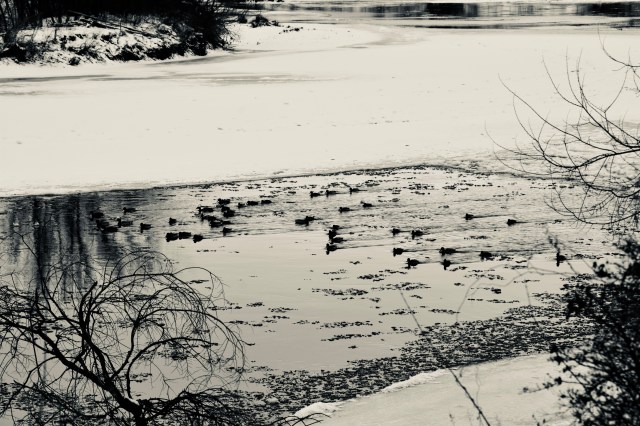
fullsizeoutput_1d1aThe river in front of my house is now a duck pond. Various sections of the river are frozen bank- to-bank, but here free water flows and water fowl float. It’s a busy sight/site with ducks and geese paddling upstream, cruising back down, taking off into the air with the frequency of planes at O’Hare, and landing again in small squadrons. The mallards come in for their landing with wings bowed, braking their speed just as they hit the water. Canada geese are less elegant, splashing onto the river’s runway in noisy, squawking turmoil.

My favorites at this time of year are the bufflehead (who I may be confusing with golden eye, or maybe we have both). Their radiant white caps make me think of novice nuns. They dip smoothly below the water’s surface, later to bob up again—never in the same place. My eyes scan the river, trying to predetermine where they’ll suddenly surface. I almost never win this game of bufflehead bluff.

At times some ducks leave the water to cluster on the edge of snow-covered ice—not exactly dry land. I have to wonder if they’re warmer, leaving the icy water and hunkering down in the wind-chilled air. I’ll bet they’re warmer in the water. What we don’t see is those webbed feet paddling hard like a cross-country skier following an uphill trail, warmed by the effort.

Occasionally—and suddenly—the pond empties of water fowl. Only small chunks of ice float desolately along the current, destined to join the glacial islands downriver. That’s when I know to look up and search for a bald eagle. Or perhaps some other raptor, an osprey for instance, is temporarily scattering the flocks. In only a few minutes, the ducks will return to resume their routine, up and down, forth and back. They organize themselves like an Esther Williams water ballet, sometimes in straight lines (although those are most often the geese, who have a penchant for the military), other times in complex choreography that unfolds like time lapse photos of flowers blooming.

There is other winter wildlife along the river bank—the hardy birds, of course, and an occasional river otter. The plucky quail scoot in nervous groups, puffed up to twice their miniscule weight to insulate themselves against the cold. I could see more if I would take time away from my ceaseless chores and distractions. Is that a resolve for the new year? Seems like a good one.

Fake News

fullsizeoutput_1d0c
A scene from the Christmas village given to me by my late husband.

My career as a news reporter began at age five, when I informed my shocked kindergarten classmates that Santa Claus was not real. I had the scoop thanks to my older sister and brother. I don’t recall being dismayed when I learned about Santa—probably so eager to spread the news. I’m sure, however, that a number of parents would’ve cheerfully throttled me if I’d been within arm’s reach when their crestfallen children returned home from school that day.

Santa Claus, whether serious mythology or child’s fantasy, is pretty much universal. Our American version reportedly came from the Dutch “Sinterklaas.” The United Kingdom has Father Christmas, if you speak French it’s Pere Noel, there’s Hoteiosho from Japan, and of course, Saint Nicholas, a flesh-and-blood human of the fourth century. Nicholas was the Bishop of Myra (located in modern-day Turkey), credited with numerous miracles including fantastic accounts of reviving people who’d been gruesomely murdered. The most credible event, say historians, and the one that connects him with Santa Claus, has to do with three young sisters whose father couldn’t afford dowries for their marriage. Prostitution was their only option. Legend has it that Nicholas anonymously tossed three bags of gold coins through their window, saving the young women from a life of degradation. One tradition has him tossing the coins down the chimney, thus we hang our stockings.

Our present-day image of Santa Claus is pretty much based on the poem, “A Visit from St. Nicholas,” published in 1823, attributed to Clement Clarke Moore. We know it as “The Night Before Christmas.” Band and choral leader Fred Waring recorded an enchanting musical version of the poem in the 1950s. Despite my atheistic view of Santa Claus, as a young woman I about wore that record out. My favorite Christmas movie is “Miracle on 34th Street,” in which the U.S. Postal Service proves Santa is real.

In our town, Santa’s sleigh is not led by Rudolph’s red nose, but the flashing blue lights of a police car. Then comes a diesel-powered pickup pulling a brilliantly lighted sleigh. Amplified Christmas music draws us to our doors and windows to see Santa waving and handing candy canes to children who brave the cold to run out and greet him. One Christmas, after my late husband’s paralyzing stroke, Santa’s sleigh paused in front of our house. Santa himself (who in another life was a business owner and president of the Chamber of Commerce) climbed out of the sleigh and delivered a candy cane to my husband in his wheelchair. This year, when I spotted the blue lights flashing through my kitchen window, I rushed to open the door and wave. Somehow our town has kept this tradition alive for at least a couple generations.

As a reporter, I made my share of errors and consequently published corrections. But that story I told back in kindergarten? It was the only time I could be accused, rightfully, of delivering fake news.

Gone Fishing

fullsizeoutput_1d00Even though he is by his own admission a prominent scofflaw in our small town, I know very little about Robert. I know only that he plants himself fairly frequently midway across the Central Avenue bridge and stands there for hours with his ten-foot cross. I’m guessing that’s the height of the cross. For sure, it’s big.
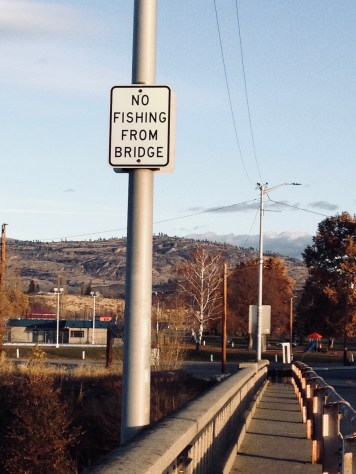
That bridge is a good site for messaging. It connects the east, or Indian reservation side of town, with the west, or non-reservation side. The bridge spans the Okanogan River, which bisects our town and is the reservation boundary. Every once in a while, if people want to demonstrate or publicize something—like a protest march against the Dakota Pipeline some months ago—they’ll line up on the bridge with their signs. My dogs and I frequently walk across the bridge on our way to the East Side Park. We walk on the upriver side of the bridge to avoid crossing two lanes of traffic. Robert is on the downriver side of the bridge because, I suspect, that sidewalk is broader. People can more easily walk around him and his cross.

Because traffic usually is heavy and noisy, Robert and I merely wave to each other as the dogs and I pass by. One time, though, there were no vehicles on the bridge. In the silence, Robert called across to me: “You need to remember just two things!”

“Yes?” I responded.

“First, love the Lord with all your heart, soul, and mind,” he answered, “and second …”

“Love your neighbor as yourself,” I joined him in his shortened version of Jesus’ message. He smiled approvingly. The dogs and I kept walking.

fullsizeoutput_1d02Another time when traffic noise was missing, Robert called out: “I’m breaking the law, but no one seems to care.”
“How’s that?” I asked.

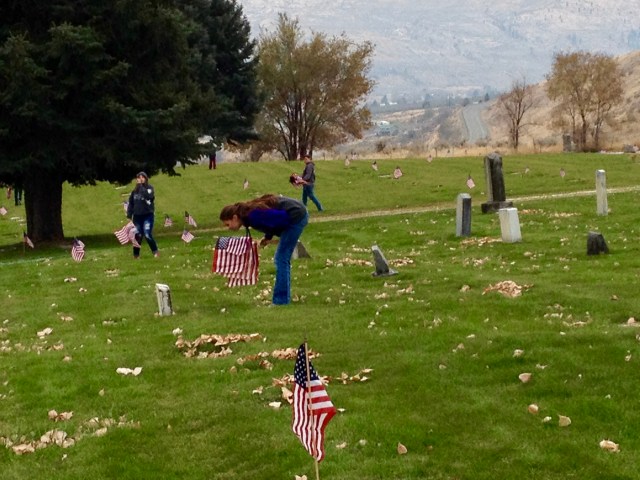
Grinning, he pointed to the sign posted above my head: NO FISHING FROM BRIDGE.

“Ah,” I said. “And you’re fishing for souls.” His smile admitted as much.

I don’t know if there’s a limit on how many souls a person is allowed to catch, with or without a license. But judging from the number of folks who drive by Robert with a friendly wave and horn toot, and judging from the number of teens I’ve seen give him a high-five as they walk past, and judging from the occasional passersby who I see stop to talk with him, Robert could be close to limiting out.

Beauty and the Beast Redux

Last month I saw a lavish production of Disney’s Beauty and the Beast onstage at the Oregon Shakespeare Festival in Ashland. Last night I saw a high school production of the same play at the Omak Performing Arts Center. To compare the two would be to mix apples with oranges, or more likely, caviar with popcorn. And I do love popcorn.

I paid $75 for the Ashland performance, and I got my money’s worth. I paid $6 for the high school production, and I got a million times more than that in enjoyment. Professional actors are good, sometimes even great, and you expect them to be. Kids onstage are good, sometimes potentially great, and they’re more: they’re discovering themselves as they venture into a world larger than themselves. That is genuine drama and comedy of a kind you don’t get to see in professional theater.

After school performances like these I hear audience members marvel at the talent of the youngsters. Youthful talent never surprises me. It’s always going to be there. What isn’t always there is the necessary level of adult support that showcases young talent. That behind-the-scenes support and direction was apparent in last night’s performance. Skilled, knowledgeable adults provided the infrastructure that allowed young actors to shine. I’m gratified to live in a community that supports kids, whether they’re on the football field, gym floor, or theater stage. I’m especially grateful for the teachers and volunteers who, as skilled grown-ups, guide youngsters through formative, life-changing experiences.

Flying the Flag

fullsizeoutput_1cf3A drab, overcast, pre-winter day. Perfect for a visit to the cemetery. I prefer to go when I suspect no one else will be there. I like solitude as I visit my husband’s (and someday my) gravesite. We’d chosen this spot on the edge of the Okanogan Cemetery because of its expansive view of the valley, river and mountains. I also enjoy walking my dogs along the cemetery lanes when I know they won’t be bothering other visitors or mourners.
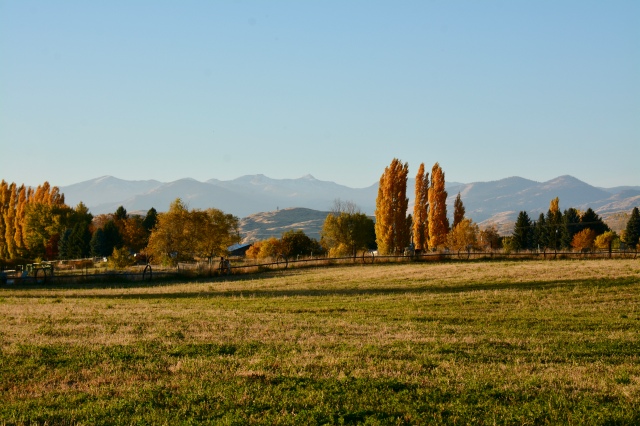
So I was there earlier this week. I’d just conscientiously “bagged” the dogs’ deposits (thank you, City of Okanogan, for providing a garbage can) when a caravan of cars arrived. Uh-oh, I thought. A funeral. I hustled my dogs into the car and was preparing to leave quietly when I turned to see a bevy of teen-agers fanning out among the graves. Turns out it was the Okanogan High School Key Club putting flags on graves for the upcoming Veterans Day observance.

At last, an opportunity to resolve something that had been vexing me for ten years, since my husband died. I approached Dennis O’Connor, Key Club advisor, and asked how the kids knew at which graves to place a flag.

“Is there a list?” I asked.

No list, he answered. The kids read every grave marker, looking for indications of military service.

“That’s all we have to go by,” he said, acknowledging that veterans whose service is not recorded on the head stone don’t get a flag. He’s heard that some people get upset over that.

Guilty as charged. Well, not upset exactly. More like mystified. My husband had served in the U.S. Navy Reserve, photographer’s mate. That was long before we were married, and I didn’t know much about it. It never occurred to me to put it on our small, rather simple gravestone. Our family did receive a flag from the American Legion when John died, so I knew there was some official record somewhere. But on Veterans Day or Memorial Day, there’d be no flag at his grave. I knew he would’ve liked his grave to be among those with flags fluttering. I wasn’t sure who to call to get his name on what I imagined to be a list. Then I’d forget about it until the next Memorial or Veterans Day.

When I began to explain all this to Dennis, he immediately handed me a flag. I felt honored to poke it into the earth by John’s headstone. John would’ve been pleased. What would’ve pleased him even more was the sight of those kids, stooping to read every headstone, sometimes having to scrape away leaves, dirt and dried grass, searching for veterans.

Happy Veterans day, John, and all who served. Whether or not there’s a flag flying  at your place of rest, there’s a flag flying for you at this nation’s heart. And just when I’d been needing reassurance, those kids were a reminder that our nation indeed has a heart.

fullsizeoutput_1cf2

Dia de los Muertos

fullsizeoutput_1cec“Did you get photos?” my friend Elizabeth inevitably asked whenever I told her about an interesting or beautiful event in my life. More often than not, I’d have to make some lame excuse about why I didn’t have my camera with me or hadn’t pulled my phone from my pocket.

I’m a competent photographer—had to be through all those years as a small-town journalist. But I’m neither brilliant nor passionate about the art. I’d rather enjoy the work of photographers who are both.

fullsizeoutput_1cf0Elizabeth and I were polar opposites when it came to photography. I use photos to illustrate my writing. Her writing was about her photography. She claimed she was merely an amateur with the camera, but she had it with her at all times. Even after her eyesight dimmed, she persisted, setting her Canon A710 IS on automatic, pointing and clicking. Then she’d pass the camera to me (or, I assume, to whomever was with her) so I could assess the image and tell her whether she needed to try again.

fullsizeoutput_1ce9One of the hardest parts of aging is letting go. Letting go of people who die ahead of us; letting go of physical abilities: mobility, the senses, a pain-free existence; letting go of activities that give us joy and express our creativity. We never discussed it, but I knew Elizabeth had reached the threshold of letting go when she no longer carried her camera. By the time she celebrated her hundredth birthday last July, she’d let go of so very much.
fullsizeoutput_1cf1Last week her longtime friend Marsha and I sat at Elizabeth’s bedside during the final hour of her life. I sang some of the old hymns that Elizabeth and I’d been singing together over the last couple months. She’d amazed me by remembering all the verses of any hymn we sang. On that last morning, as her breathing became erratic, she no longer sang. I’m not sure she could even hear me sing, but her spirit did.
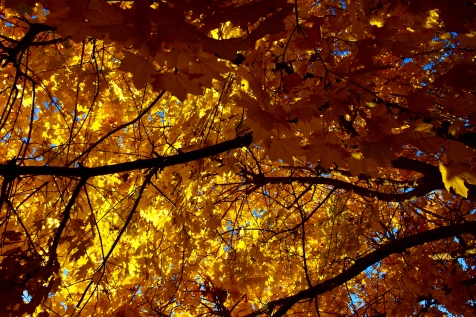
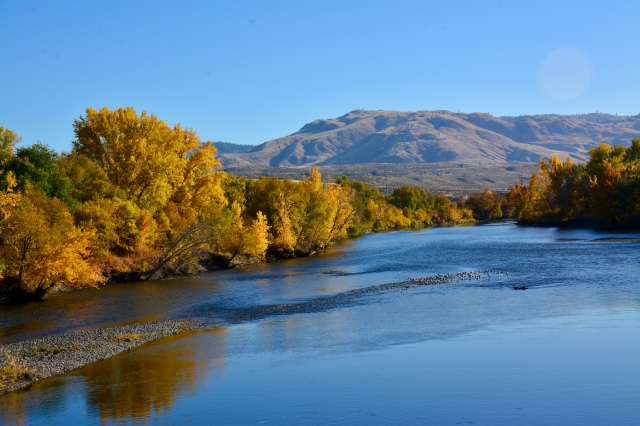
fullsizeoutput_1ced“I believe my favorite hymn is ‘This is my Father’s world,’” Marsha commented. I began to sing it. Somewhere around the “music of the spheres,” Elizabeth entered that place of deepest peace. After Marsha and I shared a few prayers, after the funeral home collected the body, I stepped outside into a glorious autumn day. There is a reason that this is the season of “Dia de los Muertos” (Day of the Dead), All Saints, Hallowed Evening (Halloween). Autumn is a fine time to die. That fall palette of reds, golds, yellows, bronzes, oranges, and on, and on, are creation’s promise to us. Leaves and grasses shimmer brilliantly before they let go, becoming part of the cycle that is eternal life.

For once, my camera was in my car. I spent the afternoon driving up and down the valley, looping back and forth, past orchards, over the river, through town, stopping with each new burst of color, breathing the redolent smells of apple harvest, the even deeper essence of Mother Earth enriching herself.

Yes, Elizabeth, my friend. I got a few photos.

fullsizeoutput_1ceb

The love-hate Facebook relationship

A young friend—less than half my age—emailed a question: “What did people do before Facebook?” Her question was neither rhetorical nor sassy. She’s honestly perplexed. She doesn’t like Facebook. I don’t know her reasons; I only know my own. She was inclined to give up her Facebook account, but death, or near-death, intervened.

She and I are members of the Holden Village community, people who are scattered world-wide, whose lives intersected at one time or another at the tiny retreat center in a remote valley of the North Cascade Mountains. There are thousands of us. One is in his final stages of life. (“Cancer sucks,” he posted on Facebook not long ago.) The community has gathered to celebrate his life and immense talent, to pray and sing together, to be with him and bless him. All on Facebook.

I’ve experienced other death-watches on Facebook. It’s a privilege to add my prayers to those who are at the bedside. Our Holden community also gathered on-line recently to offer prayers and condolences when one of us was killed in a vehicle accident. I appreciate being connected with people in this intimate way when they’re thousands of miles away and suffering.

And yet.

The medium, I try to remind myself, is not the message. Because this medium—most of the various social media for that matter—is at times raucous, chaotic, hostile, and yup, offensive. Opening Facebook on my laptop is like walking into the marketplace, a bawdy, noisy free-for-all where people bump into each other, step on toes, point fingers (especially one), and settle arguments by yelling louder and longer. It’s also a place where people ecstatically share their joy, their celebrations, their loves, and their everyday lives. In other words, Facebook is everything that we are.

In the past, my young friend asked, how did people stay in touch when important events like birth and death occurred? There were, of course, telephones and the postal service. Just yesterday, as I was contemplating all this, a family member called to tell me she’s pregnant. I was grateful not to have learned this on Facebook.

But honestly, we can’t call or write everyone. When my husband died ten years ago, I would’ve thought it unseemly to post on Facebook. Yet a friend who lived elsewhere would’ve attended his memorial, if she’d only known. With Facebook we’re more connected with other people than ever. And that’s the rub. Being connected is not always comfortable.

For years I tried to pretend Facebook would fade. It hasn’t. Two billion active users, the site claims. I choose to engage for a limited amount of time each day, and I choose to empathize with each and every post I read. That is, I try to understand, with respect, what others are experiencing, what they’re feeling and needing. I don’t always succeed. Sometimes my attempt to empathize is through gritted teeth. Still, there’s a reason there are two billion of us. We really do want to connect.

Full Circle

Life has a way of coming full circle, as I was reminded while attending a funeral recently. We were celebrating the life of Clara Thorp, who’d represented goodness-on-earth for 92 years.

I met Clara decades ago when I interviewed her for a newspaper story. She was retiring after a sterling career at the local nursing home. A single mom, she’d started as an aide, got her nursing degree, and devoted her life to the elderly, the dying. Hers was one of those stories you relish writing.

As with so many others whose stories I wrote, Clara and I went on to live our separate lives. She reportedly enjoyed her retirement, though she continued to help out at the nursing home when needed. A stone marker was placed in the home’s lawn to honor her. That old building outlived its usefulness and is boarded up now, the stone marker removed. Yet legacies of love outlast even stone.

Full circle, I met up again with Clara late last year. Her final passage in this life was spent at an adult group home, where I visit most days to read aloud to my centenarian friend Elizabeth. Many—not all—of the residents are living with neurological loss: dementia, Alzheimer’s, etc. One of Clara’s daughters had copied that newspaper story from long ago and posted it on the refrigerator at the group home. It served as a daily reminder that Clara, who may’ve been confused and lost in the present, had lived a full and meaningful life of service. It had to impress those caring for Clara to know that she’d once provided the same kind of care for others and did so from her heart.

I, too, was grateful to reread that story, to remind myself of the impressive woman I’d interviewed all those years before. Though still tall and slender, the Clara I re-met was a shadow of herself. Sometimes though, a light glimmered through that shadow. Occasionally, as I read to Elizabeth, Clara would shuffle past, pause, and stoop down to straighten the blanket that covered Elizabeth’s feet.

In death, Clara left behind a large and loving family, a crowd of friends who turned out for her memorial, and something else. A vision of heaven. I usually eschew descriptions that  mere mortals try to offer of heaven or the after-life. Eternity is a promise and a mystery. I’m willing to wait for that mystery to unfold. And yet Jack Schneider, who officiated at Clara’s memorial, offered a vision that I embrace. He reflected on the people whom Clara had tended as they approached death’s door: the many—the frail and perhaps the fearful—whom she’d comforted at the end. What a crowd of hands there are, ready to lovingly welcome Clara home, Jack concluded.

And will the circle be unbroken by and by, Lord, by and by?

Hazy, Crazy Days of Summer

IMG_4159
Omak Mountain hulks behind the haze of wildfire smoke

The Okanogan Valley, where I live, took a deep, collective breath yesterday and probably exhaled with a sigh. It was our first day of smoke-free air in weeks, a classic summer day, high in the 80s, blue sky, gentle breeze. Besides that, it was the day after the Omak Stampede, which informally serves as the apex of summer hilarity around here. After Stampede, we get back to business. The return to school, work, harvest, and the county fair are coming at us all too soon. The smoke was forecast to return, too.

Stampede is a mixed bag of community celebration with a professional rodeo and controversial horse race at its heart. There’s so much more—from art shows to the colorful and exotic Indian encampment, from swilling suds in a totally unglamorous beer garden to singing hymns at the Sunday morning cowboy worship service, from tubing the lazy Okanogan River to partaking of dizzying carnival rides. It’s too much for some of the citizenry, who leave town to escape the dust, crowds and craziness.

I agreed this year to volunteer for a few hours at a voter registration booth in the Indian encampment. I told a friend what I’d be doing, and she made a comment that shocked me. I know she thought she was saying something funny. What I heard was racist. I gasped and mildly chastised her.

Later, I regretted my response because I’m pretty sure she thought—if she thought about it all—that I was objecting on the basis of political correctness. I’d failed to tell her how I felt. I felt sad—sad because her comment reflected an unfair stereotype of Native Americans, sad because those stereotypes negate possibilities for compassion and connection, sad because I didn’t want to be in a position of judging or thinking less of a friend whom I admire.

Today the haze has returned to our valley, smoke from the myriad fires in British Columbia and in our own Pasayten Wilderness  to the north. A different kind of haze lies all across our country after the events in Charleston, Virginia—yet another episode in our confused desperation over our national legacy of racism. It’s a dense, smoky cloud that strangles us as we struggle to find ways to clear the air.

Yes, it matters what the President and all our leaders say from their bully pulpits. More important to me, however, is what I say. And what you say. I might have said to my friend, “Your comment was painful for me to hear. Could we talk about it so that I can understand how you truly feel?” I’ll try to remember that next time. And there will be a next time—probably not with this friend, but comments and attitudes are out there all around me. To work our way out of the blinding haze of racism—and all aspects of discrimination—will require each of us addressing it, one by one by one.