

My career as a news reporter began at age five, when I informed my shocked kindergarten classmates that Santa Claus was not real. I had the scoop thanks to my older sister and brother. I don’t recall being dismayed when I learned about Santa—probably so eager to spread the news. I’m sure, however, that a number of parents would’ve cheerfully throttled me if I’d been within arm’s reach when their crestfallen children returned home from school that day.
Santa Claus, whether serious mythology or child’s fantasy, is pretty much universal. Our American version reportedly came from the Dutch “Sinterklaas.” The United Kingdom has Father Christmas, if you speak French it’s Pere Noel, there’s Hoteiosho from Japan, and of course, Saint Nicholas, a flesh-and-blood human of the fourth century. Nicholas was the Bishop of Myra (located in modern-day Turkey), credited with numerous miracles including fantastic accounts of reviving people who’d been gruesomely murdered. The most credible event, say historians, and the one that connects him with Santa Claus, has to do with three young sisters whose father couldn’t afford dowries for their marriage. Prostitution was their only option. Legend has it that Nicholas anonymously tossed three bags of gold coins through their window, saving the young women from a life of degradation. One tradition has him tossing the coins down the chimney, thus we hang our stockings.
Our present-day image of Santa Claus is pretty much based on the poem, “A Visit from St. Nicholas,” published in 1823, attributed to Clement Clarke Moore. We know it as “The Night Before Christmas.” Band and choral leader Fred Waring recorded an enchanting musical version of the poem in the 1950s. Despite my atheistic view of Santa Claus, as a young woman I about wore that record out. My favorite Christmas movie is “Miracle on 34th Street,” in which the U.S. Postal Service proves Santa is real.
In our town, Santa’s sleigh is not led by Rudolph’s red nose, but the flashing blue lights of a police car. Then comes a diesel-powered pickup pulling a brilliantly lighted sleigh. Amplified Christmas music draws us to our doors and windows to see Santa waving and handing candy canes to children who brave the cold to run out and greet him. One Christmas, after my late husband’s paralyzing stroke, Santa’s sleigh paused in front of our house. Santa himself (who in another life was a business owner and president of the Chamber of Commerce) climbed out of the sleigh and delivered a candy cane to my husband in his wheelchair. This year, when I spotted the blue lights flashing through my kitchen window, I rushed to open the door and wave. Somehow our town has kept this tradition alive for at least a couple generations.
As a reporter, I made my share of errors and consequently published corrections. But that story I told back in kindergarten? It was the only time I could be accused, rightfully, of delivering fake news.
 Even though he is by his own admission a prominent scofflaw in our small town, I know very little about Robert. I know only that he plants himself fairly frequently midway across the Central Avenue bridge and stands there for hours with his ten-foot cross. I’m guessing that’s the height of the cross. For sure, it’s big.
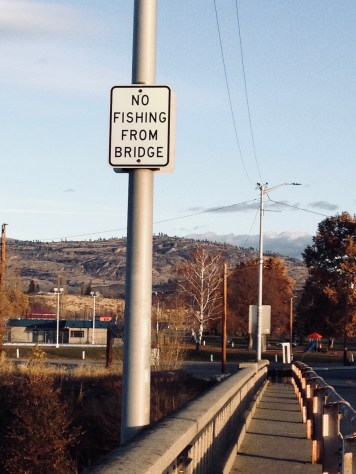 Another time when traffic noise was missing, Robert called out: “I’m breaking the law, but no one seems to care.”
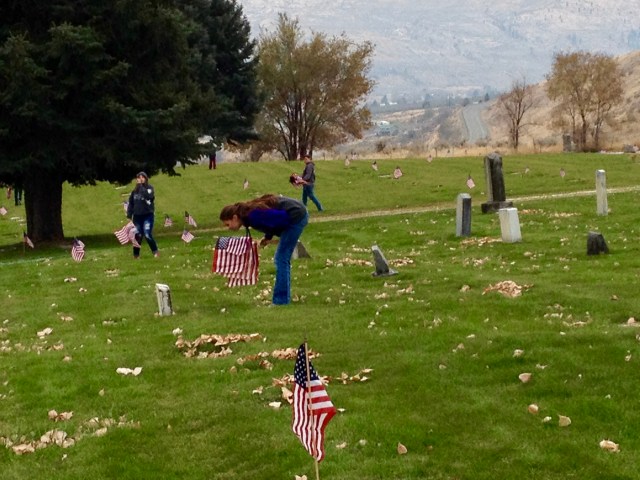 A drab, overcast, pre-winter day. Perfect for a visit to the cemetery. I prefer to go when I suspect no one else will be there. I like solitude as I visit my husband’s (and someday my) gravesite. We’d chosen this spot on the edge of the Okanogan Cemetery because of its expansive view of the valley, river and mountains. I also enjoy walking my dogs along the cemetery lanes when I know they won’t be bothering other visitors or mourners.
 “Did you get photos?” my friend Elizabeth inevitably asked whenever I told her about an interesting or beautiful event in my life. More often than not, I’d have to make some lame excuse about why I didn’t have my camera with me or hadn’t pulled my phone from my pocket.
  Elizabeth and I were polar opposites when it came to photography. I use photos to illustrate my writing. Her writing was about her photography. She claimed she was merely an amateur with the camera, but she had it with her at all times. Even after her eyesight dimmed, she persisted, setting her Canon A710 IS on automatic, pointing and clicking. Then she’d pass the camera to me (or, I assume, to whomever was with her) so I could assess the image and tell her whether she needed to try again.
 One of the hardest parts of aging is letting go. Letting go of people who die ahead of us; letting go of physical abilities: mobility, the senses, a pain-free existence; letting go of activities that give us joy and express our creativity. We never discussed it, but I knew Elizabeth had reached the threshold of letting go when she no longer carried her camera. By the time she celebrated her hundredth birthday last July, she’d let go of so very much.
 Last week her longtime friend Marsha and I sat at Elizabeth’s bedside during the final hour of her life. I sang some of the old hymns that Elizabeth and I’d been singing together over the last couple months. She’d amazed me by remembering all the verses of any hymn we sang. On that last morning, as her breathing became erratic, she no longer sang. I’m not sure she could even hear me sing, but her spirit did.
 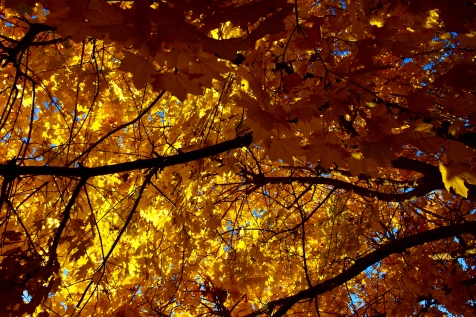 “I believe my favorite hymn is ‘This is my Father’s world,’” Marsha commented. I began to sing it. Somewhere around the “music of the spheres,” Elizabeth entered that place of deepest peace. After Marsha and I shared a few prayers, after the funeral home collected the body, I stepped outside into a glorious autumn day. There is a reason that this is the season of “Dia de los Muertos” (Day of the Dead), All Saints, Hallowed Evening (Halloween). Autumn is a fine time to die. That fall palette of reds, golds, yellows, bronzes, oranges, and on, and on, are creation’s promise to us. Leaves and grasses shimmer brilliantly before they let go, becoming part of the cycle that is eternal life.

 I was behind the wheel when my phone vibrated with an incoming text. It was the day before Washington state’s new, stringent “distracted driving” law (or DUIE—Driving Under the Influence of Electronics) went into effect. From now on, we can get a hefty fine for just holding our cell phone, never mind looking at it. Other distractions, like eating or taking a sip from our latte, can result in a thirty dollar “secondary” fine. This in the home state of Starbucks!


You must be logged in to post a comment.