Embracing Life’s Lessons: From Caregiver to Patient

If life is all about learning, I’ve just earned my post-doctoral degree following hospitalization. Ouch. I know. Self-serving puns aside, it was a novel experience to be IN bed instead of bed-SIDE.

For the past three decades I’ve been doing preparatory studies by caring for loved ones during their final passage of life. Among them were my husband, mother-in-law, mother, and sisters of my heart. I’ve witnessed the grim effects of stroke, cancer, heart disease, ALS, and simple, intractable aging.

With each passing I came to the same conclusion: I’m not particularly afraid of death, but I’m terrified of the health care industry. It is to be avoided at all costs.

When I made a full frontal landing on a concrete sidewalk nearly three weeks ago, my first thought was a prayer: please, no injuries requiring medical attention. 

“Nothing broken,” I announced cheerfully to the strangers who helped me up. What did I know?! I painfully crawled into an Uber for the short ride to my apartment complex, where a nurse checked my vital signs. I was alive.

“Ambulance,” he suggested.

“Nope,” I countered. “I’ll just ice my (screaming) knee and elbow. I’ll be fine.” An hour later I was on the phone saying, “ambulance.”

Once again I assumed the role of bedside observer, but this time observing myself as patient. I consciously sought a sense of detachment, witnessing my own experience as if I were someone else, watching, not judging.

I was not at all approaching death’s door, yet right there at my side were the beloved ones with whom I’d journeyed in years past. While I thought I was caring for them, they’d actually been teaching me: how to let go, how to accept, how and where to set boundaries, when to laugh, when to cry and grieve, how to bless and move on.

My husband, who died in 2007, has been especially present. A brainstem stroke left him with the unthinkable diagnosis of Locked-In Syndrome: a fully functioning mind “locked” inside a totally paralyzed body, unable to speak or eat. Yet he lived a meaningful life for another fourteen years. His presence is palpable, reminding me how he faced adversity with courage, determination and, most important, patience.

My mother sternly warns, “DON’T!” as I start to pick up a sock that fell on the floor. Mother broke her neck by falling when she stooped to pluck an errant thread from the carpet. She survived, but it was a long, arduous recovery. She ultimately died with cancer.

“Thanks, Mom,” I respond when I hear her voice. “You paid a heavy price to teach me this lesson.” I take the time to retrieve a mechanical grabber and safely pick up the sock.

When my dear friend Sharlene was diagnosed with ALS (Lou Gehrig’s Disease), her wry and playful humor rose to the top. Told the disease is incredibly rare, she declared, “I’m one of the CHOSEN.” She taught me that we are a mixed bag of emotions, all valid. She howled volubly with grief and rage every time the advancing disease robbed her of yet another function: walking, eating, talking.

When she could no longer speak, she typed jokes into her talking laptop and played them for strangers as we rode elevators at the medical center. One delighted passenger suggested she be hired permanently. She rather liked the idea.

With death approaching Sharlene spelled out her final request to me by painstakingly moving her one functional finger across the sheet on her bed: “Mary, write my obit.” I did, but I wish I’d done it better, made it more fun, like her.

I sat for hours with my soul sister, Mary Lou, who in her final weeks often resisted pain-killing but sleep-inducing medication. “I don’t have much life left,” she protested. “I don’t want to sleep through it.” 

Walking the route to humility

Our friendship had begun decades earlier when, as office colleagues, we discovered we both played piano. We began meeting weekly to play duets. Mary Lou insisted on playing “secondo” while I played “primo.” As in dancing, someone has to lead.

Thousands of miles and a multitude of shared adventures later, as Mary Lou lay dying she asked what of her possessions I wanted to inherit. I didn’t have to think about it.

“Your humility,” I quickly answered, humility not being one of my stronger suits. She had it in abundance, along with joy, grace, and a delicious sense of irony. Mary Lou shows up all the time now, her musical chuckle echoing in my ear at every pride-punching, ego-deflating event in my life.

“This is what you asked for,” she reminds me.

Appropriately humbled, I’m returning home today after two weeks in a hospital and four days of rehab. Therapy will continue at home. I’ll be aided by a walker, a leg brace, and many well-wishers from whom a river of prayer has flowed.

Healing is not a solo venture. If we think it is, we deceive ourselves. If it were up to just me, I could not, would not fully heal. Lesson learned.

Dependence Day: Are we really free, or are we kidding ourselves?

On day No. 12 in the hospital, as my fractured bones heal I realize I’ve been given an additional break —a pause.

When I met a Seattle sidewalk up-close and personal a week-and-a-half ago, it interrupted my schedule: things to do, people to see, places to go. Since then I’ve been given long, seemingly empty hours of “doing” nothing. My arena of activity is limited to a bedside table (15 by 34 inches — I measured it using tape from my knitting bag). The table is piled with notebooks, hospital menu, a few papers relative to injury and recovery, water jug, computer, phone, maybe a snack or two. 

If something I think I want or need is beyond my reach, it’s as unavailable as breathable air on the moon. Like that pillow, just four feet away, that would feel good under my fractured elbow just now. I’m capable of wriggling out of bed, shuffling the four feet (abetted by the hip-to-ankle brace stabilizing my fractured knee), grabbing the pillow, and shuffling back to bed.

BUT I’ve been strictly ordered not to get out of bed or even off the toilet without an “assist.” If I want to move about, someone else has to be present.

Happy Dependence Day!

We love to celebrate Independence and worship at the altar of Freedom (an altar banked with fireworks). When do we celebrate the greater gift of DE-pendence? 

Such a suggestion sounds almost unAmerican. We pride ourselves as being (as my late husband liked to observe) “independent as hogs on ice.” We wanna be free to do what we wanna do. At my age especially, independence is the NO. 1 goal —even though it’s a mirage.

We choose to ignore how much we depend on others. We can’t recognize that because too often the fellow human beings we depend upon are hidden within systems — health care system, transportation system, communications system. You can name many more. Just think about your daily activities and the systems that enable them and the people within those systems who enable you.

The other night (at the risk of being overly specific) my urinary catheter malfunctioned. What a soggy, humiliating situation! Barely awake, I mumbled apologies to the aide as she efficiently got me back on dry land. English for her, like many hospital personnel, is a second language. With her beautifully lilting accent, she replied, “That’s why I’m here on the overnight shift. To help you!”

After she left, I wondered if I’d just experienced a mystical divine presence. She’d seemed uniquely certain of who she was and why she was. It was powerful — as if destiny had hurtled us both through time and space so our paths would cross in exactly that moment, this place.

The African Bantu language gives us the word ubuntu, inadequately translated as “I am because you are.” I understand that to mean, “I would have no reason to exist except that you exist.” I’m guessing our culture understands that in a romantic sense, like the song lyrics: “I was meant for you; you were meant for me.” That’s a start, but ubuntu is universal. I suspect that word or a similar one is not in our vocabulary because it’s a foreign concept. In our individualistic world, co-dependency is considered a mental illness. 

Yet the mutuality of ubuntu is at the root of our humanity, our raison d’être. Thus showing up at 2:30 a.m. to change an old lady’s sopping bed linen becomes not just a job, but a reason for being. 

Happy Dependence Day — today, tomorrow, and every day of our lives!

After the Fall: Why me?

“80-year-old fall!”

When I heard the triage nurse’s call, I realized I had a new label. I was waiting with two ambulance attendants in the ER corridor, in line for an empty bed. They can call it emergency, but hospitals in general involve a lot of waiting. That allows time for pondering.

Ponder this: How is it that Seattle citizens, accustomed to walking around prone bodies on the sidewalk without even slowing down, would rush to my assistance as I lay facedown on hard concrete?

Welcome to my world of privilege. I was nearly 20 when I began to realize that I was privileged through no fault of my own. I was born white, middle class (not a lot of money but enough), a U.S. citizen, raised in a two-parent household by parents who habitually expressed love for each other and their children. I thought that was normal. 

With every passing decade and cultural crises of domestic violence, sexual abuse, family trauma, systemic racism, homelessness, social injustice at every turn, my privilege becomes harder to bear. Not until I work through the guilt and humbly lament can my privilege be fully acknowledged and appreciated.

People fall on Seattle sidewalks all the time. I’ve watched it happen. The falls I’ve witnessed unfold in slow motion. The faller leans forward from the waist, bends their knees, and lowers their body, ever so slowly escaping into the inevitable neverland of  gravity and drug OD.

My fall occurred instantaneously, as if the uneven sidewalk suddenly rose up, smacking my body like a thousand sledge hammers. Before I could figure out what happened, people — total strangers — hurried to help. I have to ask, “Why me?” Not the victim’s why me. Not the why me of Job or anyone who disputes bad events that are supposedly unjust, undeserved. 

I suspect people rushed to my aid because I wear my 80 years of privilege like a shining coat of armor: silver-haired matron in age-appropriate, subdued clothing, walking briskly, could even be heading home from church (which I happened to be). I was safe. My needs were simple: help me up. Maybe call an ambulance. Lots of Good Samaritans on hand. 

I think the Samaritan’s story can be misinterpreted. It’s not that we’re called to assist every needy person we come across. We are to acknowledge both their needs and our ability or inability to meet those needs. I as an individual cannot help the fellow human who is comatose in the building alcove. I can, however, join with others in community who, as a community, have the power to help, to make a difference. Even the Samaritan didn’t act on his own. He took the robbery victim to an inn where he presumably was known. He trusted the innkeeper to provide appropriate care, and the innkeeper trusted him to make good on the bill. That’s community.

I declined suggestions of an ambulance and got a Lyft ride home. After an hour of icing, I had to admit my injuries were worse than I could heal on my own. Again as a privileged person with an insurance card in her wallet (10 percent of Americans STILL don’t have insurance and others are under-insured), I called an ambulance.

Diagnosis: fractures of the left radius (elbow) and right patella (kneecap) along with a colorful variety of bruises and abrasions. Next comes elbow surgery followed by rehab. Then — date uncertain — back home, all because I’m privileged. Once back home they’ll call me by my name, or occasionally “Apartment 13-A.” Just not “80-year-old fall.”

That selfie is not at all flattering, and honestly, it looks worse than it feels.

Who Keeps Us Safe? (sometimes we never know)

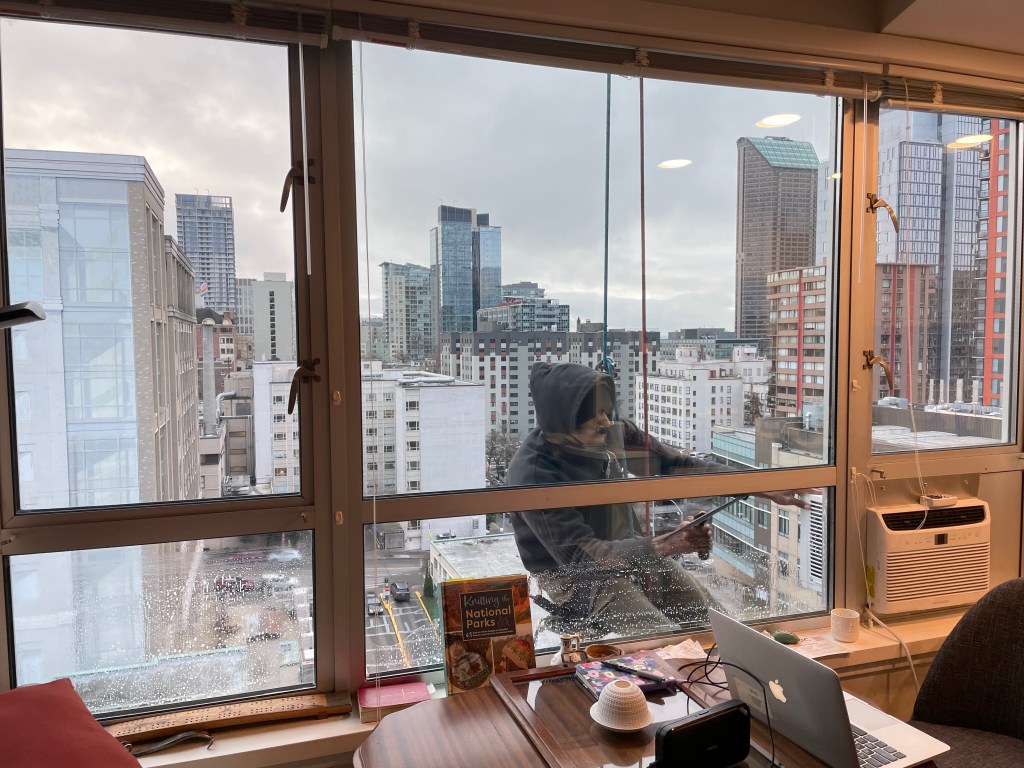
Savoring my morning coffee, scrolling through email, I suddenly became aware of a red rope slowly snaking downward outside my thirteenth floor window. What the …!? No way of telling where it came from or where it was going. Before long it was joined by a blue rope, the two of them swaying in the breeze, a sinuous tango, occasionally touching, then parting.

Mystified, I went about my morning ablutions. When I emerged from my bathroom, I discovered a man in a boatswain’s chair outside my window, expertly clearing away soap with his squeegee. I’ve long admired the efficiency of professional window washers. With just a few graceful swoops, they make the world brighter and more clear than it was. Still, I prefer to watch them work when they have both feet planted on the ground, or on a low ladder. Because of my own exaggerated fear of heights, I don’t like to see anyone in precariously high locations.

The window washer, noticing me, smiled and waved. I placed my hands over my heart to signal both apprehension and appreciation. He put his hands together and gave a bow. Then, as he began to lower himself to the twelfth floor, he pantomimed falling, first with a startled expression that gave way to a big grin. Obviously an act he’s perfected over the years.

I can’t shake from my mind how relaxed, at ease he was, trusting his life to just two ropes. No doubt he regularly scrutinizes them with an eagle eye. Still, it’s a leap of faith, not only in his equipment, but faith in whoever ran the machine that braided those ropes in the first place. He’s vitally connected with someone he’ll likely never meet.

Window cleaning isn’t on the list of the hundred most dangerous occupations, compiled by the National Institute for Occupational Safety and Health. OSHA reports eighty-eight window cleaning accidents over a fifteen-year period, sixty-two of them fatal. That’s out of millions and millions of windows washed. Squeegee Squad, a commercial window cleaning firm, claims that “statistically speaking, it’s safer to be a high rise window cleaner than it is to drive a cab.”

Or, safer than driving on rural two-lane highways, which is where I’ve driven most of my life. A federal safety initiative reports that more than twelve thousand deaths occur each year on rural roadways because drivers cross the center line or run off the road. That’s about a third of all annual highway fatalities, even though the interstates and city roads handle way more vehicles.

I used to think about that in my frequent travels along SR97, the north-south highway that bisects Washington state. I’d watch vehicles hurtling toward me at sixty mph (usually more) and think, I’ll never meet that driver, but my life depends entirely on their sobriety and attention. I’d silently message them: be aware, be safe. Then there were the occasional heart-in-throat moments when drivers passed recklessly, forcing others to brake and pull onto the shoulder. My messages were less silent and not kind.

“We are caught in an inescapable network of mutuality, tied in a single garment of destiny,” wrote Martin Luther King Jr. in his remarkable Letter from Birmingham Jail. “What affects one directly, affects all indirectly.”

We think we’re such independent individuals. But whether we’re washing windows on the thirteenth floor or driving along a two-lane highway or just reading words on a screen, we’re all as closely connected as one heart beat, one breath.

Everybody’s Business

  • Imagine a water bottle that measures your hydration level as you sip.
  • Imagine cell phone batteries that recharge off your body heat.
  • Imagine an ear piece that projects a hologram so you can read a book or watch a movie hands-free.

If you’re seventeen, these are the kinds of technological wonders you can dream up. They’re the kinds of things I was invited to invest in (virtually) during Business Week. Every year high school juniors from our two neighboring towns (Okanogan and Omak, WA) are excused from their regular class schedule for five days to sample what’s ahead for them in the realm of free enterprise. 

After the pandemic hiatus, Business Week returned this year. I was happy to again be invited to help as a judge and “investor.” During a brief training session for judges, facilitator Chris Loftis had me nearly in tears as he described what this year’s students had missed during pandemic isolation.

“These kids have lost something,” he concluded. “We’re going to give it back to them.” The “we” is our local community. While school district sponsorship is essential, professional educators are largely absent. Pretty much all the adults are volunteers. Many are giving up a full week of work; others are retirees willing to revisit the world of work. Area businesses throw in financial support to cover the $14,000 cost. 

Students are sorted into “companies” to dream up product lines, assign corporate responsibilities, determine quality standards and work ethics, and develop marketing strategies. Sounds kind of dull, frankly, but a computer program makes it more like a game. Based on the kids’ decisions, the computer churns out two years worth of various reports like sales volumes, profit and loss, and stock value. Just as in real life, the reports produce cheers and/or teeth-gnashing. By the end of the week, the kids are excited to show off their work for a spirited IPO (initial public offering). The students aren’t graded individually, but they’re rewarded as corporate teams with stock sales. All play money, of course.

I’m not necessarily a cheerleader for capitalism, but it’s the system we live and work under. Within our system there’s space for kindness and community building — if we so choose. Business Week does. The kids experience teaming up with otherwise rivals. Ordinarily the two schools are each other’s No. 1 athletic opponent. Here, students are purposely mixed — about a dozen in each company. Some years ago one of my grandsons who participated in Business Week concluded with surprise that kids from the other school had some pretty acceptable qualities after all.

Every student has a place and a role. Inclusion and participation are highly valued and required. As we judges visited the companies, we were introduced to each student by name and their individual responsibility within the company. At week’s end, every student receives a certificate awarding a college credit — something pretty amazing for a lot of these rural kids who never consider the possibility of college.

Despite pandemic disruption, teens’ resilience was vividly on display. They’d put behind them not only Covid isolation, but inevitable setbacks from the week’s taste of business life.

“Life is more than dollars and cents,” teaches Loftis. “Life is about failure … and then you get back up.”

Getting back up was part of the week’s adventure for several companies. “509 Electronics” got into trouble with the public after marketing a low-quality product, explained their CEO. After the company decided against a recall, the public (via computer program) raised a fuss. The company apologized, offered a recall and changed its manufacturer. The lesson, said the CEO: “Don’t rely on people you don’t know.”

As a consumer of a certain age, I was smitten by another company, but as a potential investor, not so  much. “Design, Love, Virtue” had chosen to target elderly consumers. They’d done admirable research into their market audience, coming up with a simple-to-use flip phone that promised a crisp speaker, easy-to-read screen and (hallelujah!) ultra-responsive tech support. They acknowledged making “hard decisions” along the way, opting for strategies that would benefit the environment, their customers and employees. Their product was so popular, they ran out. “You never want to do that,” a fellow judge muttered out of their hearing. Flooded with back orders, they watched their stock tank. Undaunted, they were promising skeptical investors a rosy comeback. I sympathetically put in a few bucks — no more than I could afford to lose.

Business Week got its start in the 1970s as a residential summer program — something like cheerleader or basketball camp — at Central Washington University (then state college). The residential program has since spread to college and university campuses in eleven states plus Poland and Italy. Yet only a handful of school districts make it available on a local basis to all students. While the residential programs offer full scholarships, it’s still unlikely that very many of our local kids could afford a week off from summer jobs to attend. Or would even feel motivated.

 One reason the in-school program is less than popular with educators, I’m told, is that teachers are under pressure to prepare students for standardized tests. Giving up a full week away from “teaching to the test” is asking too much.

I don’t know if our students’ test scores are remarkably above or below the norm. I could research it, I suppose. But I’m satisfied with what I saw kids take away from Business Week — a few of life’s lessons that can’t be measured on any test other than life itself.