MAY DAY!

They’re preaching to the choir, I said to myself.The “preachers,” in this instance, were public  television travel guru Rick Steves plus a real life preacher, Steves’ wife, Lutheran Bishop Shelley Bryan Wee. They were sharing a podium — not the pulpit — at St. Mark’s Episcopal Cathedral in Seattle. Their presentation, “The Traveler and the Bishop” focussed on threats to American democracy and the rise of Christian Nationalism.

Some, perhaps many, church goers view such topics as political and inappropriate in a church. I empathize with their need for sanctuary, an escape from poisoned politics, stress, and disagreement. These are, noted Bishop Shelley (as she prefers to be called), “fraught times.”

If the war we’re waging against Iran upsets you because gas prices are soaring, that’s a political issue. When the commander in chief of the most powerful military in the world threatens to annihilate an entire nation, that’s no longer politics. That’s a threat to the very fiber of humanity. It’s a moral issue demanding nonpartisan, nonviolent discussion in churches, synagogues, temples and mosques.

“Across the United States there’s a crescendo of concern,” said Steves. “People are rising up and they’re asking, ‘What the hell is going on?’”

St. Mark’s, which seats well over a thousand, was packed. When an evening presentation was first announced — free, but reservations required — capacity quickly was reached. Steves and Bishop Shelley agreed to a second, afternoon presentation. When I arrived, a half-hour early, the “choir” was gathering. A line spanned the large stone labyrinth in front of the cathedral and half-way down the block.

I thought about the many times singing in a choir motivated and empowered me. Maybe preaching to the choir should not be discounted. Maybe it’s more impactful than the old cliche suggests.

Steves effectively summarized events of the past year-and-a-half, none of it news to this audience. Partway into his forty-minute speech he acknowledged he didn’t like using the “F” word, but . . . and then he paused, meaningfully. I steeled myself, anticipating the profane F-Bomb. But Steves had another “F” word in mind, even more profane: Fascism. 

He’s an authority. Seven years ago he produced a documentary, “The Story of Fascism in Europe.” It is frighteningly omniscient, showing events of the 1920s and 1930s that mirror what’s happening here and now. Steves also compiled what he calls “The Dictator’s Playbook: 20 Points Followed by Mussolini, Hitler…and Every Wannabe Fascist Authoritarian Since.” (Available on Facebook.)

No. 1 on Steves’ checklist is, “Establish a mythic past … and promise a national rebirth to the good old days.” MAGA, anyone? Another is to promise simple solutions to complex problems. DOGE, anyone? A vital component of special concern to me and fellow career journalists: control the information media. 

This choir member left the cathedral both energized and discomforted. It’s my lack of personal inconvenience that worries me. I’m troubled intellectually, emotionally, spiritually. But my day-to-day life is smooth sailing. I’m aware of higher prices in the grocery store, yet I’m not struggling to feed a family. Thousands of my fellow citizens cannot afford skyrocketing health insurance premiums with the loss of supplements. My Medicare Advantage plan is still affordable — while I’m healthy, at least. 

People are dying, in this country and across the globe. Some 600,000 deaths have been attributed to the end of USAID. 

Reader, please be patient while I offer another metaphor. Am I (along with so many like me) the proverbial frog who is dropped into a pot of cool water? The frog swims around as the water heats up — until it’s too late. Wikipedia offers some comfort, if you care about frogs. Experiments have determined that when the water gets hot, the frog jumps out. Are we as intelligent as frogs?

I’m posting this late on May 1. May Day is both a call for help and a traditional day for demanding workers’ rights. And here we are, inhumanely treating and deporting people who are an essential core of our working population. That’s reality, even if the frog metaphor isn’t. How close are we to the boiling point? Can we turn down the heat? Possibly — if the preachers keep preaching, and if we in the choir sing at the top of our lungs.

*   *   *

To watch the full April 26 event at St. Mark’s Cathedral click here. (Welcome and introductions  start at five minutes in, and Steves’ talk is eight minutes in. Bishop Shelley’s talk is one hour and ten minutes in.)

EARTH DAY: Is That My Bus Pulling Away?

On Earth Day — of all days — public transportation, more specifically busses, had me bamboozled. This after two-and-a-half years of preaching about the wonderfulness of Seattle’s mass transit! How I’ve crowed about reducing my personal carbon footprint by not owning/driving a car.

My plan for the day was simple: pick up a couple sandwiches from a neighborhood deli for lunch with my sister, who lives a mere forty miles away. From the deli, I’d walk downhill seven blocks to catch the Sound Transit 594 Express, hop off in downtown Tacoma and board the Pierce Transit No. 45, which drives right past my sister’s house in Parkland.

You know the old Hebrew saying. “We plan; God laughs.” 

Undeterred by a steady rainfall, my umbrella and I arrived at the deli. The sandwiches I’d ordered online the day before weren’t ready. After a twenty-minute wait, I knew I’d missed the No. 594. I didn’t mind. It runs every thirty minutes, giving me an extra ten minutes to walk more carefully down the steep, rain-slicked sidewalk. By chance a neighbor was also waiting at the bus stop, though headed in a different direction. We agreed that we were fortunate not to be driving through rain and heavy traffic.

The 594 was a minute late, and I was a bit concerned. The wait time between the No. 594 and No. 45 to Parkland is tight. Still, the bus cruised along the express lane as I peered down at drivers — alone in their cars — making tedious if any progress.  We arrived in Tacoma right on time. I hopped off the 594 but somehow got turned around, heading in the wrong direction for the 45. By the time I realized my error, the Parkland bus was long gone. 

No matter. Our sandwiches could wait. This gave me a half-hour to explore  a bit of downtown Tacoma. What impressive changes since the 1960s when I was a student there! Buildings refreshed and repurposed. A tiered fountain takes advantage of downtown’s steep hill, spilling cascades of clear water between Commerce and Pacific streets. Even on a rainy day, it was refreshing. What used to be just plain old 9th and Broadway is now the heart of the “Theater District.” Oh, my.

Next comes the insulting part. I got back to the bus stop in plenty of time and noted that the No. 42 was parked along the curb. I figured the 45 would pull up behind it. As time for the 45 arrived, the “No. 42” started its engine and began to pull away. I turned to watch the departing bus and realized it had morphed. The electric route sign had changed from “42” to “45.”

“Hey!” I yelled pointlessly while waving my umbrella. The bus headed up the hill without me. Exasperated, not to mention hungry, I pulled out my phone and punched the Lyft app. Dominic arrived in two minutes and got me directly to my sister’s house sooner than the No. 45 would’ve.

“How much did that cost?” my sister asked. I’d been pondering the same question. The Lyft fare was a pittance when I considered the monthly cost of maintaining, insuring, parking and fueling my own car.

After our lunch and visit, I left in plenty of time to catch the No. 45 at three o’clock. So early, in fact, I barely missed the bus that departed at 2:45. Oh, well. I hunkered down. The shelter protected me from rain but not wind. Sure enough a bus pulled in at 3 p.m. As I tried to board, the driver told me we wouldn’t be leaving until 3:15. I’d misread the schedule. Upon his return from the restroom, the driver kindly allowed me to wait inside the bus and announced, “Your trip is free ’cuz it’s Earth Day.” 

I smiled, said thanks, and didn’t bother to tell him that ALL my bus rides are free. My retirement community, Horizon House, pays for my senior citizen Orca card, which covers all public transit in the region, including ferries and light rail. Every day is Earth Day.

The No. 45 got me back to catch the No. 594 with two minutes to spare. The return to Seattle was smooth sailing, but I was too exhausted to walk back up First Hill. I decided to take the G Line. It — of course — was pulling away as a red light kept me from crossing the street and boarding. Then, a miracle. Metro No. 2 pulled up. It would get me two blocks closer to home than the G Line. 

Finally home, I pondered the day. I realized each missed bus gave me an opportunity: to walk more slowly, safely downhill; to chat with a neighbor I don’t see often enough; to explore a renovated downtown Tacoma; to admire the stuffed animals in Dominic’s Lyft car and learn he’ll be a first-time father “very soon.” 

The 3:15 bus coincided with the end of the school day. What a scene! Teens tumbled onboard with adolescent bravado masking their self-awareness and uncertainty.  A few blocks further, the driver lowered the ramp for a homeless man whose pull cart was piled high, presumably with all that he owned. His large dog made friends with a chihuahua riding in a kennel on wheels. A cyclist taking a shortcut efficiently loaded his bike on the rack in front of the bus and hopped on.

Public transit is people being with other people — different people — going and getting somewhere together. If I still had a car, I would’ve driven alone to my sister’s and back. Where’s the story in that?

Chicken or Egg: Where Are You Comin’ From?

If you’ve ever puzzled over the chicken/egg primacy issue (which came first?), you might find your answer aboard the Coast Starlight Seattle-Portland train route. 

Or do I mean Portland-Seattle?

As part of “Trails and Rails,” a cooperative venture between Amtrak and the National Park Service, knowledgeable volunteers spend their summers entertaining passengers with stories about Pacific Northwest environment, history and culture.  (At least they did last summer. Who knows whether this admirable program will survive?)

Kristy and Phil, volunteers on my journey, were armed with notebooks full of facts and figures. But it was their story-telling skill that hooked passengers who filled the glass-domed observation car.

Approaching the Billy Frank Jr. Wildlife Refuge, just north of the state capitol, Phil described Frank as the “man who was arrested more times than anyone else in the state of Washington.” 

“What would you say about such a person?!” he continued, feigning dismay. Tourists murmured, disconcerted. Those in the know smiled at this introduction to one of the state’s most honored Native American activists and environmentalists. True, Frank (1931-2014) was arrested more than fifty times. The first time, at the age of fourteen, was the beginning of his decades-long fight to reestablish native fishing rights. His persistence led to the landmark Boldt Decision of 1974, upholding guarantees that had been set in an 1854 treaty but ignored. Frank’s numerous honors include the Presidential Medal of Freedom.

More stories flowed as the train whistled us through cities and towns until we approached Winlock, a small, agricultural community.

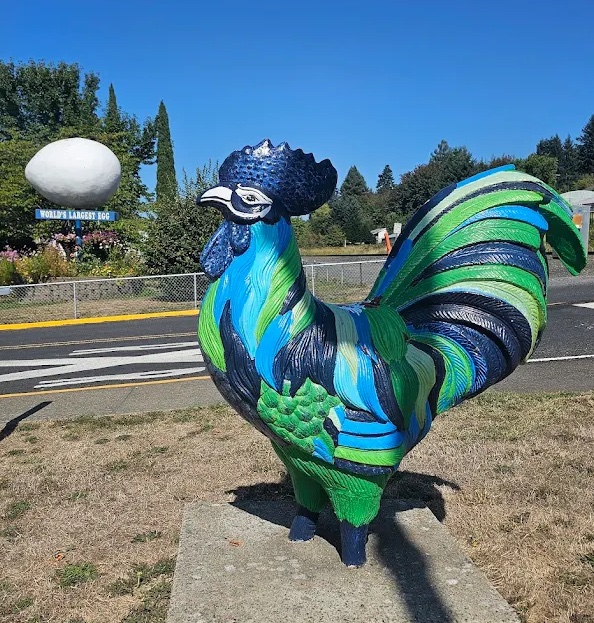
“If you remember nothing else from this trip, I hope you remember this,” prompted Kristy. Winlock historically touted itself as the “Egg and Poultry Capital of the World,” producing hundreds of thousands of chicks and eggs. To prove it, the town erected the world’s largest egg, a claim affirmed by “Ripley’s Believe It Or Not!” in 1989. 

Just across the street is another statue: a brilliantly colored but much smaller chicken. As to which came first, the answer depends on what direction you’re going. Heading south, the egg comes first. Going north, it’s the chicken.

That’s US!, I realized.

As in, U.S.

As in polarized. We’re all on the same set of tracks, but our stories depend on where we’ve been and where we think we’re going — or want to go. 

Each of us is the sum and substance of the stories we tell ourselves about ourselves. Information or ideas that don’t fit into our stories bring up uncomfortable emotions — sadness, envy, anger — and we’re inclined to reject them, as if to say the chicken absolutely came first or the egg absolutely came first. In other words, we have bias. It’s inevitable, explains writer Brian McLaren. It’s how our brains work. 

We grow up being told stories that shape our own stories. As we mature and age, our stories become more complex. When we are confronted with stories, ideas and information that conflict with our story, we have a choice. We can simply reject those other stories — take the easy route. Or we can figure out how to rewrite our story, even discarding parts, to make our narrative more inclusive. Rewriting is hard and tiring work for the brain. And it’s ongoing. There’s new stuff coming down the track every day.

It’s like the Billy Frank Jr. story. If we get only a fragment, we easily jump to a skewed conclusion. 

On my return trip, from Portland to Seattle, I was sitting on the “wrong” side of the train. I missed seeing the chicken precede the egg. In fact, I missed chicken and egg altogether, thus missing half the story.

Nevertheless, when we can simply enjoy that there are chickens and there are eggs, and there are eggs and there are chickens, we won’t have to worry about which came first. When we can hear and honor each other’s stories, acknowledge where each other is coming from, we’ll be getting back on track.

It’s a matter of perspective. Winlock’s egg is really
much larger than the chicken. – Tim Bryon photo

Driven To Drive: An Identity Crisis?

An update of Rene Descartes’ declaration, “I think therefore I am,” is long overdue. For my generation the existential truth is, “I drive, therefore I am.”

I still vividly recall the freedom and power I felt on May 12, 1960, my sixteenth birthday, when I passed my driver’s license test. As drivers, we not only have the liberty to go wherever, whenever we want, our vehicles become integrated with our persona. Watch any car commercial.The ads are not about the vehicle but about how you’ll feel driving it. We’ll feel forever youthful driving that sleek sports car. Or forever in charge steering that rugged 4×4 pickup through hostile environments. Those vehicles cruising across our TV screens are an elixir of power and eternal youth. 

Until we’re too old to drive. And just how old IS too old?

Traffic safety experts sidestep a precise answer. So does AI. When I typed in the question, AI offered a laundry list of primarily subjective guidelines: declining physical or cognitive ability, slow reaction times, getting lost easily, frequent close calls, or loved ones expressing concern. Oftentimes, those “loved ones” will be less loved if they start harping about Grandpa’s driving.

Kaiser-Permanente, in a helpful online guide to “Healthy Aging,” offers cold, hard data:

  • People age seventy and older are more likely to crash than any other age group besides drivers age twenty-five and younger. In other words, driving skills improve with age, then regress. We’re no safer now than when we were air-headed teens, oblivious to our mortality.
  • Because older drivers are more fragile, they are more likely to get hurt or die from these crashes.

A joint study by the American Society on Aging and National Highway Traffic Safety Administration offers this chilling observation: “Most people drive seven to ten years longer than they should.”

Giving up your car is life changing. I did so two years ago, BUT I had no intention of giving up driving. When I moved to Seattle from rural eastern Washington, my motivations were to save money and reduce my carbon footprint. I gave my 2009 Dodge to public radio. I planned to use mass transit when possible, and rent a car when necessary. 

Public transit — busses, light rail, ride shares — are great. Rental cars not so much. I’ve rarely needed them, but when I do, they come equipped with recently developed, high tech amenities that I can’t readily figure out — like how to START the darn thing. 

I was delighted when my retirement community, Horizon House, recently introduced a car-sharing plan. For a nominal expense, residents can rent an electric vehicle, fully insured, and be trained to drive it before we hit the road. Because I’m past age eighty, I’d have to take a driving test to participate. I think that’s an excellent idea. I’d like to be assured that I’m as good a driver as I think I am — a veteran, after all, of several solo cross-country road trips.

A no-injury accident last year, just after I turned eighty, sowed a seed of doubt. I was driving a rental car in an unfamiliar town. Looking for a place to pull over to make a phone call, I blew through a stop sign and collided with another car — which had a student driver at the wheel. Both cars required towing.

A more experienced driver might have spotted me and taken defensive action. Several people who gathered round the crunched cars claimed it was a notorious intersection with frequent collisions. Still, I was clearly at fault. I acknowledged as much to the police officer, and readily paid my fine. 

And still, there was that traumatized wanna-be driver. I sent her a gift and a note of encouragement. My insurance readily paid for damages to the rental car. I was further grieved to learn that her family’s insurance company stalled for months before paying up. 

I’m sure her dad had plenty to say about eighty-year-old drivers. While I waited for the tow truck, he showed up with his work rig to tow away the family car. Grim-faced, he grunted as we were introduced and maintained a glum silence while hooking up the vehicles. It was Memorial Day. I imagine he’d been home, tending the barbecue. I’d ruined their holiday. 

That’s the thing about our roadways. Most of us do not work in the realm of public safety. Yet our roads and streets — open to all — are where we are most responsible for the safety and well-being of our fellow citizens. It’s where we have true community, where our very lives depend on the skills and consideration of our fellow travelers.

Why is it, then, that I’m struggling with the question: do I keep driving? I enjoy walking and using public transit. I’ve needed to rent a car only a handful of times over the past  two years, and maybe those trips weren’t all that essential. Could it be — and here, dear reader, I’ll reveal the naked truth — that my ego still clings to that steering wheel? Could it be that my ego — my false self — is deflecting any suggestion that I’m “too old” to drive? 

For now, I’m side-stepping the issue. I have no immediate need to drive anywhere. The car-share program will wait. My driver’s license is still in my wallet, valid until May 12, 2031. It is merely a plastic ID card. I’m working on making it not who I am.

Is that Descartes at the wheel?

In A Word

My mother often used the word “queer.” She wasn’t referring to sexual orientation. She used the word in the same way Lewis Carroll’s Alice did while meandering “Through the Looking Glass” and in Wonderland. For Alice and my mother, “queer” meant odd, strange, weird, curious. 

As the meaning of “queer” evolved in our culture, I became uncomfortable when my aging parent (she died at 92 in 2009) commented that something was queer. I worried she might be misunderstood. Yet I was hesitant to tell her the word no longer meant what she meant it to mean. Mother was a writer and educator. She objected when words and language differed from what she’d been taught as a Depression-era honors student. 

She would’ve objected to the change in meaning — not the people who in this era proudly identify as LGBTQ+, or queer. While I don’t recall ever discussing gender issues with my parents, I do remember an episode in my teens involving a friend, Ann. It was around 1960. Ann was homeless after revealing she was a lesbian. It was an especially courageous revelation for a teen — for anyone! — in those years. My parents opened our home to her.

Ann had scars on her wrist from a suicide attempt. She’d spent some time in a mental institution. Keep in mind that homosexuality wasn’t depathologized (no longer viewed as a mental illness) until 1973. Mother became a mentor to Ann, who wanted to be a writer. After Ann left our home, she’d write letters to Mother, who lovingly used her red pen to correct errors and sent the letters back. I’ve no idea how long that exchange continued. Ann eventually disappeared from our lives. 

The memory of my parents’ nonjudgmental hospitality remains, especially in this era when religious fundamentalists have their knickers knotted over gender issues. To be clear, my dad was a Lutheran minister and Mother wrote Christian educational materials — Bible studies, Sunday School lessons, etc.

I wonder how they would’ve reacted to the documentary “1946: The Mistranslation That Shifted Culture.” Again, it’s an issue of words and how we understand them. Or don’t. I watched the movie (available on Amazon) in June, as part of “Pride” month. It explores what happened when the word “homosexual” appeared for the first time in an English-language Bible — the Revised Standard Version, issued in 1946. 

Academics ultimately agreed it was a mistranslation and a misinterpretation of the scriptural text. The documentary notes that the mistranslation was ultimately corrected in later versions, but the misuse has been repeated and is used by literalists to condemn queer love. Raised in a Lutheran parsonage, my Christian education was summed up by Jesus’ two simple and direct commandments (Matthew 22:36-40). Love  God. Love others. 

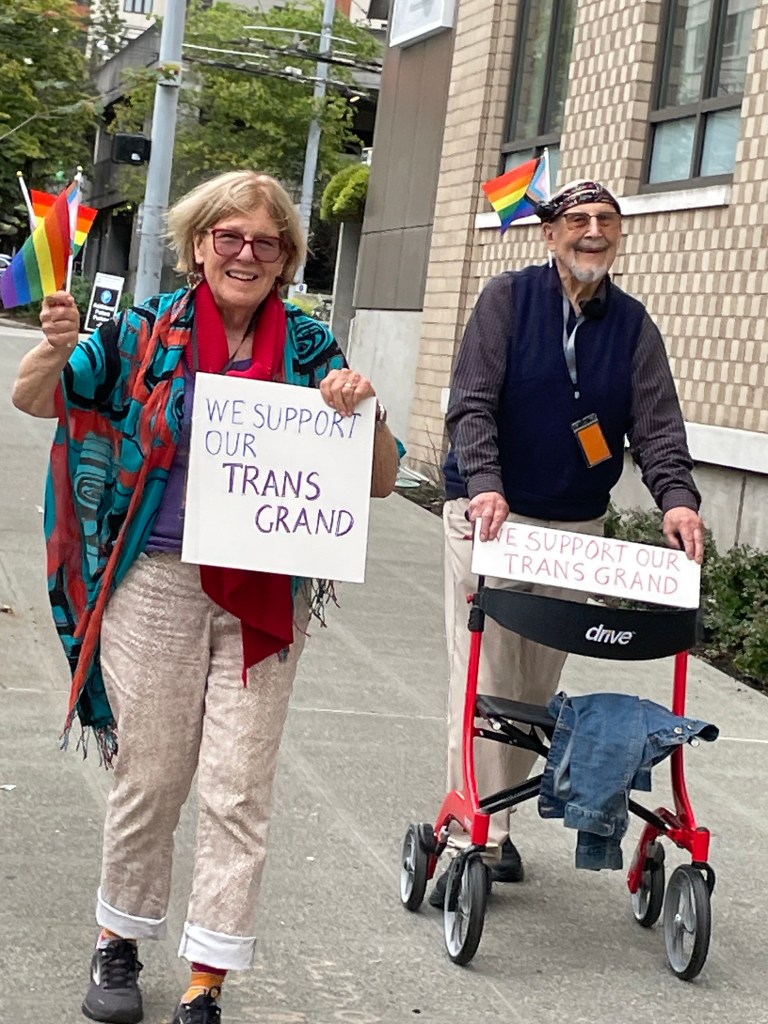
June 29 was my first opportunity to attend Seattle’s annual Pride Parade. The city’s biggest event of the year, it’s said to have drawn some 300,000 people. I was astounded by the crowd, the noise, the joy, the creative and oft-times bizarre apparel — or lack thereof. 

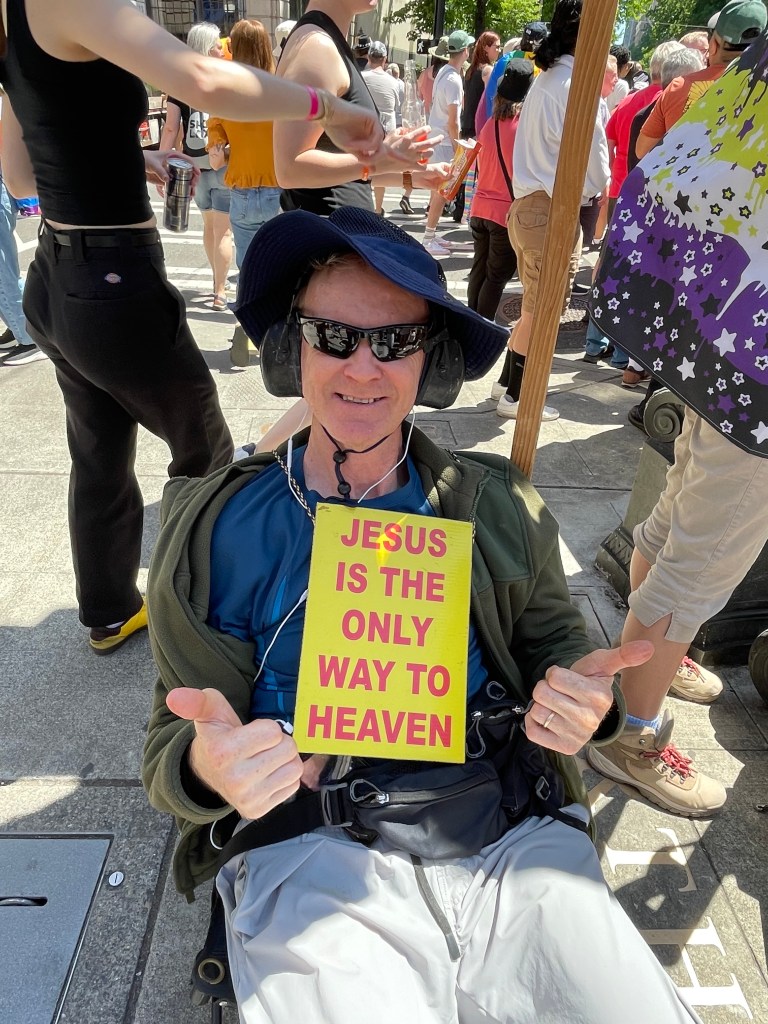
I stopped to take a photo of a fellow (with his permission) who was hunkered down in a patch of shade behind the spectators. 

“But you can’t see the parade,” I said. “It’s not my priority,” he answered.

I assume his small sign proclaiming “JESUS IS THE ONLY WAY TO HEAVEN” was intended as a protest. Well, that’s one in 300,000. We’re each, in our uniquely queer way, one in 300,000, one in a million, one in a billion, quadrillion … one.

One point of view …
… one other

After The Burn

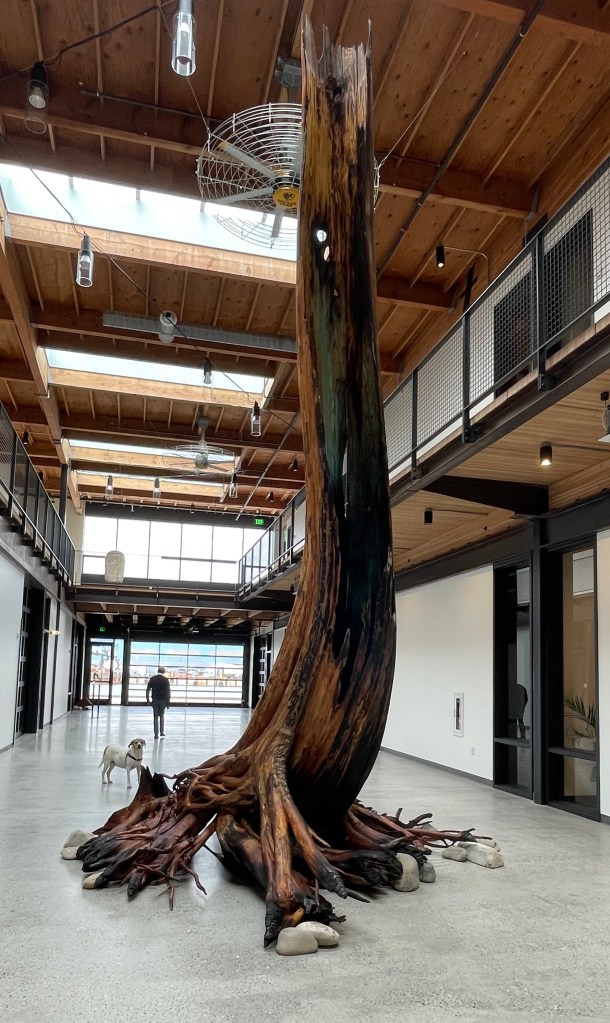
Having lived in wildfire country for decades, I’ve hiked many miles through burned-out forests. I grieved over fallen giants whose blackened bark served as shrouds. Now an urban dweller, I was recently meandering through a very different environment, a contemporary art gallery dominated by concrete and glass. Until … I turned a corner and was unexpectedly back in the burned forest, or a towering representative of it.

The sculpture, created from the twenty-two foot base and roots of a charred and hollowed western red cedar, is a compelling statement of destruction and resurrection. Tori Karpenko, an artist from Twisp, WA., salvaged the tree’s remains in cooperation with the U.S. Forest Service. Karpenko rubbed oil onto every inch of the massive corpse, giving it an ethereal glow, an essence of life after death.

Karpenko titled the work “Invitation.” It tells a story, Karpenko writes: “Of loss … Of fragility and the delicacy of this moment we are in … Of hope in the promise of renewal … Of community, holding everything from the bottom up.”

I’ve long marveled at the self-healing powers of Creation. Almost immediately after a forest fire, there’s a resurgence of life. Ferns emerge, burying thick ash on the forest floor beneath a lush, green carpet. Myriad seeds spring to life. Reporting on fires for our rural, weekly newspaper was inevitably a bitter-sweet experience for my husband and me. We and our staff would photograph and write about the destruction, the drama of firefighters battling to save homes, lives, property. 

John and I would also give each other knowing looks. We would return to the scene the following spring to hunt for the tantalizing morel mushroom. Several species of “burn morels” hide underground for years until fire prompts them to bloom, often en masse.

It’s well known by now that practices and policies over the past century led to needless destruction of forests and wildlands. Fire is not the enemy. Human conceit is. Not that many years ago, I attended a presentation on wildfire and, for the first time, heard a government forester admit, “The Indians had it right.” For centuries, Native Americans skillfully used fire as a tool to keep the forests healthy and productive. 

I’m not into romanticizing any culture over another. I’m not going to delve into whether any economic system or religious dogma is better than any other. Yet we Americans are obsessed with consumerism, materialism and status.  If we were to adopt the spiritual relationship indigenous people of this continent had with Creation — understanding all lifeforms as sacred — that WOULD make America great again.

“Invitation” demonstrates the beauty that results when humans collaborate with nature, when we work in community with nature instead of exploiting or attempting to dominate. Native American writer and scientist Robin Wall Kimmerer calls this reciprocity. The word is threaded through her best-seller, “Braiding Sweetgrass.”

“One of our responsibilities as human people,” she writes, “is to find ways to enter into reciprocity with the more-than-human world. We can do it through gratitude, through ceremony, through land stewardship, science, art, and in everyday acts of practical reverence.”

As co-creator with nature, Karpenko writes: “The tree, once connected to a family of cedars, was also a community of itself. Interwoven roots growing together, strengthening in response to what was needed. The communities we build are our greatest hope of solving the problems of our time. Perhaps this has always been true, the story of human evolution. How can we forget such things?”

Not everyone has forgotten, and we continue to learn — too often the hard way, as with wildfire. Humanity is on a steep learning curve now, discovering how vitally interdependent we are, on each other, on all of Creation. Karpenko, who once had a fire burn within six feet of his bedroom, observes that we all must own it:

“Somebody else started those fires

but we are all a part of this mess

The smoke belongs to everyone

Regardless of where it came from . . .”

PHOTOS: My photo of “Invitation” does not do it justice, other than to give a sense of dimension. To appreciate its beauty, go to Karpenko’s website, https://www.torikarpenko.com/, or even better, visit the Traver Gallery, 1100 E. Ewing Street, Seattle, where the sculpture is on loan by the artist. The bottom photo was taken after a fire near Holden Village, in the North Cascade mountains of Washington state.

Some Things Endure: Like Joy

Every once in a while, to borrow from C.S. Lewis, I’m surprised by joy.

Saturday morning another Horizon House resident and I attended the GSBA (Greater Seattle Business Association) “Scholars Celebration.” My companion and I were representing Horizon House’s Community Relations and Diversity Committee. DEI is alive and well in our retirement community. 

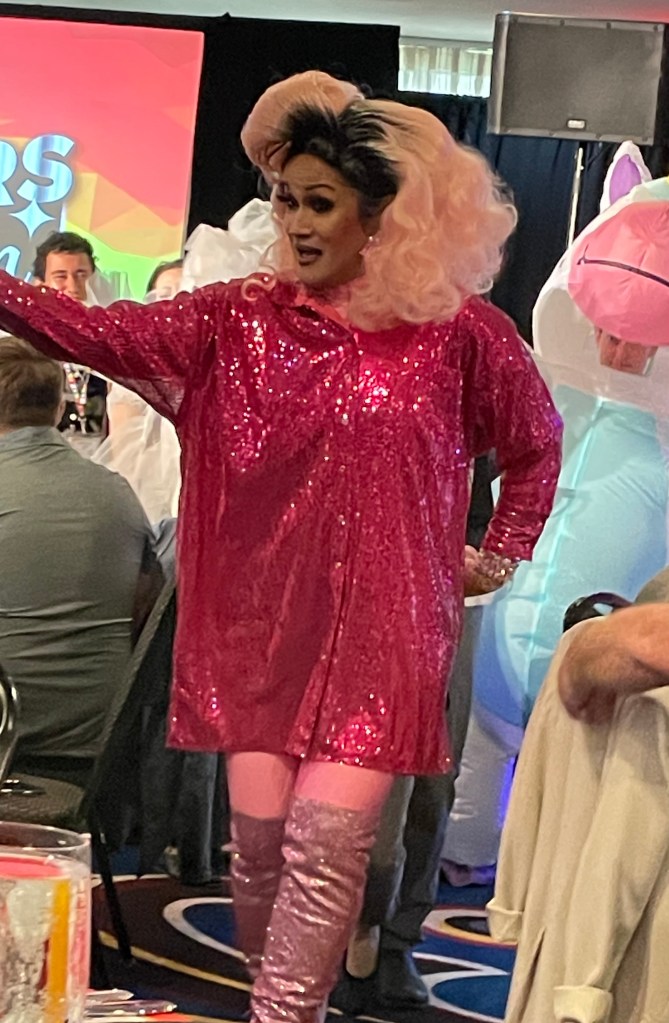
EMCEE FULLY IN COMMAND OF JOY

GSBA lays claim to being the nation’s largest LGBTQ+ chamber of commerce. Counting affiliates, there are more than 1,300 members. Given our national emotional chaos, I anticipated a crowd of fearful, angry people. Surprise! The emcee — a flamboyant and outrageously funny drag queen — set the tone. We were a crowd diverse in age, ethnicity and sundry other varieties, but uniformly joyful.

The program highlighted GSBA’s impressive record of handing out scholarships: $7 million during thirty-four years of operation. Of six hundred or so recipients, 49 percent lived with a disability, 51 percent had experienced housing insecurity, 45 percent are from rural areas, and 49 percent are first generation college students. Their graduation rate exceeds the national average.

It’s not just about the numbers. This year’s graduates lined up before us and told us their post-college plans. All of them will make impressive contributions. One of the grads was chosen to tell her story. Older than the average college student and a single mom with an autistic son, she was determined to be the first in her family to attend college. She said she repeatedly bumped into closed doors, “no” after “no,” until she found GBSA’s program and finally heard a “yes.” GBSA scholars not only receive financial assistance, but ongoing encouragement and emotional support. Armed with her bachelor’s degree, this mom is headed to graduate school and a career in public health policy. Sounds dry? Our country desperately needs intelligent, dedicated people setting health care policy. When she finished speaking, there may have been a few dry eyes in the room, but there were none at our table.

Only one GSBA leader briefly addressed the current political situation, not naming names but referring to “that little weasel.” Nonetheless, she said, “They can’t take our joy away.”

I was reminded of Jesus calling Herod “that fox.” In both cases, I think the critters were maligned. Weasels and foxes simply live as they were created to live. We humans manufacture our own brand of meanness and evil. 

We’re also responsible for nurturing our joy, which is not the same as happiness. Happiness comes and goes. Joy is a state of being.

I haven’t written in this space since the new administration took over. I’ve been too dumbstruck. Besides, there’s been a torrent of words: in print, online, over the air. More than enough analyses, assessments, judgments and predictions. One commentator’s observation stuck with me: “If you think you know what’s going to happen in the future, you’re wrong.” Absorbing what is happening in the present is agitating enough.

Last weekend I sat at a friend’s kitchen table while she put felt marker to butcher paper, fashioning a protest sign for a demonstration she would attend that afternoon. She wanted a pithy but meaningful statement. I don’t recall what she ended up with, but I finally have the six words that will help me navigate this challenging time: “They can’t take our joy away.”

Going the extra mile: Kindness drives a city bus

If I had to choose one word to describe Seattle’s Metro bus drivers, it would be “kind.” I could add other words: patient, professional, pleasant, helpful, knowledgeable. Recent events add the word “grieving.” Drivers and passengers alike are mourning last week’s fatal stabbing of a veteran driver. A homeless man has been charged with first-degree murder.

The tragedy felt personal to me and I’m sure to many Metro passengers. We trust and appreciate the drivers who skillfully navigate the clogged byways of densely populated King County. It’s common practice for passengers exiting the bus, even from the back door, to call out, “THANK YOU!”

When I read about the homicide, I immediately thought of the driver I’d ridden with just days before. I don’t know his name, and it’s unlikely I’ll ride with him again — he’s one of nearly 2,500 Metro drivers. He’d been exceptionally helpful, and I hated to think of him grieving, much less worrying about his own security.

King County Council member Peter von Reichbauer issued a statement asking, “If our bus drivers are not safe on Metro buses, then how can we convince our public that it is safe for them to ride?”

I’ve been riding buses for a year now after giving my car away. I’ve never felt endangered, insecure, or even uncomfortable. I know I’m safer climbing onto a bus than into a car. In the United States, the fatality rate for car occupants is twenty-three times higher than those for bus occupants.

The recent ride I mentioned was on a rainy, blustery day. A friend and I had tickets for a concert on the other side of town. We knew we’d have to transfer along the way, but the route schedule was confusing. When a No. 2 bus pulled up, I asked the driver about connecting with the No. 13. It became clear to him that I wasn’t understanding his directions. To save time he simply said, “Just get on.” 

This is where trust enters the picture.

The bus quickly fills with holiday shoppers, including a young family. As one child sleeps in his stroller, his slightly older brother wails about some perceived injustice that his parents can’t seem to resolve. His cries persist above the murmured conversations among passengers on the crowded bus.

We head up breathtakingly steep Queen Anne Avenue. Coming on board is an elderly woman — possibly around my age but with mobility issues. She has trouble navigating her walker across the lowered ramp. The driver gets out of his seat to guide her into place. The sleeping child’s stroller is repositioned to make room for her walker.

Upward we climb. At the next stop, the elderly woman slowly maneuvers her way off the bus. “Oh,” we hear her exclaim over the drumbeat of rain as the door begins to close. “This is the wrong stop!” 

The ramp is lowered again, the driver steers her back onto the bus. “I want you safe” he tells her. “If anything happens to you, it’s on me.” Further up the hill she disembarks, presumably at the correct stop. When we reach the hilltop, the driver sets the brake, stands up and motions to my companion and me to follow him off the bus. I can’t believe he even remembers us among the stream of passengers who’ve been boarding and exiting.

He shows us where to shelter from the rain while we wait for the No. 13. He’s back in his bus, preparing to drive onward when No. 13 pulls up next to him. Our driver once again exits No. 2, tells the No. 13 driver where we’re headed and shepherds us onto that bus. He shrugs off our exclamations of appreciation. My companion, who is always prepared for any occasion, hands him a large, carefully wrapped cookie. He accepts, possibly because he’s not inclined to argue with her. I sure hope cookie handouts aren’t contrary to Metro policy.

May we all be safe during this sacred season, and may we all be kind, just like city bus drivers.

Naming Names: A list you wouldn’t want to be on

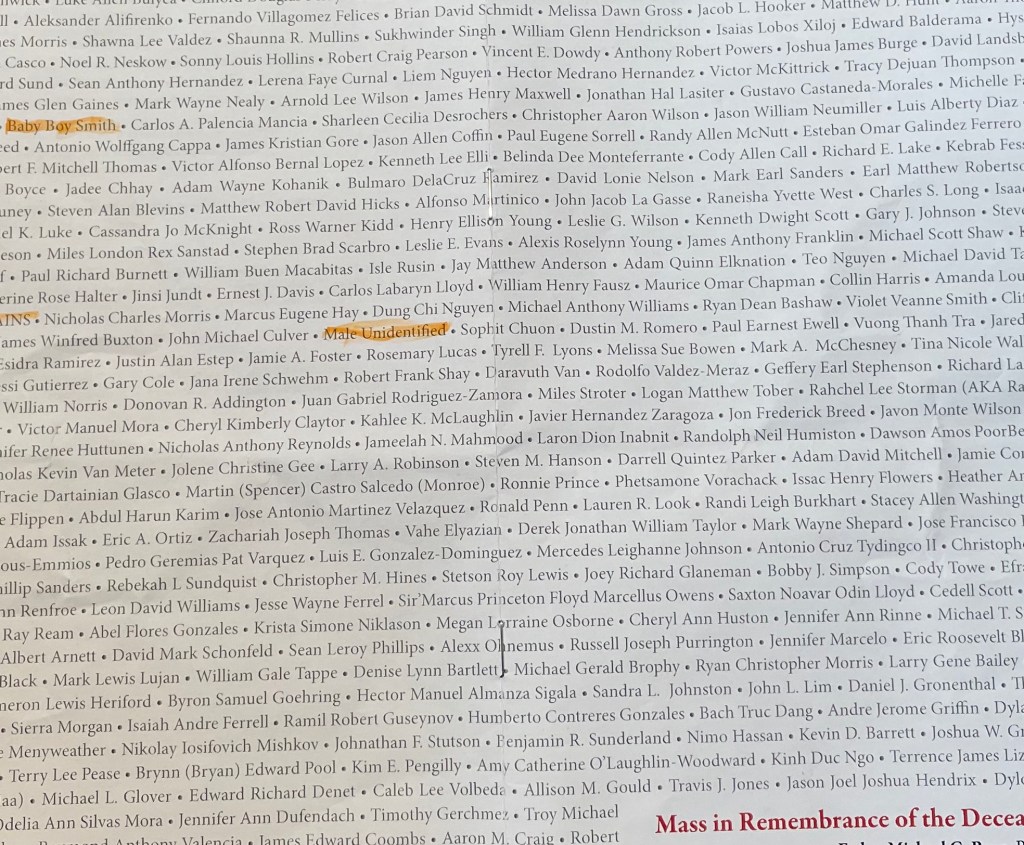
We stood in the cathedral courtyard, some hundred or more of us holding small lighted candles  that flickered in the November night. The bell above rang a solemn funeral toll. One by one the names were read of 410 homeless people who have died in Seattle over the past year.

“Clifford … David … William … Roberto … Fernando … Brian … Melissa … Matthew … Nabil … Shawna … Sukhwinder … Isaias … Edward … Hyshyn … Sirisopha …”

We were observing the annual “Mass in Remembrance of the Deceased Homeless of Seattle,” offered by St. James Cathedral. Inside the cathedral, we had sung, prayed, heard scripture and sermon, communed, and prayed some more. Finally the mournful tones of a bagpipe led us outside. We processed along the street and into the courtyard, where a sculpture of Madonna, cuddling the Child, presides.

“Santos … Noel … Sonny … Timothy … Thomas … Sean … Liem … Hector … Tracy … Jesse … Pedro … Mark … Arnold … Gustavo … Michelle … Nathan … Carlos … Sharleen …”

The rumble of planes overhead made us strain a bit to hear the names. Only a few hours earlier, I’d been aboard one of those planes, flying across the state after a brief visit to Spokane. Officials in Washington’s second largest city report a decline in homelessness, but that is of little comfort to the two thousand-or-so folks sleeping on or under cardboard while I nestled in my hotel bed.

“Martin … Isaac … Kathy … Gary … Tina … Logan … Martha … Phetsamone … Nimo …”

It’d been a gloriously clear day to fly. The fertile fields of eastern Washington spread quilt-like below. The Columbia River and its tributaries embroidered meandering designs in brilliant blue threads. 

“Wayne … Brad … Adam … Earl … Kim … Paul … Randy … Esteban … Steven … Matthew … Alexia … Cassandra … Ross … Henry … Leslie … Christopher … Katherine … Ernest …”

The Columbia River defines the southern border of Okanogan County, where I lived for forty-five years before returning to Seattle last year. I recalled the homeless individuals I’d met while volunteering at a shelter in Okanogan. Each was unique, their stories fascinating, more often than not carrying a common thread: the struggle to stay “clean and sober.” Homeless people died on the streets and under the bridges in the Okanogan Valley, too. There was no mass to honor their lives, but we spoke their names regretfully, in sorrow. What more could we’ve done?

“Vuong … Violet … Collin … Teo … James … Gary … Charles … Kebereseb … Mohammed … William … Patrick … Maria … Justin … Cheryl … Jennifer … Jameelah … Larry …”

The wail of a passing ambulance sounded as a counterpoint to the tolling bell. The reading of names had become a chant, a rhythm that matched my breathing. A dozen names, a dozen breaths, each minute. I list only first names here but full names were intoned, including middle names, if known. A few of the names stopped my breath.

“Baby Boy Smith … Baby Boy Green … Unidentified Remains … Male Unidentified …”

I focussed on the Madonna sculpture, pondering the miracle of birth that she represents. At birth, all of us were “created equal.” That’s what our nation’s founders proclaimed. With hands over heart, we pledge that we are a nation with “liberty and justice for all.” Both statements are more aspirational than reality. The signs of inequality, beginning from birth, are all around us, when we care to look. 

“Ivan … Anthony … Jason … Travis … Jennifer … Terry … Cynthia … Sean … Sompheth … Doreen … Krista … Eric … Faisal … Randolph … Sandra …”

Our candles burned to nubbins, then sputtered out. Still the names continued. I recalled the verse from John’s Gospel: “The light shines in the darkness, and the darkness cannot overcome it.”

“Olivia … Michael … Charles … Shannon.” At last we’d heard all 408 names and two Unknowns. The bell stopped tolling; the bagpipe played “Taps.” A reception followed, but I couldn’t do that. I walked home in silence, oblivious to the noise of city traffic. As a student, I strived to be on the honor roll, the dean’s list. My name likely won’t appear on this list of homelessness. I’m grateful, humbled. For this list, the roll has been “called up yonder.” These too are names, people, lives to be honored.

A 50-50 Split? Hey! It’s Only Fair

Every once in a while a random thought presents itself: Why do I have it so good? The thought occurs not when I’m in church or at times like Thanksgiving, but on more mundane occasions, like this morning. It’s rainy, chilly outside. I’m dry and warm in my small, snug apartment as I contemplate my refrigerator and its variety of breakfast options. I consider not only what I feel like eating but what will fit nutritionally with my lunch and dinner plans. I happen to know where my next meal is coming from, and the next, and the next.

Who gets to live this sumptuously? Most of the people I know — family, friends, neighbors, probably you, dear reader. In fact, most Americans. So why are so many of us so angry — especially when we consider the plight of innocents around the globe. Or do we consider them?

I can’t ignore the plight of those who do not share my abundant lifestyle. They’re huddled on sidewalks not far from my building. Worldwide, the gap between “haves” and “have nots” is so deep and broad it seems unbridgeable. How can the average American shopping for groceries complain about prices for an abundance and variety of food my Depression era grandparents could never imagine?

Especially in this election season, this time when we’re offered choices, I’m mystified by the depth of cynicism and resentment among those of us who are free and economically secure. 

How can citizens sneer that only scoundrels, egomaniacs, and incompetents run for public office? I look at my ballot, especially further down, and marvel at local, well-qualified candidates in both parties. How incredible that they’re willing to go to work for me, willing to put in long hours for pay that doesn’t come close to what they could get in the private sector.

I ponder the ballot measures that would tax me and others. I see not financial burden but opportunity to join my neighbors building better infrastructure, schools, social programs. Or, I may see an inadequate proposal, a boondoggle. I have the freedom to say no. 

Is it — as the late, great journalist Molly Ivins described — that for many people, “too much is not enough?” Are we so brainwashed by our materialistic culture, by commercials that declare we “deserve” more and better, that we feel cheated?

Many people are anxious, even fearful, as election day draws near. My own retirement community issued a memo discounting the likelihood of civil disturbance. But just in case, be prepared to … etc., etc. 

One religious leader noted that no matter the election results, half the population will be celebrating and the other half distressed. If we really are as equally divided as polls suggest, I challenge the word pundits use: “polarization.” I think back to my childhood when a 50-50 split had a different meaning. It represented fairness. We shared fairly. One cookie, two kids. One kid would break the cookie as evenly as possible, giving the other kid first choice. 

I’m not naive. I recognize the stakes in this election are higher than ever in my lifetime. The cookie we’re splitting is giant. Yet no matter on which side my — and your — vote lands, we’ll still have a share. May we savor our share of the cookie, protect its deliciousness, allow its sweetness to energize us, and not begrudge others their share. 

Cookie look good enough to eat? Sorry, it was “baked” by AI. Thanks to Ray Shrewsberry for serving it up on Pixabay