We Don’t Know What’s Ahead (thank God)

Surely one of the greatest gifts Creator bestowed on humanity is our short-sightedness. We can celebrate New Year’s Eve with abandon because we have no idea what’s just around the corner. 

I’m thinking back to Dec. 31, 2022, when I quietly observed the passing of the year in my cozy home on the river. If I’d foreseen that 2023 would include the deaths of three of my dearest friends and that by the next New Year’s Eve I’d be living on the thirteenth floor of a Seattle high-rise — I believe I’d have gone to bed, pulled the covers over my head, and never come out again. 

When I do know of coming events, they tend to loom rather than promise. I’m pessimistic when I needn’t be. Example: plans for my massive, three-day moving sale filled me with dread. It turned out to be one of the best, most fun parties I’ve ever hosted.

I look back on this year of tumult — globally and in my personal life — with both mourning and gratitude. I mourn the loss of life and separation from friends. I’m grateful for the love that has supported and sustained me, and the Divine Love that persists in sustaining us all.

Overview of Omak, WA, a slice of the Okanogan Valley and Tiffany Mountains in the distance

In November, I expressed my gratitude in a letter meant for publication in the newspaper that my husband and I long ago owned. For unknown reasons, my words never made it into print. I’ve been assured the letter will be published in the next edition. Just in case, though, and because not everyone subscribes to that (or sad to say, any) newspaper, I decided to share it here. It’s a love letter, a fond farewell to an exquisite valley that stretches across an international boundary, a valley bordered by vital shrubsteppes that climb to forested mountains, a valley thinly populated with generous, kindly people:

“When I recently moved from the Okanogan Valley to Seattle, I left behind something important: a large part of my heart. For more than forty-four years I have been nurtured and inspired by the beauty of the Okanogan landscape and the vibrancy of her people. 

“It is a joy and honor to be part of a community that is so committed and supportive. This was especially true during the fourteen years after a devastating stroke paralyzed my late husband, former Chronicle publisher John E. Andrist. That same level of care and support prevailed as I prepared to move. Friends, family and neighbors generously stepped up to help with the many challenges. 

“I’d love to name names, but I fear leaving someone out. I especially thank members of various groups: Okanogan Valley Orchestra and Chorus (OVOC), St. Anne’s Episcopal Church, the NonViolent Communication practice group (LOLO – Language Of Life in the Okanogan), and a particular circle of women who joyfully share their creativity and love of beauty. 

“The part of my heart that I’ve managed to hang onto is deeply grateful.”

As we move into a new year, many prognosticators are planting seeds of fear and foreboding. I would remind us of Casey Stengel’s wisdom: “Never make predictions, especially about the future.” Blissfully ignorant, may we lurch onward.

Uneasily At Ease

A question frequently asked by we who are s-aging is: “How (*insert) did I get here?”

(*Insert whatever exclamatory phrase you prefer, e.g., “How in the world …” or, “How on earth …” or, “How the hell,” etc.)

The “here,” when that question floated into my head, was the lobby of the retirement community that I’d moved into a few weeks earlier. The lobby is nicely furnished, not ornate but more like a mid-priced boutique hotel. On that particular day, the start of the holiday season, it was buzzing with activity and people. The automatic glass doors would barely whoosh shut before they’d glide open again, admitting a constant flow of family delegations coming either to visit or whisk away “Granny,” or “Gramps,” or in my case, “Auntie.”

It’s a significant part of family celebrations — thoughtful inclusion of the oldest generation. Often it requires extra effort, like going out of one’s way to provide transportation, figuring out how to cram a walker or wheelchair into the car trunk, altering the dinner menu in consideration of special diets, arranging chairs and tables just so. I’d done it all many times and loved doing it. 

“What we have once enjoyed we can never lose,” suggests Helen Keller. “All that we love deeply becomes a part of us.”

I believe she was talking about nostalgia, which was striking a resounding chord as I sat waiting in the lobby, feeling out of place. How (*) did I get there? I would no longer be providing for the senior generation. I’m now part of it. My niece and grand-niece would be picking me up, their car loaded with desserts and salads that I had no part in preparing. Arriving at the celebration, I would eye the kitchen filled with busy folks, leave them to it and sit, casually conversing with other elders. Uneasily at ease.

If “My Generation” is uneasy with old age, we have only ourselves to blame. We’ve been in denial since the turbulent ‘60s, when The Who released their signature song. Peter Townshend, who penned the line, “Hope I die before I get old,” is now 78. Roger Daltrey, who — as one critic wrote, “sneeringly” sang it — is 79. 

“Don’t trust anyone over 30.” Jack Weinberg, whose comment went viral before there was such a thing as viral, is now 83. Weinberg has devoted his life to social and environmental activism. In an interview he observed, “I’ve done some things in my life I think are very important, and my one sentence in history turns out to be something I said off the top of my head which became completely distorted and misunderstood. But I’ve become more accepting of fate as I get older.”

The wisdom of age: to more become accepting. Even to welcome, as in the classic Welcoming Prayer, written by contemplative Mary Mrozowski: “I welcome everything that comes to me in this moment because I know it is for my healing.”

Thus I welcomed the opportunity at the end of Thanksgiving dinner to roll up my sleeves and sink my hands into hot, soapy dishwater — no longer feeling out of place, because when it’s time to clean up, there’s ample room in the kitchen for helpers of all ages.

Letting Go

One reason for moving from my house to a studio apartment is to simplify life: live with less. But living on the light side is counter-cultural if not downright unpatriotic. After all, the “Consumer Confidence Index” — meaning our willingness to buy — is vital to the nation’s economic well-being. We Americans cooperate. We’re apparently more eager to buy than to vote.

The late comedian George Carlin, in a now-classic standup routine, summarized Americans’ obsession with acquisition in one word: “stuff.” The “whole meaning of life,” Carlin claims in oft-viewed videos, is “finding a place for your stuff.” That may be true until you reach a certain age. Then the meaning of life revolves around letting go of your stuff.

It’s painful, but it can be profitable. If you hold a yard or garage sale, you’re part of a grassroots market that puts an estimated $1.5 to $2 billion into American pockets annually. That’s a guesstimate by encyclopedia.com. The 6.5 to 9 million garage/yard sales held throughout the year are largely unofficial, unreported — and untaxed.

You can always let stuff go without letting go, but it’ll cost. Some ten percent of Americans pay an average upwards of $100 monthly to hang on to whatever. The booming storage rental industry makes $38 billion a year, including $65 million from auctioning off contents of units when renters forget to pay the rent, run out of money, no longer care, die, or whatever. 

If you try to salve your letting-go wounds by recycling, sorry, but it may not be all that effective. A  recent study, “America’s Broken Recycling System,” concludes that less than a third of the items left at recycling centers actually do get recycled or composted. Nonetheless, the recycling and/or landfill industry ballooned from $82 billion in 2021 to $91 billion last year. (Those figures are national and do not reflect the efficiency of local recycling efforts.)

I opted for a three-day moving sale, held on a sunny weekend, made entirely possible by volunteer workers from the Okanogan Valley Orchestra and Chorus, which got half the proceeds. Thanks to them, it was a heap of fun. In a rural community where everybody knows everybody, shoppers learned even more about me — A to Z — from my taste in Art to Zippered storage bags. I celebrated with grinning shoppers who strolled out with a new-to-them treasure that I had long treasured. “What a steal,” they were thinking. “For both of us,” I was thinking.

Alternative D — donating — satisfies the soul, especially if it’s really good stuff. I dreaded the thought of selling my car online, so I donated it to public radio. They’ll pick up your car at your door and give you a tax write-off.

I like to believe that I have winnowed my possessions so I no longer have mere “stuff,” but a higher class of items: “things.” It required only a pickup truck pulling a twelve-foot trailer to haul my “things” to my new apartment in Seattle. Carefully labeled boxes are stacked in a corner, leaving just enough space for bed and chairs. Uh, but I sold those.

Right. Gotta go shopping.

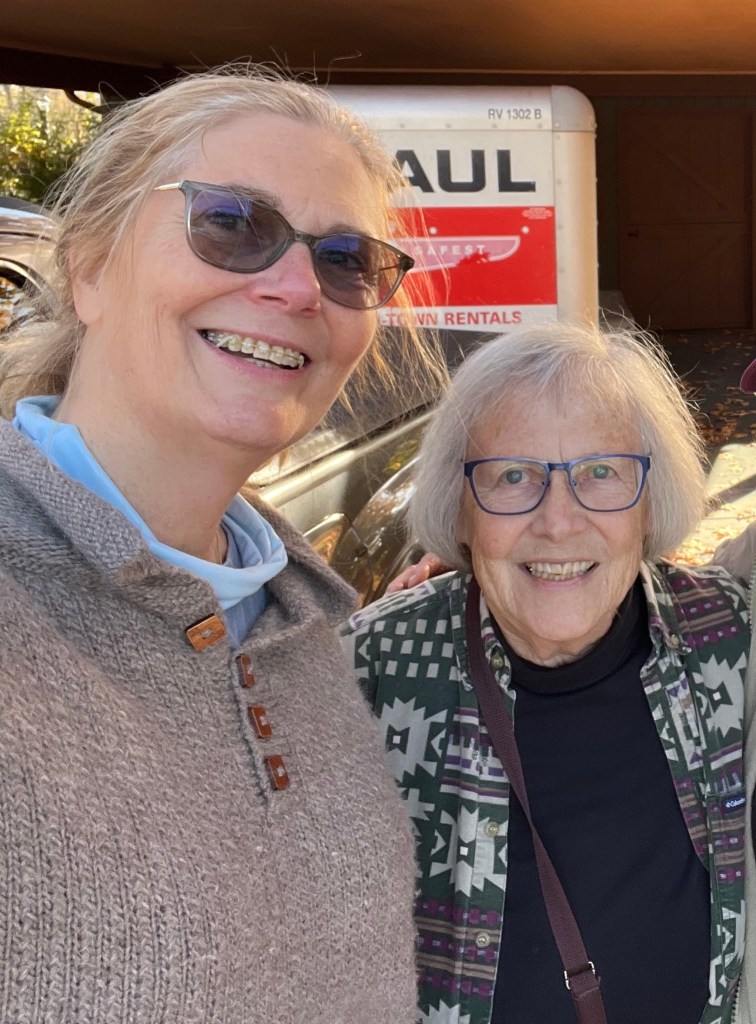
Moving day: All it takes is a rental trailer and ace truck driver, my niece Sandy

NEIGHBORS ARE THE FOLKS WHO SHOW UP – Even For False Alarms

Floating the Okanogan River on a hot summer day. What could possibly go wrong?

You know you live in a safe neighborhood when your car alarm goes off and your neighbors come running, fully armed — with cell phones, all Googling variations of “shut off car alarm.”

It’d been a quiet afternoon in my relatively crime-free neighborhood. I’d gone out to the carport, key in hand, and was about five feet from the driver’s door when the car threw a hissy-fit. Locking itself down tight, it refused to acknowledge any commands I entered on the keypad, ignored all the neighbors’ Google-advised maneuvers, and trumpeted an ear-splitting tirade. 

Every once in a while, the car would wear itself out, like a child throwing a temper tantrum who finally has to stop and gasp for breath. My neighborhood consortium would consult in whispers. Then someone would try to turn a key or open a door, and BLA-A-A-T!, the horn would start again.

Google provided the final diagnosis: my car was “brain” dead, in a self-imposed coma. The solution was like rebooting your computer. Simply disconnect, then reconnect, the battery. 

Google this: who were the nincompoop engineers who designed my Dodge Journey so that you have to remove the front left tire just to get to the battery? Ultimately my mechanic graciously made a house call, removed tire and battery, recharged the latter, put it all together again, and peace reigned in my neighborhood.

Until last week. 

People floating, swimming, and wading in the river that runs past my house are a common sight on these hot days. But it was nearly 9 p.m. with only remnants of daylight left when I spotted three youngsters in the river. In most places at this time of year, the water is shallow enough so that people who can’t swim “ride” the current. Their toes briefly bounce off the bottom, the current pulls them for a few yards, and then they bounce again. Bounce. Float. Bounce. Float. The children had already bounced/floated past my house when I spotted them.

This lazy, shallow river is deceptive. It has an insistent current and an inconsistent bottom. You can happily wade in the shallows and suddenly you’re in over your head. People drown in this river.

The youngsters (about twelve, ten, and eight years old, I’m guessing) had no flotation devices and no adults in view.  The current was carrying them into the river bend, where the water would be too deep for the youngest especially. I grabbed my car keys and ran outside. My neighbors were buttoning up their evening’s yard work.

“I’m worried about some kids in the river!” I called. As I pulled out of my carport, a neighbor jumped into the passenger seat. I drove the one block to a spot where we’d be able to access the dike. The neighbor reached into his pocket.

“I’ll leave my phone here,” he said, certain that he’d be getting wet. I held onto my phone, ready to dial 9-1-1. We ran to the top of the dike and spotted the kids. In the mere minute it’d taken us to get there, they’d somehow made it across the current into shallow water on the other side. The eldest was holding her hands aloft in a triumphant gesture. From there they’d be able to clamber up the bank and, I hoped, head home.

I apologized to my neighbor for yet again issuing a false alarm. He shook his head. He’s an experienced fisherman who grew up along this river. “These currents can be tricky,” he said.

A long time ago a wise man was asked, “Who is my neighbor?” Two thousand years later, whether you’re a Bible reader or not, you understand the meaning of “good Samaritans.” They still exist, they show up, and more than likely, they carry a cell phone.

Miles To Go

I just bought four new “premium” all-weather tires, on sale, guaranteed for 80,000 miles. Seemed like a good idea at the time. Back home, breathing fresh air instead of brain-stifling tire store fumes, I did the numbers. I’m about to celebrate my seventy-ninth birthday. I drive a fourteen-year-old car with 111,000 miles on the odometer. I calculate I’ll be eighty-nine or older before I need new tires again — assuming my car and I are both still functioning — a lot to assume. Not to mention, electric vehicles will probably own the road by then.

But this is not a question of life expectancy, either mine or the car’s. The National Institutes of Health says that only twenty-two percent of women over age eighty-five are still driving. (Fifty-five percent of men — let’s just set aside the obvious conclusion that women come to their senses sooner than men.) Drivers over age sixty-five are three times more likely to get into an accident than middle-age drivers per mile driven, and — take a breath — three times more likely to die from a car crash. We older folks are simply more vulnerable.

Exiting the driver’s seat is, for a lot of folks, as traumatic as death itself. My dad, a Lutheran pastor, was one of the most patient, kind, good-humored, compassionate people ever to walk God’s green earth. Thus I gasped when he — well into his eighties — referred to a driver licensing examiner as “that Nazi!” Despite his several physical infirmities, Dad waged an ongoing battle with the Department of Licensing to renew his license. I don’t know if it was Divine Intervention or just weariness on the part of DOL bureaucrats — they finally gave him a provisional license, allowing him to drive a prescribed route between home and church, nowhere else.

Mother, on the other hand, quit voluntarily. Well, kinda. It was after she totaled her car. She was driving home from visiting Dad’s grave one quiet morning when she blew a stop sign and crashed into another car in the intersection. No one was injured, but it was clearly her fault. For the next couple days, she followed her usual course when she had a Big Decision to make: she prayed, then wrote out a pro/con list. Finally, she called her grown children, confessed her sad story and sadder decision. The administrator of the retirement community where she lived thanked her effusively. He hated having to demand that a resident hand over their car keys. I eventually asked her if she missed driving. “All the time,” she sighed. 

Last week a friend told me she’d been diagnosed with dementia. “Of course, I quit driving immediately,” she added. We talked about her cherished pickup truck, which is more than a mere vehicle. The truck, itself older than most drivers on the road today, was her partner in decades of adventure. “I bet you wish you could be buried in it,” I said. She chuckled and agreed.

I have long promised myself that I’ll make the choice to quit driving well before some poor family member is tasked with wrestling the keys from my grip. My current license will expire on my seventy-ninth birthday. I have an appointment to get it renewed next week. Most drivers can do that online, but in this state, you have to show up in person if you’re over seventy.

Quoting Robert Frost, “I have miles to go before I sleep,” but probably not 80,000.

A Tale of Two Christmases

Yesterday (January 5) was Twelfth Night, in olden days recognized as the final day in the Christmas season. Ignored by most people now, Twelfth Night may have a ring of Shakespearean familiarity. It is the occasion for which his comedy of that name was meant to entertain.

I still cling to a Twelfth Night observation. Otherwise, it seems as if we catapult our way from Christmas to New Year’s, landing with a thud on January 2. The party is over. We’re befuddled by the new year’s reality, which feels an awful lot like the old year’s. 

Twelfth Night offers a more gentle landing, like reading a good book, coming to the end and closing the cover with a satisfied pat. It’s a lovely day for lighting candles one more time, listening to carols before tucking them away for another year, packing up decorations, and reflecting on lingering joy. I celebrated this year by lunching with two friends who described their Christmases.

“I boycotted Christmas,” announced Friend No. 1. So much for my gentle landing. She sounded both defiant and liberated. And really, if I’d had a December like  hers, I would’ve boycotted not only Christmas but the entire world. She had demands for year-end reports piling high on her desk when (a) both of the family’s two cars quit running, which maybe wasn’t that big a problem because (b) two family members were stuck at home with Covid, which was anxiety-producing because (c) this year’s especially heavy snow load has resulted in their home’s cracked ceiling.

Because they have offspring, my friend’s boycott was not total. There was a small tree and gifts. Otherwise, she advised extended family and friends that there’d be no packages or cards in the mail, no cookies in the oven.

And then there was Friend No. 2, who began by listing her Christmas dinner guests. They were a variety of ages, religious backgrounds, interests, etc., with one thing in common — they all would have been alone for Christmas dinner. (May I digress: there’s nothing wrong with peaceful solitude on Christmas if you enjoy it, and I do, but that’s another story.) 

Friend No. 2 admitted she was two hours behind schedule getting her guests seated at the table. The meal was delayed by numerous side dishes. I’m not talking about the mashed potatoes, vegetables, salads, etc. Her side dishes were plates of food she and her guests delivered to folks who couldn’t make it to her house for various reasons. I would have found the combination of guests in my home AND deliveries a hair-pulling logistical challenge. She  made it sound as if it’d been no more complicated than buttering toast. She adopted just the right tone of humility, telling us everyone proclaimed her meal delicious.

After our luncheon, I considered the many ways people celebrate Christmas, including — maybe especially — the self-proclaimed “boycotter.” Her day job involves helping people solve problems that are too often unsolvable. She’s overworked, underpaid, under-appreciated and above all, compassionate. Boycott Christmas? Nah, she observes Christmas — the REAL Christmas — every day of the year.

Roads Less Traveled By

Coyote Falls in the foreground, Enloe Dam in the background

My late husband John could recite from memory Robert Frost’s poem, “The Road Not Taken.” I too relish roads “less traveled by,” sometimes to my peril.

Just last week, I started off innocently enough. Destination: Coyote Falls on the Similkameen River, near the Canadian border, less than an hour’s drive from home. I planned to attend the traditional Native American salmon ceremony, when fish are invited to return to their spawning grounds. Tribes have been doing this for millennia, although these days the ceremony is pretty much symbolic with a soupçon of politics. Just above Coyote Falls, salmon are blocked from proceeding upriver by the defunct Enloe Dam. The dam hasn’t produced power in half-a-century. Indian tribes on both sides of the border and various environmental groups are campaigning to have it removed.

There’s a fine hiking trail on the other side of the river, but the ceremony was to be held on the road side. In my case the wrong road. The river flows through a deep canyon. High on the canyon wall, a two-lane, paved road snakes around multiple curves. I knew I’d have to turn onto a gravel road to reach the canyon bottom at some point, but I couldn’t remember where that turnoff was. I’d noticed a bright blue car in my rearview mirror and then, after one of the curves, that car had disappeared. By then I’d driven beyond the falls and dam and decided I must have missed the turn-off.

After a quick u-turn, I spotted a flash of blue making its way down a steep, winding gravel road. You don’t usually follow someone who’s behind you. That alone should have been a warning. Slowly, cautiously I proceeded downward, noting the “Primitive Road” warning sign that the county posts on back roads that are not maintained. This one should have had a skull and crossbones at the bottom.

By the time I realized I had no business on that road, it was too late. With barely a single lane, I clung to the canyon wall that brushed my car on the left, trying not to think about the sheer drop-off on my right. The ruts were troughs, littered with rocks and shards that threatened to high-center the car. Downward I crept in low gear, wishing I had a lower than low-low gear. I tried to calm myself by talking to John, pleading with his spirit to intervene, rescue me.

Finally, miraculously, halfway down the canyon, I reached a wide spot. The blue car had pulled off and parked, as did I. Thank you, John! I noticed the other driver, whom I didn’t know, had started walking downward and then stopped to wait for me. 

“I’m so sorry I took that road,” I said as I got out of my car. “Me, too,” he admitted. Turned out he was a tribal member from British Columbia. He asked where I was from. When I answered “Omak,” he asked, “You Colville?” Never before has anyone confused this blue-eyed blonde as Native. I was deeply flattered. I explained that I’ve lived for a long time along the Okanogan River, which is fed by the Similkameen. “I love the river and all its inhabitants,” I continued, as if I expected the cast of characters from “Wind in the Willows” to join us at any moment. 

Despite my lack of tribal bona fides, he treated me as the elder that I am, generously offering his arm to steady me as we scrambled downward. At this point, the road was pretty impassable even on foot. I gasped when we finally reached a large, flat area, where a dozen or more cars were parked.

“How did they get here?!” I exclaimed. That’s when we noticed the other road — the one MORE traveled by. We could have taken it had we gone up the canyon a little further.

I never did make it all the way down to the river but watched the ceremony from the bank above. The drum beat and chanting were inaudible above the roar of the falls. Still, I joined others in rhythmic clicking of rocks, calling to the salmon. Tribal biologists tell us that native fish returning to our river are pitifully few and far between. Eliminating the dam, one biologist said at a recent meeting, is “their only chance.”

I walked away from the river, wondering if my own chances of getting my car back up that road were equal to salmon butting heads against a concrete dam. But a combination of prayer, John’s encouragement, and front-wheel drive pulled me slowly, safely upward. Back on pavement, I was heading home when a coyote ran across the road ahead of me. I slowed and noticed that he stopped in the middle of an alfalfa field, turning back to watch me. In Native legend, the coyote is a trickster, a mischief-maker.

“Yeah, you thought you had me back there at Coyote Falls,” I said. “But all you did was teach me a lesson. From here on, I’ll be taking the roads more traveled by.”

You Know You’re Old When You’ve Outlived the Trees You Planted

The chainsaw massacre was about to begin when the normally docile young woman intervened. Later, she described the episode during our Zoom call. For years she and her roommate had been ideal tenants, quiet, tidy, paying their rent on time. But when she spotted the crew preparing to remove a stately tree in front of their house, she vehemently protested to her landlord. A conference with arborist, crew and others ensued. The tree survived. Neighbors quietly praised her intervention, admitting they’d been reluctant to get involved. 

“This was so unlike me,” she told her Zoom audience. The chat box filled with congratulatory notes and emoji applause. My emotions were mixed. Trees tend to live a long time and deservedly so, for all the benefits they offer. Yet just like us, trees have a life cycle, an inevitable end.

 I once was that young woman, what the cynical call a “tree hugger.” A love for trees is still deeply rooted in my heart. No pun there; a simple truth. I also know — even without seeing this particular  tree — that its reprieve is temporary. The USDA says urban trees tend to live only twenty-eight years at most — about twenty percent of a normal tree life span. Their congested environment makes them susceptible to pests, disease, inadequate care, inappropriate placement, improper planting, asphalt generated heat, etc., etc.

Living where I do, in a rural, desert-like shrub steppe environment, I’ve been a rabid defender of trees. While I was still editing the local newspaper, the city superintendent knew me well enough to call in advance whenever a tree had to be removed from the public domain. He’d explain the detection of disease and consequent threat to human health should the tree keel over on its own or topple in a windstorm. 

My town boasts a luxurious canopy of green, none of it native, and has been officially declared a “Tree City U.S.A.” by the Arbor Day Foundation. This small urban forest is a legacy of pioneer women, who a century or more ago planted the first deciduous trees, hauling water in buckets to nurture them in this arid country. More recently, volunteers tore up sidewalks to provide irrigation for trees along Main Street.

I’ve planted my share of trees over the years. I remember how eager I was the day we planted red maples in the front yard — anxious for them to grow and give luxurious shade. What I hadn’t figured on was that I’d be aging right along with those trees.

Once, my husband and I made an impulse buy in support of a newly established nursery. We brought home the tiny pine and scouted the yard for a place to plant it. While I looked around for available open space in the lawn, my wiser husband looked upward. He nixed my first choice because eventually the tree would get tangled in wires. Pines generally live at least fifty and often hundreds of years. This one gave us three beautiful decades before it became mortally diseased. 

Even as I mourned, I marveled at the skill of the sawyer who limb by limb denuded the tree and finally sawed off the naked trunk. He was, I hate to admit, graceful.

“I make it look easy, don’t I,” he boasted with a grin. I witnessed the deafening process as tree limbs and trunk were chopped into chips that would become mulch that would eventually fade back into Mother Earth. All is temporary, yet circular.

My diseased pine on his way back to Mother Earth

A question of location

“How did she end up there?!” (Read the word “there” with a tone of disbelief and possible disdain.) The question — more of an exclamation — was relayed to me by a friend. He was recounting a conversation he’d had with a long-ago mutual acquaintance who, when informed of my whereabouts after all these years, posed the very question I ask myself frequently.

The average American relocates about a dozen times over their life span. At some point do they, like me at age 77, wonder if this is the last stop. If so, how did I end up here (a tone of disbelief? disdain? delight?).

“Here” in my case is Omak, Washington, a gritty small town that wrestled itself into existence a little more than a century ago, smack-dab in the middle of a shrubsteppe valley — the Okanogan — where natives thrived for at least ten thousand years. Romance brought me here more than forty years ago — love for a man and our mutual love for small-town newspapers. My expectations were clear. We’d have fun running a newspaper until retirement, when we’d move to somewhere more, uh, civilized. Then karma happened, and here I am. Still.

The why-here question arises this gloomy morning with no glint of sun, with dingy snowbanks likely in place until June’s 100-plus temperatures, with memories of the many choices I’ve made in a lifetime. What about those roads not taken? Where else might I be now? Just then, an eagle soars past at eye level, scanning the river for fish, disrupting the ducks that have been quietly meditating just a few yards from my back door. 

The river is why I’m here. Not a raging, white-water river nor a large channel with ships and barges. Just a pleasant, hard-working stream, remnant of the Pleistocene-era glacial movement that shaped this valley’s cragged walls. The Okanogan River waters crops and wildlife, nurtures fish and fowl, and entertains folks who float aboard inflatable vessels on a hot summer’s day. 

The eagle having lifted my spirits upon her mighty wing span, I turn to breakfast — a few strips of beefsteak over toast. I eat meat only occasionally. These slices of steak originated from an animal raised on friends’ ranch, up-valley, where cattle really do live out their days beneath blue skies, never see a feedlot and are humanely butchered. The toast is artisan bread, baked locally, sold at the Okanogan Farm Stand, where I also buy local organic produce and eggs.

Still, I have an appetite for the world beyond. I open the Feb. 7, 2022, issue of “The New Yorker” magazine as I cut into my breakfast. And there, on page 28, in an essay by the esteemed John McPhee, I’m right back here, in the Okanogan. (Spoiler alert: I plan to give away McPhee’s punch line. If you want to read his version first, go here and scroll to “Citrus, Booze, and Ah Bing.”) An Easterner and aficionado of fruit (he wrote the book “Oranges” among many), McPhee and his wife were touring Washington state in 1982, hungering for cherries. He exults that “the Okanogan Valley is the Oxford and Cambridge of the Bing cherry.”

He describes crossing the North Cascade Mountains on famed Highway 20 with nary a comment about that breathtaking route. His description upon descending into the Okanogan: “Dessicated. Lovely. Irrigated green. Trees punctuated with deep-red dots.”

He didn’t stop at the newspaper office, which was just as well. We were probably busy and would’ve given the famous author short shrift unless he had local news to report. Turned out he did. He’d been given directions to an orchard owned and operated by “a knowledgeable married couple who will prefer to remain nameless.”

Too bad. In small-town newspapers, the rule is, “Names are news.” McPhee tells of arriving at the orchard, finding an abundance of cherries along with “shouting, angry shouting, more shouting, and the married owners appeared, on the apron of their barn, in a fistfight.”

Forty years later, the Okanogan cannot claim to be more civilized, but we are exotic enough to make it into the pages of “The New Yorker.” Could be, that’s why I’m here.

Winter ice turns the Okanogan River into a jigsaw puzzle

When Time Speeds Up

I’m tired of hearing the weary maxim that old age is not for the “faint-hearted” (attributed to Mae West) or “sissies” (Bette Davis). Could we of a certain age show a modicum of gratitude?

Most studies on aging set the boundary for being old at sixty-five. I know of no one who feels old at sixty-five. If they do, they probably felt old at thirty-five. But something — something — happens in our seventies. A friend, seven years older, alerted me on my seventieth birthday that major changes were ahead, and soon. 

That was just recently … No, wait! That was nearly eight years ago. Or, as long-distance swimmer Diana Nyad observes at age seventy-two: Time “actually speeds up as you get older. It speeds up exponentially every month, every day, every hour.” She was quoted in New Yorker magazine’s review of the podcast, “70 Over 70.” Reviewer Rachel Syme observed we might seek wisdom from the old but not always find it. “[W]e’re all works in progress,” she concluded, “up to the very last moment.”

That “very last moment” once was so far distant I couldn’t see it over the horizon. Now it’s visible, flying fast in my direction. Life expectancy is declining in the United States — by one-and-a-half years in 2020. The average life span fell from 78.8 to 77.3 years. Looking at it another way, if you’ve made it past age seventy-seven, you’re into the bonus years!

Also on that seventieth birthday I was given a book, “70 Things to Do When You Turn 70.” I haven’t had time to read it yet. Flipping through, I spotted an essay by a social justice activist, Sandy Warshaw. She wrote: “My seventies have been a time of self-realization and self-actualization built on the foundation of the three decades before.” 

For most of us bonus-year recipients, those “decades before” produced scar tissue — physical and emotional. We’ve been there, done that, don’t need to any longer. We’re free to let go of stuff, of attitudes, judgments, grudges and fears.

“When you age, you become wiser in so many ways,” said the late Coretta Scott King at age seventy-four. “You make adjustments for having less stamina, but you know in your mind what you can achieve.”

Living fully in the bonus years is not the same as retirement. Many retired folks think they’ve “earned” a particular lifestyle, so charmingly illustrated in AARP magazine ads. All that golfing; traveling; sunny climes; and electrically powered, multi-position recliners. Bonus years are not what we’ve earned but what we’re given as a matter of grace.

Years ago, my late husband was studying life expectancy charts. Given the difference in our ages, he predicted I would live another twenty-two years after he died. He lived to age seventy-five, “graduating” (as a friend refers to death) in 2007. You do the math, because I won’t bother. All I need to know is, I’m alive and feeling good today. With grace, tomorrow will bring the same.