
On Earth Day — of all days — public transportation, more specifically busses, had me bamboozled. This after two-and-a-half years of preaching about the wonderfulness of Seattle’s mass transit! How I’ve crowed about reducing my personal carbon footprint by not owning/driving a car.
My plan for the day was simple: pick up a couple sandwiches from a neighborhood deli for lunch with my sister, who lives a mere forty miles away. From the deli, I’d walk downhill seven blocks to catch the Sound Transit 594 Express, hop off in downtown Tacoma and board the Pierce Transit No. 45, which drives right past my sister’s house in Parkland.
You know the old Hebrew saying. “We plan; God laughs.”
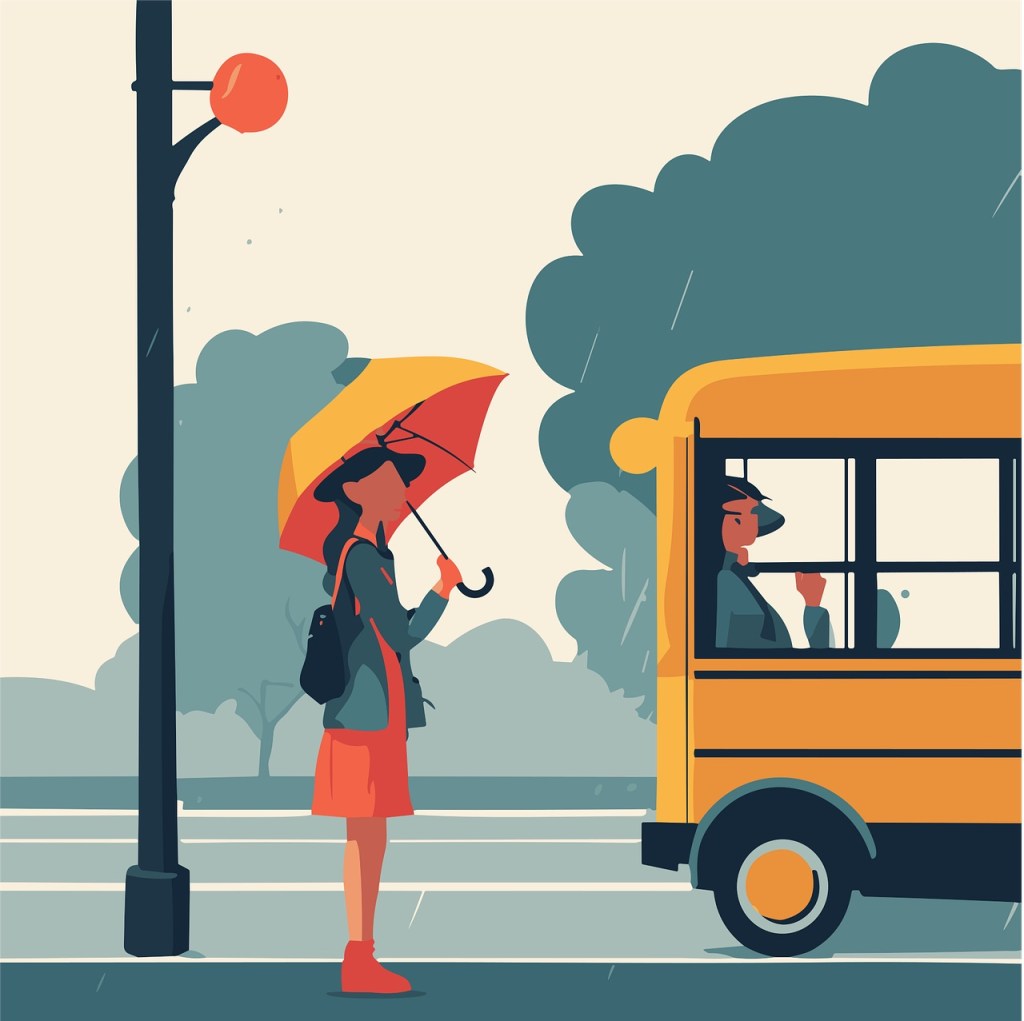
Undeterred by a steady rainfall, my umbrella and I arrived at the deli. The sandwiches I’d ordered online the day before weren’t ready. After a twenty-minute wait, I knew I’d missed the No. 594. I didn’t mind. It runs every thirty minutes, giving me an extra ten minutes to walk more carefully down the steep, rain-slicked sidewalk. By chance a neighbor was also waiting at the bus stop, though headed in a different direction. We agreed that we were fortunate not to be driving through rain and heavy traffic.
The 594 was a minute late, and I was a bit concerned. The wait time between the No. 594 and No. 45 to Parkland is tight. Still, the bus cruised along the express lane as I peered down at drivers — alone in their cars — making tedious if any progress. We arrived in Tacoma right on time. I hopped off the 594 but somehow got turned around, heading in the wrong direction for the 45. By the time I realized my error, the Parkland bus was long gone.
No matter. Our sandwiches could wait. This gave me a half-hour to explore a bit of downtown Tacoma. What impressive changes since the 1960s when I was a student there! Buildings refreshed and repurposed. A tiered fountain takes advantage of downtown’s steep hill, spilling cascades of clear water between Commerce and Pacific streets. Even on a rainy day, it was refreshing. What used to be just plain old 9th and Broadway is now the heart of the “Theater District.” Oh, my.
Next comes the insulting part. I got back to the bus stop in plenty of time and noted that the No. 42 was parked along the curb. I figured the 45 would pull up behind it. As time for the 45 arrived, the “No. 42” started its engine and began to pull away. I turned to watch the departing bus and realized it had morphed. The electric route sign had changed from “42” to “45.”
“Hey!” I yelled pointlessly while waving my umbrella. The bus headed up the hill without me. Exasperated, not to mention hungry, I pulled out my phone and punched the Lyft app. Dominic arrived in two minutes and got me directly to my sister’s house sooner than the No. 45 would’ve.
“How much did that cost?” my sister asked. I’d been pondering the same question. The Lyft fare was a pittance when I considered the monthly cost of maintaining, insuring, parking and fueling my own car.
After our lunch and visit, I left in plenty of time to catch the No. 45 at three o’clock. So early, in fact, I barely missed the bus that departed at 2:45. Oh, well. I hunkered down. The shelter protected me from rain but not wind. Sure enough a bus pulled in at 3 p.m. As I tried to board, the driver told me we wouldn’t be leaving until 3:15. I’d misread the schedule. Upon his return from the restroom, the driver kindly allowed me to wait inside the bus and announced, “Your trip is free ’cuz it’s Earth Day.”
I smiled, said thanks, and didn’t bother to tell him that ALL my bus rides are free. My retirement community, Horizon House, pays for my senior citizen Orca card, which covers all public transit in the region, including ferries and light rail. Every day is Earth Day.
The No. 45 got me back to catch the No. 594 with two minutes to spare. The return to Seattle was smooth sailing, but I was too exhausted to walk back up First Hill. I decided to take the G Line. It — of course — was pulling away as a red light kept me from crossing the street and boarding. Then, a miracle. Metro No. 2 pulled up. It would get me two blocks closer to home than the G Line.
Finally home, I pondered the day. I realized each missed bus gave me an opportunity: to walk more slowly, safely downhill; to chat with a neighbor I don’t see often enough; to explore a renovated downtown Tacoma; to admire the stuffed animals in Dominic’s Lyft car and learn he’ll be a first-time father “very soon.”
The 3:15 bus coincided with the end of the school day. What a scene! Teens tumbled onboard with adolescent bravado masking their self-awareness and uncertainty. A few blocks further, the driver lowered the ramp for a homeless man whose pull cart was piled high, presumably with all that he owned. His large dog made friends with a chihuahua riding in a kennel on wheels. A cyclist taking a shortcut efficiently loaded his bike on the rack in front of the bus and hopped on.
Public transit is people being with other people — different people — going and getting somewhere together. If I still had a car, I would’ve driven alone to my sister’s and back. Where’s the story in that?

 Every New Season
You must be logged in to post a comment.