Food for Thought: A Menu for Mother’s Day

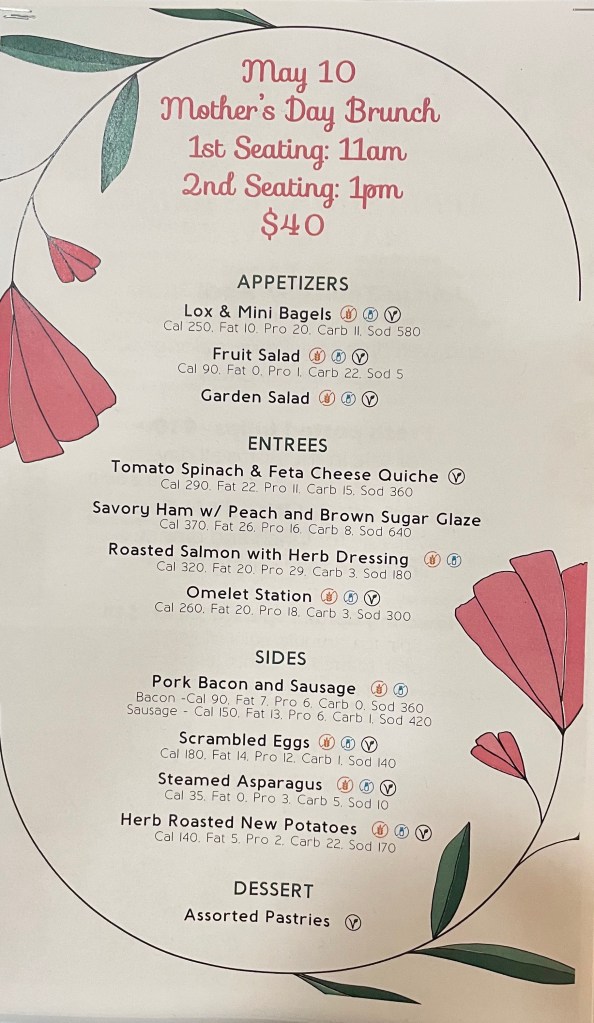
The retirement community where I live is offering the traditional lavish brunch on Mother’s Day. Not for me, thanks. I’ll honor the legacy of my mother, grandmother and mother-in-law with a menu reflecting their culinary specialty: left-overs.

All three — Elsie, Emma, and Edna Mae — had weathered the Great Depression. I was raised to believe that wasting food was the eighth Deadly Sin. Left-overs were a valued commodity. They stretched the food budget one meal further, maybe two. 

I recall my brother questioning our mother, Elsie: “How can we be having leftovers every night? Doesn’t there have to be a starter meal somewhere along the line?” Unfazed, Elsie would calculate not calories but monetary savings. She relished boasting, “This meal cost only sixteen cents per serving.” Obviously, that was in the 1950s.

Just as Grandma Emma had trained Elsie, I was taught the art and craft of repurposing victuals. Elsie, for example, would disguise Sunday’s meat-and-potatoes dinner as a Monday night casserole. I took it a step further with end-of-week Refrigerator Soup. That’s when bits and pieces of complementary leftovers find their way from the refrigerator into a simmering pot of stock (made from vegetable ends and peelings). It’s a “once-in-a-lifetime” recipe, because it’s unlikely I’ll ever again have the same mix of ingredients.

When my mother-in-law, Edna Mae, was living with my husband and me, I quickly learned Edna Mae’s frugality surpassed even Elsie’s. One evening I’d served a casserole of left-overs for the second time. After we’d eaten our fill, a tiny bit remained in the serving dish, barely more than a mouthful. When I scraped the leftover morsels into the garbage, Edna Mae loudly protested, “That’s WICKED!”

Food waste is only part of the wickedness that abounds in our nation these days. But it’s a compelling part. Once again, the U.S. is No. 1: Americans discard more food than any other country, nearly forty million tons — or 30 to 40 percent of the entire U.S. food supply. We throw out nearly as much as we consume. The tragic incongruity is that one in five children — that’s fourteen million kids — are malnourished. There are people facing “food insecurity” in every county of this nation. We all, no matter where we live, have hungry neighbors, some forty-eight million people.

I know many of you, dear readers, are already donating to or volunteering at food banks and soup kitchens. Thank God for you. I volunteer too, but it didn’t help clear my conscience as I scraped perfectly edible food into my compost bin one night.

It was to have been a special meal. I’d purchased a spaghetti squash from a farming friend’s vegetable stand and pondered what sauce to go with it. Fresh tomato? Mushroom? In my refrigerator was an exotic cheese from the supposedly gourmet section of the grocery store. A few slices of the cheese on crackers had been disappointing. It proved crumbly, dry, bland. But as I’d been taught to “rescue” food, I decided to make a cheese sauce to top the spaghetti squash. The cheese was even more dreadful in a sauce. It smothered the squash in blandness. No amount of seasoning could perk it up. 

As usual, I had enough left over for a second meal. I couldn’t face it. With “WICKED!” echoing in my head, I chose composting. I no longer have a garden. My compost materials — along with my neighbors’ — go to a commercial composting company. Even that industry is controversial, criticized for releasing greenhouse gases into the atmosphere and potentially polluting groundwater. 

Much of the solution to food and other kinds of waste begins with us, the consumers. If we ask ourselves with every purchase, “What’s going to happen with this product or package in the end?” we may reduce our own wasteful contributions.

There’s reason to hope. I found a company called Ambrosia that turns food waste into a household cleaner.  Elsie would’ve bought that, but only if it were on sale.

One night after the spaghetti squash disaster, I made fritters from left-over mashed potatoes mixed with chopped-up, left-over steamed vegetables and the remains of a stuffed portobello mushroom. Delicious! Even better, there were two fritters left over for breakfast the next day.

MAY DAY!

They’re preaching to the choir, I said to myself.The “preachers,” in this instance, were public  television travel guru Rick Steves plus a real life preacher, Steves’ wife, Lutheran Bishop Shelley Bryan Wee. They were sharing a podium — not the pulpit — at St. Mark’s Episcopal Cathedral in Seattle. Their presentation, “The Traveler and the Bishop” focussed on threats to American democracy and the rise of Christian Nationalism.

Some, perhaps many, church goers view such topics as political and inappropriate in a church. I empathize with their need for sanctuary, an escape from poisoned politics, stress, and disagreement. These are, noted Bishop Shelley (as she prefers to be called), “fraught times.”

If the war we’re waging against Iran upsets you because gas prices are soaring, that’s a political issue. When the commander in chief of the most powerful military in the world threatens to annihilate an entire nation, that’s no longer politics. That’s a threat to the very fiber of humanity. It’s a moral issue demanding nonpartisan, nonviolent discussion in churches, synagogues, temples and mosques.

“Across the United States there’s a crescendo of concern,” said Steves. “People are rising up and they’re asking, ‘What the hell is going on?’”

St. Mark’s, which seats well over a thousand, was packed. When an evening presentation was first announced — free, but reservations required — capacity quickly was reached. Steves and Bishop Shelley agreed to a second, afternoon presentation. When I arrived, a half-hour early, the “choir” was gathering. A line spanned the large stone labyrinth in front of the cathedral and half-way down the block.

I thought about the many times singing in a choir motivated and empowered me. Maybe preaching to the choir should not be discounted. Maybe it’s more impactful than the old cliche suggests.

Steves effectively summarized events of the past year-and-a-half, none of it news to this audience. Partway into his forty-minute speech he acknowledged he didn’t like using the “F” word, but . . . and then he paused, meaningfully. I steeled myself, anticipating the profane F-Bomb. But Steves had another “F” word in mind, even more profane: Fascism. 

He’s an authority. Seven years ago he produced a documentary, “The Story of Fascism in Europe.” It is frighteningly omniscient, showing events of the 1920s and 1930s that mirror what’s happening here and now. Steves also compiled what he calls “The Dictator’s Playbook: 20 Points Followed by Mussolini, Hitler…and Every Wannabe Fascist Authoritarian Since.” (Available on Facebook.)

No. 1 on Steves’ checklist is, “Establish a mythic past … and promise a national rebirth to the good old days.” MAGA, anyone? Another is to promise simple solutions to complex problems. DOGE, anyone? A vital component of special concern to me and fellow career journalists: control the information media. 

This choir member left the cathedral both energized and discomforted. It’s my lack of personal inconvenience that worries me. I’m troubled intellectually, emotionally, spiritually. But my day-to-day life is smooth sailing. I’m aware of higher prices in the grocery store, yet I’m not struggling to feed a family. Thousands of my fellow citizens cannot afford skyrocketing health insurance premiums with the loss of supplements. My Medicare Advantage plan is still affordable — while I’m healthy, at least. 

People are dying, in this country and across the globe. Some 600,000 deaths have been attributed to the end of USAID. 

Reader, please be patient while I offer another metaphor. Am I (along with so many like me) the proverbial frog who is dropped into a pot of cool water? The frog swims around as the water heats up — until it’s too late. Wikipedia offers some comfort, if you care about frogs. Experiments have determined that when the water gets hot, the frog jumps out. Are we as intelligent as frogs?

I’m posting this late on May 1. May Day is both a call for help and a traditional day for demanding workers’ rights. And here we are, inhumanely treating and deporting people who are an essential core of our working population. That’s reality, even if the frog metaphor isn’t. How close are we to the boiling point? Can we turn down the heat? Possibly — if the preachers keep preaching, and if we in the choir sing at the top of our lungs.

*   *   *

To watch the full April 26 event at St. Mark’s Cathedral click here. (Welcome and introductions  start at five minutes in, and Steves’ talk is eight minutes in. Bishop Shelley’s talk is one hour and ten minutes in.)