FINDING HOME: Wherever It Is

The stretch of Interstate 5 between Seattle and Tacoma is long familiar to me. The man-made landmarks have changed over the decades I’ve driven this route. But the Creator-made landmark, the mountain that we inappropriately call Rainier,* is constant, standing vigil over this vast and turbulent Puget Sound territory.

“You’re home,” The Mountain said to me as I drove a steady 60 mph (being steadily passed by fretful Puget Sounders). “I’m home,” I murmured, startled. Instantly the next thought landed: “Did I just dream the past forty-four years of my life?” Did I out-Ripple Van Winkle? Was I picked up by some tornado and set down in a land of Oz, aka the Okanogan Valley? Did I just spend more than half my life in a place that doesn’t really exist? For surely, the Okanogan — its land and its people — are too good to be true.

The state of Washington is really two states. Of mind. Some people call the massive north-south mountain range that divides the state the “Cascade Curtain,” recalling the infamous Red Curtain of the Cold War. Western Washington is perceived as urban, densely populated, gridlocked and expensive. East is rural, agricultural, with wide-open spaces that are getting expensive. West is the “wet” side, East dry.

In my thirties, during a stint as Washington state editor for the Associated Press, I learned to love the state’s diversity of people, landscape, culture, and ecology. It felt — and still feels — like this rich state has something for everyone.

Still, I was content on the west side until, at age thirty-five, I got swept eastward by a tornado named John E. Andrist and dropped into the Okanogan. It’s a land shaped by glaciers and a people shaped by the land. Rugged. Solid. Nurturing. Bountiful. Beautiful. The next fourteen years I lived my dream, sharing the fun and frustration of publishing the best doggone weekly community newspaper we could. The dream was rudely interrupted by John’s stroke and another fourteen years devoted to the frustration and fulfillment of caregiving.

If I’d follow the every-fourteen-year pattern, I would’ve moved two years ago. I couldn’t pull myself from my cozy home by the Okanogan River. I couldn’t pull away from the land nor — most of all — from the people who are so deeply rooted in that land. 

Somehow, a few weeks ago, I yanked myself away. Now I’m sitting in a thirteenth floor apartment on Seattle’s First Hill, gazing at the city skyline and mostly at the sky. I’m no longer soaking up the river’s flowing energy, but I’m energized by the equally constant flow of clouds, birds, planes. Every once in a while my gaze is distracted by the stream of tiny vehicles and pedestrians below.

My computer isn’t convinced that this is our new reality. No matter how many times I update the settings, it insists on alerting me to weather in the Okanogan. Please, all of you who are technologically more adept than I, do NOT by any means send instructions on how to “correct” the computer. There’s that saying: home is where the heart is. The reverse is also true: my heart is where my home is. The computer reminds me that my heart still beats to the rhythm of the Okanogan, and it always will.


*Indigenous people had perfectly lovely names for Washington state’s signature mountain before the Europeans arrived. One was pronounced something like “Taquoma” and meant “mother of all waters.” The name “Rainier” stuck after Captain George Vancouver named it for his buddy, an admiral in the British Navy who never saw the  mountain and fought against Americans in the Revolutionary War. Efforts to rename the mountain haven’t gained much traction, but the name change of Alaska’s Mount McKinley to Mount Denali in 2015 may signal a change of attitudes.

Letting Go

One reason for moving from my house to a studio apartment is to simplify life: live with less. But living on the light side is counter-cultural if not downright unpatriotic. After all, the “Consumer Confidence Index” — meaning our willingness to buy — is vital to the nation’s economic well-being. We Americans cooperate. We’re apparently more eager to buy than to vote.

The late comedian George Carlin, in a now-classic standup routine, summarized Americans’ obsession with acquisition in one word: “stuff.” The “whole meaning of life,” Carlin claims in oft-viewed videos, is “finding a place for your stuff.” That may be true until you reach a certain age. Then the meaning of life revolves around letting go of your stuff.

It’s painful, but it can be profitable. If you hold a yard or garage sale, you’re part of a grassroots market that puts an estimated $1.5 to $2 billion into American pockets annually. That’s a guesstimate by encyclopedia.com. The 6.5 to 9 million garage/yard sales held throughout the year are largely unofficial, unreported — and untaxed.

You can always let stuff go without letting go, but it’ll cost. Some ten percent of Americans pay an average upwards of $100 monthly to hang on to whatever. The booming storage rental industry makes $38 billion a year, including $65 million from auctioning off contents of units when renters forget to pay the rent, run out of money, no longer care, die, or whatever. 

If you try to salve your letting-go wounds by recycling, sorry, but it may not be all that effective. A  recent study, “America’s Broken Recycling System,” concludes that less than a third of the items left at recycling centers actually do get recycled or composted. Nonetheless, the recycling and/or landfill industry ballooned from $82 billion in 2021 to $91 billion last year. (Those figures are national and do not reflect the efficiency of local recycling efforts.)

I opted for a three-day moving sale, held on a sunny weekend, made entirely possible by volunteer workers from the Okanogan Valley Orchestra and Chorus, which got half the proceeds. Thanks to them, it was a heap of fun. In a rural community where everybody knows everybody, shoppers learned even more about me — A to Z — from my taste in Art to Zippered storage bags. I celebrated with grinning shoppers who strolled out with a new-to-them treasure that I had long treasured. “What a steal,” they were thinking. “For both of us,” I was thinking.

Alternative D — donating — satisfies the soul, especially if it’s really good stuff. I dreaded the thought of selling my car online, so I donated it to public radio. They’ll pick up your car at your door and give you a tax write-off.

I like to believe that I have winnowed my possessions so I no longer have mere “stuff,” but a higher class of items: “things.” It required only a pickup truck pulling a twelve-foot trailer to haul my “things” to my new apartment in Seattle. Carefully labeled boxes are stacked in a corner, leaving just enough space for bed and chairs. Uh, but I sold those.

Right. Gotta go shopping.

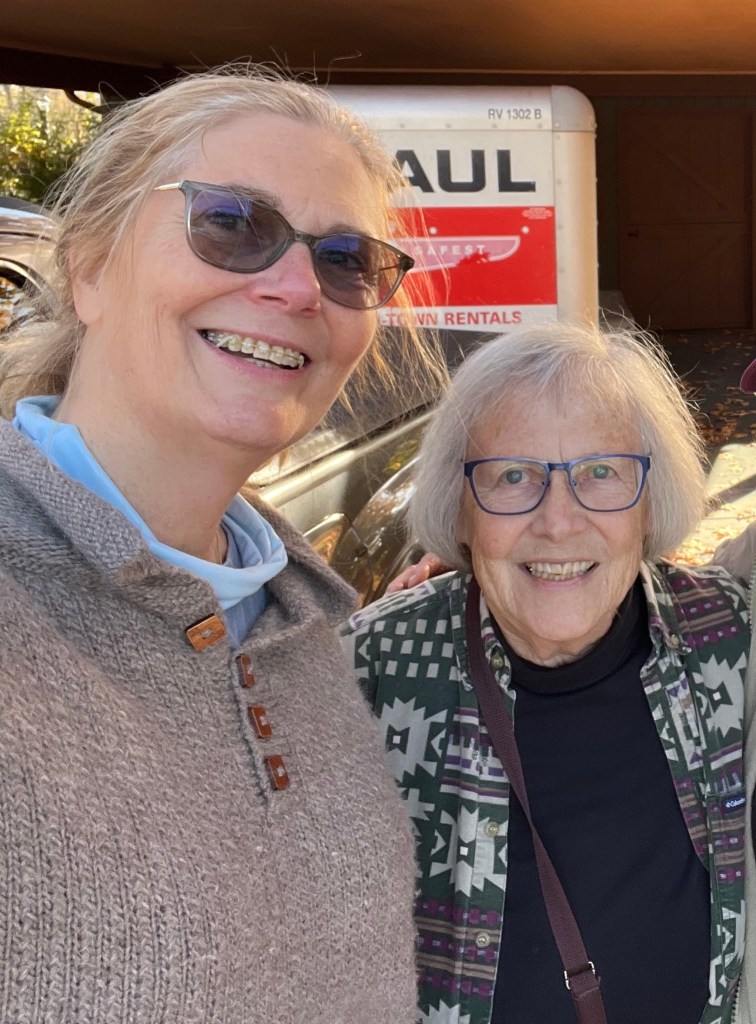
Moving day: All it takes is a rental trailer and ace truck driver, my niece Sandy

Heart Medicine

Six p.m. Time to feed the dog. Except that the dog’s absence is the loudest presence in my silent house. Giving up my canine companion is one of the sadder parts of moving from my small-town, riverside house to a thirteenth floor studio apartment in downtown Seattle.

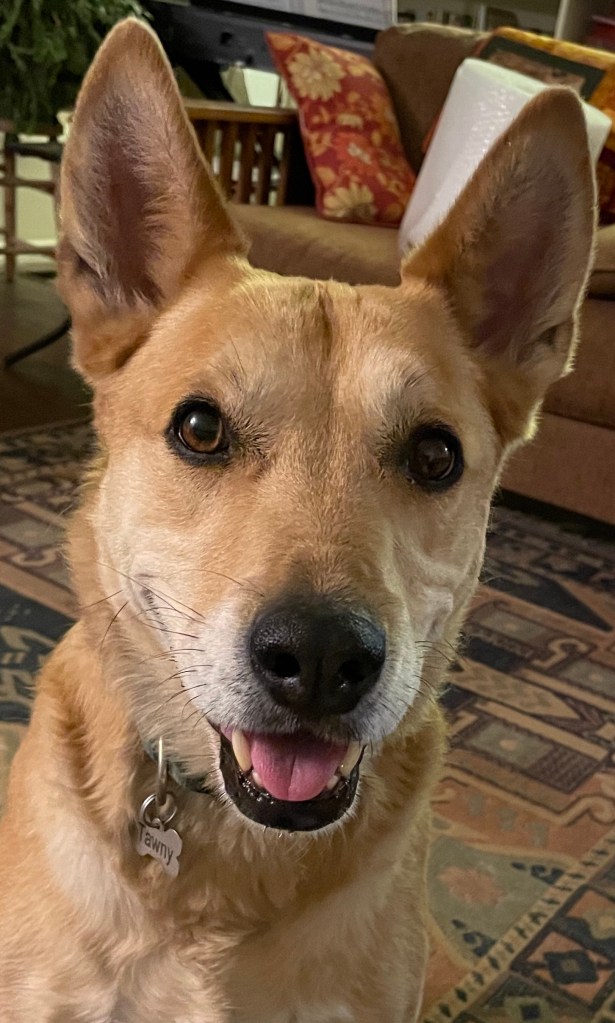
Tawny arrived at my front door in the arms of a friend eight years ago. She’d found him abandoned in the park across the river from my home. I named him for his tawny color, a mix of gold and amber. He’s also a mix of whatever breeds you want to assign him. 

I should’ve named him Coyote after the mythical coyote trickster of Native American lore. Tawny would play his little tricks, like tearing around the house with an illicitly acquired shoe in his mouth. At my command he’d drop the shoe, perk up his big ears, and give me a wide-mouthed grin as if to say, “Wasn’t that fun?!” The dog trainer said he had an “attitude,” but that’s a lousy name for a dog.

I’d always thought I’d stay in this house at least through the end of Tawny’s life — surely another five years, or more. Recently, it became increasingly clear that the time to move was now. I made the decision sooner and more quickly than I ever imagined. With that decision came the certainty (the hope?) that there would be a good new home for Tawny.

As weeks went by, my certainty wavered. Friends repeatedly sighed,  “We’d love to take him, but …” My ear-worm kept repeating that beautiful Bernstein/Sondheim song from “West Side Story:” Someday, somewhere … there’s a place for us. 

Somehow, somewhere, there’d be a place for Tawny. I envisioned plenty of space for him to run around — within a sturdy fence.

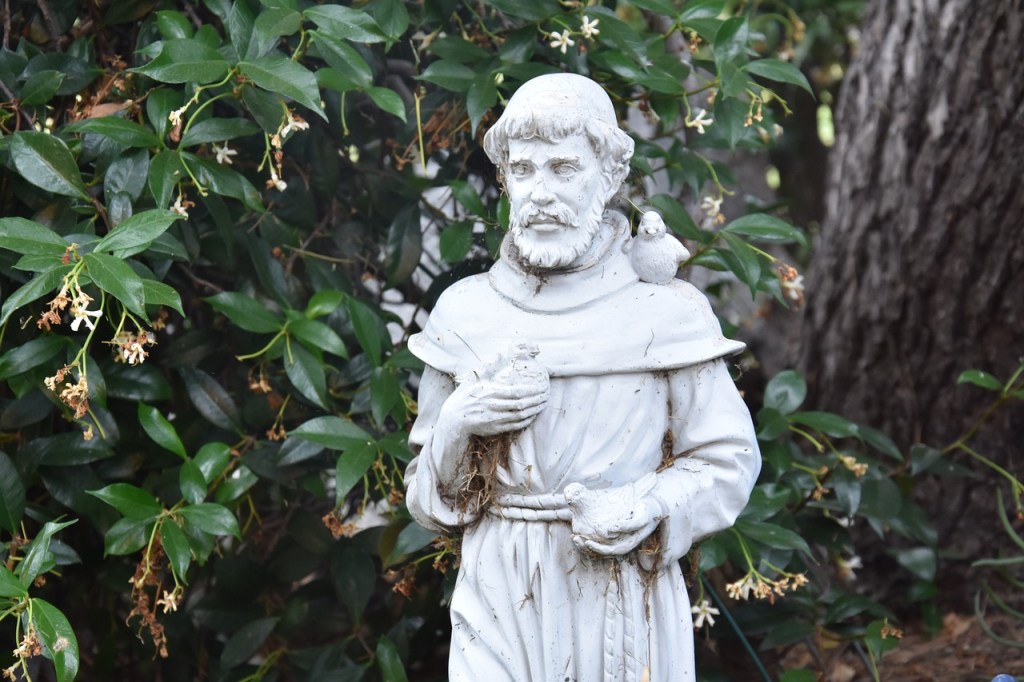
The call came shortly before the Feast of St. Francis of Assisi. It’s Francis’ sculpture you see in gardens, most often with a bird perched on his shoulder. He wrote the poem celebrating “all creatures of our God and King.” Many Christian churches celebrate St. Francis’ feast day by inviting people to bring their pets to church for a blessing. On the Feast of St. Francis, Tawny was invited not to church but to a new home, inhabited by a dog-adoring human and surrounded by two beautiful acres of fenced green grass. 

Tawny’s new human partner recently lost her longtime canine companion, leaving her with a hole in her heart — a hole that Tawny is snuggling into. He can’t fill that hole — nothing could — but he can make it feel less huge. 

Adopting out a healthy dog is not as heart-breaking as making the end-of-life decision for a cherished animal who’s in pain. Still, I’m bereft because Tawny is the last in a long line of faithful dogs — and occasional cats — who have enriched my life, grounded, entertained, and inspired me. Each, in their departure, left a hole in my heart. And each made my heart a little fuller, a little stronger.

Sure Signs

Just as the bull moose disappeared into the early evening shadows, my neighbor commented, “You’re not gonna be seeing this in Seattle.” 

A few minutes earlier, he’d phoned me and asked, “You lookin’ out your window?” I hadn’t been.

“There’s a moose walking down the middle of the river in your direction.”

This was a first. I’ve lived along the Okanogan River — a humble little tributary to the great Columbia — for forty years. I’ve seen an extraordinary variety of wildlife: eagles, osprey, all sorts of ducks, raucous Canada geese, beaver, river otters, great blue heron, fish jumping, sun-bathing humans on floating inflatables, and one time (I’m not making this up) a pelican. But never a moose.

I almost didn’t see this one. Despite my neighbor’s phone alert, I didn’t immediately spot the moose as he waded past my house. He was camouflaged in the reflection of trees that grow on the opposite river bank. Then, a few yards downriver, he suddenly came into view, backlighted by the last glimmer of twilight. If my neighbor hadn’t called, I would’ve thought it a mirage. 

Moose are, after all, larger than life. They can weigh up to sixteen hundred pounds and measure six feet from hoof to shoulder. At this time of year the Okanogan River is so shallow, this fellow had no trouble keeping his massive head and horns above water.

“I wonder where he’ll get out,” I said to my neighbor.

“Anywhere he wants,” was the reply.

Those fleeting moments — staring at a moose on his evening promenade — felt like a final gift from a river that has nurtured and inspired me through the years. At the end of the month I’ll move to the thirteenth floor of a high-rise in downtown Seattle with a view of city skyline. I don’t mean to be totally self-absorbed, as if the moose’s appearance were some kind of sign meant just for me. Still, I asked a Native American friend what it might’ve meant. His response was both practical and mystical. He said it’s time for the moose to migrate in order to thrive now and in the future. Conditions are always changing, and moose know when the time is right. Yes, it was a sign.

Signs have been coming my way for quite a while. At first they’re just little nudges, fleeting thoughts, offhand comments that somehow resonate. At some point, you begin to pay attention. You wonder where this is leading. Finally the signs become billboards in flashing neon. The direction is clear: time to follow a different path.

After the decision comes the checklist: 

  • Inform and try to explain the decision to family and friends (not to mention myself). Check.
  • Hold a gigantic moving sale that, with a lot of help from friends, was bigger and as much fun as any party I’ve ever hosted. Check.
  • “Stage” the house to make it look livable but not personal — like a hotel lobby. Check.
  • List the house for sale with all the necessary marketing tools, signs, photos, internet videos. Check.
  • Accept an offer on the house within an unbelievable twenty-four hours. Check.

Again, it’s evening. As I write,  I watch the rosy glow of sunset reflected on the river. No moose tonight but the ducks are staging an aerial show that never fails to take my breath away. Flying in perfect formation like Air Force Blue Angels, they land as a squadron with a singular splash.

Not long from now, when the river freezes over, the ducks will head to open water on the Columbia. Earlier today I heard the sandhill cranes overhead on their way south. 

The signs are always clear when it’s time to move on.

Just Like That

“Just like that, here we are,” said the son of the deceased.

We were standing in a parking lot, reminiscing about events stretching back fifty or more years. The memorial celebration was over, chairs and tables stored away, guests and caterer departed. No reason to hang around and every reason not to go.

The deceased, Lee, with his wife Lou, had been a significant part of my life for more than five decades. Their son’s observation, “just like that,” named the dismay I’d been feeling but hadn’t been able to put in words. A life completed. For me, three lives completed. And with those three lives, an era was finished. Like a snap of the fingers. 

I met Lee when his wife Lou, who I barely knew at the time, arranged a blind date for us. We were living on Vashon Island, in Puget Sound. When Lou learned that I commuted to Tacoma every Wednesday evening for choir rehearsal, she declared, “You can carpool with my husband.” Lee was attending evening classes at Tacoma Community College. Carpooling would lower our ferry costs. It also meant having supper together at a little restaurant near the ferry dock. 

The restaurant was renowned for its clam chowder, which Lee and I both ordered. When the bowls were placed before us, Lee reached for the condiment tray and, with unbridled gusto, poured tabasco sauce into the creamy white chowder. When I gasped, he looked at me quizzically. 

“T-t-t-basco in CLAM CHOWDER?!” I remarked. (Ah, but I neglected to mention. Lee and Lou were immigrants to the Northwest. Their native country was Texas.) Lee shrugged and gave me a pitying look. He’d often feel called to do so through the coming decades of friendship. These days people use the dismissive, “Get a life.” Lee was too kind for that. He’d silently resort to a disbelieving shake of his head. Either I didn’t get it, or he didn’t get me.

As years flew by, Lou, Lee and I grew close. Their four kids honored me with the sobriquet “Aunt Mary.” Lee and I would never see eye-to-eye on issues that weren’t worth discussing anyway, like religion and politics. That freed us to focus on what did matter: the Three B’s — Blues and Bluegrass music and Barbecue.

Then, when some real spice showed up in my life — namely a newspaper editor from a rural, eastern Washington town — I wondered how the newcomer would fit in. I needn’t have. John wore cowboy boots when the occasion warranted, and he owned a respectable collection of firearms. That was all the character reference Lee required. 

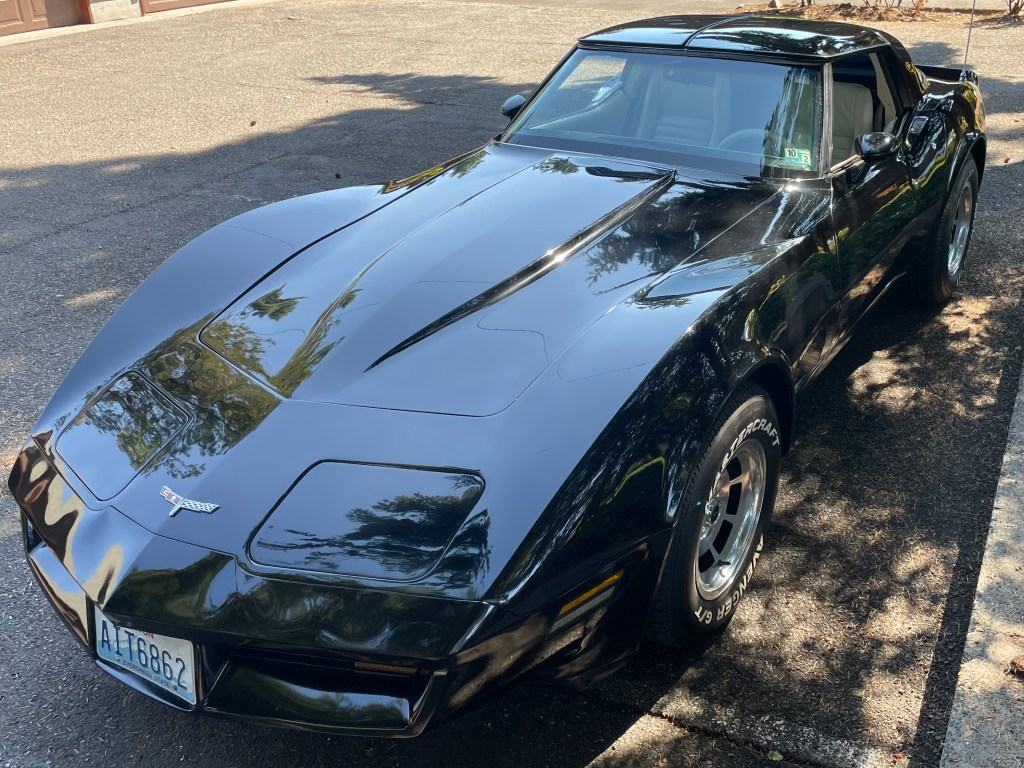
LEE’S CORVETTE: A Roaring Farewell

Though we lived miles apart over the years, we four managed to rendezvous pretty much wherever Lee’s work took them — as far one time as Pusan, Korea. Always there was good music and something spicy. I learned to love Korean kimchee but couldn’t quite embrace the deep-fried dill pickles of Biloxi, Miss. And there was the day Lee paid John the ultimate compliment:  letting him drive Lee’s cherished, classic Corvette on the wide-open roads of Texas.

When John died in 2007, Lee and Lou came to offer comfort. When Lou died three years ago, I was at her bedside. At the end of July I drove to Portland to be with Lee as he lay dying. We did something we’d never done through all those years. We held hands. 

I returned to Portland for Lee’s memorial Sept. 9. The Corvette was parked front and center for the occasion. His daughter started it up and gunned the engine in a roaring farewell. 

I feel like the survivor in one of those fabled agreements, where the last person alive gets the dust-covered bottle of fine wine. Only for me, it’s a bottle of tabasco, which I’ll be sprinkling on my clam chowder.

Featured

Savor

Let’s call it pro-active aging: making the big decisions for ourselves before the inevitability of time and age compel others to make them for us. It’s why I’m selling my car, my home, most of my possessions, and moving 250 miles to Horizon House, a retirement community in the heart of Seattle.

It’s a “Continuing Care Retirement Community” or CCRC. There are about 1,900 CCRCs nationwide, says AARP, offering “a long-term care option for older people who want to stay in the same place through different phases of the aging process.”

At seventy-nine, I consider myself barely into Phase One of “the aging process.” This is a pretty typical age for moving into a CCRC, I’m told. Residents are still young and agile enough to enjoy the long list of amenities: gym and swimming pool, hobby and entertainment rooms, library, special events, lectures, etc. I’ll be able to walk to theaters, restaurants, museums. Routine health services are provided in-house. Nearby are several of Seattle’s primary health care facilities. No more overnight, 200-mile round trips from my rural home for ordinary procedures like cataract surgery. 

I’ll reduce my carbon footprint as I turn to public transportation and squeeze into 340 square feet of a studio apartment. Is this easy? Absolutely not. Is it an adventure? Absolutely.

Not everyone around my age or in my situation would choose the same. I hope all of us, as we age, are given the freedom and dignity to make our own choices. Sharing this decision with friends and neighbors has been the toughest part. Most agree it’s a good choice, but they (and I) lament my soon-to-be absence from the Okanogan Valley, my home for more than half my life.

Tawny, a people-loving pooch, and I must part ways as we each set off on our next adventure

I’ll leave behind people I admire and cherish. I’ll leave behind the Okanogan River, which every day inspires me with its steady flow and diverse wildlife. I also must leave behind Tawny, my eight-year-old rescue dog of many breeds. He’s a charmer who deserves better than confinement in a high-rise city apartment — even if he were allowed there, which he’s not.

Still, it is possible to thrive in a season of transition. With only a few months left here, my default mode is to savor. First thing in the morning, I step outside to savor river-scented air and murmuring ducks. At bedtime I step out again to say goodnight to a waxing moon and its reflected path across the glassy water. 

I savor each and every encounter with friends. A quick “hi” in the post office lobby. A meandering conversation over a game of cards. Deep discussion during a three-hour lunch at the Mexican restaurant while the waiter patiently, continually refreshes our coffee.

I savor all the ordinary, everydayness of small-town living, like making an early Sunday morning run to the grocery store, where the only other soul is the owner, who rings up my forgotten carton of milk. 

I savor the thought of another new season in my life while maintaining the illusion that I’m in charge of me. I’m sure there’ll be sunny days and a few gloomy hours to come. I intend to share those joys and sorrows, and so, dear reader, please savor this adventure with me.

RITES OF PASSAGE: They Come at Any Age

Cataract surgery, it seems, is a rite of passage required with age. Kinda like a similar rite of passage that often occurs in adolescence — braces on the teeth. Up to 75 percent of people could benefit from orthodontic treatment, claims the American Association of Orthodontics. Nearly everyone ultimately requires cataract surgery, says the National Institutes of Health.

Me with the pre-orthodontic tooth gap

Both involve a degree of discomfort: an orthodontist cranking away in your mouth or a surgeon poking into your eyeball. We undergo such rites expecting a brighter smile in the first instance and clearer vision in the second. Sixty-six years later, I’m still grateful to my parents for financing the process that eliminated a wide gap between my front two teeth.

Given modern anesthetics, discomfort from the eye surgery comes more from thinking about it than actually undergoing it. “Piece of cake,” was the most common description I heard from cataract veterans when I mentioned my upcoming procedure. 

Because my local hospital doesn’t offer the service, travel logistics — 200 miles round trip and overnight lodging — were more complex than the surgery itself, which can best be described as a medical assembly line. Cataract extraction is the most prevalent surgical procedure of all medical specialties in our country, says the NIH.

What happens if you don’t get your cataracts removed? Pretty much, you go blind. The NIH reports that globally, the number of people blind from cataracts is increasing by approximately one million per year. The number of people who qualify for cataract surgery is increasing by four to five million per year. Knowing that, I had no complaints about landing in the assembly line.

For my surgery day, the clinic required that I be accompanied by a “responsible adult.” A friend volunteered and was given a tag with my patient number. She could sit in the waiting room and keep track of me remotely. Patient numbers flashing on a large screen show who’s in pre-op, operating, or post-op. We chose for my friend to accompany me during the pre-op portion, which occurs in a banquet-sized room where gurneys are scattered about with minimal privacy. Nurses roam the room, hooking folks up to the vital tubes and instruments, each time affirming name, date of birth, and which eye was being operated on. Ultimately the surgeon stopped by to place a mark above my left eye — the one that had become especially blurry.

I have no idea what went on during surgery, other than awareness of a brilliant kaleidoscope of color. Finally, I felt adhesive tape being pulled off my face — the only real ouch of the morning. In post-op, the nurse offered coffee, tea or juice. I opted for coffee, since I’d been required to bypass my usual wake-up java. It was the best/worst cup of coffee ever.

Some two hours after we’d entered the clinic, a nurse was pushing me in a wheelchair to the exit. In the elevator she chatted with another nurse, who was also wheeling an outgoing patient.

“What’re you doing today?” asked the other nurse.

“Cataracts,” was the reply.

“Oh, today?”

“Every day is cataract day,” answered my nurse.

Sure enough, because Creator doubly blessed us, I get to do it all over again in two weeks. Maybe not a rite of passage. Next time the right of passage.

NEIGHBORS ARE THE FOLKS WHO SHOW UP – Even For False Alarms

Floating the Okanogan River on a hot summer day. What could possibly go wrong?

You know you live in a safe neighborhood when your car alarm goes off and your neighbors come running, fully armed — with cell phones, all Googling variations of “shut off car alarm.”

It’d been a quiet afternoon in my relatively crime-free neighborhood. I’d gone out to the carport, key in hand, and was about five feet from the driver’s door when the car threw a hissy-fit. Locking itself down tight, it refused to acknowledge any commands I entered on the keypad, ignored all the neighbors’ Google-advised maneuvers, and trumpeted an ear-splitting tirade. 

Every once in a while, the car would wear itself out, like a child throwing a temper tantrum who finally has to stop and gasp for breath. My neighborhood consortium would consult in whispers. Then someone would try to turn a key or open a door, and BLA-A-A-T!, the horn would start again.

Google provided the final diagnosis: my car was “brain” dead, in a self-imposed coma. The solution was like rebooting your computer. Simply disconnect, then reconnect, the battery. 

Google this: who were the nincompoop engineers who designed my Dodge Journey so that you have to remove the front left tire just to get to the battery? Ultimately my mechanic graciously made a house call, removed tire and battery, recharged the latter, put it all together again, and peace reigned in my neighborhood.

Until last week. 

People floating, swimming, and wading in the river that runs past my house are a common sight on these hot days. But it was nearly 9 p.m. with only remnants of daylight left when I spotted three youngsters in the river. In most places at this time of year, the water is shallow enough so that people who can’t swim “ride” the current. Their toes briefly bounce off the bottom, the current pulls them for a few yards, and then they bounce again. Bounce. Float. Bounce. Float. The children had already bounced/floated past my house when I spotted them.

This lazy, shallow river is deceptive. It has an insistent current and an inconsistent bottom. You can happily wade in the shallows and suddenly you’re in over your head. People drown in this river.

The youngsters (about twelve, ten, and eight years old, I’m guessing) had no flotation devices and no adults in view.  The current was carrying them into the river bend, where the water would be too deep for the youngest especially. I grabbed my car keys and ran outside. My neighbors were buttoning up their evening’s yard work.

“I’m worried about some kids in the river!” I called. As I pulled out of my carport, a neighbor jumped into the passenger seat. I drove the one block to a spot where we’d be able to access the dike. The neighbor reached into his pocket.

“I’ll leave my phone here,” he said, certain that he’d be getting wet. I held onto my phone, ready to dial 9-1-1. We ran to the top of the dike and spotted the kids. In the mere minute it’d taken us to get there, they’d somehow made it across the current into shallow water on the other side. The eldest was holding her hands aloft in a triumphant gesture. From there they’d be able to clamber up the bank and, I hoped, head home.

I apologized to my neighbor for yet again issuing a false alarm. He shook his head. He’s an experienced fisherman who grew up along this river. “These currents can be tricky,” he said.

A long time ago a wise man was asked, “Who is my neighbor?” Two thousand years later, whether you’re a Bible reader or not, you understand the meaning of “good Samaritans.” They still exist, they show up, and more than likely, they carry a cell phone.

Close Encounters with the Fourth Grade

I stepped on the brake, did a u-turn in a vacant parking lot and drove back the way I’d come. Who wouldn’t stop at a kid’s lemonade stand on a hot July day?

In truth, I wasn’t certain it was a lemonade stand. I’d been on a quick errand, driving south out of town when I spotted the youngster playing tug-of-war with persistent wind gusts as he struggled to erect a shade umbrella. A few minutes later, errand completed, I was driving back home when I again spotted the kid. He’d given up on the umbrella and was grappling a large, hand-printed sign that threatened to fly off with the wind. 

I couldn’t read the sign, but I had to turn back. Maybe he was selling huckleberries — hope springs eternal. Or any kind of berry. Or cherry. As I walked toward his table, he pulled a gallon of pink lemonade from his cooler. Oh, well.

Before I could even express interest, he was pouring me a glass. 

“How much is it?” I asked. He didn’t hand me the glass but put it on the table and pointedly shoved it in my direction.

“Free,” he responded. 

“Why are you giving away lemonade?”

“Sumthin’ to do.”

As I sipped, he reached into his cooler to pull out a tall bottle of Coca Cola. He took a swig, and I couldn’t help myself. 

“Why are you drinking Coke when you have all this lemonade?” Dumb adult question that got the answer it warranted. He shrugged.

Probing further, I learned that his name was Wyatt, his grandmother had made the lemonade, he’ll go into the fourth grade next year, he knows who his teacher will be but has no opinion whether he’ll like her. About this time, a man walked up.

“How much for a glass?” he asked.

“Free.”

“How’re you gonna make money that way?”

In a rebuke to capitalism, Wyatt poured another glass of lemonade. The man turned to me and said, “Hi, Mary.” I looked at him questioningly with only the merest inkling of recognition. He grinned, told me his name, and I realized I hadn’t seen him for at least a dozen years, when he’d done some work on my old house. As we chatted, Wyatt disappeared into the adjacent shop — apparently headquarters for his enterprise. He returned with a pickle jar bearing the sign, “TIPS.” It was suggestively seeded with dollar bills. The man and I both stuffed in more folding money. Long gone are the days of ten-cent lemonade stands.

The man left, and I continued my inquisition.

“Tomorrow’s the Fourth!” I declared in that bright, patronizing adult tone that must make kids want to flee for their lives. “Do you have fireworks?” I persisted.

“I have three mortars,” he declared, barely concealing his pride. In a burst of loquaciousness he added: “We’re going to the park.”

In this dry valley of sagebrush and highly flammable grasses, folks eagerly patronize the fireworks stands and then — in deference to the wildfire danger — bring the explosives to our large city park on the Colville Indian Reservation. The city obliges by having ambulance and fire truck at the ready as well as putting out dozens of empty oil barrels for the resulting trash. Around nightfall the skyline erupts with utterly spontaneous, un-choreographed bursts of color and noise that continue until midnight or so. Insanely entertaining.

“I live across the river from the park,” I told Wyatt. “I’ll watch for your mortars.”

He nodded solemnly, my attempt at humor unnoticed. When I drove away, he did what I least expected from a shy, about-to-be fourth grader. He waved.

Miles To Go

I just bought four new “premium” all-weather tires, on sale, guaranteed for 80,000 miles. Seemed like a good idea at the time. Back home, breathing fresh air instead of brain-stifling tire store fumes, I did the numbers. I’m about to celebrate my seventy-ninth birthday. I drive a fourteen-year-old car with 111,000 miles on the odometer. I calculate I’ll be eighty-nine or older before I need new tires again — assuming my car and I are both still functioning — a lot to assume. Not to mention, electric vehicles will probably own the road by then.

But this is not a question of life expectancy, either mine or the car’s. The National Institutes of Health says that only twenty-two percent of women over age eighty-five are still driving. (Fifty-five percent of men — let’s just set aside the obvious conclusion that women come to their senses sooner than men.) Drivers over age sixty-five are three times more likely to get into an accident than middle-age drivers per mile driven, and — take a breath — three times more likely to die from a car crash. We older folks are simply more vulnerable.

Exiting the driver’s seat is, for a lot of folks, as traumatic as death itself. My dad, a Lutheran pastor, was one of the most patient, kind, good-humored, compassionate people ever to walk God’s green earth. Thus I gasped when he — well into his eighties — referred to a driver licensing examiner as “that Nazi!” Despite his several physical infirmities, Dad waged an ongoing battle with the Department of Licensing to renew his license. I don’t know if it was Divine Intervention or just weariness on the part of DOL bureaucrats — they finally gave him a provisional license, allowing him to drive a prescribed route between home and church, nowhere else.

Mother, on the other hand, quit voluntarily. Well, kinda. It was after she totaled her car. She was driving home from visiting Dad’s grave one quiet morning when she blew a stop sign and crashed into another car in the intersection. No one was injured, but it was clearly her fault. For the next couple days, she followed her usual course when she had a Big Decision to make: she prayed, then wrote out a pro/con list. Finally, she called her grown children, confessed her sad story and sadder decision. The administrator of the retirement community where she lived thanked her effusively. He hated having to demand that a resident hand over their car keys. I eventually asked her if she missed driving. “All the time,” she sighed. 

Last week a friend told me she’d been diagnosed with dementia. “Of course, I quit driving immediately,” she added. We talked about her cherished pickup truck, which is more than a mere vehicle. The truck, itself older than most drivers on the road today, was her partner in decades of adventure. “I bet you wish you could be buried in it,” I said. She chuckled and agreed.

I have long promised myself that I’ll make the choice to quit driving well before some poor family member is tasked with wrestling the keys from my grip. My current license will expire on my seventy-ninth birthday. I have an appointment to get it renewed next week. Most drivers can do that online, but in this state, you have to show up in person if you’re over seventy.

Quoting Robert Frost, “I have miles to go before I sleep,” but probably not 80,000.