
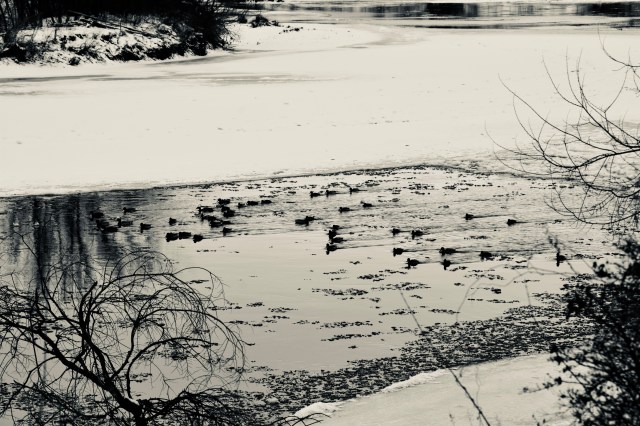
 The river in front of my house is now a duck pond. Various sections of the river are frozen bank- to-bank, but here free water flows and water fowl float. It’s a busy sight/site with ducks and geese paddling upstream, cruising back down, taking off into the air with the frequency of planes at O’Hare, and landing again in small squadrons. The mallards come in for their landing with wings bowed, braking their speed just as they hit the water. Canada geese are less elegant, splashing onto the river’s runway in noisy, squawking turmoil.
My favorites at this time of year are the bufflehead (who I may be confusing with golden eye, or maybe we have both). Their radiant white caps make me think of novice nuns. They dip smoothly below the water’s surface, later to bob up again—never in the same place. My eyes scan the river, trying to predetermine where they’ll suddenly surface. I almost never win this game of bufflehead bluff.
At times some ducks leave the water to cluster on the edge of snow-covered ice—not exactly dry land. I have to wonder if they’re warmer, leaving the icy water and hunkering down in the wind-chilled air. I’ll bet they’re warmer in the water. What we don’t see is those webbed feet paddling hard like a cross-country skier following an uphill trail, warmed by the effort.
Occasionally—and suddenly—the pond empties of water fowl. Only small chunks of ice float desolately along the current, destined to join the glacial islands downriver. That’s when I know to look up and search for a bald eagle. Or perhaps some other raptor, an osprey for instance, is temporarily scattering the flocks. In only a few minutes, the ducks will return to resume their routine, up and down, forth and back. They organize themselves like an Esther Williams water ballet, sometimes in straight lines (although those are most often the geese, who have a penchant for the military), other times in complex choreography that unfolds like time lapse photos of flowers blooming.
There is other winter wildlife along the river bank—the hardy birds, of course, and an occasional river otter. The plucky quail scoot in nervous groups, puffed up to twice their miniscule weight to insulate themselves against the cold. I could see more if I would take time away from my ceaseless chores and distractions. Is that a resolve for the new year? Seems like a good one.

 Even though he is by his own admission a prominent scofflaw in our small town, I know very little about Robert. I know only that he plants himself fairly frequently midway across the Central Avenue bridge and stands there for hours with his ten-foot cross. I’m guessing that’s the height of the cross. For sure, it’s big.
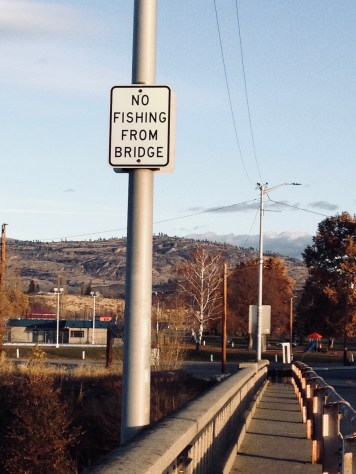 Another time when traffic noise was missing, Robert called out: “I’m breaking the law, but no one seems to care.”
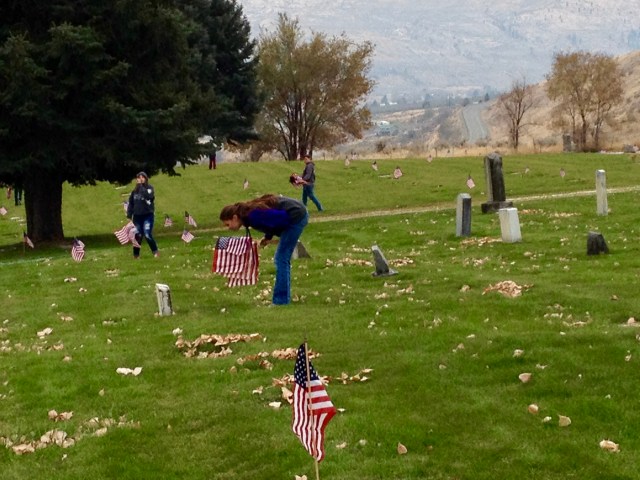 A drab, overcast, pre-winter day. Perfect for a visit to the cemetery. I prefer to go when I suspect no one else will be there. I like solitude as I visit my husband’s (and someday my) gravesite. We’d chosen this spot on the edge of the Okanogan Cemetery because of its expansive view of the valley, river and mountains. I also enjoy walking my dogs along the cemetery lanes when I know they won’t be bothering other visitors or mourners.
 “Did you get photos?” my friend Elizabeth inevitably asked whenever I told her about an interesting or beautiful event in my life. More often than not, I’d have to make some lame excuse about why I didn’t have my camera with me or hadn’t pulled my phone from my pocket.
  Elizabeth and I were polar opposites when it came to photography. I use photos to illustrate my writing. Her writing was about her photography. She claimed she was merely an amateur with the camera, but she had it with her at all times. Even after her eyesight dimmed, she persisted, setting her Canon A710 IS on automatic, pointing and clicking. Then she’d pass the camera to me (or, I assume, to whomever was with her) so I could assess the image and tell her whether she needed to try again.
 One of the hardest parts of aging is letting go. Letting go of people who die ahead of us; letting go of physical abilities: mobility, the senses, a pain-free existence; letting go of activities that give us joy and express our creativity. We never discussed it, but I knew Elizabeth had reached the threshold of letting go when she no longer carried her camera. By the time she celebrated her hundredth birthday last July, she’d let go of so very much.
 Last week her longtime friend Marsha and I sat at Elizabeth’s bedside during the final hour of her life. I sang some of the old hymns that Elizabeth and I’d been singing together over the last couple months. She’d amazed me by remembering all the verses of any hymn we sang. On that last morning, as her breathing became erratic, she no longer sang. I’m not sure she could even hear me sing, but her spirit did.
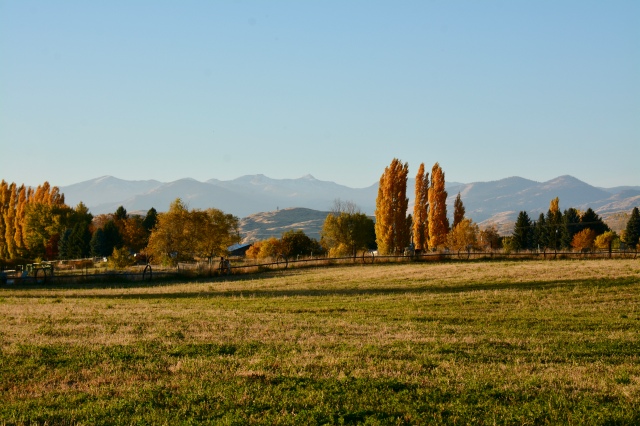
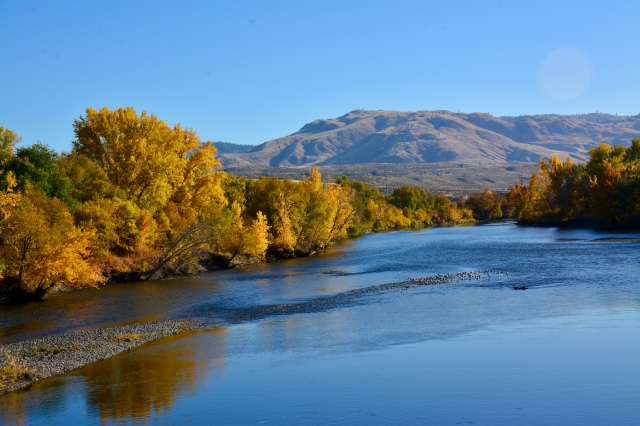
 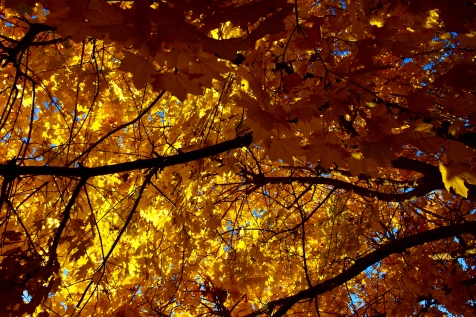 “I believe my favorite hymn is ‘This is my Father’s world,’” Marsha commented. I began to sing it. Somewhere around the “music of the spheres,” Elizabeth entered that place of deepest peace. After Marsha and I shared a few prayers, after the funeral home collected the body, I stepped outside into a glorious autumn day. There is a reason that this is the season of “Dia de los Muertos” (Day of the Dead), All Saints, Hallowed Evening (Halloween). Autumn is a fine time to die. That fall palette of reds, golds, yellows, bronzes, oranges, and on, and on, are creation’s promise to us. Leaves and grasses shimmer brilliantly before they let go, becoming part of the cycle that is eternal life.

 I was behind the wheel when my phone vibrated with an incoming text. It was the day before Washington state’s new, stringent “distracted driving” law (or DUIE—Driving Under the Influence of Electronics) went into effect. From now on, we can get a hefty fine for just holding our cell phone, never mind looking at it. Other distractions, like eating or taking a sip from our latte, can result in a thirty dollar “secondary” fine. This in the home state of Starbucks!
 Every New Season
You must be logged in to post a comment.