
 Even though he is by his own admission a prominent scofflaw in our small town, I know very little about Robert. I know only that he plants himself fairly frequently midway across the Central Avenue bridge and stands there for hours with his ten-foot cross. I’m guessing that’s the height of the cross. For sure, it’s big.
That bridge is a good site for messaging. It connects the east, or Indian reservation side of town, with the west, or non-reservation side. The bridge spans the Okanogan River, which bisects our town and is the reservation boundary. Every once in a while, if people want to demonstrate or publicize something—like a protest march against the Dakota Pipeline some months ago—they’ll line up on the bridge with their signs. My dogs and I frequently walk across the bridge on our way to the East Side Park. We walk on the upriver side of the bridge to avoid crossing two lanes of traffic. Robert is on the downriver side of the bridge because, I suspect, that sidewalk is broader. People can more easily walk around him and his cross.
Because traffic usually is heavy and noisy, Robert and I merely wave to each other as the dogs and I pass by. One time, though, there were no vehicles on the bridge. In the silence, Robert called across to me: “You need to remember just two things!”
“Yes?” I responded.
“First, love the Lord with all your heart, soul, and mind,” he answered, “and second …”
“Love your neighbor as yourself,” I joined him in his shortened version of Jesus’ message. He smiled approvingly. The dogs and I kept walking.
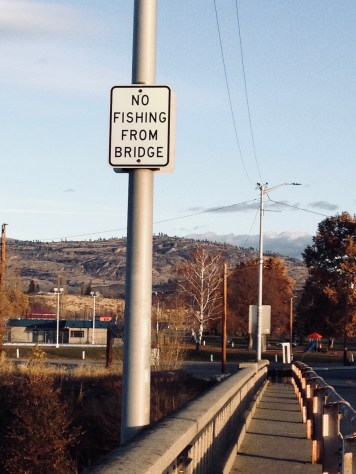 Another time when traffic noise was missing, Robert called out: “I’m breaking the law, but no one seems to care.”
“How’s that?” I asked.
Grinning, he pointed to the sign posted above my head: NO FISHING FROM BRIDGE.
“Ah,” I said. “And you’re fishing for souls.” His smile admitted as much.
I don’t know if there’s a limit on how many souls a person is allowed to catch, with or without a license. But judging from the number of folks who drive by Robert with a friendly wave and horn toot, and judging from the number of teens I’ve seen give him a high-five as they walk past, and judging from the occasional passersby who I see stop to talk with him, Robert could be close to limiting out.
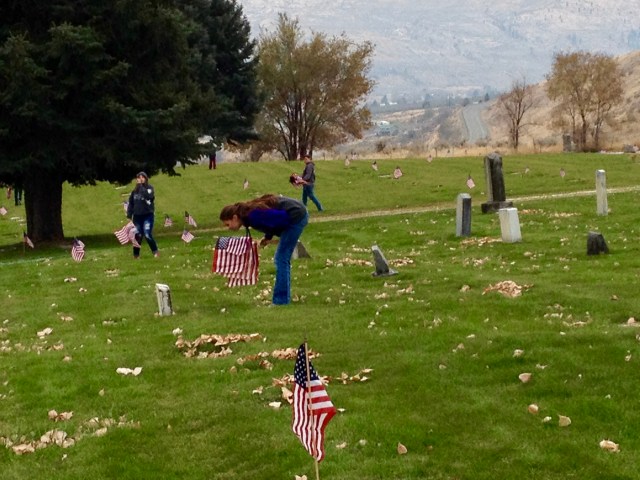 A drab, overcast, pre-winter day. Perfect for a visit to the cemetery. I prefer to go when I suspect no one else will be there. I like solitude as I visit my husband’s (and someday my) gravesite. We’d chosen this spot on the edge of the Okanogan Cemetery because of its expansive view of the valley, river and mountains. I also enjoy walking my dogs along the cemetery lanes when I know they won’t be bothering other visitors or mourners.
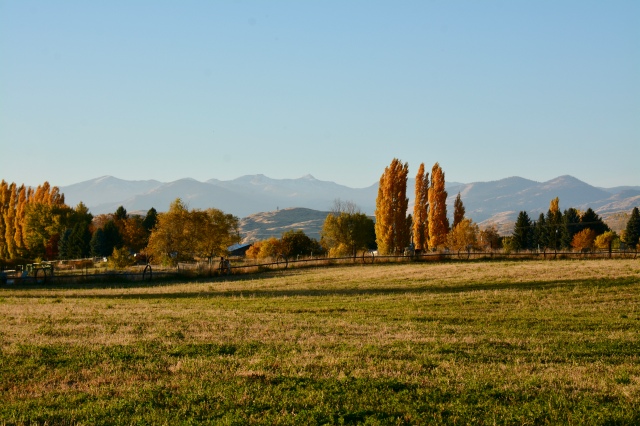 “Did you get photos?” my friend Elizabeth inevitably asked whenever I told her about an interesting or beautiful event in my life. More often than not, I’d have to make some lame excuse about why I didn’t have my camera with me or hadn’t pulled my phone from my pocket.
  Elizabeth and I were polar opposites when it came to photography. I use photos to illustrate my writing. Her writing was about her photography. She claimed she was merely an amateur with the camera, but she had it with her at all times. Even after her eyesight dimmed, she persisted, setting her Canon A710 IS on automatic, pointing and clicking. Then she’d pass the camera to me (or, I assume, to whomever was with her) so I could assess the image and tell her whether she needed to try again.
 One of the hardest parts of aging is letting go. Letting go of people who die ahead of us; letting go of physical abilities: mobility, the senses, a pain-free existence; letting go of activities that give us joy and express our creativity. We never discussed it, but I knew Elizabeth had reached the threshold of letting go when she no longer carried her camera. By the time she celebrated her hundredth birthday last July, she’d let go of so very much.
 Last week her longtime friend Marsha and I sat at Elizabeth’s bedside during the final hour of her life. I sang some of the old hymns that Elizabeth and I’d been singing together over the last couple months. She’d amazed me by remembering all the verses of any hymn we sang. On that last morning, as her breathing became erratic, she no longer sang. I’m not sure she could even hear me sing, but her spirit did.
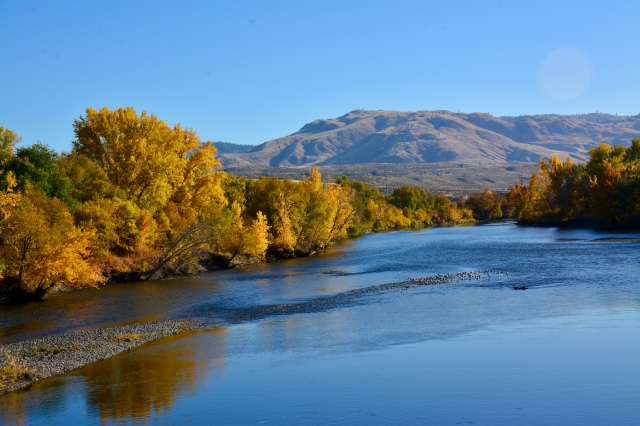
 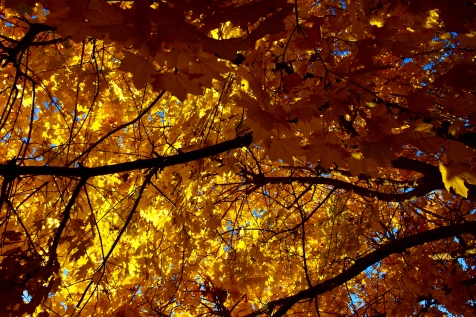 “I believe my favorite hymn is ‘This is my Father’s world,’” Marsha commented. I began to sing it. Somewhere around the “music of the spheres,” Elizabeth entered that place of deepest peace. After Marsha and I shared a few prayers, after the funeral home collected the body, I stepped outside into a glorious autumn day. There is a reason that this is the season of “Dia de los Muertos” (Day of the Dead), All Saints, Hallowed Evening (Halloween). Autumn is a fine time to die. That fall palette of reds, golds, yellows, bronzes, oranges, and on, and on, are creation’s promise to us. Leaves and grasses shimmer brilliantly before they let go, becoming part of the cycle that is eternal life.

 I was behind the wheel when my phone vibrated with an incoming text. It was the day before Washington state’s new, stringent “distracted driving” law (or DUIE—Driving Under the Influence of Electronics) went into effect. From now on, we can get a hefty fine for just holding our cell phone, never mind looking at it. Other distractions, like eating or taking a sip from our latte, can result in a thirty dollar “secondary” fine. This in the home state of Starbucks!


You must be logged in to post a comment.