One Woman’s Vote

Election Day November 4, 2025, will mark my sixtieth anniversary as a registered USA voter. I have a perfect record, having cast my ballot in every election over those six decades, from presidential to school levies. Nonetheless, it’s not getting any easier. 

I came of legal age (in those days, twenty-one) in 1965. That year President Lyndon Johnson signed the Voting Rights Act, part of the Civil Rights Movement. It was a significant achievement, meant to eliminate restrictions on who can vote. Even so, the act of voting can feel like a feat of survival. First we have to endure weeks, months, of political campaigns that have become increasingly hostile and decreasingly informative.

Election 2025 is all about local positions — mayor, city council, school board, etc. In my mind, these are the most important. Even though I moved to Seattle two years ago, I got a phone call from Cindy Gagne, longtime mayor of Omak, Washington (population around 5,000), the small town where I previously lived for forty years.  Cindy was appointed mayor to fill a vacancy in 2008. After being re-elected unopposed four times, she’s running again, for the first time with opposition. Would I endorse her, she asked. Happy to! Not that it’ll mean much.

Cindy and I first met when I was on the city Parks Commission, and she was a soccer mom, volunteering long hours to raise money for decent fields. From there she moved on to the city council, ultimately the mayor’s office. Her service to the community has been even-handed and selfless.

My endorsement may not be much help because my tiny corner of the blogosphere is followed by only a few of her constituents. But the problems she and I face — as candidate and as voter — are universal. Many citizens fear that our nation’s progress toward full democracy has shifted into reverse. How does Cindy reach a fragmented, polarized citizenry that relies overly much on social media, replete with falsehoods? How do I, just one voter, sort through the propaganda and well-financed smear attacks to make an intelligent choice?

I miss my days as a news reporter, when I interviewed candidates personally. I tried my best to write objectively while inwardly concluding how I’d vote. There’s no more significant way to size up a candidate than to meet them in person. I’ve been attending voter forums for the past couple weeks and will continue until the election. That puts me in the minority. Cindy had called after a voters’ forum drew a disappointingly paltry turnout.

Well, if the voters won’t come to you, the candidate’s next-best choice is door-belling. I door-belled on behalf of a school levy many years ago. It was exhausting, discouraging, and I swore I’d never do it again. I’ve kept that promise. Sometimes it’s easier to follow Jesus’ commandment to love my neighbor when I’ve not MET my neighbor. The New York Times carried a story last week about a Democrat in Texas who walked the 25-mile length of  his Republican-leaning legislative district. He ended up in hospital, exhausted, but won the election.

“Endorsements matter to me,” a neighbor observed as we were riding the elevator after a voters’ forum. I agree, if you know that the person or organization making the endorsement shares your viewpoints and values. 

My late husband, with whom I owned and published a weekly newspaper, scoffed at so-called “endorsements” by small papers like ours. “It’s only one person’s opinion,” he’d say. Instead, he published a pre-election column called “One Man’s Vote,” listing his choices and reasoning. People appreciated it. Some trusted John and followed his recommendations. Others knew that if John was for something, they were automatically agin-it. Helpful in both directions. 

Maybe the good news is that Cindy has an opponent. Too often non-opposition reflects a lack of interest or participation from the electorate. That’s not healthy, not if we really believe in democracy. A survey by the Washington League of Women Voters a couple years ago recorded a distressing lack of candidates for local offices. Incumbents (not Cindy) can get to feeling entitled. 

Here in Seattle, the top-two primary election was a shocker. The seemingly shoo-in incumbent tallied a weak second behind an upstart, a previously unknown challenger. I’m still undecided. I’m attending every forum I can, both in-person and on-line. Big money is being spent and the race is getting heated. I don’t watch TV, so I can ignore the ads. But my mailbox will be filled with glossy, printed B.S. 

You can’t get away from it. Navigating political campaigns is like slogging through the swamp in an effort to reach high ground. This is no time for despair, but determination. These final pre-election weeks are when we put on our hip boots, study our options, and examine the facts — the “true” facts, not “alternative” facts. We’re heading for the high ground of democracy, insisting on a government that is of and for us, the people.
Cast in Concrete: Solid Footing in Treacherous Times

“Cast in concrete” is a metaphor for something permanent, unchangeable. And yet, “nothing is forever,” my late husband John once observed.

Cast aluminum, not concrete, was a favored medium for sculptor Richard Beyer. At least one time, however, he did make his mark in concrete.  It was a fond gesture, a gift beyond value honoring John, me, and the community newspaper we published in Washington state’s spacious Okanogan County.  John’s observation became all too true. Not even art cast in concrete is safe from willful destruction.

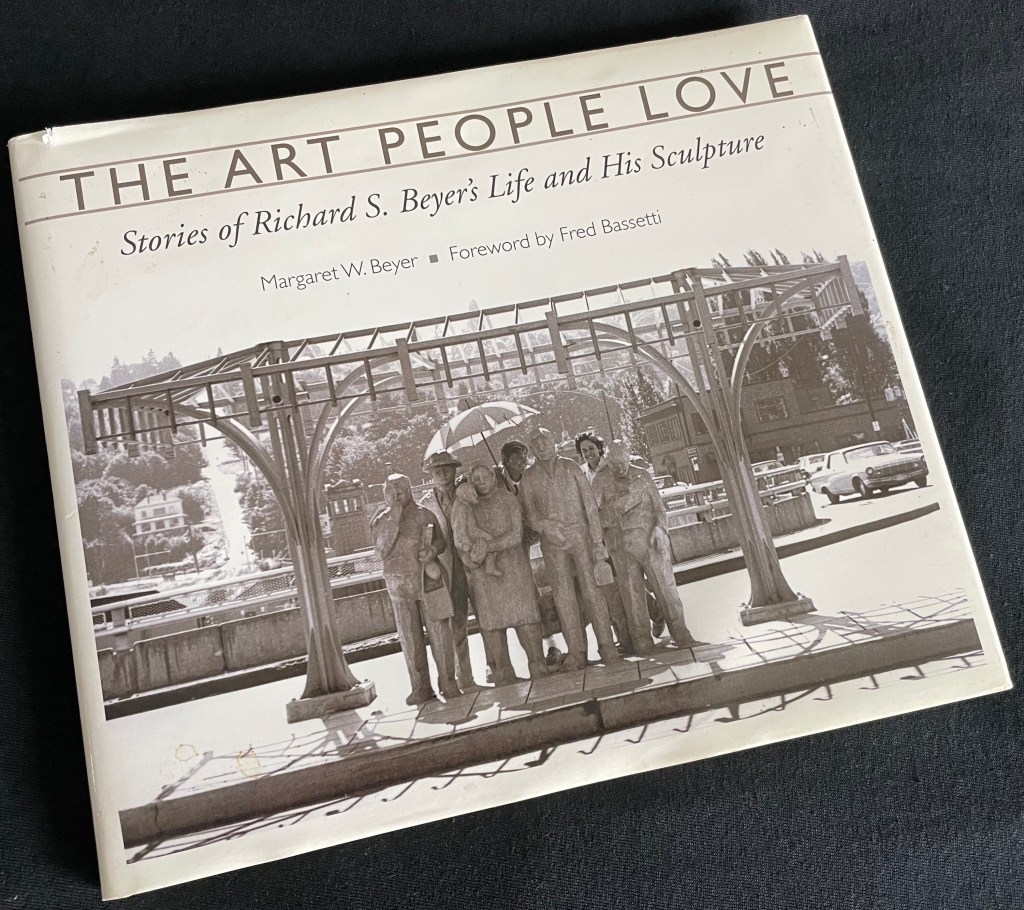
The Seattle Times recently published a retrospective of Beyer and his work. Reading it, I nearly drowned in a tsunami of memory and emotion. The piece by veteran journalist Erik Lacitis described Beyer as controversial and largely unrecognized. I have to agree. A recent show at the Seattle Art Museum celebrating contemporary West Coast artists omitted Beyer, even though there are more Richard Beyer public sculptures in Greater Seattle than by any other artist, Lacitis notes. That includes “Waiting for the Interurban” in the Fremont District, which after it was installed took on a life of its own. Many would claim it to be Seattle’s most popular piece of public art. Lacitis tallied more than ninety Beyer art works scattered throughout the Northwest and as far as Uzbekistan in Central Asia.

Beyer expressed his outsized humor in satirical creations that were met with consternation and adoration, fury and fun. He was either amused or indifferent when art snobs or critics spurned his folksy work. Since he died in 2012, his sculptures have not only endured but become even more endeared. 

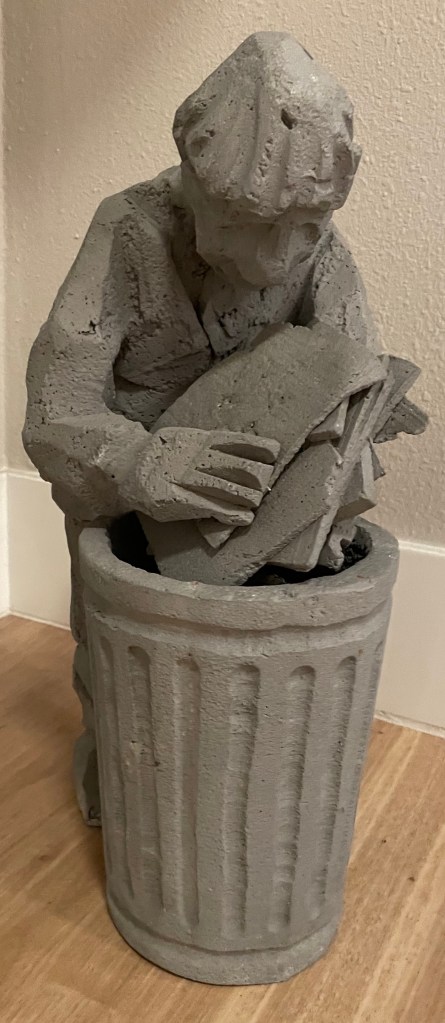
A Beyer fan long before we met, I was excited when he and his wife Margaret moved to Okanogan County in the late 1980s. I eagerly attended a show featuring some of Beyer’s smaller pieces at Sun Mountain resort in the Methow Valley. As I studied an eighteen-inch high, cast aluminum figure entitled, “Man Throwing Newspapers into Garbage Can,” I became aware of someone standing next to me. I looked up and instantly recognized Rich. My first words blurted to this man whose work I so admired were: “You could at least have him recycle them!”

Rich was momentarily taken aback before releasing his characteristic guffaw. We became friends, and I bought the sculpture for my husband. John proudly displayed it on the front counter of our newspaper office. Rich, who had so often been skewered in print, was no fan of newspapers. He made an exception in our case, frequently complimenting our paper’s brand of community journalism.

In late 1993, my husband suffered a brainstem stroke. Unable to speak, he was diagnosed as “Locked-In,” a syndrome described as a fully functioning brain locked inside a totally paralyzed body. Despite the gloomy medical prognosis, I was convinced John could and would recover. To accommodate John’s wheelchair, I had a ramp built to the front door of our newspaper office.

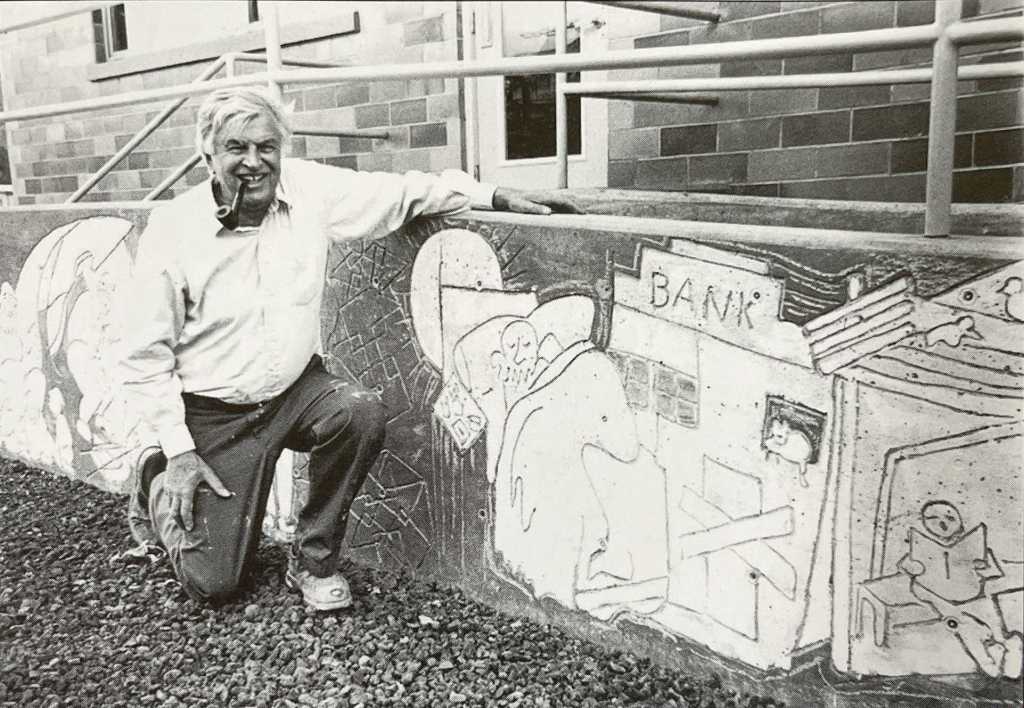
The contractor was Gary Headlee, also an artist and Rich’s friend. He convinced Rich to etch and paint a mural onto the side of our concrete ramp. Rich dreamed up a whimsical story that, as he worked, changed with every telling. He titled it “The Precious Jewel.” 

By 1996, I had to face reality. Trying to do both John and my jobs, largely from home, while providing twenty-four/seven care for him, was not sustainable. We sold the paper, careful to put on a happy face in public. In private, I wept. I’d sold a chunk of my soul and pretty much all of my identity.

Not long after, Margaret got in touch with me. She wanted to write Rich’s biography and asked for my help. She arrived at our house with a shopping bag full of notes, photos, and a title for her imagined book: “The Art People Love.” I went to work on the opening chapters, but time was not on our side. I had too little of it, and Margaret wanted the book published ASAP. She ultimately retrieved the unfinished manuscript, the rest of her notes, completed the book, and found donors to fund its publication in 1999.

“Mary: you showed me the way!” she graciously wrote in my copy. One beautiful May morning in 2004, Rich called. Margaret was nearing the end of her journey with cancer. Would I come visit? 

I’ve always described spring in the Okanogan as the five minutes when snowmelt colors our brown hills a delicate green. That day, throughout my forty-five minute drive to Margaret’s bedside, the green shone more brilliantly than I’d ever seen, before or since.

I don’t know if Margaret was aware of my presence. I prayed, seeking forgiveness for not having done more for her. She’d been the rock, the firm foundation that allowed Rich freedom to create. She was equally as brilliant and creative, yet self-effacing. I treasure a small watercolor that Rich gave to me. Margaret had painted it. I also treasure “Man Throwing Newspapers into Garbage Can,” which stands at my apartment door. 

But “The Precious Jewel?” The new owners of the newspaper decided to remodel the building. The Beyer mural didn’t fit into their plans. They brought in heavy equipment, turning a work of art into a heap of rubble. I was shocked and horrified. Gary retrieved some of the larger chunks of brightly painted concrete and piled them next to a building he owned on Main Street. Every time I drove by, they reminded me that my dreams and expectations had also been shattered. Even the legacy of art I thought we were leaving to the community was destroyed.

After reading the Lacitis article, I had a sleepless night. Why, I wondered, had such a beautiful tribute left me so troubled? A hundred-or-so tosses and turns later I realized: some wounds never heal. We must tend to them, care for them and avoid infection. Bitterness will only contaminate ourselves and others.

The capacity to destroy is within us all. Some feel empowered by envy, greed or fear to rationalize acts of destruction. Others counter the darkness of destruction through love, creativity and compassion. 

We are experiencing an epic era of destruction. Mouths agape, stunned, we daily witness attempts to demolish essential institutions — art, science, public education, and — this especially hurts — venomous attacks on freedom of speech and ethical journalism. We grieve as people’s lives are ruined. We gasp at the erasure of values we thought were cast in concrete in the U.S. Constitution. People are marching in the streets, yet in our hearts, how do we confront this darkness?

Spiritual writer Rabbi Brian Zachary Mayer recently offered advice in one of his emails: “Forgive and forget. And if you can’t, pick one.” I can forgive. I long ago forgave the destruction of “Precious Jewel.” Empathy for another paves the path toward forgiveness. Maybe I can forget the pile of concrete rubble, but no amount of heavy equipment can smash my memories of the artists’ generosity, joy, and love.

I realize now that those memories nurture a confidence that is cast in something more solid than concrete. It is a confidence in Martin Luther King Jr.’s “long arc” toward justice. It is a confidence to resist, to seek truth, perhaps even to hope. It is vital not to forget.

Richard Beyer with a portion of “The Precious Jewel” mural — Al Camp photo

An old man tells a story:
A man mines the sky
and finds a beautiful blue gem.
Holding it to the light he sees the world anew,
in 4 dimensions
The governor is asleep,
The banks are closed,
Cattle have moons in their horns,
Children ride flying horses,
Angels fill the trees,
Rocks speak,
Coyotes dress in Wal-mart suits,
The snake pipes and the rabbits dance,
Fish and the wapato dance too.
He gives the stone to his wife to look through,
To see what he is seeing.

Seven Days to a More Joyful You

Once again I’ve become a statistic. Like it or not, we’re all numbers in various data banks. This time being a number makes me happy. In fact, makes me more joyful. At last count (it increases daily) I’m one of 109,048 worldwide participants in the Big Joy project. Devised by the Greater Good Science Center of the University of California, Berkeley, the online exercise claims to be the “largest-ever citizen science project on JOY.”

An inspiration is the film, “Mission: JOY,” which features a meeting between the Dalai Lama and the late Archbishop Desmond Tutu. The documentary (available for streaming online) is contagiously joy-filled.

Happiness, resilience, connection and kindness are skills that can be taught and practiced through “micro-acts of JOY,” says the Big Joy website. All it takes is seven minutes a day for seven days. On Day One you establish a well-being baseline. Each day you record your feelings before and after engaging in a micro-act of joy. That may be sharing a laugh, doing something kind, celebrating someone else’s joy, etc. On Day Seven, you get a report measuring how your sense of well-being (or joy) may have improved.

I guess you could call it your JQ — joy quotient. At week’s end, mine had shot up all of 4.3 percent. Not much, but every little bit helps. I’d started out with a relatively high JQ. On a scale from one to ten, I measured in the high sevens to begin with. At week’s end, I made it all the way to eight. 

I probably could’ve gone higher, but I blew it on Day Two, during the seven minutes in which I was supposed to experience awe. The project invited me to sit back, relax and “immerse” myself in an “awe-inspiring video.” Then came four minutes of drone-captured scenes from California’s Yosemite Park, all of it at rocket-forward speed. From sunrise to sunset took fifty-nine seconds. (Some days are like that.) We were treated to thirty-four seconds of heavenly splendor until dawn broke.  Myriad stars in a bejeweled night sky sparkled and disappeared faster than a flash bulb. A full moon sped past like a helium balloon caught in a gale wind. 

I was impressed by the skill of the film makers, but awed by the sights? Hardly.

Awe takes time. My late husband and I visited Yosemite years ago. I well remember the awe we shared as we slowed our pace, lingered to absorb sights, sounds, scents. I am frequently awed by what Creation offers on just about any day, just about any place. One of the gifts of aging is a willingness — a need! — to slow down, even stop. To pay attention. To drink it all in. To open ourselves to awe. To not cover the spectacular 1,170 square miles of Yosemite Park in four minutes or less.

Even if I wasn’t happy with the awe portion, I don’t regret devoting seven minutes daily to joy for a week. As the website points out, there’s a big difference between happiness and joy. Happiness tends to be fleeting, based on temporary emotions — feelings that we think of as positive. Joy is deeper, able to embrace sadness, anger, loneliness. Aristotle described it as “eudaimonic” happiness rather than hedonistic happiness — living a meaningful life as opposed to merely pursuing pleasure. Joy, said the Greeks, is a spiritual high.

Much of the time, I’m not happy. I’m unhappy over global and national events. I’m unhappy as I walk past the silent young woman who spends night after night on the bench in the park by my apartment.

I suspect you’re unhappy, too. It’s joy that empowers us when we’re unhappy. Joy allows space for hope and counters futility. In joy we recognize those daily opportunities, small and large, that allow us to address our unhappiness. Send that email, make that phone call, give that donation, carry that picket sign, deliver that hot meal to someone who’s ailing, listen patiently to someone who’s hurting, sing that song — even/especially if it’s the blues.

Micro-actions promise joy. Maybe even awe, when we take the time.

A moment in Yosemite Park captured by “fancycrave1” on pixabay

Two Powerful Words

A commonly used two-word phrase can make you either despondent or hopeful, depending on how you use it. The two words are “what” and “if.” What if … ? And we speculate.

“I got caught up in ‘what-ifs,’” a friend recently moaned. Just a few days earlier she’d made a life-changing decision. She was heading toward an exciting new future until the “what-ifs” attacked. By the time I returned her phone call, she’d recovered, her initial decision intact. That was a close one.

Another friend, confronted with protracted legal issues, nervously asked, “What if I go bankrupt?” I’m confident that’s not going to happen, but the specter haunts him.

These days it can feel as if we’re well beyond any nightmarish what-if. Events in our nation and around the world are more appalling than we could ever have imagined. It’s hard to find hope when the meanness quotient increases on a daily basis. 

Yet “what if” can lead to hope, when it’s aspirational. Not ridiculously so, such as “what if I win the lottery” or “what if I lose 20 pounds so I can wear that outfit again.” I’m talking about realistic aspirations, like “what if I take a break from the news (or Facebook, or whatever) one day a week, because it depresses/angers me so much” or, “what if I find a way to be kind to my neighbor/in-law/co-worker whose politics make me crazy.”

In fact, what if we all found a way to be kind to our neighbors, family members, strangers whose politics — or other choices — annoy us. We may think they have bricks for brains; all the more reason to be kind. What if instead of polarized, we were simply polite? What if our whole country abandoned our culture of consumerism? (I’ve never recovered from the counsel President Bush offered to the American people after 9/11: “Go shopping.”) What if instead of consumerism we opted for a culture of kindness?

While some dispute the science behind vaccines and climate change, I’ve heard no one question the abundance of science measuring the very real, positive effects of kindness. Several studies tell us that when we witness or participate in acts of kindness our brain produces oxytocin (the “love” hormone), serotonin (a “feel-good” chemical), and endorphins that naturally relieve discomfort, while cortisol (the stress hormone) decreases. Overall results are lowered blood pressure, healthier hearts, increased energy and extended life expectancy.

All that just by — for example — when in heavy traffic, allowing another vehicle to move into your lane instead of stubbornly hugging the bumper ahead of you!

We don’t have to rely on government policies, programs or grants to increase our level of kindness. Kindness doesn’t have to trickle down from above. It’s most powerful at the grassroots. You don’t have to be authorized, licensed, documented, diploma’d, or even rich, to be kind.

Moreover, scientists at the University of Wisconsin-Madison have established that compassion, aka kindness, can be taught! Rogers and Hammerstein figured out years ago that the opposite was true. The song “You’ve Got to be Carefully Taught” in their musical “South Pacific” insisted people aren’t born to be racist — or hateful. They learn it. Science has caught up with common sense. We can learn and teach kindness. Teach by example, in fact. 

A pandemic can begin with just one obscure virus unleashed from one obscure place. What if kindness became viral? What if our world experienced a pandemic of kindness? What if it took only you and me to unleash the power of kindness, right here, right now?

What if?

In A Word

My mother often used the word “queer.” She wasn’t referring to sexual orientation. She used the word in the same way Lewis Carroll’s Alice did while meandering “Through the Looking Glass” and in Wonderland. For Alice and my mother, “queer” meant odd, strange, weird, curious. 

As the meaning of “queer” evolved in our culture, I became uncomfortable when my aging parent (she died at 92 in 2009) commented that something was queer. I worried she might be misunderstood. Yet I was hesitant to tell her the word no longer meant what she meant it to mean. Mother was a writer and educator. She objected when words and language differed from what she’d been taught as a Depression-era honors student. 

She would’ve objected to the change in meaning — not the people who in this era proudly identify as LGBTQ+, or queer. While I don’t recall ever discussing gender issues with my parents, I do remember an episode in my teens involving a friend, Ann. It was around 1960. Ann was homeless after revealing she was a lesbian. It was an especially courageous revelation for a teen — for anyone! — in those years. My parents opened our home to her.

Ann had scars on her wrist from a suicide attempt. She’d spent some time in a mental institution. Keep in mind that homosexuality wasn’t depathologized (no longer viewed as a mental illness) until 1973. Mother became a mentor to Ann, who wanted to be a writer. After Ann left our home, she’d write letters to Mother, who lovingly used her red pen to correct errors and sent the letters back. I’ve no idea how long that exchange continued. Ann eventually disappeared from our lives. 

The memory of my parents’ nonjudgmental hospitality remains, especially in this era when religious fundamentalists have their knickers knotted over gender issues. To be clear, my dad was a Lutheran minister and Mother wrote Christian educational materials — Bible studies, Sunday School lessons, etc.

I wonder how they would’ve reacted to the documentary “1946: The Mistranslation That Shifted Culture.” Again, it’s an issue of words and how we understand them. Or don’t. I watched the movie (available on Amazon) in June, as part of “Pride” month. It explores what happened when the word “homosexual” appeared for the first time in an English-language Bible — the Revised Standard Version, issued in 1946. 

Academics ultimately agreed it was a mistranslation and a misinterpretation of the scriptural text. The documentary notes that the mistranslation was ultimately corrected in later versions, but the misuse has been repeated and is used by literalists to condemn queer love. Raised in a Lutheran parsonage, my Christian education was summed up by Jesus’ two simple and direct commandments (Matthew 22:36-40). Love  God. Love others. 

June 29 was my first opportunity to attend Seattle’s annual Pride Parade. The city’s biggest event of the year, it’s said to have drawn some 300,000 people. I was astounded by the crowd, the noise, the joy, the creative and oft-times bizarre apparel — or lack thereof. 

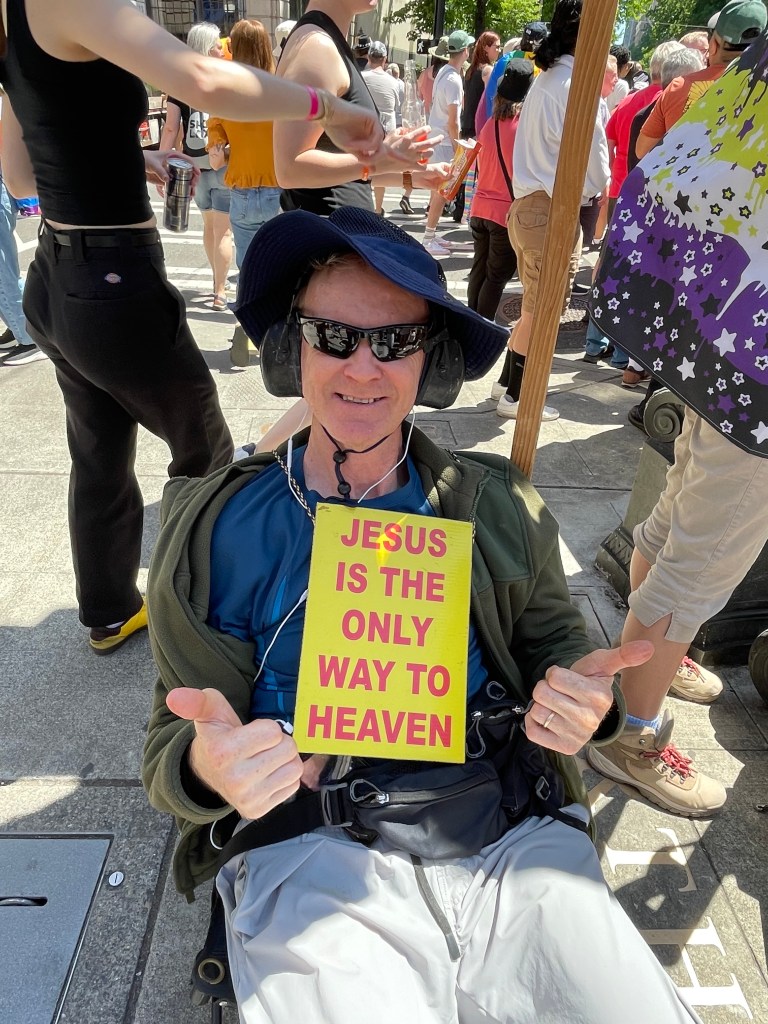
I stopped to take a photo of a fellow (with his permission) who was hunkered down in a patch of shade behind the spectators. 

“But you can’t see the parade,” I said. “It’s not my priority,” he answered.

I assume his small sign proclaiming “JESUS IS THE ONLY WAY TO HEAVEN” was intended as a protest. Well, that’s one in 300,000. We’re each, in our uniquely queer way, one in 300,000, one in a million, one in a billion, quadrillion … one.

One point of view …
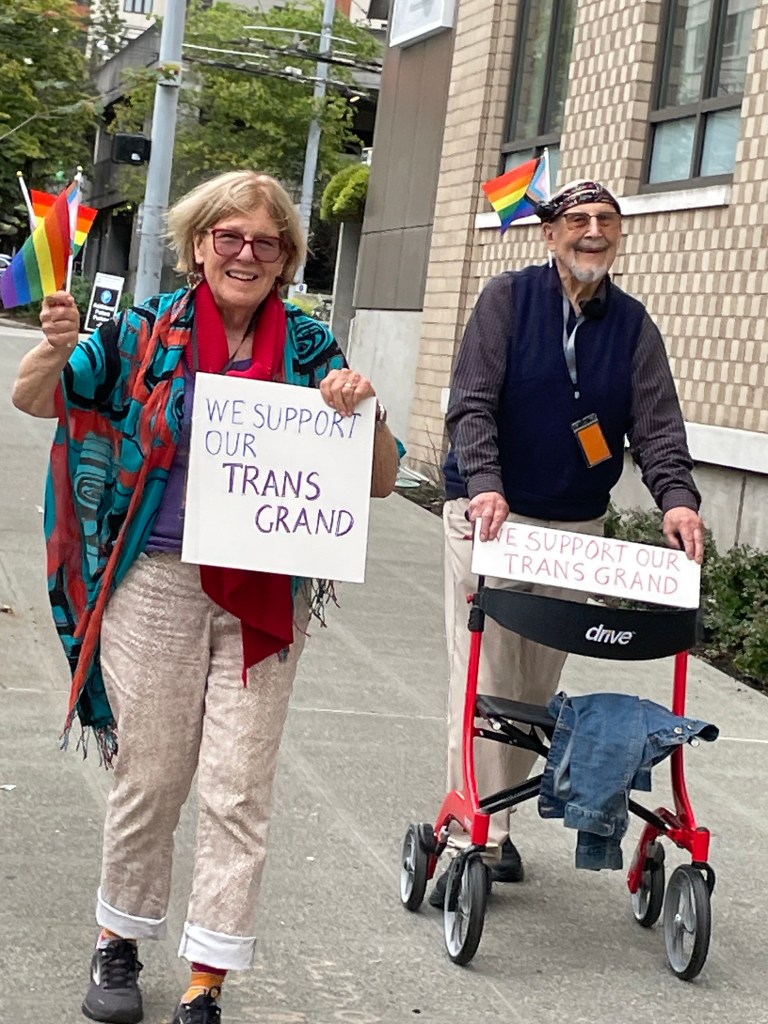
… one other

After The Burn

Having lived in wildfire country for decades, I’ve hiked many miles through burned-out forests. I grieved over fallen giants whose blackened bark served as shrouds. Now an urban dweller, I was recently meandering through a very different environment, a contemporary art gallery dominated by concrete and glass. Until … I turned a corner and was unexpectedly back in the burned forest, or a towering representative of it.

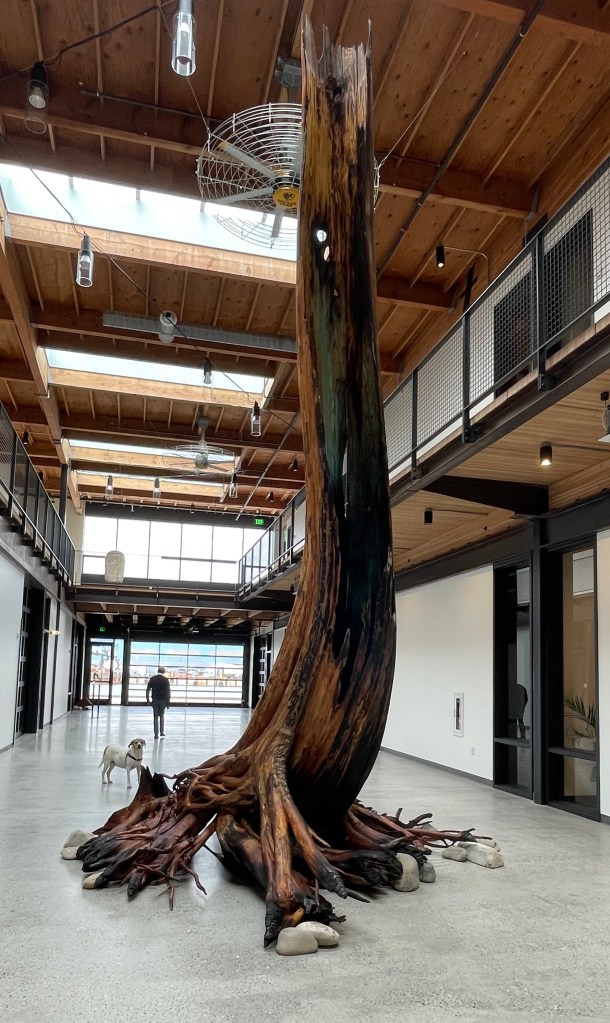
The sculpture, created from the twenty-two foot base and roots of a charred and hollowed western red cedar, is a compelling statement of destruction and resurrection. Tori Karpenko, an artist from Twisp, WA., salvaged the tree’s remains in cooperation with the U.S. Forest Service. Karpenko rubbed oil onto every inch of the massive corpse, giving it an ethereal glow, an essence of life after death.

Karpenko titled the work “Invitation.” It tells a story, Karpenko writes: “Of loss … Of fragility and the delicacy of this moment we are in … Of hope in the promise of renewal … Of community, holding everything from the bottom up.”

I’ve long marveled at the self-healing powers of Creation. Almost immediately after a forest fire, there’s a resurgence of life. Ferns emerge, burying thick ash on the forest floor beneath a lush, green carpet. Myriad seeds spring to life. Reporting on fires for our rural, weekly newspaper was inevitably a bitter-sweet experience for my husband and me. We and our staff would photograph and write about the destruction, the drama of firefighters battling to save homes, lives, property. 

John and I would also give each other knowing looks. We would return to the scene the following spring to hunt for the tantalizing morel mushroom. Several species of “burn morels” hide underground for years until fire prompts them to bloom, often en masse.

It’s well known by now that practices and policies over the past century led to needless destruction of forests and wildlands. Fire is not the enemy. Human conceit is. Not that many years ago, I attended a presentation on wildfire and, for the first time, heard a government forester admit, “The Indians had it right.” For centuries, Native Americans skillfully used fire as a tool to keep the forests healthy and productive. 

I’m not into romanticizing any culture over another. I’m not going to delve into whether any economic system or religious dogma is better than any other. Yet we Americans are obsessed with consumerism, materialism and status.  If we were to adopt the spiritual relationship indigenous people of this continent had with Creation — understanding all lifeforms as sacred — that WOULD make America great again.

“Invitation” demonstrates the beauty that results when humans collaborate with nature, when we work in community with nature instead of exploiting or attempting to dominate. Native American writer and scientist Robin Wall Kimmerer calls this reciprocity. The word is threaded through her best-seller, “Braiding Sweetgrass.”

“One of our responsibilities as human people,” she writes, “is to find ways to enter into reciprocity with the more-than-human world. We can do it through gratitude, through ceremony, through land stewardship, science, art, and in everyday acts of practical reverence.”

As co-creator with nature, Karpenko writes: “The tree, once connected to a family of cedars, was also a community of itself. Interwoven roots growing together, strengthening in response to what was needed. The communities we build are our greatest hope of solving the problems of our time. Perhaps this has always been true, the story of human evolution. How can we forget such things?”

Not everyone has forgotten, and we continue to learn — too often the hard way, as with wildfire. Humanity is on a steep learning curve now, discovering how vitally interdependent we are, on each other, on all of Creation. Karpenko, who once had a fire burn within six feet of his bedroom, observes that we all must own it:

“Somebody else started those fires

but we are all a part of this mess

The smoke belongs to everyone

Regardless of where it came from . . .”

PHOTOS: My photo of “Invitation” does not do it justice, other than to give a sense of dimension. To appreciate its beauty, go to Karpenko’s website, https://www.torikarpenko.com/, or even better, visit the Traver Gallery, 1100 E. Ewing Street, Seattle, where the sculpture is on loan by the artist. The bottom photo was taken after a fire near Holden Village, in the North Cascade mountains of Washington state.

Some Things Endure: Like Joy

Every once in a while, to borrow from C.S. Lewis, I’m surprised by joy.

Saturday morning another Horizon House resident and I attended the GSBA (Greater Seattle Business Association) “Scholars Celebration.” My companion and I were representing Horizon House’s Community Relations and Diversity Committee. DEI is alive and well in our retirement community. 

EMCEE FULLY IN COMMAND OF JOY

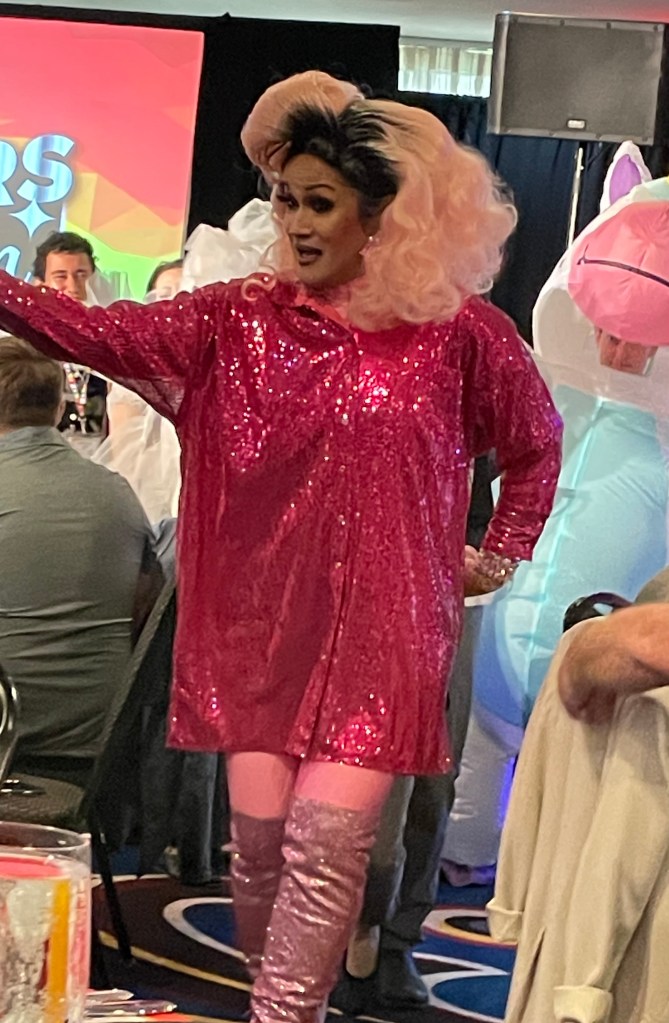
GSBA lays claim to being the nation’s largest LGBTQ+ chamber of commerce. Counting affiliates, there are more than 1,300 members. Given our national emotional chaos, I anticipated a crowd of fearful, angry people. Surprise! The emcee — a flamboyant and outrageously funny drag queen — set the tone. We were a crowd diverse in age, ethnicity and sundry other varieties, but uniformly joyful.

The program highlighted GSBA’s impressive record of handing out scholarships: $7 million during thirty-four years of operation. Of six hundred or so recipients, 49 percent lived with a disability, 51 percent had experienced housing insecurity, 45 percent are from rural areas, and 49 percent are first generation college students. Their graduation rate exceeds the national average.

It’s not just about the numbers. This year’s graduates lined up before us and told us their post-college plans. All of them will make impressive contributions. One of the grads was chosen to tell her story. Older than the average college student and a single mom with an autistic son, she was determined to be the first in her family to attend college. She said she repeatedly bumped into closed doors, “no” after “no,” until she found GBSA’s program and finally heard a “yes.” GBSA scholars not only receive financial assistance, but ongoing encouragement and emotional support. Armed with her bachelor’s degree, this mom is headed to graduate school and a career in public health policy. Sounds dry? Our country desperately needs intelligent, dedicated people setting health care policy. When she finished speaking, there may have been a few dry eyes in the room, but there were none at our table.

Only one GSBA leader briefly addressed the current political situation, not naming names but referring to “that little weasel.” Nonetheless, she said, “They can’t take our joy away.”

I was reminded of Jesus calling Herod “that fox.” In both cases, I think the critters were maligned. Weasels and foxes simply live as they were created to live. We humans manufacture our own brand of meanness and evil. 

We’re also responsible for nurturing our joy, which is not the same as happiness. Happiness comes and goes. Joy is a state of being.

I haven’t written in this space since the new administration took over. I’ve been too dumbstruck. Besides, there’s been a torrent of words: in print, online, over the air. More than enough analyses, assessments, judgments and predictions. One commentator’s observation stuck with me: “If you think you know what’s going to happen in the future, you’re wrong.” Absorbing what is happening in the present is agitating enough.

Last weekend I sat at a friend’s kitchen table while she put felt marker to butcher paper, fashioning a protest sign for a demonstration she would attend that afternoon. She wanted a pithy but meaningful statement. I don’t recall what she ended up with, but I finally have the six words that will help me navigate this challenging time: “They can’t take our joy away.”

What’s With the Three Wise Gals?

During my many decades as a church musician, I’d take a deep breath of gratitude at the arrival of Twelfth Night, either January 5 or 6, depending on who’s counting. Having plowed my way through the annual blizzard of Christmas pageants, carol sing-alongs, renditions of Handle’s “Messiah” and midnight masses, I welcomed the church’s Epiphany — official end of the Christmas season.

In the secular world, Christmas has long since been forgotten by now, buried under New Year’s Eve revelry and (resulting?) “Dry January” resolutions. Meanwhile, in churches Epiphany marks the arrival of the Three Kings. Now a new tradition is taking hold, designating January 6 as “Women’s Christmas.” 

Methodist minister Jan Richardson explains that Women’s Christmas originated in Ireland as Nollaig na mBan, a day when the women, “who often carried the domestic responsibilities all year, took Epiphany as an occasion to celebrate together at the end of the holidays, leaving hearth and home to the men for a few hours.”

A prolific artist and writer, Richardson issues an annual collection of meditations, poetry and illustrations for Women’s Christmas. Her art includes Three Wise Women en route to the manger. (You can see it here.) As I struggle with Christianity’s two millennia of patriarchal oppression, I’m only too happy to see the women gently nudge the old guys aside with their own presence and gifts. For sure, the Kings’ gifts of gold, frankincense and myrrh are highly symbolic and precious. In her poem, “Wise Women Also Came,” Richardson notes the equally essential aspect of women’s giving:

“Wise women also came,
and they brought
useful gifts:
water for labor’s washing,
fire for warm illumination,
a blanket for swaddling.”

This past Christmas I received an unusual, unsought gift: a head cold. I’d decided already to spend the day mostly in quiet solitude. December 25 is my late husband’s birthday. I choose to devote at least part of the day in the presence of his spirit and memories of his life. This year his spirit was having to put up with my sniffles and sneezes. Had he been here in person, he’d have made me his curative hot drink of whiskey, honey and lemon. I settled for diluting my coffee with a little brandy. 

I didn’t feel the least bit sorry for myself. I live between two beautiful cathedrals, St. Mark’s and St. James. The previous Sunday — the Fourth Sunday of Advent — I’d managed to visit both. That last Sunday before Christmas, the church pays close attention to two women: Mary and her cousin Elizabeth. In the morning I heard a woman Episcopal priest sermonize on Elizabeth’s wisdom as counselor to her younger cousin. In the evening, at Catholic Vespers, I was immersed in candlelight and incense while contemplating, “Lo! How a rose e’er blooming … with Mary we behold it … ”

I was well prepared for a Christmas that was as quiet as any “Silent Night,” a Christmas that was healing and empowering. I always smile during December days when people ask the standard question: “Are you ready for Christmas?” I inevitably answer, “I’m always ready for Christmas.” Of course we’re probably talking about two very different states of readiness.

Merry Women’s Christmas. 

(Whether you’re female or male, I recommend Richardson’s free Women’s Christmas guide: https://sanctuaryofwomen.com/womenschristmas.html.  And please note, to not infringe on Jan Richardson’s copyrighted art, I’m using clip art to illustrate this post. You can see her Wise Women here.

Going the extra mile: Kindness drives a city bus

If I had to choose one word to describe Seattle’s Metro bus drivers, it would be “kind.” I could add other words: patient, professional, pleasant, helpful, knowledgeable. Recent events add the word “grieving.” Drivers and passengers alike are mourning last week’s fatal stabbing of a veteran driver. A homeless man has been charged with first-degree murder.

The tragedy felt personal to me and I’m sure to many Metro passengers. We trust and appreciate the drivers who skillfully navigate the clogged byways of densely populated King County. It’s common practice for passengers exiting the bus, even from the back door, to call out, “THANK YOU!”

When I read about the homicide, I immediately thought of the driver I’d ridden with just days before. I don’t know his name, and it’s unlikely I’ll ride with him again — he’s one of nearly 2,500 Metro drivers. He’d been exceptionally helpful, and I hated to think of him grieving, much less worrying about his own security.

King County Council member Peter von Reichbauer issued a statement asking, “If our bus drivers are not safe on Metro buses, then how can we convince our public that it is safe for them to ride?”

I’ve been riding buses for a year now after giving my car away. I’ve never felt endangered, insecure, or even uncomfortable. I know I’m safer climbing onto a bus than into a car. In the United States, the fatality rate for car occupants is twenty-three times higher than those for bus occupants.

The recent ride I mentioned was on a rainy, blustery day. A friend and I had tickets for a concert on the other side of town. We knew we’d have to transfer along the way, but the route schedule was confusing. When a No. 2 bus pulled up, I asked the driver about connecting with the No. 13. It became clear to him that I wasn’t understanding his directions. To save time he simply said, “Just get on.” 

This is where trust enters the picture.

The bus quickly fills with holiday shoppers, including a young family. As one child sleeps in his stroller, his slightly older brother wails about some perceived injustice that his parents can’t seem to resolve. His cries persist above the murmured conversations among passengers on the crowded bus.

We head up breathtakingly steep Queen Anne Avenue. Coming on board is an elderly woman — possibly around my age but with mobility issues. She has trouble navigating her walker across the lowered ramp. The driver gets out of his seat to guide her into place. The sleeping child’s stroller is repositioned to make room for her walker.

Upward we climb. At the next stop, the elderly woman slowly maneuvers her way off the bus. “Oh,” we hear her exclaim over the drumbeat of rain as the door begins to close. “This is the wrong stop!” 

The ramp is lowered again, the driver steers her back onto the bus. “I want you safe” he tells her. “If anything happens to you, it’s on me.” Further up the hill she disembarks, presumably at the correct stop. When we reach the hilltop, the driver sets the brake, stands up and motions to my companion and me to follow him off the bus. I can’t believe he even remembers us among the stream of passengers who’ve been boarding and exiting.

He shows us where to shelter from the rain while we wait for the No. 13. He’s back in his bus, preparing to drive onward when No. 13 pulls up next to him. Our driver once again exits No. 2, tells the No. 13 driver where we’re headed and shepherds us onto that bus. He shrugs off our exclamations of appreciation. My companion, who is always prepared for any occasion, hands him a large, carefully wrapped cookie. He accepts, possibly because he’s not inclined to argue with her. I sure hope cookie handouts aren’t contrary to Metro policy.

May we all be safe during this sacred season, and may we all be kind, just like city bus drivers.

Pro-Active Aging: Mapping a path toward the inevitable

November 5 marked one year since I moved to an “old folks’ home,” as a friend patronizingly describes it. I neglected to observe the anniversary. Apparently other events on November 5 distracted me.

Now I’m taking a breath, reflecting on that decision to turn my life upside down one year plus one month ago. I exchanged a rural riverside home that I loved for a city studio apartment in — NOT an old folks’ home — but what the industry prefers to call a CCRC — Continuing Care Retirement Community. I live independently in my own apartment until, until … I no longer can. Then I’ll be appropriately cared for.

Do I miss my previous life, the people and place I left behind? Every moment of every day. Did I do the right thing? Absolutely.

I carry this paradoxical load of joy and sorrow by embracing both present and past with gratitude. I’m thrilled to be where I am: in a vibrant community, soaking up the energy and culture of a large metropolis. All the while, I revel in memories of rich relationships and events that once were and can be no more.

During the final hectic weeks of preparing to move last year, seeds of doubt threatened to erupt into full-blown angst. To ward off inner explosions, I kept a list in my journal under the heading,“Reasons For Moving.” No. 1 on that list was “Pro-Active Aging.” More than anything else, I wanted to make my own decisions while I still had the capacity to make them. Above all, I didn’t want to reach the point when family and friends would debate, “What should we do with/for/about dear old Mary?”

I’m not interested in denying the effects of aging. There’s no debate. Our bodies and our mental capacities change. I’m interested in acknowledging those changes, accommodating them, even savoring them. Age is a convenient avenue for setting boundaries: No thank you. Not interested in going there. Not doing that. And the world shrugs its shoulders. What d’ya expect? She’s old!

Even as my own Earth-bound future grows shorter, I care about the future of our world. No. 3 on my “Reasons” list (after No. 2 — financial) was “Lower My Carbon Footprint.” That could’ve been a sub-head under No. 1. One of the most vexing issues for families with aging members is convincing them to stop driving. For too many, losing the freedom to drive is the death of independence. 

I recall a friend at age 90 gleefully maneuvering England’s country roads, one leather gloved hand on the wheel, the other briskly shifting gears as we sped from curve to corner. “They’re going to have to pry my cold, dead fingers from around the steering wheel,” she declared. They didn’t have to. A paralyzing stroke ended her driving days.

I gave away my car before it became an issue. I revel in the true independence offered by mass transit. No hassles with parking, gas prices, insurance, maintenance and repair bills. And, oh my, the interesting people one can engage with on the bus.

“Want little: you’ll have everything,” advises Portuguese poet Ricardo Reis. He continues, “Want nothing: you’ll be free.”

I’m not suggesting everyone should follow my path of aging. We each find our own route, which is why some folks call it (s)aging. We don’t have a choice. Aging begins with that first breath and continues throughout our lives. I’ll not quote that old saw — the one that says growing old beats the alternative. 

Oh. I guess I just did. A sign of age?