The Play’s The Thing–England 2019 Part Three

fullsizeoutput_216b
At Shakespeare’s Globe Theater the cheap seats aren’t seats at all but standing room in the “pit,” directly in front of the stage

When you take a seat on a plane, train, or bus, you expect to travel a set number of miles in a specific amount of time. When you take a seat in a theater for a live stage performance, you can anticipate an infinite journey across time and space.

I signed up for a week-long, Road Scholar tour featuring London theater. I knew I’d see six plays in as many days but I didn’t know which ones. Formerly known as Elder Hostel, Road Scholar specializes in educational travel for seniors. The tour included lectures and other adventures during the day and a play each evening. It was a satisfying mix: some Shakespeare, some contemporary, some comedy, and plenty of soul-searing drama.

Live theater is all about being “in the moment.” Many, if not all of the plays spoke to what’s going on in our world today: especially politics and the #MeToo movement. The week began with “Bitter Wheat,” billed as a farce but in reality a disturbing commentary on the Harvey Weinstein scandal. The main attraction was the chance to see the brilliant actor, John Malkovich, live on stage. The play was still in previews, and as we watched, David Mamet—its celebrated author—stood directly behind us, more or less breathing down our necks. Many in our group who disliked the play were joined by newspaper reviewers a few days later, after it officially opened. Some of the reviews were more scathingly clever (like this one) than the play itself.

Politics can unite and divide. Both the U.S. and England are experiencing a profoundly divisive political era, which, playwrights would remind us, is nothing new. More than a century ago Henrik Ibsen wrote “Rosmersholm,” a dark drama enmeshed in political differences, with suicide and incest added for flavor. During England’s Thatcher era (when Conservative Margaret Thatcher became England’s first woman prime minister), Caryl Churchill wrote “Top Girls,” an examination of the severe cost to women who aspire to power—and not just political power. Our seats in those theaters were comfortable enough, but the message? Not so much.

Sometimes the setting itself—even the audience—can have as much a role in the play as leading characters. The Old Globe is a modern recreation of Shakespeare’s theater, allowing us to experience the bawdy hilarity of his era while watching “The Merry Wives of Windsor.” Action was not confined to the stage, but spread into the “pit,” where the rabble of Shakespeare’s day would’ve been standing. And drinking. And brawling.

fullsizeoutput_2169
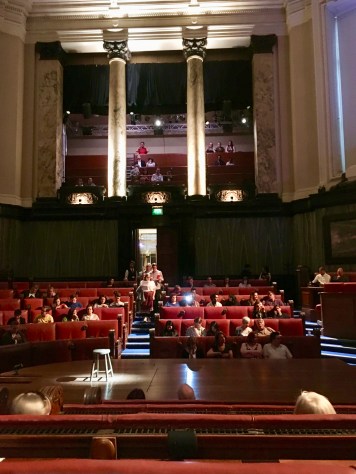
County Hall council chambers: somber setting for a murder mystery

Agatha Christie’s venerable mystery, “Witness for the Prosecution,” was performed in the opulent council chambers of County Hall, once the seat of local government. The play—a murder trial— is lightweight entertainment, but the setting gave it the somber depth a murder trial deserves.

My favorite—the show I want all the world to see—was “Come From Away,” a musical about, of all things, 9/11. After the attack, thirty-eight planes were ordered to land in the small Canadian town of Gander. The tightly choreographed musical is based on the true experiences of those small-town citizens and the seven thousand stranded visitors they hosted. It sugar-coats nothing but depicts the full spectrum of human behavior, from prejudice to compassion, from hostility to charity.

Six evenings. Six plays. Sunday I would board the plane taking me from London to Seattle, a journey of mere miles.


All Aboard? Not Quite–England 2019 Part Two

IMG_0434
View from the front seat

“These trains get funnier looking all the time,” the bus driver mused for the benefit of his passengers. I’d planned on boarding a train that morning, heading to London after a wondrous if rainy week in the Cotswolds.

Did Great Malvern Station have it in for me, I wondered. Earlier in the week I couldn’t get off the train there, and now I couldn’t get on. Instead, a line-up of motor coaches awaited at the station. The Great Western Railway was taking advantage of a Sunday morning lull to do track repair. I’d be riding a bus as far as Evesham, where I’d transfer to the train.

I settled in a front seat to take advantage of the panoramic view through the windshield. That put me in conversational proximity with the driver, who was genial in a John Cleese sort of way.  At each stop he’d cheerfully welcome passengers aboard, then as the bus started rolling again, he’d get on the intercom: “Captain speaking. Seatbelts are provided for your safety, not comfort. If you choose not to use one and are caught, the fine is a hundred quid.”

His driving style was skilled yet casual. He needed only his right hand to guide the massive coach around even the sharpest corners while his left tapped the steering wheel, matching the rhythms of music playing softly on his radio.

When he learned I was from the United States, he said, “I guess this is the question all Americans get asked—is Trump good or bad?”

“Is Brexit good or bad?” I responded. I’d meant the question rhetorically but he replied, “I guess they are pretty much the same,” and launched into his assessment of Brexit.

“It’s stupid,” he began, declaring it wouldn’t help anyone. No one was willing to listen to people who knew anything, he continued. The problem, he declared, is that “this generation” (his own, presumably) has never had to suffer.

“You mean like the World War II generation did?” I asked.

“Exactly,” he answered.

Later, on my fifth day in London, I gave up hoping that the bronchial cough I’d been fighting for two weeks was going to cure itself.  I was in a National Health Service waiting room, where twenty or so people sat quietly, like me, waiting to see a physician. In front of us was a giant TV screen, showing a news broadcast with volume off. Dialogue captions crawled across the screen. As I watched, the announcers were revealing the three finalists in the race for prime minister.

Somehow I’d managed to visit England at a time of political vortex, arriving the week following President Trump’s visit and amidst the chaos of an election. Or seeming chaos. The consensus seems to be that Boris Johnson has a lock on the prime minister’s spot. I looked around the room to measure reactions to the latest news, and there were none. Most people were either consulting their phones or staring into blank space.

What if no one cares?

Mind The Gap–England 2019 Part One

fullsizeoutput_20ec

After forty-five minutes on the airport shuttle, ten hours in the air, forty-five minutes in a bus followed by two-and-a-half hours on the train, I’d finally reached my destination: Great Malvern, Herefordshire County, England. Waiting for me was my long-time friend, Jan, who is celebrating her ninetieth birthday.  As the train slowed, I donned my backpack, slung my laptop bag over my shoulder, and wheeled my suitcase to the end of the car, where I waited for the exit door to open.

It didn’t.

“How do you get the door to open?” I called back to the nearly empty car. A young woman who’d been sitting across from me quickly rose from her seat and ran to the door. By the time she reached me, the train had begun rolling again. She whipped out her phone to consult the train schedule.

“The next stop is Colwall. You can get off there and wait for the next northbound train back to Great Malvern. They won’t charge you,” she assured me. The train pulled up to Colwall, which  offered nothing more than a small shelter, like you find at city bus stops. There was no one around.

“Will you be alright?” she asked with concern. I assured her I would be. I was not at all sure as I stepped into the rainy, English countryside. An electronic sign promised the northbound train would arrive in thirty-five minutes. Before long, a weathered, older-looking man showed up.

“This [bleeping] weather, you can’t do [bleep]!” he exclaimed. He continued to complain about the “[bleeping] rain.”

“Where I live, we welcome the rain,” I said brightly.

“Where’sat?” he asked.

“Western United States,” I answered.

“Oh, well,” he shrugged dismissively.

He’d recently retired from farming, I learned: “Seventy years old, and I decided fifty-three years o’ it was enough,” he said. He was headed south to Hereford for the afternoon, he said. Might as well, because in “this [bleeping] weather, you can’t do [bleep]!” he repeated.

The train to Hereford arrived.

“Nice to meetcha,” he grumbled in farewell.

It was my first conversation with a Brit since landing in England hours earlier. I missed the customs officer from my last trip who asked me why I didn’t visit more often. Going through customs is all automated now. You slide your passport through a scanner that simultaneously takes your photo. Ticket sellers at the bus and train stations don’t have time or inclination to chat amidst the throng of passengers. I would’ve struck up a conversation with the young woman on the train, but she’d been concentrating on her phone the entire time.

Finally I boarded the northbound train and planted myself next to the door. Back at Great Malvern, I pushed the exit button with fierce determination.

“MIND THE GAP,” the traveler is consistently warned. This time the door opened and I stepped across the “gap,” a space of thin air between the train and concrete landing. Minding the gap, I’d arrived at last at my destination.

fullsizeoutput_20ee

Covered Piles of Stuff: My Stuff & Stories May 31

fullsizeoutput_1fdbI could go on, but mercifully I will not. For the past month, during which I celebrated my seventy-fifth birthday, I’ve posted daily blog entries about stuff I’ve acquired through these seven-and-a-half decades. This Google satellite photo illustrates comedian George Carlin’s famous observation: “A house is a pile of stuff with a cover on it.”

The cover on my pile of stuff is in the center of the photo. On the right is my former home, which allowed for a much larger pile of stuff. On the left is a rental home, where new folks are just now moving in with their pile of stuff.

The stuff I wrote about didn’t include essentials, such as stove, refrigerator, bed, couch. The stuff I featured had to have a story. My reasoning is that we don’t hang onto cherished stuff for practical reasons but for reasons of the heart.

I’m afraid I didn’t make that entirely clear, because a couple of readers suggested that I simply take photos of the stuff, give the stuff away, and enjoy the photos, which require less space. I already have way too many photos stashed away as it is. More important, to badly paraphrase an adage attributed to Pierre Teilhard de Chardin, we are spiritual beings having a physical experience. A photo is not the same as touching, looking directly at, being surrounded by, and appreciating the mysterious ways atoms come together to create the stuff that we love. I relish the physical presence of my storied stuff in my space, even if it does create clutter.

As I sorted through the stuff, I discovered a few items to give away. Their stories had faded or weren’t so great to begin with. That does NOT mean I’ve created shelf space for more stuff. If you’d like to binge-read the entire series, you can find it on my website archive. I deeply appreciate all who have followed the series, and I’ve enjoyed your comments.

Digitally Doomed? My Stuff & Stories May 30

fullsizeoutput_1fda
A part of my digital inventory. I’m stuck between not wanting to go back and not wanting to go forward in the computer age.

I’m glad to belong to the generation that witnessed the dawn of the digital age and its impact on our day-to-day lives. Younger generations have no more clear picture of what life was like before computers than I can conceive of what it was like when horses were the primary mode of transportation.

I’d never want to go back to manual typewriters, pay phones, stopping at gas stations to ask for directions, and loading film into cameras. But I’m not much interested in going forward either. I have all the personal devices and apps I need. More in fact.

Not in the photo of my digital world is the Amazon Dot, “Alexa.” I bought it for my centenarian friend, Elizabeth, who could no longer see well enough to operate a CD player. I figured she could use voice commands to play music. Sadly, she died before I got it set up. I brought it home and use it as a timer or to stream music. I continually receive emails detailing all the wonderful things I could be doing with Alexa. My response is, “Who needs it?”

That was my response when tablets arrived on the scene. Then I attended a recital featuring a pianist who was reading his music on an iPad and turning pages with a foot pedal. Instantly I realized, “I need that!”

When Facebook arrived on the scene, I wondered “Who needs it?” Apparently 2.7 billion people.

Before moving into my smaller house I measured to make sure there’d be room for a small grand piano. I bought a high-end keyboard, thinking it would serve me temporarily until I found the right acoustic grand. That was five years ago. If a grand piano were to land in my lap (unfortunate metaphor—that would hurt!), I’d make room for it. But I still wouldn’t give up the keyboard and its varied sounds, rhythmic functions, recording ability. I need those.

Innovation continues to happen, and obsolescence is an essential part of digital marketing. Whatever you just bought is obsolete the day after the Amazon drone delivers it. A lot of people worry about the impact of Artificial Intelligence. That doesn’t worry me as much as human intelligence, or the lack thereof. Self-driving cars are predicted to take over the roads just around the time when I should give up driving. I’m sure I’ll need one of those.

(To celebrate my 75th birthday this month, I’m posting daily stories about the stuff I’ve acquired over a lifetime and can’t let go of. I invite you to consider the stories attached to the stuff you treasure—maybe even share them.)

High School Yearbooks: My Stuff & Stories May 29

Scan 3
From my senior yearbook: My last name isn’t the only thing that’s changed!

Raise your hand if you still have your high school yearbooks. I’ll bet most people hang onto them out of nostalgia, or for no better reason than to refresh their memories before attending class reunions. I was on the yearbook staff my senior year in high school, though I have not attended a reunion since the twentieth.

I graduated from a large school—more than four hundred in our class. The first two reunions were massive, noisy cocktail parties, with little opportunity for meaningful conversation. I’m still in touch with three of the surviving members from the Class of ’62, and I’ve promised I’ll attend the sixtieth reunion in three years—if I’m still alive and if there’s still enough organizational energy to put one together. The email invitation to the fifty-fifth reunion included a sobering list of classmates who’d reached their ultimate graduation.

When I leaf through the pages of that 1962 yearbook, I’m more absorbed by the photos of teachers than of my fellow students. The first reunion I attended—the tenth—I was disappointed that no teachers were there. Had they even been invited? I finally realized that teachers surely have better things to do than attend class reunions, year after year. 

Those teachers’ faces in the yearbook remind me of the lasting impact they’ve had on my life. I’m sad that I never let them know that. They’re most certainly gone by  now. I remember running into one teacher, Robert Thornburg, when I was in my thirties. He’d been my eighth grade English teacher, and I’ve never forgotten a comment he made on a theme I wrote. My opening sentence was, “Music is the universal language.” His response in the paper’s margin was, “Says who?” An appropriate challenge for someone headed toward a journalism career.

He seemed to enjoy challenging me, as if he thought I could become something special if I’d try. And I wasn’t the only one. Mr. Thornburg moved from junior high to teach at our high school and, among other things, was yearbook advisor. That’s why I wanted to be on the staff. When I bumped into him (metaphorically) all those years later, I happily told him I was an editor for the Associated Press. He smiled and nodded.

Why didn’t I say, “Your classes and your faith in me have been instrumental to my career” … or why didn’t I simply say, “thank you”? I sure wish I had.

(To celebrate my 75th birthday this month, I’m posting daily stories about the stuff I’ve acquired over a lifetime and can’t let go of. I invite you to consider the stories attached to the stuff you treasure—maybe even share them.)

Edna Mae: My Stuff & Stories May 28

fullsizeoutput_1fca
Edna Mae as a young woman

My mother-in-law, Edna Mae, died owning little more than the clothes on her back. That’s exactly how she wanted it. The morning after her death, I cleaned out the drawers and closet in her room at the nursing home. After donating her clothing, I walked out with only a small box of personal items and memorabilia. I remember feeling sad and thinking, “There should be more.”

As she’d aged, she carried the concept of down-sizing to an extreme. The few things that mattered to her were passed on to younger generations. She kept only the necessities for day-to-day life. A veteran of the Great Depression, she needed and wanted very little. Even Christmas gifts were routinely returned to the giver.

Frugality was her religion. Toward the end of her life, she lived with us for a while. One evening I was clearing the table after dinner. We’d had a casserole that had been left-over from left-overs. There was still a tiny bit in the dish—not enough to choke a sparrow. She saw me scrape that bit of food into the garbage and declared sternly, “That’s wicked!”

At one point we learned she’d burned the daily diaries she’d been keeping for years. I suspect it was less about clearing clutter and more about keeping her private life private. The diaries from her later years made it safely into her granddaughter’s care. Then they too were burned when Katie lost her home in the Carlton Complex Fire. It was as if the Universe were adhering to Edna Mae’s wishes.

All family photos are precious. This one of Edna Mae is especially dear to me. It was taken, I believe, for high school graduation. In her eyes, I see a glint of the “gotcha” genes her son inherited. She walked to the beat of her own drum, raised her kids well, and loved her husband above all else.

Her final years were miserable. She was in pain both physically and emotionally. Her husband and one son had died. Her other son was in a wheelchair and unable to speak with her. Dementia had erased her spirited, adventuresome self. The photo reveals who she was, how she loved life, and how life loved her back.

(To celebrate my 75th birthday this month, I’m posting daily stories about the stuff I’ve acquired over a lifetime and can’t let go of. I invite you to consider the stories attached to the stuff you treasure—maybe even share them.)

The Letters: My Stuff & Stories May 27

fullsizeoutput_1fc9I’d intended to burn them when I moved and down-sized. Three boxes of letters, two large ones containing John’s letters to me, and one small box of my letters to him. He could always out-write me. He’d sit at the typewriter, later computer, and punch those keys with the passionate fury of Horowitz playing Chopin.

As I prepared to burn our pre-marital love letters from more than forty years ago, I made the mistake of opening and reading one. And then another. I could read no further, but I quickly realized there’d be no incinerating John’s letters—although they were hot enough to ignite a flame on their own. He wrote three or four pages every day, the words flowing, the sentiment naked and honest. I wrote maybe a page or two a week, reserved, cautious.

I was working in Seattle, weary of my job as an AP editor. I lived on Vashon Island, a beautiful place I swore I’d never leave. He was, of course, in Omak, where I claimed I could never live. Besides passion, there was a lot of negotiation in those letters. We wrote our way toward the epic decision of marriage and my relocation.

The letters have been stored in the far corner of a high shelf, where I wouldn’t see them but be assured of their presence. Today, Memorial Day, I didn’t go to the cemetery, with all the flags, flowers, and people. As the poet Mary Elizabeth Frye observed, John is “not there.” Instead, I dragged out the stepladder and retrieved the boxes of letters. That’s where I find John. His presence in those letters is so real, I cannot read more than one or two. It’s a paradox. His presence in the letters makes his absence more vivid.

The letters still need to be sorted, possibly burned. Another project for “Someday.”

(To celebrate my 75th birthday this month, I’m posting daily stories about the stuff I’ve acquired over a lifetime and can’t let go of. I invite you to consider the stories attached to the stuff you treasure—maybe even share them.)

Someday: My Stuff & Stories May 26

fullsizeoutput_1fc8These are my “someday” projects. When you turn seventy-five, you begin to realize that your opportunities to find that “someday” are steadily diminishing. This odd assortment of notebooks, journals, and scrapbooks are the private musings of four people: my father, mother, husband, and me.

Especially precious is the “Scrap Book” (lower left), compiled by my dad for my mom during the years they were courting. It has various clippings and a number of Dad’s own poems. I never knew he wrote poetry as a young man until I found the “Scrap Book” while emptying my mother’s apartment after her death. We kids knew our parents loved each other deeply. At the end of every meal, Dad routinely rose from his chair, walked to Mother’s end of the table, and gave her a thank-you kiss. Still, I was surprised and moved when I read the tender poems he wrote for her before they married.

Mother’s journals make up the two stacks in the upper right. Some date from before their marriage. Her diaries were sporadic as she raised three kids, but later in life she was a faithful journalist. When she died I packed them all up and put them on a back shelf. I needed time before reading them, before invading her privacy. Yesterday was the tenth anniversary of her death; I think I’m about ready to start reading.

The spiral-bound notebooks on the lower right are my late husband’s, just a few from the large stack that I put in storage. John began what he called a “phone message log” on Jan. 18, 1984. Those were the days before texting and email. He was on the phone constantly, scribbling notes with each call. His note-taking expanded into recording each conversation in the office, business activities, meetings, private conferences, and personal concerns. These jottings leave me breathless from the scope and variety of his daily activities. Most poignant are his final entries in late November, 1993. “Don’t feel well,” he notes, just days before the stroke that would paralyze him and end his note-taking.

In the top left are some of my own journals. “Someday,” with the help of John’s notebooks and my journals, I may finally finish the memoir I’ve been struggling with for more than a decade. “Someday” I’d like to write a biography of my parents, based on Dad’s “Scrap Book” and Mother’s journals. I’m telling myself, “Someday” had better come soon.

(To celebrate my 75th birthday this month, I’m posting daily stories about the stuff I’ve acquired over a lifetime and can’t let go of. I invite you to consider the stories attached to the stuff you treasure—maybe even share them.)

It’s All Temporary: My Stuff & Stories May 25

fullsizeoutput_1fc6.jpegIf Okanogan County were to elect an official county bird, I would vote for the quail. I understand this quirky little bird is not native to the county, but then neither am I. With its bouncy topknot, woo-hoo call, and clumsy strut the beloved quail is frequently found in the work of local artists. Some of my favorite quail representations are in the pottery of the late Everett Lynch (1898-1988).

A retired U.S. Forest Service district ranger, Everett and his wife Dorothy, a weaver, were giants in the local arts and crafts scene. I felt privileged to interview them not long after I moved here. I always feel privileged to interview artists of note, and I was already familiar with Everett’s work. One of our wedding gifts was a covered dish created by him, inscribed “for John + Mary.” (top shelf of photo) Since then I’ve acquired quite a bit of Lynch pottery thanks to the sharp eye of my antiquer friend, Harley, who occasionally finds his work at (gasp) yard sales.

I believe Everett made his pottery not only to be admired but to be used. That, of course, comes with the risk of breakage and chipping. I’m willing to take the risk in exchange for the simple joy of holding and using art in every day life. Yet when I broke the beautiful brown bowl with quail design (top shelf, right), I was appalled. It had been one of my favorites. It was a clean break, though, right down the center. I glued the two pieces together and continue to use the bowl for late night popcorn.

That’s the point of collecting and keeping stuff. It’s a show of appreciation and, at the same time, an acknowledgement that all things material are in some sense fragile, temporary, or in a temporary form. All our stuff will eventually break, shatter, erode, melt, fade, rot, or evolve into something else. As do we.

fullsizeoutput_1fc7
Pottery by the late Everett Lynch

(To celebrate my 75th birthday this month, I’m posting daily stories about the stuff I’ve acquired over a lifetime and can’t let go of. I invite you to consider the stories attached to the stuff you treasure—maybe even share them.)