Lighting My Fire: My Stuff & Stories May 24

fullsizeoutput_1fc5Last night, on the eve of a rainy Memorial Day weekend, I indulged myself with a seventy-five-year-old’s version of a campfire. Certainly there are more attractive chimineas than this battered, rusted Coleman so-called fire pit, but the brand name alone makes me nostalgic.

I think of the Coleman kerosene lantern and Coleman two-burner gas stove that my husband and I hauled around on numerous camping trips. We even had one of those impossibly heavy Coleman canoes. I never did master the stove. That was probably a ruse on my part because it made John responsible for all the cooking. Consequently, he was a happy camper.

The lantern and stove are long gone, along with the tent, backpacks, and other paraphernalia, but I still have both our goose down sleeping bags. They, of course, can be zipped together. I can’t remember the last time I slept in a sleeping bag, yet I refuse to give them up. Seems to me, in this age fraught with uncertainties, every home should have sleeping bags, just as every home should have a first aid kit, a supply of bottled water, batteries, emergency food, etc., etc.

Forty years ago this weekend, John and I went on our first camping trip as newlyweds. We met up with another couple at Salmon Meadows, a U.S. Forest Service campground, elevation about 4,500 feet. I remember standing around the campfire watching snowflakes melt in our steaming coffee mugs.

I’ve known people who continue to backpack and camp well into their eighties. I’m happy to limit myself to day hikes so I can sleep in a bed at night. The Coleman fire pit, which can double as a barbecue, was given to me some fifteen-or-so years ago by one of John’s healthcare aides. Her family had outgrown it. Much as I enjoy it, I rarely use it. Just on these cool spring evenings before the inevitable burn bans of summer, when the smell of smoke is no longer pleasurable and the air becomes acrid from wildfires.

(To celebrate my 75th birthday this month, I’m posting daily stories about the stuff I’ve acquired over a lifetime and can’t let go of. I invite you to consider the stories attached to the stuff you treasure—maybe even share them.)

Tawny: My Stuff & Stories May 23

fullsizeoutput_1fc4
Tawny just back from one of his escapes, exhausted, elated

Many’s the time I’ve thought about giving him away. Maybe a notice on Facebook: “Free to good home. Four-year-old neutered male, 44 pounds, shots current, housebroken. Loves people and other dogs. Breed uncertain. Only a little neurotic.”

He arrived at my home, a pup in the arms of a friend who’d found him abandoned.

“I already have two dogs!” she pleaded. I had one dog, Daphne, a mixed-breed black lab, dear to my heart. She was seven at the time, and I thought that was a good age to bring on another dog—old enough to teach the younger dog manners and young enough so the two could run and play together. Turns out, she barely tolerates him.

This pup had all the features neither one of us wanted in a dog. He’s male. That leg-up thing alone is a non-starter. I spent an entire career putting up with obnoxious males who assumed they had the proverbial leg-up on me and other women.

But we’re talking about a dog. He sheds copiously, his light fur floating through the house, mixing with Daphne’s black, mandating daily vacuuming. I named him Tawny in accord with his color. I should have named him Coyote in accord with his personality. He has all the characteristics of the mythical native coyote trickster, including a “gotcha” grin.

He never fails to take advantage if a door or gate is accidentally left open. Off he goes on a wild chase around the neighborhood, ignoring my commands and/or pleas to “Come!” If I try to catch him, he dances off, thrilled to be playing this game. After fifteen or twenty minutes of running and sniffing, he returns home, panting, deliriously happy.

His worst trait: he digs. Yesterday afternoon I saw him digging where I’d just planted flowers. I don’t hit dogs, especially not Tawny. A strong vocal command alone terrifies him. (I suspect he was abused as a pup by the human who ultimately dumped him.) I rarely am lucky enough to catch him in the act, so I burst out of the house yelling, “NO! STOP DIGGING! BAD, BAD, DOG!” He immediately ran to a far corner of the yard, where he cowered for hours.

Eventually we get over these escapades. He rests his chin on my knee and looks at me with eyes that spell love. He’s not the dog I wanted, but he’s the dog I have. Or does he have me?

(To celebrate my 75th birthday this month, I’m posting daily stories about the stuff I’ve acquired over a lifetime and can’t let go of. Tawny’s not “stuff,” but I sure can’t let go of him. I invite you to consider the stories attached to the stuff you treasure—maybe even share them.)

The Etude: My Stuff & Stories, May 22

fullsizeoutput_1fc2
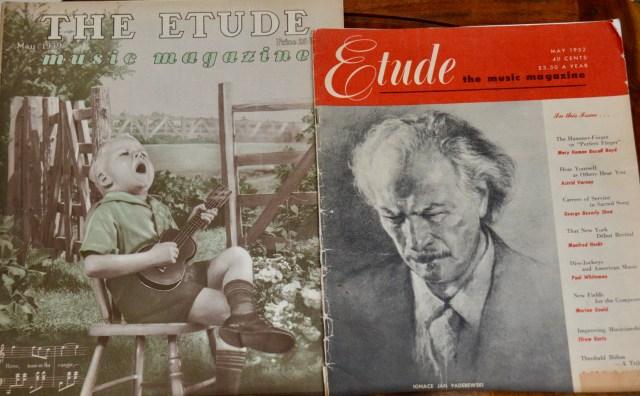
On the left, an Etude from May 1939, and on the right, the May 1952 cover featuring composer Ignace Jan Paderewski (1860-1941), looking not nearly as pleased as the young ukulele player

When I was a fledgling piano student, the most exciting event of each month was the arrival of “Etude” music magazine in the mail. My piano teacher, like most, taught according to a “method,” a series of music books that guided students from a basic beginning to gradually more complex music. Didn’t matter what a student’s individual interests or abilities were, the “method” was followed religiously, page by page. No chance of moving on to triplets until AFTER you’d mastered eighth notes.

That’s why the “Etude” was so delicious. Tucked into its pages between essays about great composers and advice columns for music teachers, was actual sheet music, including music for young players like me. The pieces were graded, so I knew I could just sight-read Grade 1 music and maybe be challenged a bit by Grade 2. I was thrilled when I mastered a Grade 3 composition. I would spend just enough time practicing my assigned “method” pages to assure my teacher that I was progressing. Then I’d play from the “Etudes” for my own pleasure. My mother didn’t know that I wasn’t practicing, but playing. It was all music to her.

I have collected “Etudes” over the years, partly out of nostalgia, but mostly because I still prefer playing over practicing. I have nearly two hundred of the more than eight hundred “Etudes” published by Theodore Presser Co. between the years of 1883 and 1957. The oldest magazine in my collection is from July 1907; the newest, December 1954. Each month I pull out the magazines that were published in that particular month and play some of the music, everything from classics to contemporary composers of the day. I’m proud to announce that I can pretty much sight-read my way through grades 4 and occasionally 5. Many of the “modern” compositions are extraordinarily corny, occasionally with politically incorrect titles referencing various ethnic groups. Much of the music, however, has withstood the test of time. So have many of the essays and advice columns.

There isn’t much of a market for “Etude” magazines. My antique dealer friend, Harley, has been trying to sell duplicates from my collection with no takers. On-line I’ve seen offers ranging from $1.50 per magazine (that’s what it cost for an annual subscription in 1907) to one being offered on etsy.com for $104.96 with free shipping. I wish that purveyor well, but I suspect they’d be better off playing instead of selling.

(To celebrate my 75th birthday this month, I’m posting daily stories about the stuff I’ve acquired over a lifetime and can’t let go of. I invite you to consider the stories attached to the stuff you treasure—maybe even share them.)

Morel Moral: My Stuff & Stories May 21

fullsizeoutput_1fbeThere’s a myth about downsizing that goes something like, “Once you get rid of this stuff, you’ll never miss it.” So not true. Many times over the past five years, since I moved from an unreasonably larger home to a reasonably smaller one, I’ve had this inner dialogue:
Me: “Now where did I put [whatever] … ?”

Myself: “You’ve looked in all the likely places?”

I: “I’ll bet you gave it away.”

Me: “No. Never. Not me. It’s too precious.”

Myself: “Speaking for myself, it was probably time to let go of [whatever] …

I: “I’m not sure I can ever forgive myself for that.”

Me: “Don’t blame me!”

Just today this discussion ran through my head as I searched for my husband’s extensive collection of books on identifying, collecting, and cooking wild mushrooms. It all started when my friend Marilyn and I decided to hunt morel mushrooms this morning. It’d been years since I’d hunted morels, most certainly one of the world’s finest fungi. I relished the opportunity for us to be one in spirit with our late husbands, both of whom were aficionados of morel collecting and cooking.

After several hours, she’d found six, I’d found three, and the nine of them were so small they couldn’t cover a twenty-dollar bill. Which is exactly what I happily paid per pound later in the afternoon for freshly picked morels at the Farm Stand in Okanogan.

Since I’d been thinking of nothing but morels all day, I drove home salivating. I thought about John’s books. Maybe I’d find a tantalizing recipe. Yet I couldn’t find the books on any of the obvious shelves. Had I betrayed him by giving away his beloved mushroom books?

I didn’t really need a recipe. Morels are utterly delicious just fried up in butter with maybe a tiny splash of wine. But how could I enjoy them in the midst of guilt, regret, and sorrow? Finally I remembered an obscure, high cupboard, reached by climbing a ladder. There were five books, our favorite five of John’s collection. They’d been hiding, just like morels like to hide from their hunters. I’ll spend a while thumbing through the books and then probably fry the morels in plenty of butter with a splash of wine.

(To celebrate my 75th birthday this month, I’m posting daily stories about the stuff I’ve acquired over a lifetime and can’t let go of. I invite you to consider the stories attached to the stuff you treasure—maybe even share them.)

Good Vibrations: My Stuff & Stories May 20

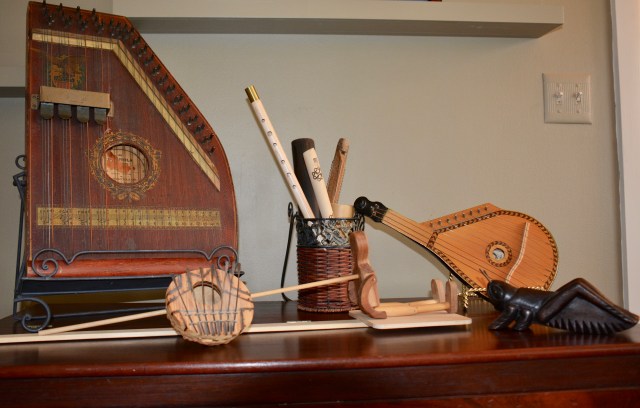
fullsizeoutput_1fb4They all vibrate—either by strumming, or plucking, or striking, or tapping, or rubbing, or blowing into them. And those vibrations make music. There are so many ways to create music and so many ingenious musical instruments in the world. This is just a sample of my humble yet global, intercultural collection of instruments.
I think this compulsion first hit in 1962 at the Seattle World’s Fair. I purchased a wooden flute (the one leaning to the right) at the Yugoslavian exhibit. Or was it Czechoslovakian? Ever since, I haven’t been able to stop myself from gathering musical instruments like a hen gathering chicks. In addition to the music makers around my house, I keep a drawer full of tambourines, drums, and various jingling, ringling instruments at my church. Episcopalians, among several Protestant denominations, may be known as the “frozen chosen,” but we can cut loose on a good ol’ spiritual or Gospel song when abetted by appropriate percussion.

Knowing my weakness, friends and family have added to my collection, especially those who are world travelers. Among many gifts, I received a nose flute from Africa, a Melodica from Germany, and a “piping chanter kit” from Scotland. The kit, complete with instruction tape and booklet, is a way to play the bagpipes without the bag. I have yet to master it, bag or no bag.

The photograph includes an antique (on the left) that I believe is a precursor to the more modern autoharp, the instrument Mother Maybelle Carter made famous—not to mention Brian Bowes in the Pacific Northwest. I haven’t figured out how to make the antique playable, but I have three modern, working autoharps to make up for it.

One of my favorites (and my great-grandson’s favorite) is the wooden fellow sitting so stiffly on his paddle. But when you stand him up and get his paddle bouncing, he can tap dance like nobody’s business. The cricket to his right sounds, yup, just like a cricket when you stroke his belly with a stick.

Over the years, I’ve had a succession of pianos and organs, too. Limited now by space, I have just a keyboard. It’s a good one, and I enjoy it, but it’s dependent on electricity. At least I know if the power ever goes out, I’ll still be able to make music.

(To celebrate my 75th birthday this month, I’m posting daily stories about the stuff I’ve acquired over a lifetime and can’t let go of. I invite you to consider the stories attached to the stuff you treasure—maybe even share them.)

JEA Mug: My Stuff & Stories May 19

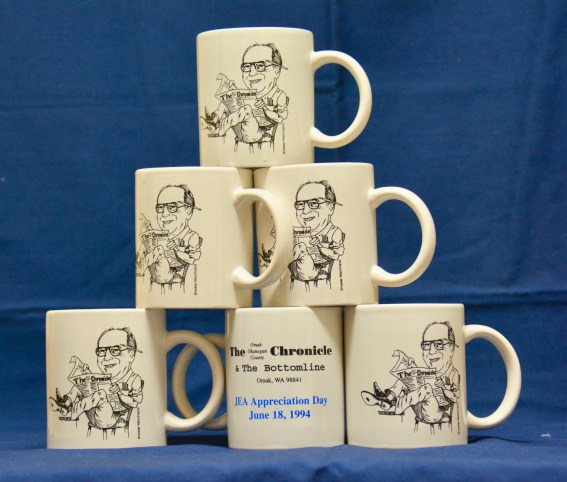
fullsizeoutput_1fb3Smoker Marchand, who created the caricature of my late husband, is renowned for his magnificent, life-size metal sculptures portraying native life. They’re all over the place, from Sasquatch leaping across the highway near Desautel Pass to women digging roots not far from Grand Coulee Dam. I’m in awe of Smoker’s artistic skill and humbled that he took the time to sketch this amusing likeness. But that’s not the only reason I cherish my remaining six mugs from the many dozen that were created twenty-five years ago.

The occasion was JEA (as John E. Andrist was fondly known) Appreciation Day. It was an official welcome home for John after he’d survived a brain stem stroke, endured months in Seattle rehab facilities, and returned to Omak with an uncertain future, totally paralyzed and unable to speak. Too often we wait until people are gone to say thank you and honor them. Our community was not going to let that happen. They pulled out all the stops with a parade (led by an Omak city councilwoman riding a horse as Lady Godiva), a program in the high school gym with music and speeches, and these commemorative mugs.

Dave Harper, our business neighbor and friend, came up with the mug idea and induced Smoker to draw John’s likeness. Smoker captured John more quintessentially than any photographer could. The smile’s the best part, the receding hairline, his pride and content as he surveys the newspaper fresh off the press.

The thing that’s always amused me about the caricature is the Adlai-Stevenson-type hole in the bottom of John’s shoe. John didn’t like to spend much money on clothing, except when it came to shoes. He wanted his feet to be comfortable. It seemed only Nordstrom’s very best, most expensive shoes of finest leather could meet his needs. At the end of the day, he religiously inserted cedar shoe trees into each treasured shoe. He polished his shoes with more precision and care than I use to apply lipstick.

Still, the hole is appropriate. It suggests the wearer of the shoe is too busy with the big picture to sweat the small stuff. That would be John.

(To celebrate my 75th birthday this month, I’m posting daily stories about the stuff I’ve acquired over a lifetime and can’t let go of. I invite you to consider the stories attached to the stuff you treasure—maybe even share them.)

fullsizeoutput_1fb2
Smoker Marchand’s dueling horses at the Omak Stampede Historical Museum

Letting Go: My Stuff & Stories May 18

fullsizeoutput_1fb0Time out. Yesterday, within the span of eight hours, two of my friends became widows. I’ve been posting daily stories about stuff I’m hanging onto. Yet sometimes the universe—God, if you will—insists that we let go. It feels appropriate to spend this day pondering that.

Neither man’s death was a surprise. For years, both had journeyed the grueling road of occasional hope and frequent despair that accompanies cancer treatment. For both, when all possibilities of cure had been eliminated, death came mercifully soon. Both leave a legacy of service in our community with a resulting vacuum that is felt deeply.

David Lindeblad was a professor, beloved by students and colleagues, a supporter of the arts, a fierce advocate of community solidarity, generous with time, talent, and treasure. His patient determination bespoke of the skilled fly fisher that he was.

Richard Ries came to Okanogan County in 1981 to run the IT department at the county courthouse. His work as a public servant was augmented, perhaps even outstripped, by his years of volunteer labor on behalf of the arts and the county historical society.

David’s wife Betty and Richard’s wife Marilyn are powerful forces in their own right. They were champions in helping their husbands navigate and endure the medical maze. They will not be alone as they grieve. This community has a way of showing up when needed. People call and ask, “How can we help?” Sometimes there are small ways to help, but there’s no way to help with the letting go part, no way to fill the hole in the heart. We have to let go of the ones we love, but we never let go of the love itself.

Barn Jacket: My Stuff & Stories May 17

fullsizeoutput_1fadI wrote about my late husband’s barn jacket a number of years ago when I was adjusting to widowhood. I explained how I tried to sell the jacket for fifty cents in a yard sale and, when there were no buyers, how I paid to have it dry-cleaned, thinking it would come out looking less disgusting. It didn’t.

When I moved from the house John and I’d shared to one two-thirds smaller, when I theoretically gave away two-thirds of my stuff, somehow the barn jacket once again survived the purge. John called it his barn jacket because at one time in his life he had horses—a lot of them—and wore this jacket to muck out the barn. By the time we married he’d given up horses, but we had dogs. John wore the barn jacket when cleaning the dog kennel.

And that’s the thing. In our marriage we pretty much didn’t follow traditional gender assignments when it came to household chores. He did most of the cooking, I did most of the laundry, and we hired someone else to clean the house. He took it upon himself, however, to shovel the dog poop. It was a lot. We always had at least two dogs—at one point three. He never complained, never suggested I join the fun. I never fully appreciated it until he couldn’t do it anymore. The task fell to me, and what a revelation that was!

Now when I shovel dog poop in winter or run the snow blower, I don the barn jacket, more for inner strength than for warmth. The fabric may be seriously frayed, but this jacket has within it a mysterious moral fiber.

(To celebrate my 75th birthday this month, I’m posting daily stories about the stuff I’ve acquired over a lifetime and can’t let go of. I invite you to consider the stories that make you treasure your own stuff—maybe even share them.)

Tea Cart: My Stuff & Stories May 16

fullsizeoutput_1fa7
No more tea sets in my home, but the cart continues to serve, holding a birthday bouquet from my sister

This antique tea cart puts me solidly in the LOL category. I don’t mean Laugh Out Loud or Lots Of Love, but Little Old Lady. It’s the kind of thing you find in Little Old Ladies’ homes. Jan, the friend who gave me the tea cart, is approaching the age of ninety. She has expanded on the LOL acronym by adopting a kind of alter ego she has named Lollie. Lollie has invaded Jan’s body, and they’re not on particularly good terms. Jan wants to go to an event, but Lollie insists on staying home. Jan wants to get a list of things done in a day, but Lollie lingers in an easy chair, imprisoned by aches and pains.

I don’t use the “old” of LOL in a pejorative sense. Jan refers to this time of life as s-aging. Wikipedia tells me that the term “ageism” was coined in 1969 by Robert Neil Butler to describe discrimination against older people. But, wrote historian Georges Minois, our ambiguity about old age has “been with us since the stage of primitive society.” Old age, he continued, has been seen as “both the source of wisdom and of infirmity, experience and decrepitude, of prestige and suffering.” Thus we hide our ambivalence with euphemisms such as “elderly” and “senior citizen.” Never “old.”

Jan gave me her deceased mother’s tea cart decades ago when she moved to England. It was a common enough furnishing for that generation of women who had a specific approach to gracious hospitality and entertaining. That’s why I suspect you’d be hard pressed to find a tea cart in the home of anyone under sixty.

Forty years ago, our weekly newspaper still had what we called “country correspondents,” women who reported the social events in their rural neighborhoods. John and I happened to own numerous, dainty tea cups, inherited from both sides of our families, so we hosted the correspondents for tea at our home, spotlighting the cart. That kind of journalism has disappeared, and I’ve sold and/or given away all my tea sets. Still, I enjoy the cart. I roll it around when I’m dusting under and behind it. It squeaks and groans as it moves. Apparently it has its own Lollie.

(To celebrate my 75th birthday this month, I’m posting daily stories about the stuff I’ve acquired over a lifetime and can’t let go of. I invite you to consider the stories that make you treasure your own stuff—maybe even share them.)

Conception Deception-My Stuff & Stories May 15

fullsizeoutput_1fa4It’s one hundred percent wool, a Hudson’s Bay blanket that at one time had the distinctive store label and binding in satin. More than eighty years old, it’s the kind of thing most people would repurpose as the dog’s bed. For me it is sacred. I was sure I was conceived under this blanket.

I suspect most people don’t give a lot of thought to their conception; it may be uncomfortable to think about our parents, um, doing it. While on staff at Holden Village, the church retreat center, I asked a young man where he was from.

“Cannon Falls, Minnesota,” he replied.

“Oh,” I blurted. “I was conceived there.” He was visibly nonplussed.

I remember this blanket being on my parents’ bed when I was a small child. I inherited it when they discovered the joy of a dual control electric blanket. Then, sorting through old family photos, the significance of the blanket finally dawned on me. It was prominent among a photo of my parents’ wedding gifts. Having read both parents’ journals from that time, I know how madly in love they were as newlyweds. Sleeping under that blanket held an aura of romance for me, warming not only my body but my heart.

While I was arranging the blanket for this photo, I finally did the math.  I realized I was conceived in August. Cannon Falls is in southern Minnesota, where August is hot and humid, and the air does not cool much at night. Seventy-five years ago, no one had air conditioning. That blanket was nowhere in the vicinity when I was conceived. In fact, it’s unlikely anyone was conceived under it. My sister probably got her start in early September and my brother in July. My parents were clearly warm weather lovers.

So now what? It’s just another old woolen blanket. Give up and use it for dog bedding? No way. My heart is telling me that sometimes the mythology around an object can hold a deeper truth than the facts.

(To celebrate my 75th birthday this month, I’m posting daily stories about the stuff I’ve acquired over a lifetime and can’t let go of. I invite you to consider the stories that make you treasure your own stuff–maybe even share them.)