Back to Bach: My Stuff & Stories May 14

fullsizeoutput_1f91
My altar to Bach includes recordings, books, and a bust.

“How did you know?” I asked the choir at Sand Point Methodist Church in Seattle when they presented me with a bust of Johann Sebastian Bach as a going-away gift. They laughed. They’d been hearing me play Bach at every opportunity throughout my tenure as organist for their church. It was a wonderful pipe organ, the best I’d ever played. Yet I was giving up my career as a professional (aka paid) church musician for a less esoteric (and better paying) career in journalism.

I no longer have the “chops” to play Bach as I did in my college years. Nor do I have words to explain why the music of Bach sears my heart, comforts my soul, defies my musical abilities, and excites my brain. Calvin R. Staper, a music professor, claims in the preface to his book on Bach’s music: “In the history of western music, J.S. Bach is unsurpassed in mastery of technique and profundity of thought.” Unsurpassed.

Though my CD collection is far from extensive—given the massive amount of Bach’s music that has been recorded—I do more listening than playing these days. The bust itself is not great art, possibly not even a credible likeness. Yet it represents a time, a place, an experience in my life—a reminder that I’ve been given many wonderful opportunities, and for that I’m grateful.

One of those opportunities came earlier this month when I played with the pit band for the Okanogan Valley Orchestra and Chorus annual stage musical. The camaraderie among the musicians in the pit was joyous; the boundless energy of conductor Matt Brown inspiring. But after months of rehearsals and hours of individual daily practice, I’m left with nagging “earworms,” snatches of melodies from the show playing in endless loops inside my head.

I’m trying Bach as a cure. Just now, I’m listening to the opening notes of the Andante in his First Violin Concerto. In a moment the deep, hypnotizing rhythm in the orchestra will underscore a soaring melody of intense longing and ardor, and I will have to stop writing. Bach cures earworms but also, as usual, leaves me wordless.

(To celebrate my 75th birthday this month, I’m posting daily stories about the stuff I’ve acquired over a lifetime and can’t let go of. I invite you to consider and possibly share the stories that make you treasure your own stuff.)

Island Life: My Stuff & Stories May 13

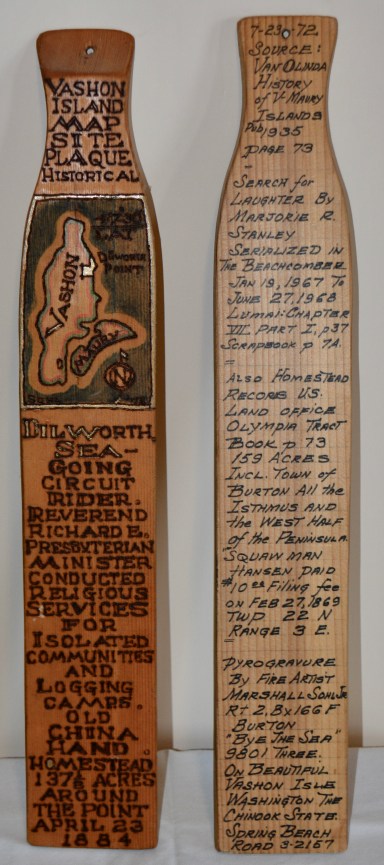
fullsizeoutput_1f88 These odd-looking paddles are among the very few artifacts I’ve kept from the ten years I lived on Vashon Island in Puget Sound. It was a formative decade, starting at age 25. I ended a marriage by mutual agreement, discovered my vocation at last, made lifelong friendships, played in a funky bluegrass band, and learned to sail. I should say, I learned to crew on sailboats. The few times people sailed with me at the rudder, they tended to decline a repeat voyage.
In the 1970s, island life was relatively inexpensive. Rents were cheap, and I eventually bought a small house with a million dollar view for ten thousand dollars.  The island setting with affordable cost of living attracted a thriving population of artists, philosophers, and hippies. For example: Marshall Sohl Jr., creator of the paddles, which he preferred to call “historical pyrogravures.” Marshall referred to himself as a “fire artist,” specializing in historical anecdotes. Kind of like wood-burned tweets.

This pyrogravure tells us that Dilworth Point, where I lived for a while, was named for a “sea-going circuit rider, Reverend Richard E., Presbyterian minister [who] conducted religious services for isolated communities and logging camps.” Not great art nor in-depth history, but the pyrogravures hang on my bedroom wall because they take me back to a time and place that are no more. Sure, Vashon Island is still there, not as affordable, and most of my friends have moved on. As Thomas Wolfe proclaimed, “you can’t go home again.”

As an Associated Press editor, I’d relished the daily commute via Washington State ferry from my island home to my Seattle office. I passed up several promotions because it meant I’d have to move from the island. Finally I got an offer I couldn’t refuse. My husband-to-be promised me I’d learn to love the Okanogan just as much as any island. Now, instead of living on a salt water sea, I live along a fresh water river. Instead of daily tides, I watch the river ebb and flow on an annual basis. John was right.

(To celebrate my 75th birthday this month, I’m posting daily stories about the stuff I’ve acquired over a lifetime and can’t let go of. I invite you to consider and possibly share the stories that make you treasure your own stuff.)

A Real Mother’s Day: My Stuff & Stories May 12

fullsizeoutput_1f81
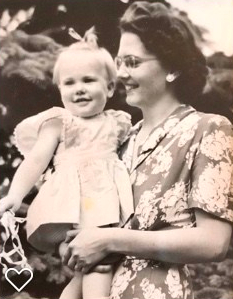
This photo of my mother and me is in a “memory book” she gave me for my 52nd birthday. She died May 25, 2009, at age 92.

Early in the morning of Friday, May 12, 1944, Elsie Louise Koch Fagerlin realized she was going into labor. Even though she and her family had moved to a new town just ten days earlier, she had everything well organized. Her mother was on hand to care for the two older children, Carol, about to turn seven, and Mark, who’d just turned five. Elsie, an attractive twenty-eight-year-old, figured she had time to paint her toe nails before leaving for the hospital, just twenty-five miles away. So she did.

She didn’t take into account that her beloved husband Carl had a knack for getting lost nor that this particular baby was in a big hurry to join the family. As Carl attempted to steer while simultaneously checking on his wife, she’d insist, “Never mind me. Just drive!” When they finally arrived at Swedish Hospital in downtown Minneapolis, Carl rushed to sign in his wife while nurses rushed Elsie directly to the delivery room.

It wasn’t long before she was holding me for the first time and later remembered being thankful “that you made it here so quickly.”

Maybe I was trying to catch up with my name, which they’d decided upon five years earlier. Pregnant with Mark, my mother was certain she was going to have twins. She herself had a twin brother and, she explained, “I was so big!” They decided that the twin names would be Mark Louis and Mary Louise. Cute. I’m sure my brother is as relieved as I that we had a convenient five-year gap between us.

Every once in a while my birthday falls on Mother’s Day, as it has this year. Some time ago I realized that we have things backwards when we celebrate birthdays. Our birthdays should be the real mothers’ days, when we recognize that the biggest birthday gift we’ll ever get is the life they gave us.

(To celebrate my 75th birthday this month, I’m posting daily stories about the stuff I’ve acquired over a lifetime and can’t let go of. I invite you to consider and possibly share the stories that make you treasure your own stuff.)

Up, Dry, and a Little Dirty: My Stuff and Stories May 11

fullsizeoutput_1f79My friends and family consider me the Martini Doyenne of Omak, WA. I don’t think there’s much competition for the title.
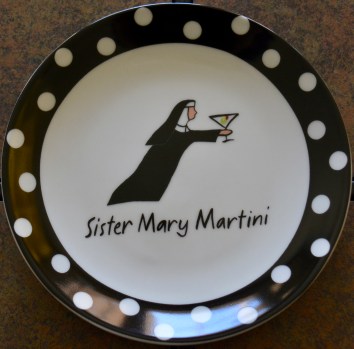
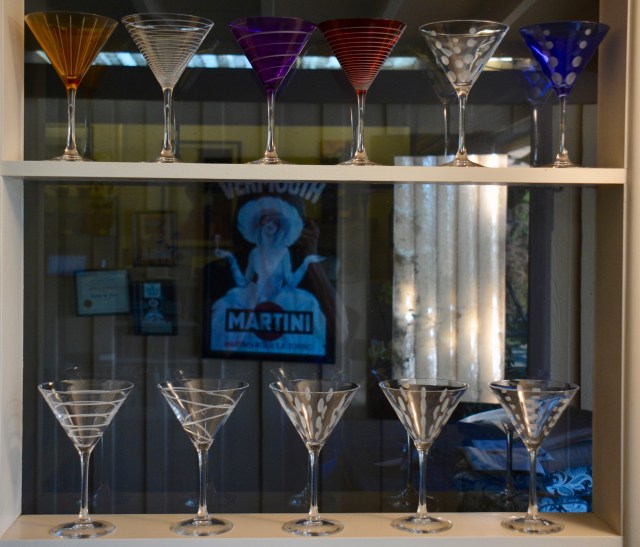
Truth is, I suspect their claim that I’m an expert martini maker is an easy way to come up with gifts for a woman who’s probably hard to buy for. (It’s clear by now that I already have a lot of stuff.) The martini glasses in the photo are a small representation of the martini accoutrements that have been given me over the years, much of it irreverently humorous: shakers, jiggers, glasses, towels, napkins, recipe books, olive picks, plates, placemats, note cards, and that poster in the background, which came from my mother.

There’s nothing magic or mysterious about my martini recipe. I like ’em up, dry, and just a little dirty. For non-martini speakers, that means cold but no ice to dilute the drink, very little sweetener, and a hint of olive juice. The big issue, among martini connoisseurs, is whether to shake or stir. Stirrers claim that shaking bruises the juniper, an essential ingredient of gin. I’m ecumenical. If I’m making just one or two servings, I shake. It chills the drink more thoroughly. If I’m making a pitcher for a crowd, I stir.

I begin by pouring just a dab of dry white wine over ice. I don’t use the standard vermouth, because it’s too sweet. Next comes the gin. I prefer Amsterdam. It’s not expensive and it has a nice citrusy edge. If someone brings me the pricier Beefeater or Bombay, who am I to complain? I occasionally make vodka martinis for a friend who can’t stand gin. The friendship is more precious than my taste for gin, and that’s saying something.

fullsizeoutput_1f7dI top the mixture off with a sprinkle of olive juice (that’s the dirty part), stir or shake, and pour into the glass over an olive or two. The olives need to be big and bold, like Tassos Double Stuffed Garlic & Jalapeno.

I bet you think I’m going to have a martini on my birthday. Wrong. For seventy-five, it’s champagne all the way.

(To celebrate my 75th birthday this month, I’m posting daily stories about the stuff I’ve acquired over a lifetime and can’t let go of. I invite you to consider and possibly share the stories that make you treasure your own stuff.)

Flute Player & Listener: My Stories & Stuff May 10

fullsizeoutput_1f76
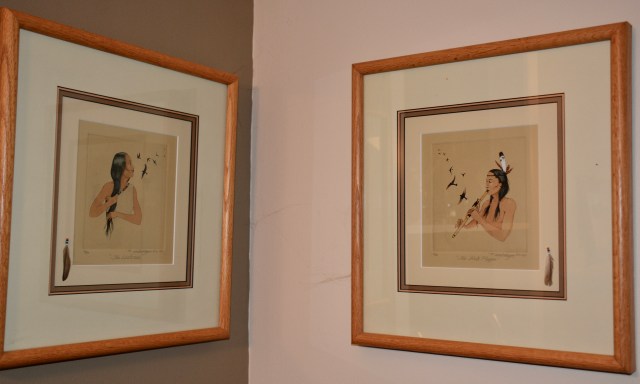
“The Flute Player” on the right and “The Listener” (left) by Laura Woolschlager

These two were awkward to photograph. I purposely have them in a corner so they can gaze at each other as “The Flute Player” sends his music flying like birds for “The Listener” to hear.

The prints are by Laura Woolschlager, a longtime friend, who showed them at a benefit art exhibit my husband and I attended in late November, 1993. John and I had already agreed beforehand that we would not buy anything. Underline not buy. Underline anything. We already had more art than walls on which to hang it, including several paintings by Laura. When I expressed delight in these two prints, John—behind my back—quietly signaled to Laura that he would buy them. Presumably as a Christmas gift for me.

Days later he suffered the stroke that would leave him totally paralyzed and unable to speak for the final fourteen years of his life. By Christmas, he was in a rehab facility in Seattle, and I was at his side. A carefully wrapped package arrived from Laura containing the two prints and a long-sleeved cashmere sweater. She refused payment for the prints and suggested that when I wore the sweater, it should feel like John embracing me.

These prints are meaningful not only because of Laura’s generosity, but because they were harbingers of what was to come in our lives. The two lovers are separated. If Laura had placed them in a single painting, the idea would have lost its power. The flutist’s music escapes beyond the frame, beyond boundaries, as birds flying to his lover, the listener.

When someone becomes caregiver to a spouse, there is a new frame of reference, a separation of sorts, dictated by new responsibilities. What was once a shared landscape becomes two islands, individually afloat. Yet love itself deepens and soars, escaping all boundaries, flying free as birds, connecting across the divide.

(To celebrate my 75th birthday this month, I’m posting daily stories about the stuff I’ve acquired over a lifetime and can’t let go of. I invite you to consider and possibly share the stories that make you treasure your own stuff.)

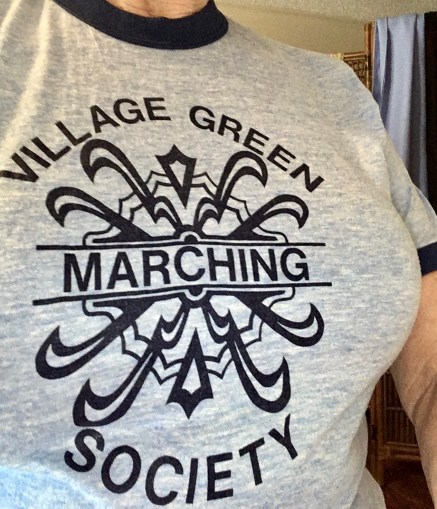
Village Green Marching Society: My Stuff & Stories May 9

fullsizeoutput_1f73I rarely wear T-shirts for the same reason I rarely take selfies: I’m rarely happy with how they look. Nonetheless, I have three of these shirts tucked away in a drawer. Maybe, just maybe, I could have a reason to wear them again someday.
The Village Green Marching Society, starting in the late 1970s and through most of the ’80s, entertained folks around Okanogan County and even into British Columbia by making music, or some semblance thereof, for small-town festivals and parades. Our motley crew were primarily people who’d played in high school and/or college marching bands, including some music teachers. They wanted to relive those glory days.

There were others: an elderly violinist who played from the bed of a small pickup (thus proceeding backwards along every parade route); a drum major who beat time with a plumber’s helper and protected her anonymity by wearing a Lone Ranger-style mask; folks who’d never learned to play an instrument but participated in a raucous kazoo section; youngsters who were drafted to carry our elegant, homemade banner, or rode on their father’s shoulders; a dog who sported a colorful bandana … pretty much whoever wanted to join in.

We were nominally good at marching in step because we had a U.S. Forest Service district ranger who beat the bass drum with federal authority. Our routines were complex. Three sharp blasts from the drum major’s whistle and band members would take off in all directions, improvising whatever step seemed to work in the moment: a little Charleston, a little can-can, maybe a do-si-do.

fullsizeoutput_1f75I played flute and piccolo; my husband played baritone horn. The band had a wide-ranging repertoire. Favorites were “I Love To Go A-wandering,” “Yankee Doodle Dandy,” and “The Stripper.” During the latter, one of the kazoo players would unleash a cascade of bubbles from an ornate bubble blower.

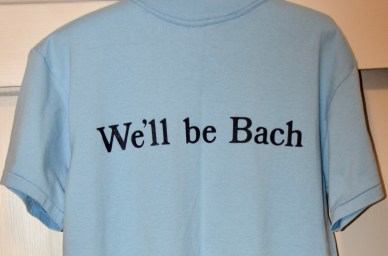
Ultimately, we were victims of our popularity. When we found ourselves scheduled to play every weekend one summer, sometimes even twice a weekend, we burned out. The back of our T-shirts promised: “We’ll be Bach.” Probably not. But I have the shirts, just in case.

(To celebrate my 75th birthday this month, I’m posting daily stories about the stuff I’ve acquired over a lifetime and can’t let go of. I invite you to consider and possibly share the stories that make you treasure your own stuff.)


A Tale of Two Boxes: My Stuff & Stories May 8

fullsizeoutput_1f68“Mary gets everything!” my brother Mark teasingly chided our parents as they were slowly downsizing, distributing items among family members. Not that our parents had heirlooms of monetary value. If we wanted anything of theirs it was purely for sentiment.

Mark wanted and was given the box on the left. Six inches tall, the hand-carved chest has a hidden lock and key—you have to know how to slide the books in order to find the key and lock. The titles on the tiny books are Hungarian classic literature. Inside is a neatly hand-written inscription, “With grateful love from the Mazanyi Family.”

Miklos Mazanyi made the box and presented it to my parents when I was quite young. He, his wife Elizabeth, and 21-year-old son Nikolas were displaced persons from war-torn Hungary. Our small-town Minnesota church sponsored the family, providing a modest home and other assistance to get them started in a new country. They were brilliant, creative people who needed just that little bit of help at the starting line to prosper.

Because of them I began to understand what it was like to be a refugee: to lose all, to face frightening uncertainties, to have to learn a new language and culture, to be dependent on the generosity of strangers. Most of all, I learned that a community is enriched when welcoming the stranger—not only with handmade gifts but with a deepening of soul. That lesson has never been more vital than now, with sixty-eight million people in the world displaced because of conflict or persecution—more than at any time in human history.

A few years back Mark apparently decided he’d had the Mazanyi box long enough. He sent it to me for my birthday and a jolly reminder that “Mary gets everything!” A few years after that he one-upped himself. A woodworker in his own right, he sent me a box he made, having mastered the art of inlay. I’m not sure if the mountains are the North Carolina Blue Ridge, where he lives, or the Okanogan range that envelops my valley. Either way, he’s right. Mary pretty much gets everything.

(To celebrate my 75th birthday this month, I’m posting daily stories about the stuff I’ve acquired over a lifetime and can’t let go of. I invite you to consider and possibly share the stories that make you treasure your own stuff.)

Five Feet of Books: My Stuff & Stories May 7

fullsizeoutput_1f66
Two-and-a-half feet worth of Great Books

The home I grew up in had a goodly number of books, the most significant being the Bible. Yet more important to me in my high school years was the Harvard “Five-Foot Shelf” of classics. This fifty-one volume anthology was based on the premise (in 1909) that all the writings necessary for a liberal education could fit on a five-foot shelf.

Thanks to that five feet worth of books and their excellent index, which enabled quick research, I earned a steady stream of A’s in what were called “high achievement” English classes. (Also, kudos to my mother who typed my essays and, as a professional writer, I suspect couldn’t stop herself from correcting punctuation and syntax.)

Out on my own at age twenty, I no longer had that five-foot set of books, much less the shelf to put them on. Then a feature in the local newspaper caught my eye. Encyclopedia Britannica had come out with its own fifty-four volume anthology called “Great Books.” To promote it, the publisher provided newspapers with a weekly essay based on content from the “Great Books.” Readers were invited to send in questions, and if their question inspired an essay, they got a free set of “Great Books.”

I wanted those books. I sent in the question, “Why is there war?” not because I particularly wanted to know. I was certain it was the kind of question the essay writer could quickly research and quote several centuries worth of great minds. I won the books. They happen to take up five feet of shelf space and have been boxed and re-shelved with every one of my several moves for fifty-five years.

Have I read them all? Uh, no. Volume One includes a ten-year plan for reading the entire set. It feels a bit presumptuous, at age seventy-five, to jump into a ten-year reading plan. But I guess it’s now or never.

(To celebrate my 75th birthday this month, I’m posting daily stories about the stuff I’ve acquired over a lifetime and can’t let go of. I invite you to consider and possibly share the stories that make you treasure your own stuff.)

fullsizeoutput_1f67
The other two-and-a-half feet

Motto Ware: My Stuff & Stories May 5

mottoware
Motto Ware: Collectibles from England

What inspires people to collect things? I don’t mean amass stuff, as in hoarding. I mean honing in on a particular genre of items, such as stamps, or antique pistols, or native baskets, or sets of salt and pepper shakers. Why collect things that have no particular usefulness, other than to be looked at, admired, traded, and occasionally dusted?

I’m an accidental and almost indifferent collector of a peculiar line of pottery known as motto ware. It’s also known as Torquay pottery, coming from the town of Torquay in England. The area has a wealth of red terra cotta clay and a number of potteries sprung up in the late 1800s. For several decades—to meet the demands of the tourism trade—they produced low-priced kitchen ware like small pitchers, tea pots and cups, cream and sugar sets, candle holders, and yes, salt and pepper shakers. The items feature a rustic scene on one side and homey advice, such as “Nothing good is got by worry,” etched onto the other.

Some fifty-five years ago, when I left my parents’ home to live on my own, a friend gave me two pieces of motto ware that had been her grandmother’s. I didn’t realize they were a “thing” until I started bumping into motto ware in second-hand stores. They weren’t expensive, so I’d add to my so-called collection: a candle holder advising “Many are called but few get up” a tiny creamer declaring “Bustle is not Industry,” and my favorite, a cheese dish with the sly saying, “If you can’t be easy, be as easy as you can.” My collection of twenty-three pieces is paltry. Serious hobbyists that I found on the internet have hundreds of these preachy, dust collectors lining their shelves.

Yet the “why” is probably as true for them as it is for me. They make me smile.


(To celebrate my 75th birthday this month, I’m posting daily stories about the stuff I’ve acquired over a lifetime and can’t let go of. I invite you to consider and possibly share the stories that make you treasure your own stuff.)

Set in Concrete: My Stuff & Stories May 6

fullsizeoutput_1f65
Man Throwing Newspapers Into Garbage – cast aluminum sculpture by Richard Beyer

The late Richard Beyer was internationally renown for his cast-aluminum sculptures, probably most famous for his life-size “Waiting for the Interurban” in Seattle’s Fremont District. I’d long been an admirer and was excited that I’d finally meet him at a showing of his work at Sun Mountain in the Methow Valley.

This small sculpture, only eighteen inches high entitled “Man Throwing Newspapers into Garbage,” immediately caught my eye.

“He could at least be recycling them!” I blurted to the gentleman standing next to me, who turned out to be Rich Beyer. It was the start of a good friendship. I bought the sculpture as a gift for my husband, John, who happily displayed it on the front counter at our newspaper office. It was a reminder not to take ourselves nor our work too seriously, as journalists are wont to do.

Rich generally had a low opinion of the press. He made an exception in our case. I ended up helping his wife, Margaret, with her book about Richard’s work, “The Art People Love.”

After John’s stroke, we built a concrete wheelchair ramp at the newspaper. Rich agreed to carve and paint a whimsical mural along the side of the ramp, assisted by contractor Gary Headlee. It was a colorful landmark for a few years. After we sold the building, the mural was demolished in a remodeling project. I was broken-hearted.

Yet, it’s a good reminder that nothing lasts forever, not even when set in concrete.

(To celebrate my 75th birthday this month, I’m posting daily stories about the stuff I’ve acquired over a lifetime and can’t let go of. I invite you to consider and possibly share the stories that make you treasure your own stuff.)