

There’s nothing like a natural disaster to bring out some kind of perverse competitiveness in the best of us. Thus I smiled (weakly) when my town, Omak, was riding high with some of the world’s largest cities in this week’s Washington smoke blog. People were complaining that air pollution across the state—the result of mega fires throughout the Northwest—was “worse than Beijing.” That’s comparing apples with oranges, responded the Department of Ecology’s Ranil Dhammapala.
If you look at a global map of this week’s air pollution, Washington state “probably has the ignoble distinction of being one of the most polluted places” in the world, Dhammapala admits. Yet we in the Northwest suffer smoke pollution only a few weeks out of the year, while cities such as Beijing and New Delhi have unsafe air year-round, especially in winter months. To demonstrate, he posted a color-coded chart detailing air pollution in Beijing, New Delhi, and three Washington population centers: Seattle, Spokane, and Omak.
Omak!? How the heck did this usually ignored, dusty little eastern Washington town (population 4,833) get onto a chart with the likes of Seattle and Spokane, not to mention Beijing and New Delhi—two of the world’s most populated cities?
Here enters perverse competitiveness. New Delhi’s gray stripe and Beijing’s mint green swath show a consistent high level of bad air throughout the year. Well beneath those swaths are three squiggly lines—black for Seattle, blue for Spokane, and a kind of pale cerise for Omak. The lines demonstrate how lovely and clean our air usually is from January until—oops!—August, when the black, blue and cerise go screaming upward like a Cape Canaveral rocket. Seattle makes it a third of the way up, Spokane two-thirds, but only Omak reaches the very top of the chart, right up there with New Delhi.
Well, not quite.
“Delhi records concentrations higher than Omak’s spike, for three months of the year,” wrote Dhammapala. “Omak’s air is unlikely to remain ‘hazardous’ for several months.”
The past three weeks felt like several months. Nonetheless, we stubbornly ignore health warnings to stay inside, to avoid strenuous activity outside. My neighbors painted their house, I walk the dogs and weed the garden every day while watching people kayaking down the river. Last night I attended an outdoor fund-raising event. I probably would’ve skipped it, but I’d already paid for my ticket, and I wanted to see how many other idiots would attend. There were many of us, including several doctors. Even as we chatted and sipped wine, the air quality monitor was rising from “unhealthy” (red) to “very unhealthy” (maroon). Eat, drink, and be merry for tomorrow …
Landing in the same league with Beijing and New Delhi probably won’t cheer the Omak Chamber of Commerce. Imagine our slogan: “Why fly halfway around the world when you can simply drive to Omak and breathe the air?”
 For long minutes stretching into eternity, I stared at the grocery store shelf, paralyzed by indecision, conflicted in a war of values. Finally I grabbed a bottle of apple cider vinegar and fled to the next aisle, where my dilemma would only deepen.

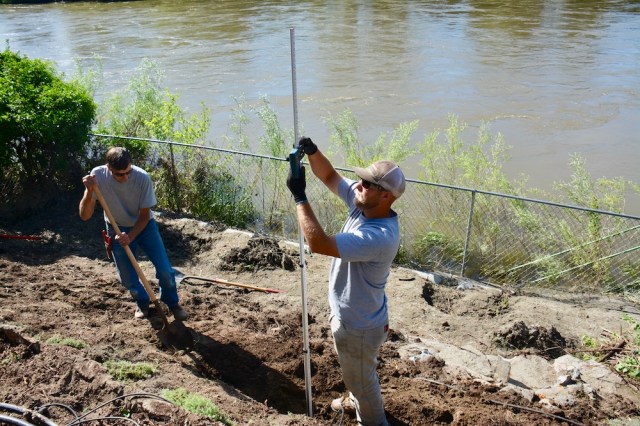 Day Two: Sculpting. Reuben adapted his paper plan to fit the naked ground, drawing a shovel to line out terrace walls like a sculptor pulling form from clay.
 Day Three: Blocks. Stacks of retaining blocks magically appeared on my patio in early morning. The stack slowly diminished as Leon, working solo that day, erected walls. By afternoon, as the walls stretched further from the block piles, I watched Leon walk up the steps, retrieve two blocks, descend the steps, place the blocks. Over and over. I picked up one of the blocks, decided I could heft and deliver them one at a time. That would keep him building instead of walking.
 Day Four: Rocks. The morning began with delivery of rocks the size of July Fourth watermelons. I did not even consider picking one up. Toting the rocks one by one down a full flight of stairs, the men meticulously created my lower terrace wall.
 Day Five: Shifting sands. At least we didn’t need fill dirt. The river had left more than an adequate amount of s
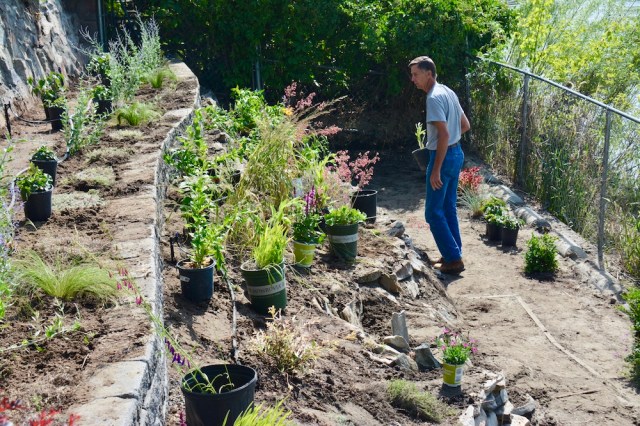 Day Six (after a weekend off): Planting! Shrubs and grasses were carried in their pots to the lower level, where Reuben stood, eyeballing his empty canvas of dirt, placing the pots so the rest of the team could dig in. Irrigation lines were functioning by day’s end.
 Day Seven: Perennials. We began in Reuben’s garden, a glorious oasis of color amidst the Okanogan’s sage and sand. He generously donated perennials from his abundance.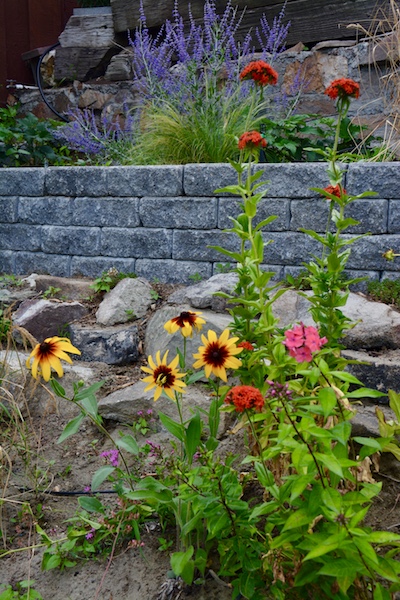



 The chance combination of seeing a particular movie and reading a particular book stirred sorrowful memories of bullying in my childhood. Sorrowful because I was not bullied; I was among the bullies.
 Every New Season
You must be logged in to post a comment.