Motto Ware: My Stuff & Stories May 5

mottoware
Motto Ware: Collectibles from England

What inspires people to collect things? I don’t mean amass stuff, as in hoarding. I mean honing in on a particular genre of items, such as stamps, or antique pistols, or native baskets, or sets of salt and pepper shakers. Why collect things that have no particular usefulness, other than to be looked at, admired, traded, and occasionally dusted?

I’m an accidental and almost indifferent collector of a peculiar line of pottery known as motto ware. It’s also known as Torquay pottery, coming from the town of Torquay in England. The area has a wealth of red terra cotta clay and a number of potteries sprung up in the late 1800s. For several decades—to meet the demands of the tourism trade—they produced low-priced kitchen ware like small pitchers, tea pots and cups, cream and sugar sets, candle holders, and yes, salt and pepper shakers. The items feature a rustic scene on one side and homey advice, such as “Nothing good is got by worry,” etched onto the other.

Some fifty-five years ago, when I left my parents’ home to live on my own, a friend gave me two pieces of motto ware that had been her grandmother’s. I didn’t realize they were a “thing” until I started bumping into motto ware in second-hand stores. They weren’t expensive, so I’d add to my so-called collection: a candle holder advising “Many are called but few get up” a tiny creamer declaring “Bustle is not Industry,” and my favorite, a cheese dish with the sly saying, “If you can’t be easy, be as easy as you can.” My collection of twenty-three pieces is paltry. Serious hobbyists that I found on the internet have hundreds of these preachy, dust collectors lining their shelves.

Yet the “why” is probably as true for them as it is for me. They make me smile.


(To celebrate my 75th birthday this month, I’m posting daily stories about the stuff I’ve acquired over a lifetime and can’t let go of. I invite you to consider and possibly share the stories that make you treasure your own stuff.)
Set in Concrete: My Stuff & Stories May 6

fullsizeoutput_1f65
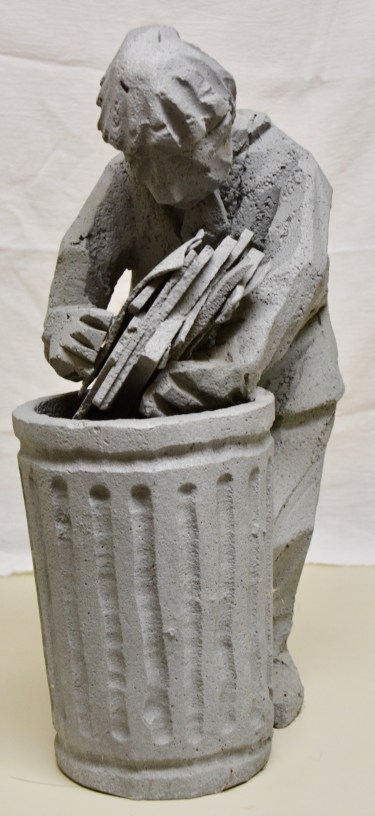
Man Throwing Newspapers Into Garbage – cast aluminum sculpture by Richard Beyer

The late Richard Beyer was internationally renown for his cast-aluminum sculptures, probably most famous for his life-size “Waiting for the Interurban” in Seattle’s Fremont District. I’d long been an admirer and was excited that I’d finally meet him at a showing of his work at Sun Mountain in the Methow Valley.

This small sculpture, only eighteen inches high entitled “Man Throwing Newspapers into Garbage,” immediately caught my eye.

“He could at least be recycling them!” I blurted to the gentleman standing next to me, who turned out to be Rich Beyer. It was the start of a good friendship. I bought the sculpture as a gift for my husband, John, who happily displayed it on the front counter at our newspaper office. It was a reminder not to take ourselves nor our work too seriously, as journalists are wont to do.

Rich generally had a low opinion of the press. He made an exception in our case. I ended up helping his wife, Margaret, with her book about Richard’s work, “The Art People Love.”

After John’s stroke, we built a concrete wheelchair ramp at the newspaper. Rich agreed to carve and paint a whimsical mural along the side of the ramp, assisted by contractor Gary Headlee. It was a colorful landmark for a few years. After we sold the building, the mural was demolished in a remodeling project. I was broken-hearted.

Yet, it’s a good reminder that nothing lasts forever, not even when set in concrete.

(To celebrate my 75th birthday this month, I’m posting daily stories about the stuff I’ve acquired over a lifetime and can’t let go of. I invite you to consider and possibly share the stories that make you treasure your own stuff.)

The Desk: My Stuff & Stories May 4

fullsizeoutput_1f5eThis little desk, just five-feet tall, has followed me around all my life. My mother told me it was made by her great-grandfather (photographed below with his wife). It must be at least 150 years old, or twice my age. Neither of my parents used it as a desk—it wasn’t sturdy enough to hold Mother’s typewriter, and my six-foot-plus dad couldn’t possibly fit his legs under the fold-down writing table. It was just an odd piece of furniture that got stuck in any available corner until ultimately it landed in my childhood bedroom.

I loved it, especially the little nooks and crannies behind the writing table, though I couldn’t and still haven’t figured out which papers and writing tools should go where. I remember storing my potato-head game in the bottom cabinet and then forgetting about it. Months later, a peculiar smell suggested I ought to clean out the desk, where I found a disgustingly wizened potato-head.

At one time, I was told, hinged glass doors covered the desk’s book shelves. When the doors broke, a gentleman in my dad’s church offered to fix them and took them away. His life got complicated when he was sent to prison for tax evasion, and the doors were never recovered.

The desk comes apart in two places so I can easily move it without help. Those moves have taken a toll. The wood protested when, after existing for ten years in the damp

environment of a Puget Sound island, it was abruptly moved to the arid Okanogan Valley. That was forty years ago. It’s still hanging in here with me, and I with it.

(To celebrate my 75th birthday this month, I’m posting daily stories about the stuff I’ve acquired over a lifetime and can’t let go of. I invite you to consider and possibly share the stories that make you treasure your own stuff.)


Quilts: My Stuff & Stories May 3

fullsizeoutput_1f5bWhen someone gives you a handmade quilt, it’s like receiving a warm, enduring embrace. I’ve been given various quilts by family and friends, some just the right size for a nap, some commodious enough to shelter against cold winter nights, and some designed purely for looks, to hang on a wall.

My grandmother made the green and yellow quilts at the top of this photo—every tiny stitch by hand. My niece inherited my grandmother’s penchant for quilt making. I did not, though I did participate in one intergenerational quilting effort.

It started years ago when, during long roads trips with my husband, I began making quilt blocks decorated with counted cross-stitch embroidery. Each block represented the official flower of states we visited. My plan was to someday make a quilt for our bed. Then John suffered a paralyzing stroke. I became a full-time caregiver with no time or energy for embroidery.

My mother also enjoyed the logistical challenge of counted cross-stitch. She begged to finish the quilt blocks, whether we’d visited the states or not. When she was done, I showed the fifty quilt squares to step-daughter Jean, who is an expert quilter.

“They’ll never get made into a quilt,” I admitted with resignation.

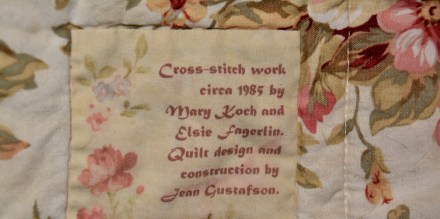
“We’ll just see about that,” said Jean, as she took the squares from me. Before long, she delivered a finished quilt. My mother enjoyed the quilt until she died, and now I get to sleep under it.

fullsizeoutput_1f5d
The label on our intergenerational quilt

(To celebrate my 75th birthday this month, I’m posting daily stories about the stuff I’ve acquired over a lifetime and can’t let go of—because of those stories. I invite you to consider your own stuff, maybe even share your stories.)

A photo: My Stuff & Stories May 2

jea-napping.jpg
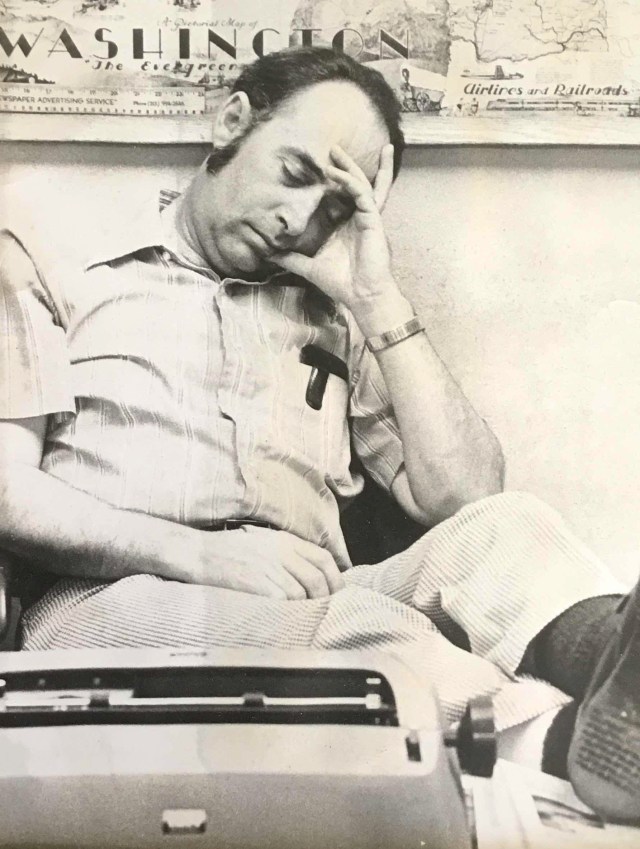
Napping on a Tuesday night?

As I ponder my life-long inventory of stuff, this photo of my late husband, John E. Andrist (better known as JEA), is high on my list of keepers. The photo was taken before I even met him. A member of his newspaper staff snuck this candid shot I’m guessing late on a Tuesday evening as the paper was in its final throes of going to press. The Selectric typewriter and pocket protector (not to mention those sideburns) date the photo somewhere in the ’70s.

For weekly newspaper editors, Tuesdays were a 36-hour working day, a flurry of writing, editing, darkroom processing, typesetting, pasting up, and proof-reading. Page layouts or plates would be transported to the press, an hour away, and the printed newspapers returned for addressing and mailing. These days everything’s done by computer and on the internet. I have no idea if that has made the process any less frantic or tiring. Probably not.

It was our mutual love of newspapers, especially community weeklies, that brought John and me together. I’d burned out as an Associated Press editor and wanted to get back to small-town journalism. I’ve often joked that John needed an editor and I needed a job, so we got married.

The photo sits on the headboard above my bed. He died in 2007, but we still sleep together.

(To celebrate my 75th birthday this month, I’m posting daily stories about the stuff I’ve acquired over a lifetime and can’t let go of. I invite you to consider and possibly share the stories that make you treasure your own stuff.)

Seventy-five Years of Stuff and Stories

Is it just me, or has this year’s orchard bloom been unusually short? Seems like the colorful blossoms lasted only days before the trees began leafing out. Or is it that every season flies by more quickly with each passing year?

This year’s May Day launches me into my birth month and my seventy-fifth birthday. I’m not planning a celebration because I held the party of a lifetime for my seventieth birthday. The joy from that gathering of family and friends still resonates.

I intend to spend my birth month contemplating the collection of stuff I’ve amassed over these seventy-five years. Shortly after my seventieth birthday, I moved from the home I’d shared with my husband for forty years to a smaller house next door. Smaller by two-thirds. Theoretically, to fit into this smaller space, all I had to do was give away two items for every one I kept. Two-thirds of my books, two-thirds of my furniture, two-thirds of my kitchenware. That was the theory.

I thought I’d done well until a friend came to see my new-to-me home. After a short tour, she remarked, “You sure have a lot of stuff.”

Mine is the stuff of stories. It’s the stories attached to my things that make me hang onto them with a python-worthy grip. I’m afraid if I let go of the things, which have little or no monetary value, I’ll no longer remember the stories, which have value beyond measure.

fullsizeoutput_1f4fLike this little weeping cherry tree—a wedding anniversary gift from my parents to my husband and me. I’m not sure which anniversary it was, but I couldn’t leave the tree behind when I moved. I had it dug up from the old yard and replanted next to my new-to-me patio. It survived the transplant and is blessing me this May Day with a full bloom, a vibrant memorial to the three most important people in my life.

A while back, I read a bit of advice to those of us who have acquired a lifetime’s worth of stuff: put a label or note on family heirlooms and personal keepsakes, explaining their significance for those who end up dealing with the things we ultimately leave behind. I’m guessing a lot of us are contemplating our abundance of stuff, which is why Marie Kondo, the guru of “tidying up,” has become such a sensation. It’s not about what you throw away, she teaches. It’s about receiving joy from the stuff you keep.

Each day this month I plan to post a short story about my treasures. I invite you to join me in contemplating what among your stuff tells a story—or gives you joy. Each of my stories will be short, and I won’t flood your inbox with emails. I’ll post them on Facebook and my website. We may even figure out that if there’s no story, no joy, we can let go of more stuff.

The Good Ol’ Days

fullsizeoutput_1f44
An autumn view of my street, East Bartlett Avenue, where nothing, well, hardly anything, ever happens.

The good ol’ days, my father liked to say, “were formerly known as ‘these trying times.’” We humans have a tendency to not enjoy the present until it’s past. I recalled Dad’s observation when a neighbor, John Wilson, and I were indulging in a nostalgic conversation about the “good ol’ days” of newspaper journalism.

John was an investigative reporter for the Seattle Times when I was an editor for the Associated Press in its Seattle bureau. We’d never met, but I admired and respected John’s reporting. I was dumfounded when I moved to Omak and discovered he was living here, a fellow refugee from the big, vexing city.

Our conversation about the decline of newspapers (twenty percent of the nation’s newspapers went out of business between 2004 and 2018) was prompted because John and his wife had been the victims of a violent crime. The story was not in that week’s local newspaper, much less the regional daily. The daily once vigorously covered news of our county but now, with a greatly reduced reporting staff, rarely looks in our direction.

Weekly papers are faring better than metropolitan dailies. More than twice as many papers in urban areas have stopped publishing as in rural communities. One reason might be that rural areas don’t always have good internet service. Social media, as everyone knows, has pulled advertising revenue from newspapers. Even if they manage to keep publishing, many have become ghosts of the vital information sources they once were.

John has long been retired, but he still can’t ignore an important story. Important not because it’s about him, but because we in the community need to know when bad stuff happens. We need to know when the police respond quickly and effectively. We need to know when emergency room services fall short.

Our local newspaper did ultimately report the incident, but John and his wife were not contacted.  Sometimes victims don’t want to talk to the news media. John wrote an account of the event from his perspective and brought it to me to read. The most compelling part of his story is that the attack was utterly random. The attacker had no previous connection with the Wilsons. The victims could have been in any town, on any street, or even myself, a mere five doors away. I don’t care to live in fear, but it’s good to be reminded of my vulnerability so that I can take precautions, be more alert.

Besides the Wilsons’ injuries and damage to their home, another neighbor’s fence was extensively damaged. About a week later a men’s prayer group—with no direct connection to either family—showed up to repair the fence. Again, a random act, and a kind one. The group also brought gifts to the Wilsons and offered to do yard work, which was declined.

“That’s the way things used to be,” John commented. Yeah, the good ol’ days. They’re not entirely in the past.

You can read John’s story here.

Good News/Bad News by John Wilson

The following is my neighbor John Wilson’s account of an event that occurred recently. I’m posting it because his story was not included in news accounts.-MK

The bad news is we were the victims of a violent home invasion. The good news is we survived.

It happened in broad daylight with the lone intruder entering through the kitchen window at about 5:35 p.m. Friday, March 22, at our home on Bartlett Avenue East, Omak.

Our ten-pound dog, Cricket, tried to warn us but we’ve only had him a few months. He barks at any normal neighborhood noises, and we thought that was what was going on.

Tonya, 73, was punched twice in the face and hit repeatedly over the head with an end table. I’m 82 and was punched twice in the face as I tried to fight him off. I knew I had to last long enough to call 911. We couldn’t survive on our own.

The assailant is a 27-year-old University of Washington student with no connection to us or Omak. He wanted our truck to leave Omak.

When I finally understood he wanted our truck, I told him where the keys were. He got the keys and left, and I called 911.

He crashed the truck 100 feet away into a neighbor’s fence and high-centered it on the manhole cover that protrudes above the ground. He was walking three houses north of us when two sheriff’s deputies arrived. He tried to disarm one of them, punched the other officer twice in the face and was finally subdued.

Tonya suffered a concussion and a lot of facial bruising, plus other injuries. She is very sore, has a constant headache and, of course, PTSD.

I got a broken tooth, split lip, and a black eye. I have a few symptoms of concussion but I am doing much better than Tonya. (I wasn’t hit over the head repeatedly with a table.)

There is much more to the story, some of it good and some of it appalling. We went to the ER but left without being seen. Tonya returned a second time, got a CT scan, was told she had a concussion and was discharged without ever being examined by the doctor.

The turnout and concern shown by the Omak police officers and sheriff’s deputies who responded were wonderful. We were in good hands with them.

We are home, glad to be alive and working on returning to a peaceful life. The truck escaped serious damage.

And Cricket? Tonya couldn’t locate him and thought he had been killed. She searched and found him curled into a tiny ball, trembling against the wall in the TV-computer room where I had my battle.

Things That Go Bump in the Night

My Christmas amaryllis has experienced a trauma while in its prime. In fact, my entire household experienced a middle-of-the-night trauma, but only the amaryllis suffered irreversibly. 

A loud thud awakened me from a deep sleep. When I got up to investigate and opened my bedroom door, I was met by my two frightened dogs who appeared ready to leap into my arms at sixty pounds apiece. Ordinarily, the dogs sleep outside. Their kennels have heated pads and are out of the weather. But this cold spell has melted my heart. Every night I bring them and their cushioned beds inside.

Still half-asleep, I found a light switch and discovered my antique organ—the kind traveling missionaries folded up and carried in their wagons for church services—had collapsed. My peace plant, which was sitting on the organ, landed in one of the dog beds. Various other items that’d been on the organ were scattered about. I managed to wake up just enough to right the plant, sweep most of the dirt out of the dog bed, and convince the dogs we could all go back to sleep now. Which I at least did. Tawny, the younger dog, is still exhibiting signs of PTSD.

By morning, I’d forgotten all about the incident until I again opened my bedroom door. There was the little organ in a most undignified position, its nether parts fully exposed. Most astonishing, the amaryllis—which was on a table a couple feet away from the accident scene—had been decapitated, apparently by flying debris. A long stalk rose from its pot like a flagpole robbed of its banner. Its five blossoms lay on the table—still resplendent, but how long could they survive without bulb and stem?

I put them in a glass with water. Slowly, one withered away, and then another. By Valentine’s Day, three viable blooms remained. I decided they’d be an appropriate love memento to place on my husband’s grave. Thus the dogs, the blooms, and I set out on that miserably cold and windy day. I allow the dogs to run off-leash in the cemetery if no one else is around. No one else was crazy enough to venture out that day. A vicious north wind blew snow in my face, my fingers were numb even inside my mittens, and my dogs scampered freely through the snow.

I generally like to read a poem when visiting the gravesite. Given the weather, I needed something short. These lines from a traditional Scottish poem seemed right:

From ghoulies and ghosties
And long-leggedy beasties
And things that go bump in the night,
Good Lord, deliver us!

fullsizeoutput_1f26I laid the amaryllis blossoms on John’s (and someday my) headstone and fled back to the shelter of my car. Back home, the amaryllis’s second stalk has produced another three blooms with possibly two more to come. Good Lord, deliver them!


fullsizeoutput_1f2b
Stepson John, adept at wood working, got the organ back on its feet. It will no longer be asked to hold heavy potted plants.


Facing Up To My Age

The amaryllis I received at Christmas is changing daily—kinda like my face. Every morning I check the amaryllis and it’s grown like Jack’s beanstalk overnight. Then I sneak a glance over my toothbrush at the bathroom mirror, and my! How I’ve changed. Deeper lines, chin disappearing into my neck, blotches and spots, and ever more, well, face.

Photographs portraying the depth of experience and wisdom in old faces enchant me. Facial lines etched like a map of life’s journey, happy crinkles at the eyes, questioning horizons across the brow intersecting with vertical furrows of thought. Trouble is, I’m at that not-quite-there-yet stage, like that pubescent era when my pre-teen nose and teeth got ahead of the rest of my face—beyond child but not yet adolescent.

How long does it take to get from an aging face to an interestingly aged face? I’m on my way. Most disappointing has been the gradual disappearance of what I always considered my best feature: eyebrows. Initially they turned white and wiry, then they stopped showing up altogether. Some of my friends do an artful job of penciling in eyebrows. I’m not up to it. In fact, my use of makeup has diminished as my face ages. My lips, which I thought were a little too full when I was young, have thinned—the only part of me that has.

I spend less on lipstick, but steroids soak up the cost savings. I’ve been diagnosed with an inflammatory skin condition that causes balding. Called “lichen planopilaris,” it’s rare, noncontagious, non-genetic, and idiopathic (meaning, said the dermatologist, “we idiot doctors don’t know what causes it.”) It’s more common in younger adult women, which makes me grateful to be a late bloomer. Topical steroids were prescribed with no assurance they’ll be effective. The alternatives suggested in medical brochures are scarves, wigs, and yup, comb-overs.

As I deal with this latest insult of aging, I found inspiration at the cinema. Who wouldn’t be charmed by Angela Lansbury, age ninety-three, presumably wearing her own wiry hair, handing out balloons to Mary Poppins? And unlike Hollywood actors who seek younger roles, Clint Eastwood at eighty-eight plays someone even older, a ninety-year-old drug runner in “The Mule.”

dsc_9773
A blossom too old or in its prime?

Not the amaryllis, but another house plant suggests to me the glory of aging. My peace plant offers one elegant white bloom at a time. I noticed the mature bloom was getting dark around the edges as the younger replacement blossom began to appear. When I inadvertently delayed snipping off the older bloom, it developed a glorious bronze border enveloping a bulging stamen. Sexy and gorgeous even on the way out.

A friend, now well into her nineties and living in a care facility, made an astute comment years ago when mutual friends underwent plastic surgery to smooth out their faces.

“I’m proud of the lines on my face,” she said. “I earned every one of them.”