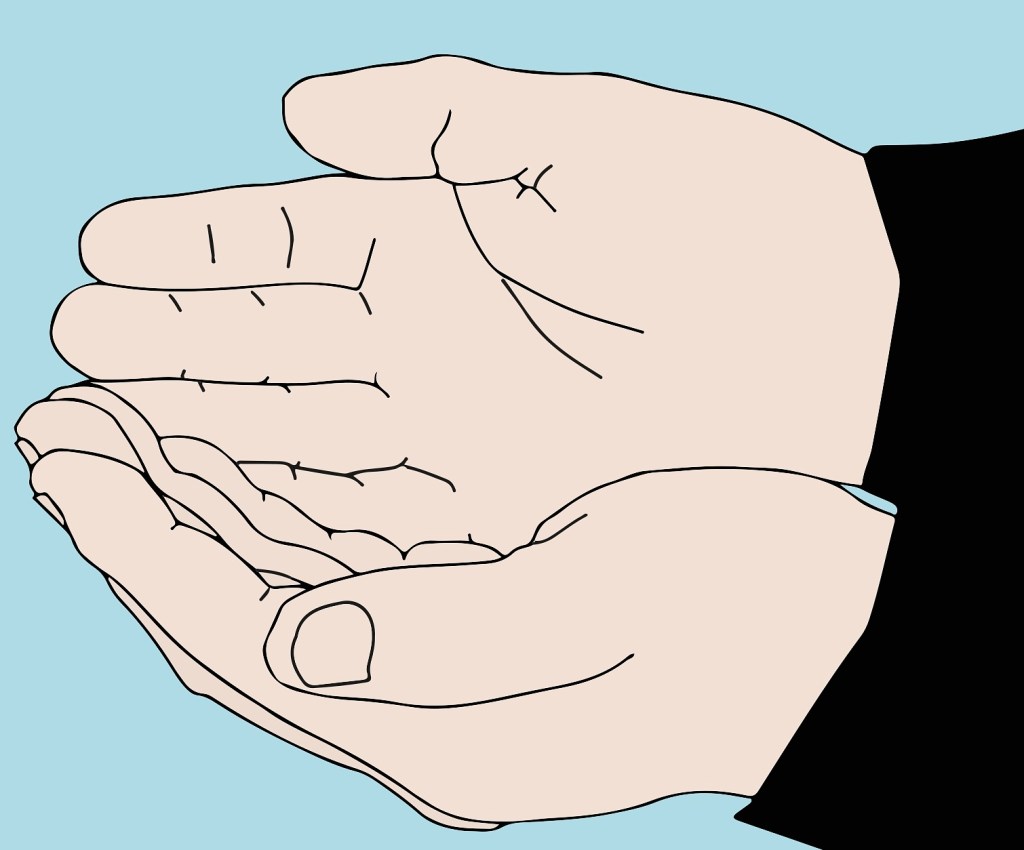
A Helping Hand — Or No Help At All?

I learned the hard way never to give cash to a “panhandler.” Then I learned that hard-fast rules like that are made to be broken.

A man we’ll call Jerry was a regular guest at a homeless shelter where I volunteered. The shelter, staffed entirely by volunteers, operated only in winter, when nights in the Okanogan Valley are bitterly cold. The shelter required “guests” to pass a high bar: they had to be “clean and sober” for the previous twenty-four hours.

Jerry was a regular guest, earnest and helpful, ready to carry a hot casserole from my car into the shelter kitchen. He’d chat about the job he was about to get, or the apartment he was considering …

One day after the shelter had closed for summer, I ran into Jerry while walking my dogs through the park. He asked if I could give him some money. I told him, truthfully, that I never carried money when walking the dogs, only my phone. He shrugged, okay.

All the way home I thought about him, how “clean and sober” he’d been all winter. I grabbed my purse and drove back to the park, handed Jerry a twenty saying that I “knew” him and was confident he’d spend the money wisely. The next day, again walking the dogs, I spotted Jerry. He was out-of-his-mind high. 

“You idiot,” I said. Not to him. To myself. I should never have given him cash. I could have bought a gift certificate at Arby’s or something like that. More important, with the shelter closed, Jerry had lost a vital base of support. Better than cash, I could have simply sat and talked with him a while. Months later I learned that Jerry had died on the street.

Now I live in Seattle, where a disastrously high number of people live on the streets. Nonetheless, I’m rarely panhandled. When I am, I offer a believable lie that I never carry cash. I excuse the lie by donating to various nonprofits that minister to homeless people. 

A while ago, I was waiting at a bus stop when a woman rolled up with a luggage carrier neatly piled with an assortment of cloth and canvas bags. Short and a little stout, she smiled at me brightly, and I smiled back. Out of the corner of my eye, I examined what were probably all her life’s belongings. The bags were arranged so she could remove the top one, creating a temporary bench to sit upon.

After a minute or so, she turned to me and asked in heavily accented English, “Could you loan me five dollars so I can buy bread?” I gave my standard lie — no cash. She nodded and turned away. Again, I watched while avoiding eye contact. At first, her face was stoic, but in silence, her expression changed. Her eyes scrunched to avoid tears, and her mouth was tight. What was I seeing? Defeat? The last thread of determination? I was convinced she was neither a drinker nor a user, but probably at a loss, without hope.

My bus rolled up. She continued to sit. 

“I have change!” I declared, as if I’d just remembered. My small change purse was stuffed with quarters, but it was hard to dig out more than two or three at a time. I kept digging for quarters while she shyly held out her hand. My bus was preparing to leave.

“Sorry it’s not more,” I said in a rush. It may have been close to five dollars. She murmured her thanks as I boarded the bus. I never saw her again. I’ve been asked for cash a few times since. Remembering Jerry, I still raise my hands in a gesture that says sorry, no. 

I have no grand solution to the complex problem of homelessness. I continue to donate to programs that make a difference, one person at a time. I volunteer at the St. James Cathedral Kitchen. And I follow my rules — except when my heart takes me in a different direction.


Last-Minute Shopping? Think Extravagance

A well-worn five dollar bill tucked inside a Christmas card is the most extravagant gift I expect to receive this year. It was given to me during my Friday night piano gig at St. James Cathedral Kitchen.

Five nights a week Kitchen volunteers serve a free, hot meal to whomever shows up — usually around two hundred folks or more. By appearances, I’m guessing the patrons include plenty of homeless folks, some elderly residents of subsidized apartments in the neighborhood, maybe a few university students, occasional families with youngsters. And dogs. Dogs on leash are admitted.

I’m one of the pianists who add background ambience, making the church social room feel less institutional with a layer of music under the chatter and clatter of dishes. The piano is one of the most out-of-condition I’ve ever contended with. There’s no bench, but an office chair on wheels. That does not work for me. I haul a couple of cushions on the four-block trek from my apartment to the cathedral. I set them on a folding chair so I can approach the keyboard from a perch that won’t roll away. The keys almost always sound when activated. Who could ask for anything more? 

It is the highlight of my week. I occasionally substitute for pianists on other nights, but Friday is mine.

Friday happens to be the night when Sue and Susan meet up for their weekly dinner together. I do not know their last names, stories or ages (I’m guessing in their sixties, maybe crowding seventy). Nothing about their appearance suggests monetary wealth. I know Sue rides the bus from her home in the south end of Seattle. And I know that they will always, always exclaim after I finish how wonderful my playing was (whether it was or not). 

Last Friday Sue placed an envelope on the piano as I played. When music and dinner were done, I began to open the envelope, anticipating a Christmas card. 

“Careful,” Sue cautioned. Tucked inside the card was the five-dollar bill. 

“I can’t …” I began. 

“Stop!” Sue interrupted. “It’s a gift! You can’t refuse a gift. I wouldn’t give it if I couldn’t afford it.” 

I’ve occasionally supplemented my income with piano and organ gigs. But no payment could top the handwritten message in the card: “To our piano player who myself and Susan love to hear your beautiful music while we have our dinner. You make us feel so comfortable and Happy. From your friends, Sue and Susan”

We talked a little longer. Sue is celebrating that her son just got out of jail, where he spent seven months. It was his girlfriend who got him in trouble, says Sue.

“I told him! No more girlfriend!”

After they left, I handed the five dollars to Mick, who runs the Kitchen, and told him the story. “This was from OUR folks?” he asked, mildly disbelieving. Then he smiled.

Whenever I’m given a gift of cash, I like to tell the giver how I used the money. I’ll enjoy telling Sue — and she’ll enjoy hearing — that I spent her gift on a new book of music that I’ve been wanting. Music that she and others will soon be hearing.

Wait a minute, you may be saying. You gave the money to the Kitchen. Yeah, well, money is an illusion. Gifts from the heart are the real thing. There’s no limit to how much love they can buy.

Everybody’s Business

  • Imagine a water bottle that measures your hydration level as you sip.
  • Imagine cell phone batteries that recharge off your body heat.
  • Imagine an ear piece that projects a hologram so you can read a book or watch a movie hands-free.

If you’re seventeen, these are the kinds of technological wonders you can dream up. They’re the kinds of things I was invited to invest in (virtually) during Business Week. Every year high school juniors from our two neighboring towns (Okanogan and Omak, WA) are excused from their regular class schedule for five days to sample what’s ahead for them in the realm of free enterprise. 

After the pandemic hiatus, Business Week returned this year. I was happy to again be invited to help as a judge and “investor.” During a brief training session for judges, facilitator Chris Loftis had me nearly in tears as he described what this year’s students had missed during pandemic isolation.

“These kids have lost something,” he concluded. “We’re going to give it back to them.” The “we” is our local community. While school district sponsorship is essential, professional educators are largely absent. Pretty much all the adults are volunteers. Many are giving up a full week of work; others are retirees willing to revisit the world of work. Area businesses throw in financial support to cover the $14,000 cost. 

Students are sorted into “companies” to dream up product lines, assign corporate responsibilities, determine quality standards and work ethics, and develop marketing strategies. Sounds kind of dull, frankly, but a computer program makes it more like a game. Based on the kids’ decisions, the computer churns out two years worth of various reports like sales volumes, profit and loss, and stock value. Just as in real life, the reports produce cheers and/or teeth-gnashing. By the end of the week, the kids are excited to show off their work for a spirited IPO (initial public offering). The students aren’t graded individually, but they’re rewarded as corporate teams with stock sales. All play money, of course.

I’m not necessarily a cheerleader for capitalism, but it’s the system we live and work under. Within our system there’s space for kindness and community building — if we so choose. Business Week does. The kids experience teaming up with otherwise rivals. Ordinarily the two schools are each other’s No. 1 athletic opponent. Here, students are purposely mixed — about a dozen in each company. Some years ago one of my grandsons who participated in Business Week concluded with surprise that kids from the other school had some pretty acceptable qualities after all.

Every student has a place and a role. Inclusion and participation are highly valued and required. As we judges visited the companies, we were introduced to each student by name and their individual responsibility within the company. At week’s end, every student receives a certificate awarding a college credit — something pretty amazing for a lot of these rural kids who never consider the possibility of college.

Despite pandemic disruption, teens’ resilience was vividly on display. They’d put behind them not only Covid isolation, but inevitable setbacks from the week’s taste of business life.

“Life is more than dollars and cents,” teaches Loftis. “Life is about failure … and then you get back up.”

Getting back up was part of the week’s adventure for several companies. “509 Electronics” got into trouble with the public after marketing a low-quality product, explained their CEO. After the company decided against a recall, the public (via computer program) raised a fuss. The company apologized, offered a recall and changed its manufacturer. The lesson, said the CEO: “Don’t rely on people you don’t know.”

As a consumer of a certain age, I was smitten by another company, but as a potential investor, not so  much. “Design, Love, Virtue” had chosen to target elderly consumers. They’d done admirable research into their market audience, coming up with a simple-to-use flip phone that promised a crisp speaker, easy-to-read screen and (hallelujah!) ultra-responsive tech support. They acknowledged making “hard decisions” along the way, opting for strategies that would benefit the environment, their customers and employees. Their product was so popular, they ran out. “You never want to do that,” a fellow judge muttered out of their hearing. Flooded with back orders, they watched their stock tank. Undaunted, they were promising skeptical investors a rosy comeback. I sympathetically put in a few bucks — no more than I could afford to lose.

Business Week got its start in the 1970s as a residential summer program — something like cheerleader or basketball camp — at Central Washington University (then state college). The residential program has since spread to college and university campuses in eleven states plus Poland and Italy. Yet only a handful of school districts make it available on a local basis to all students. While the residential programs offer full scholarships, it’s still unlikely that very many of our local kids could afford a week off from summer jobs to attend. Or would even feel motivated.

 One reason the in-school program is less than popular with educators, I’m told, is that teachers are under pressure to prepare students for standardized tests. Giving up a full week away from “teaching to the test” is asking too much.

I don’t know if our students’ test scores are remarkably above or below the norm. I could research it, I suppose. But I’m satisfied with what I saw kids take away from Business Week — a few of life’s lessons that can’t be measured on any test other than life itself.