Voting Matters: I know. It’s complicated.

“Your vote will be counted.” 

The email from King County Elections just before our Aug. 4 primary election was especially reassuring amidst all the furor these days over voting. I’d done my homework: attended voters’ forums, read endorsements and candidates’ statements. I was ready when my ballot arrived in the mail. I quickly filled it out and returned it — forgetting to sign the enclosure envelope. Turns out, that is not a minor detail.
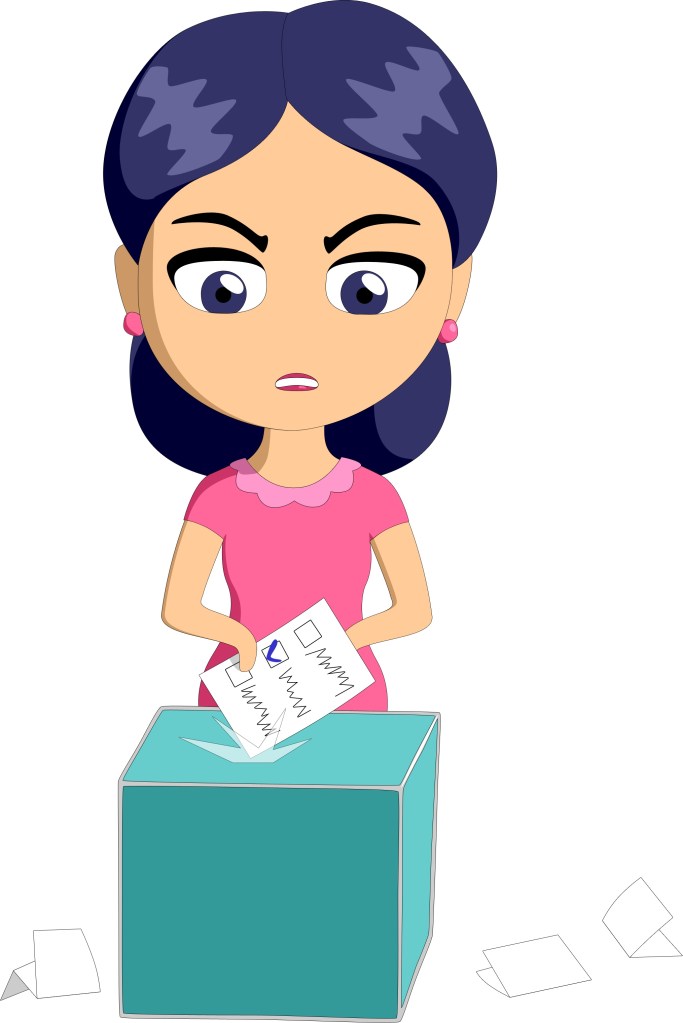
I’d been in a rush to mail back the ballot after learning some years ago not to trust the USPS with timely delivery. Shortly after Washington state turned to all vote-by-mail, I’d dropped off my ballot at the post office the day before an election deadline. I was stunned the next week when the elections deputy in rural Okanogan County (where I lived) called to report my ballot was invalid. Seems my small town post office no longer postmarked the mail. My ballot had been sent to a distribution center a hundred miles away, where it was postmarked too late.

The elections clerk was sympathetic. (As I mentioned, it’s rural — pretty much everyone knows everyone.) The election was for a school levy. She knew I’d campaigned for it. Fortunately, the measure passed, assuaging my vexation. From then on, I placed my ballot in an official drop box at city hall, an easy walk from my home. Ironically, now that I live on densely populated First Hill in Seattle, there is no ballot drop box within easy walking distance. Hence my determination to overcome USPS sluggishness — or whatever is going on.

King County Elections, on the other hand, was anything but sluggish. Almost immediately after I received a text that my ballot had arrived, I received another text saying there was a problem. It included instructions on what to do next. Before I could even act, I received an email. Then I received a letter. On top of that, when I called, I did not get sent to the limbo of “hold.” I was immediately in touch with a living, friendly, helpful human being. It was not too late to sign the ballot, which I did, hence the affirming email. 

My enthusiasm for voting began when my third-grade teacher, the creative Miss Bogue, gave her students an opportunity to “vote” in the presidential race between Dwight D. Eisenhower and Adlai Stevenson. Miss Bogue honored my best friend, Jeanette, and me with the task of tallying the votes. 

I suspect we eight-year-olds were minimally aware of policy issues but maximally aware of our parents’ leanings. My parents were solidly in the I-like-Ike camp. Jeanette’s were keen on Stevenson, who I thought seemed less genial. He didn’t have Ike’s grandfatherly twinkle.

Jeanette’s job was to read the name on each “ballot” aloud while I applied a solid check mark next to the respective candidate’s name. As Ike began to emerge victorious, Jeanette’s voice reflected increasing irritation. With every “Ike” like, she’d slam the offending ballot back onto the table. Funny that memory remains so clear all these decades later. Perhaps it’s because decades of voting have given me empathy for her frustration.

I’m a nonpartisan voter, not only because of my years as a journalist but because I prefer choosing candidates and issues on their merits, not by party. I’m frequently on the losing side. Worse, there’ve been times I wished I could retract my vote. A good campaigner turned out to be inept at governing, or an initiative that sounded wise at the time resulted in undesirable side effects — like Washington’s money-infected initiative process itself.

The current fracas over mailed ballots has residents in my retirement community concerned. Given a green light by local election officials, they’re figuring out a way to deliver ballots directly and securely to drop boxes. Their goal is to skip the USPS, which most residents — including me — would otherwise depend upon.

That school levy election years ago and this year’s angst are reminders of how much the privilege of voting matters to me. I’m reminded of my late mother, who was born four years before the 19th Amendment gave women the power to vote. At a very late age, she finally had the chance to vote for a woman candidate for President. That was in a primary election. Because of Washington’s weird partisan rules, she was advised by a friend that her primary vote didn’t really matter.

“It does to me,” declared my mom. 

Dear reader, if you’ve come this far with me, I suspect your vote matters to you, too. Let us cherish and protect our franchise.

One Woman’s Vote

Election Day November 4, 2025, will mark my sixtieth anniversary as a registered USA voter. I have a perfect record, having cast my ballot in every election over those six decades, from presidential to school levies. Nonetheless, it’s not getting any easier. 

I came of legal age (in those days, twenty-one) in 1965. That year President Lyndon Johnson signed the Voting Rights Act, part of the Civil Rights Movement. It was a significant achievement, meant to eliminate restrictions on who can vote. Even so, the act of voting can feel like a feat of survival. First we have to endure weeks, months, of political campaigns that have become increasingly hostile and decreasingly informative.

Election 2025 is all about local positions — mayor, city council, school board, etc. In my mind, these are the most important. Even though I moved to Seattle two years ago, I got a phone call from Cindy Gagne, longtime mayor of Omak, Washington (population around 5,000), the small town where I previously lived for forty years.  Cindy was appointed mayor to fill a vacancy in 2008. After being re-elected unopposed four times, she’s running again, for the first time with opposition. Would I endorse her, she asked. Happy to! Not that it’ll mean much.

Cindy and I first met when I was on the city Parks Commission, and she was a soccer mom, volunteering long hours to raise money for decent fields. From there she moved on to the city council, ultimately the mayor’s office. Her service to the community has been even-handed and selfless.

My endorsement may not be much help because my tiny corner of the blogosphere is followed by only a few of her constituents. But the problems she and I face — as candidate and as voter — are universal. Many citizens fear that our nation’s progress toward full democracy has shifted into reverse. How does Cindy reach a fragmented, polarized citizenry that relies overly much on social media, replete with falsehoods? How do I, just one voter, sort through the propaganda and well-financed smear attacks to make an intelligent choice?

I miss my days as a news reporter, when I interviewed candidates personally. I tried my best to write objectively while inwardly concluding how I’d vote. There’s no more significant way to size up a candidate than to meet them in person. I’ve been attending voter forums for the past couple weeks and will continue until the election. That puts me in the minority. Cindy had called after a voters’ forum drew a disappointingly paltry turnout.

Well, if the voters won’t come to you, the candidate’s next-best choice is door-belling. I door-belled on behalf of a school levy many years ago. It was exhausting, discouraging, and I swore I’d never do it again. I’ve kept that promise. Sometimes it’s easier to follow Jesus’ commandment to love my neighbor when I’ve not MET my neighbor. The New York Times carried a story last week about a Democrat in Texas who walked the 25-mile length of  his Republican-leaning legislative district. He ended up in hospital, exhausted, but won the election.

“Endorsements matter to me,” a neighbor observed as we were riding the elevator after a voters’ forum. I agree, if you know that the person or organization making the endorsement shares your viewpoints and values. 

My late husband, with whom I owned and published a weekly newspaper, scoffed at so-called “endorsements” by small papers like ours. “It’s only one person’s opinion,” he’d say. Instead, he published a pre-election column called “One Man’s Vote,” listing his choices and reasoning. People appreciated it. Some trusted John and followed his recommendations. Others knew that if John was for something, they were automatically agin-it. Helpful in both directions. 

Maybe the good news is that Cindy has an opponent. Too often non-opposition reflects a lack of interest or participation from the electorate. That’s not healthy, not if we really believe in democracy. A survey by the Washington League of Women Voters a couple years ago recorded a distressing lack of candidates for local offices. Incumbents (not Cindy) can get to feeling entitled. 

Here in Seattle, the top-two primary election was a shocker. The seemingly shoo-in incumbent tallied a weak second behind an upstart, a previously unknown challenger. I’m still undecided. I’m attending every forum I can, both in-person and on-line. Big money is being spent and the race is getting heated. I don’t watch TV, so I can ignore the ads. But my mailbox will be filled with glossy, printed B.S. 

You can’t get away from it. Navigating political campaigns is like slogging through the swamp in an effort to reach high ground. This is no time for despair, but determination. These final pre-election weeks are when we put on our hip boots, study our options, and examine the facts — the “true” facts, not “alternative” facts. We’re heading for the high ground of democracy, insisting on a government that is of and for us, the people.